

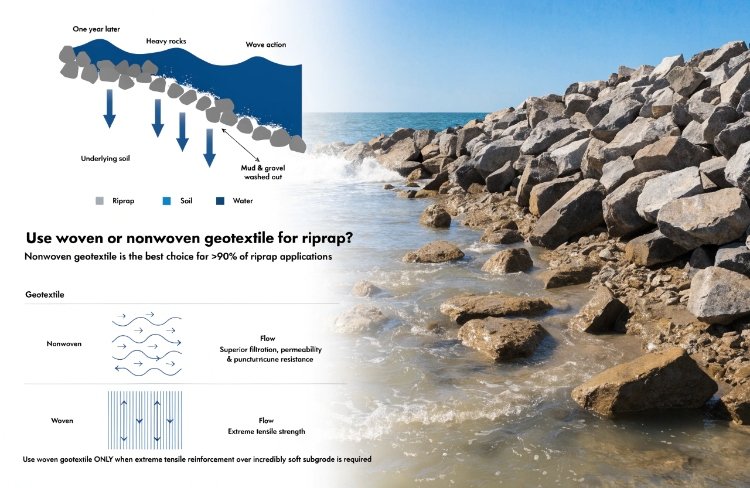
Dumping expensive heavy rocks on a shoreline only to watch them sink into the mud a year later is a costly nightmare. Without the right filter layer beneath the stones, water washes out the underlying soil, collapsing the entire protective structure.
Choosing between woven and nonwoven geotextile for riprap dictates the success of your erosion control project. Nonwoven geotextile is the best choice for over 90% of riprap applications due to its superior filtration, permeability, and puncture resistance. Woven geotextile should only be used in rare cases requiring extreme tensile reinforcement over incredibly soft subgrades.
Over my years exporting geosynthetics and supplying global projects, I have seen too many contractors make the wrong choice simply to save a few cents per square meter. Here is how you can make the right material decision for your site conditions and avoid a catastrophic blowout.
1. Introduction: Why Choosing the Right Geotextile Matters
When buyers contact me for shoreline protection materials, they often focus entirely on the size and cost of the armor stones. They correctly understand that thick, heavy, interlocking rocks are necessary to absorb the punishing impact of waves, tidal currents, and flooding rivers. But many fail to understand that riprap alone cannot stop internal erosion.
Rocks have large voids between them. When water flows over and through these rocks, it directly attacks the bare soil underneath. Over time, wave action and fast-moving currents actively scour the fine silt, clay, and sand particles right out from the bank. This continuous loss of soil is known as piping. Once the soil washes away, empty pockets form beneath the riprap. Under the massive weight of the rocks, the slope inevitably caves in, and the stones sink deep into the mud or tumble into the river.
The only way to prevent this is by installing a properly specified geotextile filter fabric layer between the raw subgrade and the heavy stones. The fabric acts as a permanent barrier. It holds the soil securely in place while allowing the kinetic energy of the water to dissipate against the rocks.
However, picking just any fabric off a container ship will not work. Woven and nonwoven geotextiles perform fundamentally different functions. If you choose a fabric with the wrong physical properties, it will either tear immediately during installation or silently clog beneath the surface, leading to rapid hydrostatic pressure buildup and total slope failure. Your choice of fabric is the single most critical factor in the long-term survival of your riprap structure.
2. Woven vs Nonwoven Geotextile: Quick Overview
To make an educated purchasing decision, you need to understand how these two materials are manufactured and how they behave in the field. Although both are typically made from durable synthetic polymers like polypropylene or polyester, their structural differences are massive.
Woven geotextiles are manufactured by taking individual flat slits, tapes, or monofilament yarns and weaving them together on massive industrial looms. The result is a rigid, plastic-like sheet that looks very similar to a heavy-duty tarp or a traditional burlap sack. Because the yarns are tightly bound in a strict over-and-under pattern, woven fabrics possess incredibly high tensile strength and minimal stretch (low elongation). They excel at stabilizing soft or swampy ground because they spread heavy compressive loads over a wide area without deforming. However, their tight, flat weave severely restricts water flow and makes them prone to clogging over time.
Nonwoven geotextiles, on the other hand, are created through a completely random mechanical process. Millions of synthetic fibers are tangled and bonded together, usually through an intense needle-punching process or heat bonding. This creates a thick, felt-like material with a continuous, three-dimensional pore structure. Unlike their woven counterparts, nonwoven fabrics stretch significantly when placed under stress. They conform easily to uneven, rocky ground and allow high volumes of water to pass through freely while physically trapping fine soil particles within their tangled matrix.
While woven geotextile focuses heavily on structural strength and load distribution, nonwoven geotextile is primarily designed for high-efficiency filtration, drainage, and impact absorption.
3. Key Differences That Matter for Riprap
When we review engineering drawings for riprap projects, we do not just look at basic material definitions. We look at five specific performance dimensions that directly impact how the fabric will survive underneath massive armor stones. Understanding these differences allows you to see exactly why these materials behave so differently under stress.
Filtration Performance
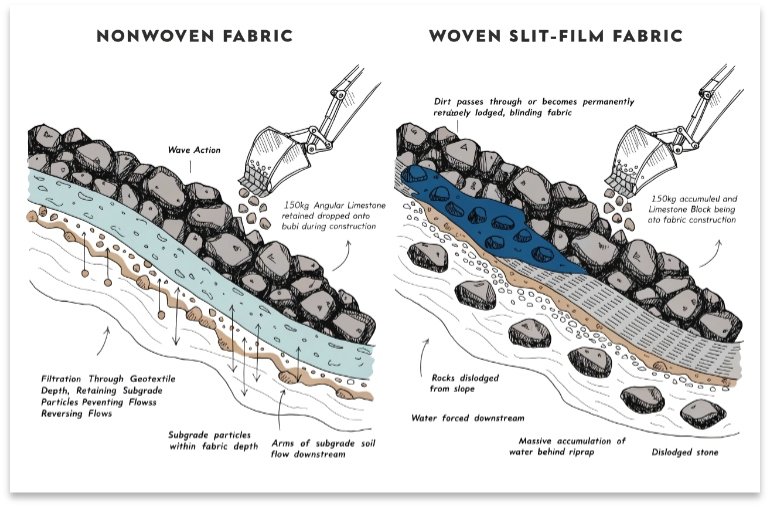
This is the most critical function of any riprap installation. The fabric must retain the fine soil particles of the subgrade while handling continuous, reversing water flows. Nonwoven fabrics provide superior filtration because their three-dimensional thickness traps particles at different depths, much like a thick sponge or an air filter. Woven fabrics are two-dimensional; dirt either passes through the small slit or gets permanently stuck in it, blinding the fabric.
Permeabilidade
Permeability refers to the volume of water the fabric allows to flow through its surface per second. When a wave crashes against a coastal breakwater and then pulls back, the water trapped behind the fabric must drain instantly. Nonwoven materials have exceptionally high permittivity and permeability. Water passes through them instantly. Slit-film woven fabrics have notoriously low permeability. If water cannot escape quickly enough, hydrostatic pressure builds up behind the fabric and physically blows the rocks off the slope.
Strength (Tensile vs. Puncture)
Woven materials win easily when it comes to raw tensile (pulling) strength. If you are building an access road over a peat bog, you need that tension. But for riverbanks, puncture resistance is far more important. When an excavator drops a 150kg angular limestone block onto the fabric, a rigid woven material acts like a tight drumhead and can easily snap or puncture. Nonwoven fabric acts like a cushion. It stretches, deforms, and absorbs the localized impact without tearing, retaining its integrity.
Flexibilidade
Natural ground is almost never perfectly flat or uniform. After you grade a shoreline, there are still ruts, dips, and bumps. Because woven geotextiles are stiff, they tend to span completely over these small ruts, creating hollow "bridges." When a rock is placed on that bridge, the fabric undergoes immense localized stress. Nonwoven geotextile for erosion control is incredibly flexible. It drapes naturally over the contours of the soil, ensuring continuous contact with the subgrade and eliminating those dangerous voids.
Clogging Resistance (AOS)
The Apparent Opening Size (AOS) determines the largest soil particle that can pass through the fabric. Because woven fabrics have uniform, distinct holes, fine silt and clay particles can easily become permanently wedged in those openings, creating a solid, waterproof layer. Nonwoven geotextiles have high porosity and dynamic pore structures. They are far more resistant to clogging, ensuring that drainage remains effective for the 50-year design life of the project.
Filtration and permeability are the most critical factors in riprap applications. A fabric that cannot filter and drain is useless, no matter how strong it is.
4. Which Geotextile Is Better for Riprap?
If you are looking for a direct, professional recommendation without any ambiguity: Nonwoven geotextile is the correct choice for at least 90% of all riprap and coastal armoring projects.
The primary job of a geotextile under riprap is not to hold the riverbank together through brute tensile force; the heavy rocks do that via gravity and mass. The fabric's job is purely to act as a resilient, permeable separator. Nonwoven fabrics excel here because they perfectly balance the three things a shoreline project demands: they prevent soil from washing out, they allow subsurface water to drain freely into the river, and they do not clog over decades of tidal action.
Furthermore, the high elongation properties of needle-punched nonwoven fabrics mean they can survive the chaotic, destructive installation process. When heavy stones are dumped from heavy machinery, the thick felt-like texture of a heavy-duty nonwoven fabric (such as a 400gsm or 500gsm roll) provides a protective cushion that resists puncturing and tearing far better than a stiff woven sheet.
However, as an experienced supplier, I must note the rare exception. There is a small margin of projects where woven geotextile (or a woven/nonwoven composite) is required. If your riprap is being placed over exceptionally soft, deeply saturated, unstable subgrades—like deep marshlands or highly organic peat—the sheer weight of the stones might cause deep rotational slip failures. In these extreme heavy-load scenarios, the high tensile strength of a high-strength woven structural fabric is necessary to span the weak soil and prevent the entire system from sinking.
Even then, a composite approach is often used: a woven layer for base reinforcement, topped by a nonwoven layer for filtration. But for standard riverbanks, drainage channels, culvert outlets, and coastal slopes, nonwoven geotextile remains the undisputed industry standard.
5. Selection Guide Based on Project Conditions
Making the final material choice requires evaluating the specific hydraulic forces and subgrade conditions at your job site. I frequently walk my import clients through a basic site assessment to narrow down their exact requirements before we arrange factory production.
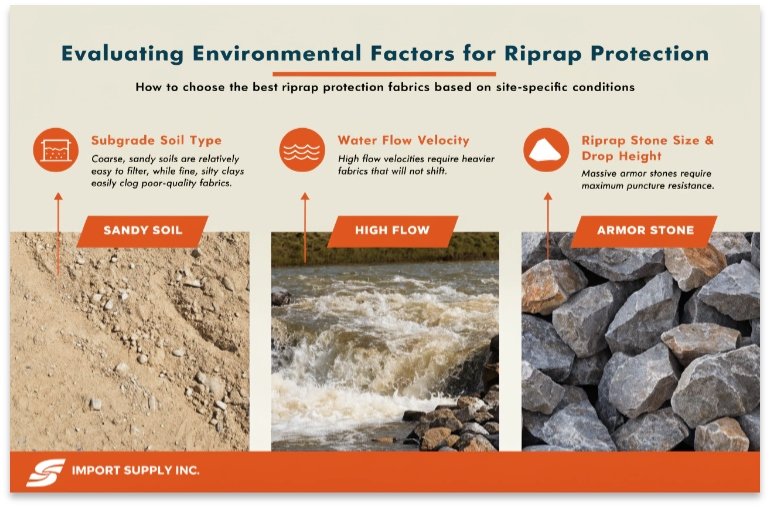
You must evaluate three main environmental factors: the subgrade soil type, the water flow velocity, and the average size and drop-height of the riprap stones. Coarse, sandy soils are relatively easy to filter, while fine, silty clays easily clog poor-quality fabrics. High flow velocities require heavier fabrics that will not shift, and massive armor stones require maximum puncture resistance.
Here is a practical selection guide based on common project conditions we encounter:
| Project Environment | Recommended Geotextile | Practical Specs & Notas |
|---|---|---|
| Standard Riverbank | Heavy Nonwoven | Use 300–400 gsm. Ideal for fluctuating water levels. High permeability prevents hydrostatic pressure from building up behind the bank during rapid river drawdown. |
| Coastal Breakwater | Extra-Heavy Nonwoven | Use 500+ gsm. Mandatory for heavy wave impact. The thick fabric cushions the subgrade against massive, sharp armor stones and severe tidal suction forces. |
| Roadside Drainage Swale | Medium Nonwoven | Use 200–300 gsm. Suitable for low-impact environments, smaller rock sizes, and slower water velocities. Highly cost-effective for civil contractors. |
| Deep Marsh / Peat Subgrade | Woven (Slit-Film) or Composite | Required for heavy load stabilization. Only use when subgrade bearing capacity is near zero. If filtration is also needed, place a standard nonwoven layer on top of the woven sheet. |
If you are uncertain about the geology of your site, base your decision primarily on the stone weight. The heavier and sharper the riprap, the thicker and heavier (higher gsm) your nonwoven geotextile needs to be to survive the initial installation.
6. Risks, Limitations, and Common Mistakes to Avoid
As a serious industry practitioner, I have to be upfront about the limitations of these materials. Geotextiles are engineering tools, not magic solutions. If a contractor misapplies a product or cuts corners during installation, the project will fail regardless of the material's lab specifications.
Here are the critical limitations of geotextile under riprap, and the common mistakes buyers must avoid:
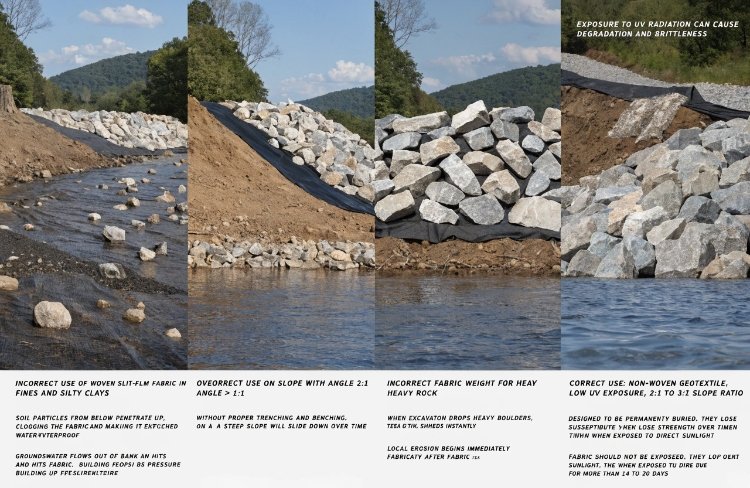
Using Woven Fabric in Silty Soils: This is a catastrophic error. If you place a standard woven slit-film fabric over fine, silty clay, the microscopic soil particles will eventually plug the precise woven gaps. The fabric becomes effectively waterproof. Groundwater flowing out of the bank hits this waterproof barrier, pressure builds up, and eventually, the entire slope—fabric, rocks, and all—blows out into the river.
Ignoring Severe Slope Angles: Geotextile cannot fix an inherently unstable, overly steep slope. If you try to build a riprap wall at a 1:1 angle (45 degrees), gravity will win. The nonwoven fabric surface is relatively smooth. Heavy rocks placed on a steep incline without proper trenching and benching will simply slide down the face of the fabric over time. Riprap slopes should generally not exceed a 2:1 or 3:1 ratio.
Choosing Inadequate Material Weight: In an effort to fit more square meters into a shipping container, buyers often order thin 150gsm nonwoven fabrics for heavy marine projects. When the excavator drops 300kg boulders onto thin fabric, it shreds instantly. Once the fabric is torn, local erosion begins immediately. Always match the fabric’s CBR puncture resistance to the stone size.
UV Degradation Exposure: This is a strictly enforced limitation. Both woven and nonwoven geotextiles are highly susceptible to ultraviolet degradation. They are designed to be permanently buried. If you unroll the fabric on a shoreline and leave it exposed to the hot sun for three months while waiting for the rock quarry to deliver the riprap, the polymer chains will break down. By the time the rocks arrive, the fabric will be brittle and practically useless. Do not expose the fabric to direct sunlight for more than 14 to 30 days.
7. Factory Direct: Our Recommendation
When you are securing hundreds of tons of rock on an eroding riverbank, the quality of your underlying filter layer is non-negotiable. At Waterproof Specialist, we highly recommend our heavily needle-punched nonwoven geotextile for all standard erosion control and riprap applications.
Because we operate our own manufacturing facilities, we do not just sell off-the-shelf sizes. We offer extensive OEM and customization services specifically tailored to your engineering requirements. We produce ISO-certified nonwoven materials ranging from lightweight 150 gsm rolls for landscaping drainage, all the way up to heavy-duty 800+ gsm rolls for extreme coastal breakwaters.
Furthermore, we optimize our production for export. We manufacture extra-wide rolls (up to 6 meters wide) to minimize overlapping seams on your job site, saving your crew days of labor. I personally oversee our logistics to ensure we maximize every cubic meter of your 40HQ container, drastically reducing your landed cost per square meter. Our materials are battle-tested in massive overseas infrastructure projects, ensuring reliable delivery and uncompromising quality.
Contact us today with your project specifications, and our technical team will provide a tailored technical data sheet, product samples, and a highly competitive factory-direct quotation.
8. Conclusion
Securing a shoreline with riprap is a significant investment, and choosing the correct underlying geotextile dictates how long that investment will last. While woven geotextile has its place in heavy load distribution, nonwoven geotextile remains the indisputable choice for riprap due to its unmatched ability to prevent soil washout, allow rapid water drainage, and resist structural clogging. By matching a high-quality nonwoven fabric to your site's specific soil conditions and stone size, you ensure the permanent, long-term stability of your erosion control project.