

إن نقل آلاف الأطنان من الركام المسحوق إلى أعلى جبل بعيد للحصول على منصة ترشيح كومة يدمر ميزانيات المشروع ويؤخر البناء. لكن التقليل من طبقة الصرف والحماية يخاطر بحدوث ثقب كارثي في الغشاء الأرضي، ومنع استعادة المحلول الحامل، وغرامات بيئية ضخمة.
يساعد هذا الدليل فرق مشتريات التعدين ومهندسي الموقع على تقييم مدى قدرة المواد الاصطناعية الجيولوجية الثقيلة على استبدال أجزاء من الركام التقليدي بأمان. من خلال فهم القدرات المادية، سوف تتعلم كيفية اختيار مواد التكسية الأرضية والمركبات الأرضية عالية الكتلة لتقليل تكاليف النقل دون تعريض سلامة الصرف والبطانة الأساسية للخطر.
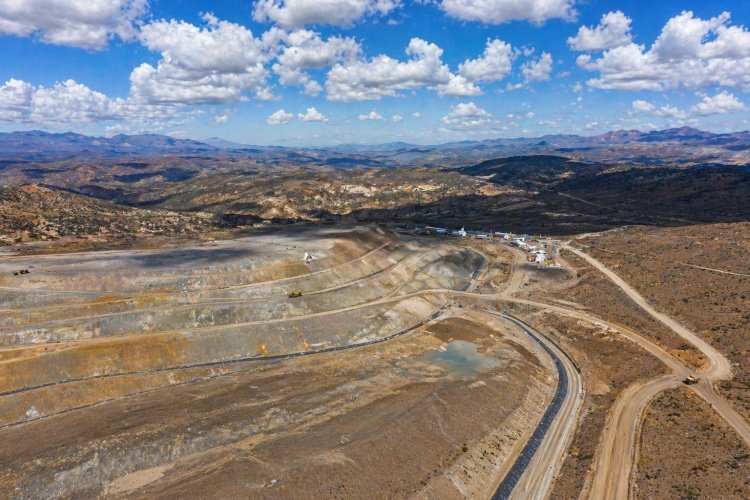
عندما يتصل بي مشغلو التعدين لأول مرة بشأن توريد المواد، غالبًا ما يكون هدفهم الأساسي هو خفض التكاليف اللوجستية الباهظة. إن جلب الحصى النظيف والمكسر إلى موقع يقع على ارتفاع 4000 متر فوق مستوى سطح البحر أمر مؤلم على مستوى العالم. من الناحية العملية، من الممكن تقليل الركام، ولكنه يعتمد دائمًا على شروط التصميم الدقيقة والاختيار الدقيق للمواد.
لماذا لا تزال الطبقات المجمعة حاسمة في ترشيح الكومة
قبل أن نناقش استبدال الركام، يجب أن نفهم ما يفعله بالفعل. لا يمكنك ببساطة سحب طبقة 500 مم من الحصى من النظام دون مراعاة العمل الفيزيائي والهيدروليكي المكثف الذي يؤديه الحصى على مدار عمر المنجم الذي يمتد لعقود.
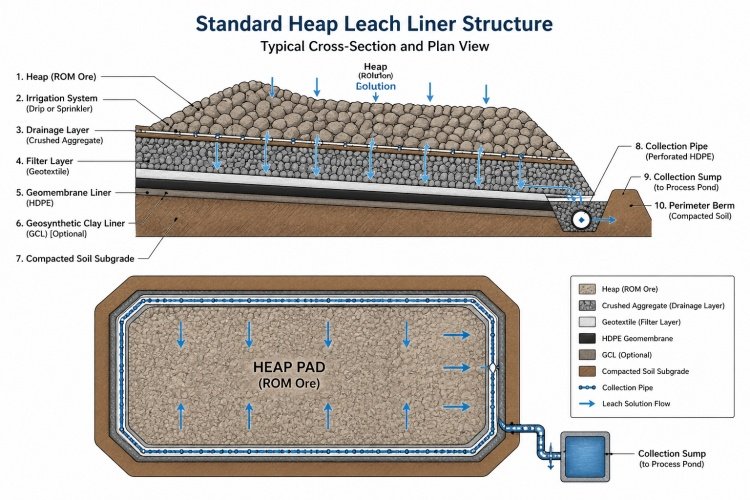
في بناء الترشيح الكلاسيكي، بعد إعداد طبقة التربة المضغوطة ونشر الغشاء الأرضي المصنوع من البولي إيثيلين عالي الكثافة (HDPE)، يتم تثبيت طبقة فوقية. عادةً ما تكون هذه البطانة عبارة عن بطانية سميكة من الركام المغطى والمكسر. إنه يخدم ثلاث وظائف غير قابلة للتفاوض.
أولاً، يوفر حماية مطلقة للثقب لبطانة الغشاء الأرضي. عندما تقوم شاحنات النقل الضخمة بتفريغ الدفعة الأولى من الخام الخام المسنن (ROM) على المنصة، سيتم تدمير البطانة البلاستيكية على الفور إذا لم يكن هناك حاجز. يعمل الركام كدرع مادي بين الخام الثقيل والحاد والحاجز غير المنفذ.
ثانيًا، يضمن الركام تصريفًا عالي السعة. يعتمد النموذج المالي بأكمله لمنجم الترشيح الكامي على محلول الترشيح الحامل (PLS) - السائل الكيميائي الذي يحمل الذهب أو النحاس المذاب - الذي يتدفق بسلاسة إلى البطانة وينتقل بسرعة إلى أنابيب التجميع. تمنع المساحات الفارغة الموجودة في الركام السائل من التراجع.
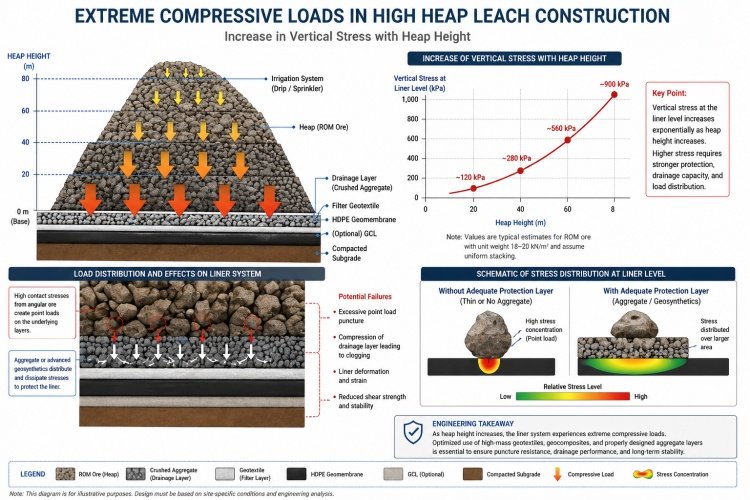
ثالثا، يوفر توزيع الحمل الحرج. ومع نمو الكومة إلى ارتفاع 60 أو 80 مترًا، تضغط ملايين الأطنان من قوة الضغط على البطانة. تقوم الطبقة المجمعة ذات التصنيف الجيد بتوزيع إجهاد الحمل النقطي الشديد بالتساوي، مما يمنع فشل البطانة الموضعي. لهذه الأسباب الميكانيكية الأساسية، لا يزال الركام ضروريًا في معظم التصميمات ولا يمكن التخلص منه ببساطة.
التحدي الحقيقي: التكلفة مقابل المخاطر
عندما أراجع فواتير الكميات لمشاريع التعدين الدولية، فإن التوتر بين التكاليف المدنية والمخاطر طويلة الأجل واضح للغاية. غالبًا ما يكون نقل الركام المناسب أكبر بند منفرد في ميزانية البناء الإضافية. إذا كانت التضاريس المحلية تفتقر إلى الصخور الصلبة المناسبة، أو إذا تأخرت عمليات التكسير، فإن مديري المشاريع يتعرضون لضغوط شديدة لتقليل سمك الركام المحدد.
ومع ذلك، فإن عواقب الإفراط في تقليل الركام كارثية. إذا كان المخزن المؤقت الواقي رقيقًا جدًا، فإن قطعة حادة واحدة من الخام تحت ضغط ملايين الأطنان سوف تنقطع عبر بطانة HDPE. بمجرد أن يتم اختراق البطانة، فإن PLS ذات القيمة العالية والمحملة كيميائيًا يتسرب مباشرة إلى المياه الجوفية. لا يفقد المنجم منتجه النهائي فحسب، بل يؤدي أيضًا إلى مسؤوليات بيئية هائلة.
الخطر الأكثر خطورة هو فشل الصرف. إذا قمت بإزالة الركام وانضغطت الطبقة القاعدية وتحولت إلى طين، فلن تتمكن PLS من التصريف. يتراكم السائل داخل الكومة، مما يخلق رأسًا تفريطيًا هائلاً من ضغط الماء. وهذا يقلل بشكل كبير من قوة القص لمكدس الخام. في نهاية المطاف، يفشل المنحدر، مما يؤدي إلى انهيار أرضي كارثي للصخور السامة والأحماض.
لذلك، فإن تعديل طبقة البطانة لا يعني اختيار لوح بلاستيكي أرخص. هذه مشكلة تحسين المخاطر، وليست بديلاً بسيطًا. وتعتمد الاستراتيجية على إدخال مواد صناعية جيولوجية متقدمة تؤدي الوظائف الميكانيكية والهيدروليكية للصخور المفقودة بشكل آمن.
الأساليب القائمة على المواد لتقليل الركام
ومن أجل تقليص حجم الطبقة الإجمالية بشكل آمن، يحدد مهندسو التعدين مواد تركيبية جغرافية متخصصة من الدرجة الصناعية. كمورد، دوري هو التأكد من أن هذه المواد تصمد أمام الواقع الكيميائي والفيزيائي القاسي للمنجم. فيما يلي طرق المواد الأساسية الثلاثة المستخدمة لتقليل حجم الصخور.
1. المنسوجات الأرضية غير المنسوجة عالية الكتلة
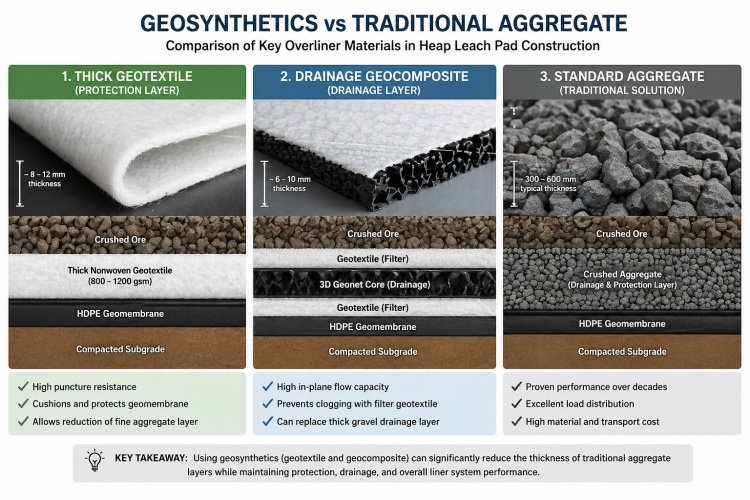
عادةً ما يتراوح حجم المنسوجات الأرضية المدنية القياسية (مثل تلك المستخدمة في بناء الطرق) بين 200 إلى 300 جرام لكل متر مربع. فهي عديمة الفائدة تمامًا تحت وسادة الترشيح الكومة. لاستبدال تأثير التوسيد للحصى، يحدد المهندسون منسوجات أرضية غير منسوجة عالية الكتلة ومثقوبة بالإبرة تتراوح من 800 جم إلى 1200 جم أو أكثر.
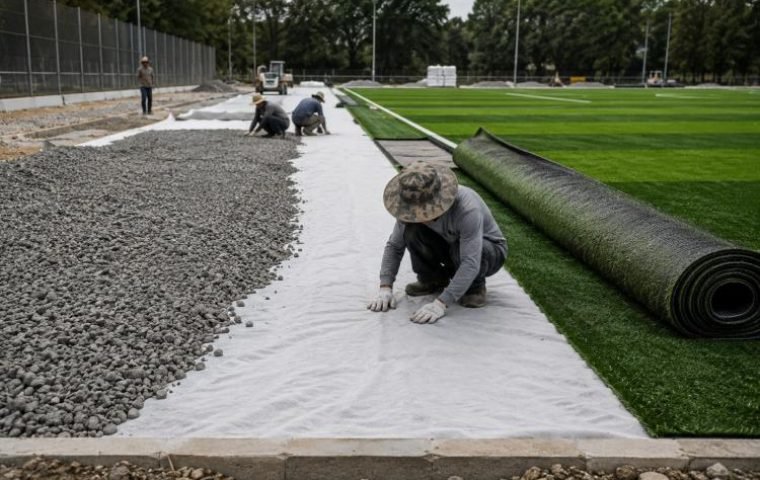
تعمل هذه الأقمشة السميكة والكثيفة للغاية مثل اللباد الصناعي الثقيل. عند وضعه مباشرة فوق غشاء أرضي HDPE، فإن النسيج الأرضي بوزن 1000 جرام في المتر المربع يوفر مقاومة هائلة للثقب. هو - هي يمتص تأثير الحمل النقطي للخام المسحوق، ويوزع الحواف الحادة بأمان لذلك لا يمكنهم وضع مسافة بادئة للبلاستيك الموجود أسفله. من خلال استخدام مواد تكسية أرضية ثقيلة، يمكن تقليل السُمك المطلوب للرمل الواقي أو طبقة الحصى الناعمة بشكل كبير.
2. طبقات الصرف الجيومركبة
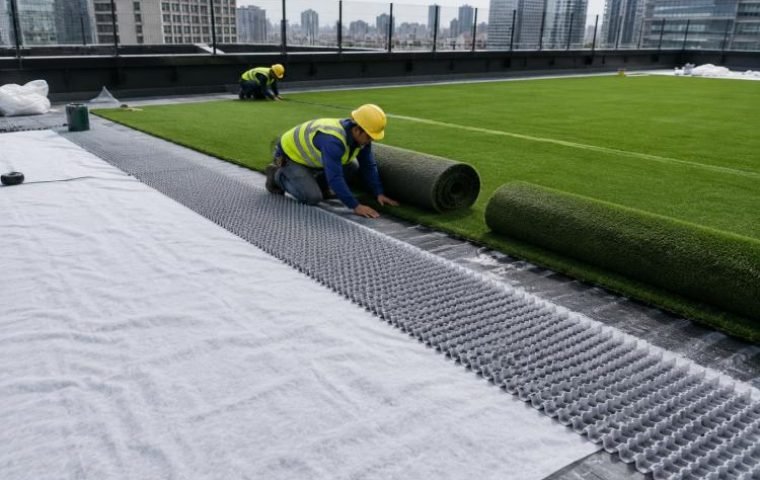
الجيوكومبوسيت هو نظام صرف مُصنَّع. وتتكون من قلب بلاستيكي سميك ثلاثي الأبعاد (شبكة جيونية) يتم ربطه حرارياً بمادة تكسية أرضية غير منسوجة على أحد الجانبين أو كليهما.
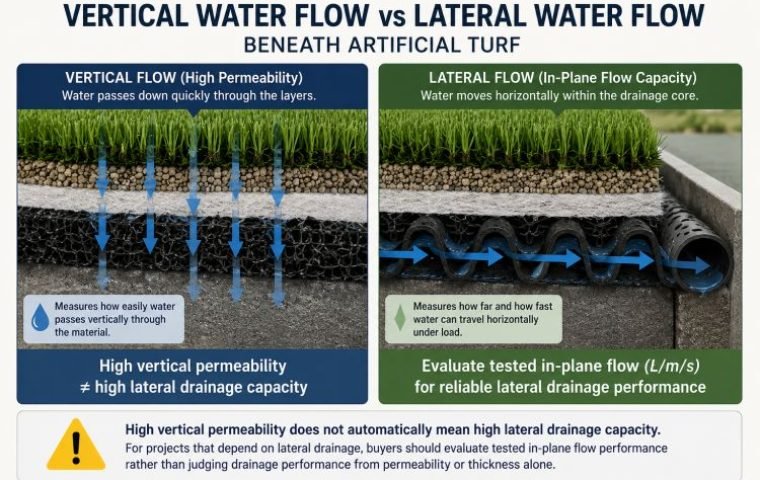
يوفر القلب تصريفًا داخليًا، مما يعني أن السوائل تتدفق بسرعة أفقيًا عبر الشبكة البلاستيكية. تعمل المنسوجات الأرضية المرفقة كمرشحات، مما يمنع الطين الناعم والخام المسحوق من الدخول وسد القلب البلاستيكي. في ظل ظروف تحميل محددة، يتم استخدام لفة واحدة من مركب جيولوجي عالي النفاذية يمكن أن يحل محل سمك هائل من حصى الصرف التقليدي. يتم ترشيح السائل المتساقط من الكومة بسرعة عبر القماش، ويدخل إلى الفراغ البلاستيكي، ويندفع إلى أسفل المنحدر إلى خندق التجميع.
3. أنظمة Overliner الهجينة
في معظم مشاريع التصدير الكبرى التي نقوم بتوريدها، لا يكون الهدف هو التخلص من الصخور، بل تحسينها من خلال نهج مختلط. يستخدم النظام نسيجًا أرضيًا عالي الكتلة أو مركبًا جغرافيًا يتم وضعه على الغشاء الأرضي، مغطى بطبقة أرق بكثير ومحددة للغاية من الخام المسحوق أو الحصى الناعم.
لإعطائك منظورًا واقعيًا، قمنا سابقًا بتوريد المواد اللازمة لواحدة من أكبر منصات ترشيح أكوام الذهب في المنطقة، والمصممة لمعالجة 5 ملايين طن من الخام سنويًا بارتفاع نهائي لكومة يبلغ 72 مترًا. بدلاً من الاعتماد فقط على الصخور الثقيلة، قام الفريق الهندسي بتحديد غشاء أرضي HDPE مزدوج النسيج مقاس 2.0 مم لتحقيق أقصى قدر من الاحتكاك. لقد قمنا بتوفير نسيج أرضي غير منسوج بوزن 800 جرام للمتر المربع لاستبدال طبقة الركام الدقيقة بشكل كامل، وإقرانها بمركب جيولوجي 6 مم الذي حل محل 25 إلى 30 سم من حصى الصرف النقي. ونتيجة لذلك، انخفض إجمالي الاستخدام الكلي لتلك المرحلة بنسبة مذهلة بلغت 70%، وعملت المنشأة باستقرار ممتاز واستعادة السوائل لأكثر من عقد من الزمن.
التطبيقات القائمة على السيناريو
يتم تحديد اختيار المواد من خلال البيئة المادية للمنجم. إن الحل الذي ينجح في تقليل الركام في صحراء جافة ومسطحة سوف يتسبب في فشل كارثي في منطقة جبلية متجمدة. استنادًا إلى تاريخ توريد مشروعنا، إليك كيفية تكييف المواد عبر سيناريوهات متطرفة مختلفة.
السيناريو 1: بيئات المنطقة الباردة (-40 درجة مئوية)
In mining regions like Northern Canada, Alaska, or high-altitude Asian plateaus, temperatures regularly drop to -40°C. Cold regions introduce the extreme threat of frost heave. When moisture in the subgrade freezes, it expands violently, creating ice lenses that push upward like jagged rocks.
To reduce the need for massive layers of insulating soil and aggregate, engineers often utilize a highly robust, multi-layered geosynthetic defense. We provided the barrier materials for a massive gold operation facing these exact conditions, processing 13 million tons annually in a climate that hits -40°C. To ensure year-round operation without the luxury of deep gravel insulation, the pad utilized a custom double-layer 1.5mm HDPE geomembrane stack, specially formulated for chemical compatibility and extreme freeze resistance.
Instead of paying massive premiums to truck in 15cm of crushed protection aggregate, we supplied a heavy-duty 1000 gsm high-strength geotextile as the primary cushion, followed closely by an 8mm composite drainage net and geotextile structure that replaced over 30cm of traditional drainage aggregate. The facility has proven highly successful, suffering zero freeze-induced liner cracks and no leakage.
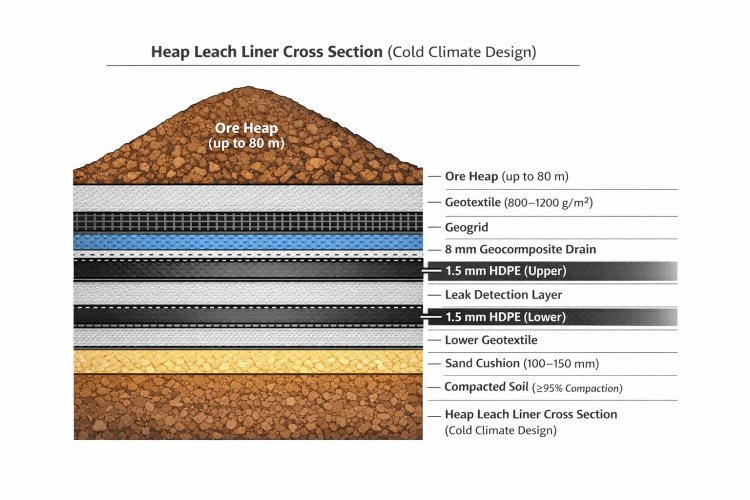
Typical heap leach liner cross section used in cold climate conditions (for reference only)
Scenario 2: High Heap Applications (60–80m)
Modern copper and gold mines maximize their footprint by stacking the ore incredibly high. It is common to see heap leach pads reaching 60 to 80 meters in total height. At this scale, the compressive load on the bottom liner system is astronomical.
If you attempt to replace the basal aggregate entirely with a standard الصرف الجيولوجي in a high heap, the system will fail. The massive weight of the rock will literally crush the plastic geonet core flat, erasing its void space and instantly shutting down all fluid drainage.
To reduce aggregate safely under extreme loads, engineers must specify high-compressive-strength geonets combined with maximum-mass protection geotextiles. In another landmark gold project we supplied, the mine was processing an extraordinary 30 million tons per year, stacking up to a 60-meter peak. Knowing standard materials would compress, we provided a system anchored by a robust 2.0mm HDPE geomembrane. We paired this with a highly resilient 1000 gsm protective geotextile—successfully eliminating a required 20cm gravel cushion—and an extremely dense 7mm geocomposite core. Through careful structural engineering and correct material specs, the mine cut aggregate requirements by 75% globally across the pad while maintaining total base stability.
Scenario 3: Copper Bioleaching Systems
Gold is typically leached using a weak cyanide solution, but copper extraction often relies on bioleaching. This process uses aggressive sulfuric acid combined with bacteria that eat the sulfide minerals. This is a very slow, highly chemically active environment that operates continuously for years.
When reducing aggregate in a copper bioleaching pad, the chemical resistance of the replacement materials is strictly evaluated. Standard polyester (PET) geotextiles will dissolve in a sulfuric acid environment via hydrolysis. For these pads, we exclusively supply Polypropylene (PP) and high-density polymer systems.
We recently supported the material supply for a massive low-grade sulfide copper bioleach facility focused heavily on environmental safety and cost control. Given the regulatory scrutiny, they adopted a double-layer 2.0mm HDPE geomembrane system, pioneering a new standard for copper pad containment. We delivered 600 to 800 gsm specialist geotextiles to outright replace the gravel protection mat, combined with a flow-optimized 6mm geocomposite that safely eliminated the need for a 25cm gravel drainage layer.
Similarly, for a smaller-scale secondary waste-rock bioleach pad (stacking 30 to 50 meters, producing 1 million tons a year), we provided 1.5mm HDPE liners backed by 500-600 gsm geotextiles and a 5mm geocomposite. These tailored thicknesses successfully replaced 20cm of gravel, creating a 60% reduction in aggregate and making the extraction of low-grade waste rock financially viable.
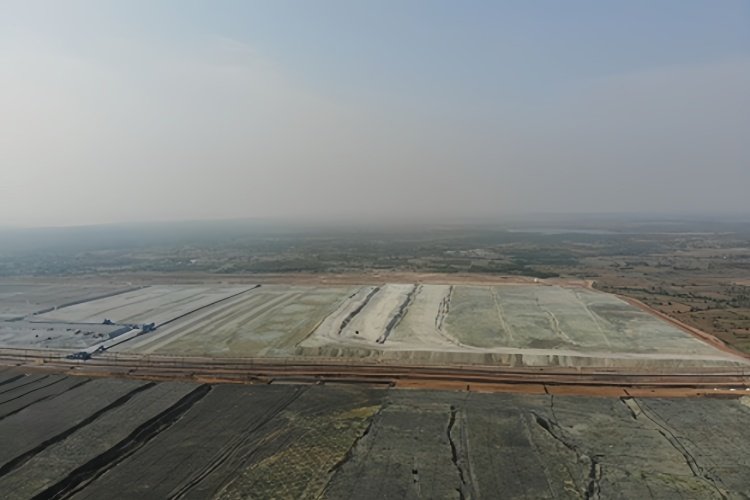
Scenario 4: Humid and High-Rainfall Regions
Operating a heap leach pad in the tropical rainbelts of Southeast Asia or South America introduces massive fluid management challenges. The system is not just draining the slow trickle of operational leach solution; it must suddenly handle millions of gallons of torrential rainwater during a monsoon.
If the aggregate layer is reduced here, the replacement geocomposite must possess extreme transmissivity (flow capacity). However, the biggest risk in high-rainfall zones is clogging. Heavy rain washes thousands of tons of fine silt and clay out of the crushed ore. If these fines wash into the geotextile filter layer, they will 'blind' the fabric, creating an impermeable mud wall that blocks fluid from entering the drainage core.
To prevent this, the Apparent Opening Size (AOS) of the nonwoven geotextile must be perfectly calibrated by engineers to match the particle size distribution of the local ore. It must be woven tight enough to hold back the mud, but open enough to let the massive volume of water efficiently pass through.
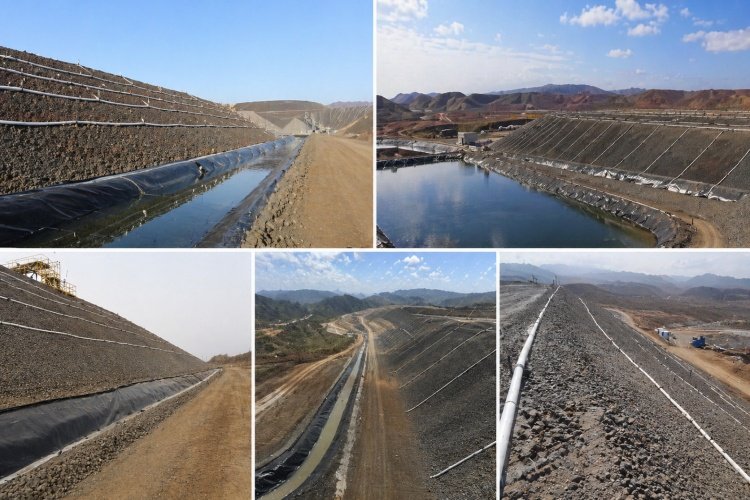
Can Aggregate Be Eliminated Completely?
This is the most common question I receive from international EPC contractors looking to drastically cut their site preparation budgets. The short, honest answer is no.
While advanced geosynthetics are incredible engineering tools, they possess undeniable physical limitations. Plastics creep, deform, and compress over decades when subjected to the weight of a hundred-meter rock pile. Geotextiles can suffer from biological and chemical blinding. A plastic geonet simply cannot hold the same sheer volume of fluid as a standard 500mm thick layer of highly porous, graded river rock.
If you eliminate the aggregate buffer entirely, you place 100% of the mechanical and hydraulic burden on a few millimeters of manufactured plastic. The safety factor drops to near zero. A single error in the geotextile selection or a localized collapse in the geonet core will cause a regional slope failure. Therefore, in most cases, aggregate is reduced, not eliminated. The goal is achieving safe optimization, not reckless deletion.
Supplier Perspective: What Matters Most to Project Success
From the supply side, a successful heap leach pad relies entirely on strict material compatibility and verifiable, long-term performance testing. You cannot build a safe mine by buying generic materials out of a catalog.
When procurement teams send me their technical specifications, I look heavily at the required transmissivity tests. We do not evaluate how a geocomposite drains water on a laboratory table; we need to know how it drains when subjected to 10,000 hours of 1,500 kPa compressive loads. Does the core crush? Does the geotextile intrude deeply into the mesh and block the flow of the solution?
Testing the chemical compatibility of the HDPE geomembrane resin against the specific site's leachate at operational temperatures is critical. Engaging with your geosynthetic manufacturer early in the feasibility stage prevents catastrophic delays. Early material selection helps optimize design, allowing the engineers to definitively prove their safety models before the purchasing budget is officially locked.
Frequently Asked Questions
Can a high-mass geotextile completely replace the overliner aggregate?
No. While a thick 1000 gsm geotextile provides superior puncture protection for your geomembrane, it does not offer the necessary void space for high-volume fluid drainage, nor does it possess the adequate aggregate friction needed to distribute massive dynamic loads from mining haul trucks. It is successfully used alongside a significantly reduced aggregate layer, rather than strictly in place of it.
What geotextile thickness is needed for a heap leach protection layer?
Optimal thickness depends strictly on the maximum rock size dumped onto the pad, the initial drop height, and the final estimated heap weight. Generally, large-scale mining applications require heavy-duty needle-punched nonwoven geotextiles ranging from 800 gsm up to 1500 gsm. Standard civil engineering fabrics (200–400 gsm) will fail almost instantly under the jagged pressure of ROM ore loads.
Is a geocomposite drainage layer sufficient to manage Pregnant Leach Solution?
It is highly effective for localized drainage, side-slope fluid capture, and lower-height heaps. However, for massive pads experiencing extreme compressive stresses from high ore stacks, the plastic geonet core's transmissivity will naturally drop over time. To ensure safe, redundant PLS recovery, it is usually combined with an integrated network of perforated HDPE collection pipes and a minimized, precision-graded gravel layer to prevent fluid backing up.
خاتمة
Reducing the immense costs and logistical nightmares of hauling aggregate at a mining site is highly achievable through modern geosynthetic engineering. Our past supply projects prove that by smartly integrating double-lined HDPE systems, high-mass nonwoven geotextiles, and advanced drainage geocomposites, mine operators can safely reduce their bulk rock haulage by 60% to 75% without sacrificing environmental safety or metal recovery.
However, aggregate reduction is an engineered optimization, not a total substitution. Success demands rigorous material selection, load-specific compression testing, and polymer chemistry that strictly matches the site's unique operational constraints.
Are you looking to optimize the liner design and mitigate heavy aggregate costs for your next heap leach operation? Precise material data is your greatest asset. Contact the technical team at Waterproof Specialist today to discuss your specific heap loads, request comprehensive technical data sheets, and secure industrial-grade geosynthetics built to confidently survive the life of your mine.