

You're designing a liner system for a steep landfill slope or a mining dam. A standard smooth geomembrane would be like laying a plastic slide on the hill—the soil cover would slip right off, leading to a catastrophic failure.
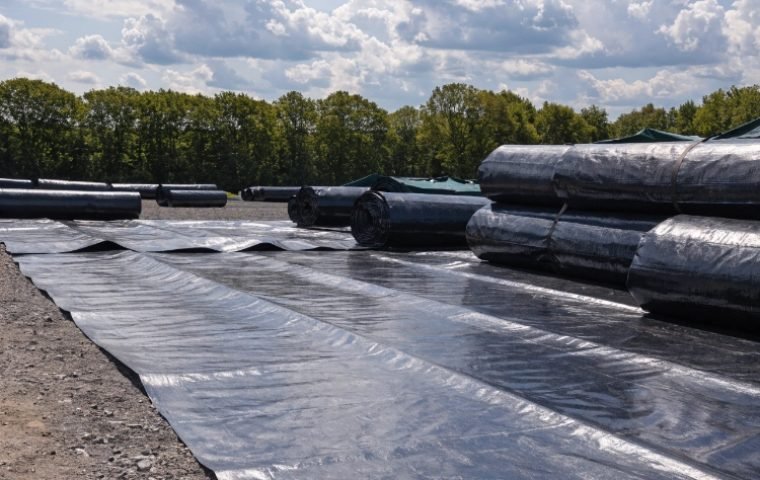
A textured geomembrane is a liner with an engineered rough surface designed to increase friction. This added grip prevents soil and other geosynthetics from sliding, ensuring the stability of liner systems on steep slopes where smooth liners are unsafe.
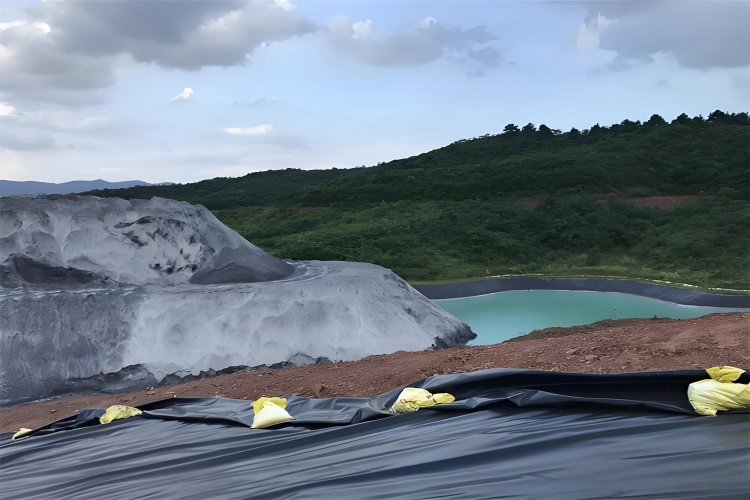
As a geosynthetics supplier, one of the most critical conversations I have with clients is about choosing between a smooth and a textured geomembrane. Using a smooth liner where a textured one is needed is one of the most dangerous and costly mistakes in containment design. The texture isn't just a random pattern; it's a precisely engineered feature that creates the friction needed to hold entire systems together on challenging slopes. Understanding the different types of textures, their specifications, and how they are measured is essential for any importer or contractor to ensure project safety and success.
What is a textured geomembrane and how does its rough surface improve friction performance?
You know a textured liner provides "grip," but how does that actually translate to project stability? Misunderstanding this function can lead to specifying a liner that isn't robust enough for your project's specific slope and soil conditions.
The rough surface dramatically increases the interface friction angle between the geomembrane and adjacent materials like soil or geotextiles. This added friction creates a powerful braking force that resists the pull of gravity on steep slopes.

Beyond a Simple Rough Surface
A smooth geomembrane against soil is like wet plastic on wet clay—it has a very low friction angle, making it extremely slippery. On any significant slope, the weight of the cover soil or other layers will easily overcome this minimal friction, causing a slide. A textured surface changes this dynamic completely.
-
The Science of Grip: Interface Friction Angle
In geotechnical engineering, stability is measured by the "interface friction angle." A higher angle means more grip. While a smooth HDPE liner might have a friction angle of only 10-15 degrees against a geotextile, a textured HDPE liner can increase that angle to 30-40 degrees or more. This is the difference between a system that is guaranteed to fail and one that is safely locked in place. The tiny peaks and valleys of the texture mechanically interlock with the soil particles or geotextile fibers, creating a strong bond that resists shear forces. -
Meeting Industry Standards
This performance isn't just guesswork. Standards from the Geosynthetic Research Institute (GRI), specifically GRI-GM13 for textured HDPE, set the minimum requirements for properties like tensile strength, puncture resistance, and durability. Importantly, designers rely on project-specific lab tests (ASTM D5321) that measure the exact friction angle between your chosen textured liner and the actual site soil or geotextile you'll be using. This data is critical for safe and stable slope design.
What are the main types of textured geo liners based on surface texture and manufacturing method?
You've decided on a textured liner, but now you see options like "nitrogen-blown," "column-point," or "sprayed." Choosing based on price alone is risky, as each manufacturing method creates a different texture with unique performance characteristics.
The three main manufacturing methods are blow film texturing (using nitrogen gas), column-point texturing (using a studded mold), and spray-on texturing. Each method produces a distinct surface profile that affects friction and liner thickness.

How Texture is Made Matters
As a supplier, I always clarify the manufacturing process with my clients because it impacts both performance and cost. Here's a breakdown of the methods, based on what we see in our factories.
-
Blow Film Texturing (Nitrogen Gas Method)
This is one of the most common methods. During the manufacturing process, molten HDPE resin is extruded into a large bubble. Nitrogen gas is injected into the molten plastic, and as the bubble expands and cools, the gas creates an irregular, sandpaper-like texture on the surface. This method is highly effective for creating a high-friction surface and is widely used for critical applications like landfill liners. The texture is an integral part of the sheet. -
Spray-On Texturing
This is a two-step process. First, a standard smooth geomembrane is produced. Then, a machine sprays fine, molten plastic filaments onto the smooth surface. These filaments cool and bond to the liner, creating a very aggressive, high-friction texture. This method allows for a very rough surface but adds a secondary process to production. -
Column-Point Texturing
This method uses a special mold or roller with evenly spaced studs or "columns" to press a uniform pattern onto the geomembrane surface as it's made. The result is a liner with clean, consistently shaped bumps. This type looks very neat and performs well. A key point for importers to watch: with this method, the thickness of the base liner and the height of the texture points are sometimes calculated separately. You must verify that the base liner meets your specified thickness antes the texture points are added.
What is the difference between single-sided and double-sided textured geomembranes?
You have a quote for a textured liner, but it offers single-sided and double-sided options, with the double-sided being 20-30% more expensive. Choosing the wrong one means either over-paying for friction you don't need or creating a hidden slip plane in your design.
A single-sided liner has texture on one face and is smooth on the other, for when friction is needed only on one side. A double-sided liner has texture on both faces, providing maximum grip when sandwiched between two other materials.
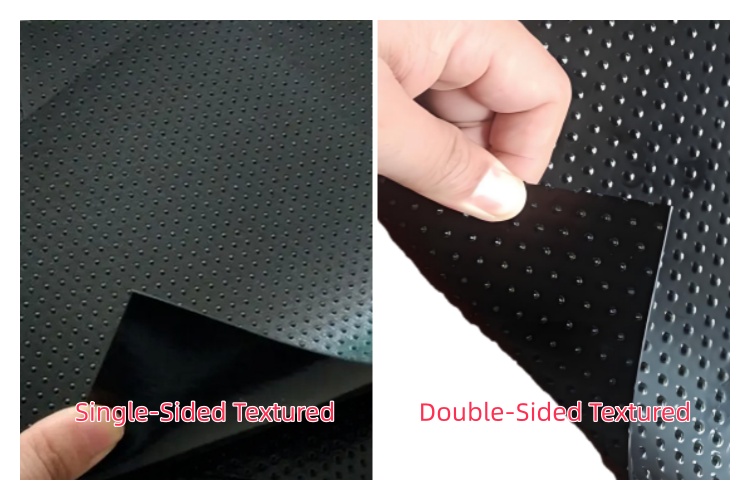
One Side or Two? Matching the Liner to Your System
The choice between single and double-sided is entirely dependent on what layers are above and below your geomembrane.
-
Single-Sided Textured Geomembrane
This is the most common choice. It is used when you need friction against one material but not another. In a typical slope design, the geomembrane is placed on a prepared soil or GCL subgrade. You need friction between the geomembrane and the top cover soil or drainage geocomposite. In this case, you would place the liner with the textured side facing up to grip the cover material, while the smooth side lies against the subgrade. This is a cost-effective solution for many standard applications. -
Double-Sided Textured Geomembrane
This is a specialized product for high-stakes, multi-layer systems. It's essential when the geomembrane is sandwiched between two other geosynthetics that both require high friction. For example, in a landfill cap, you might have a GCL below the geomembrane and a drainage geocomposite above it. To prevent slippage at ambos interfaces, you need texture on both sides of the geomembrane. While it costs more, it provides the ultimate stability for complex designs on the steepest slopes.
What are the typical thickness specifications, material options, and common applications of textured HDPE liners?
You know you need a 1.5 mm textured HDPE liner. But when the material arrives, your caliper measures 1.75 mm. Is the product wrong? Or did you just get a bonus?
Textured geomembranes typically range from 0.75mm to 3.0mm thick and are made from HDPE for its chemical resistance. A key detail is that the specified thickness refers to the core liner; the final measured thickness will be higher due to the texture height.
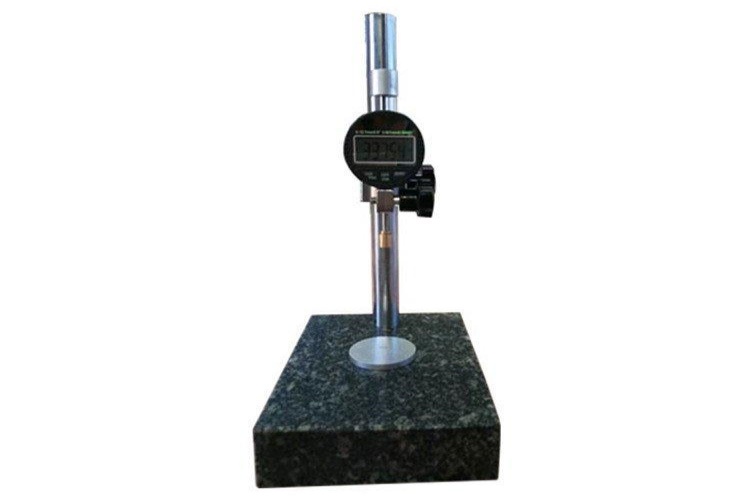
A Spec Sheet Deep Dive
Understanding the key specifications is crucial for sourcing the right material and verifying quality upon delivery. Here are the ares I focus on with my B2B clients.
-
Material: HDPE is King
Polietileno de alta densidade (HDPE) is the go-to material for most textured liner applications. Its excellent durability, chemical resistance (crucial for landfills and mines), and UV stability (when properly formulated with carbon black) make it the most reliable choice for long-term containment. LLDPE is sometimes used for its greater flexibility if significant settlement is expected. -
Thickness: A Critical Importer Tip
This is a point that often confuses new buyers. The industry standard, like GRI-GM13, specifies the nominal core thickness. The texture itself adds height. For example, if you order a 1.5 mm textured liner, the smooth, untextured part of the sheet must be 1.5 mm. The tiny peaks of the texture add height, typically at least 0.25 mm per side.- UM 1.5 mm single-sided liner should measure ~1.75 mm at the peaks.
- UM 1.5 mm double-sided liner should measure ~2.0 mm at the peaks.
Always bring a caliper to the job site. If your 1.5 mm liner measures only 1.5 mm at its peaks, you have been supplied with an underspecified product.
-
Common Applications
You will find textured geomembranes specified for any project involving steep slopes, including:- Landfill Liners and Caps: For lining the side slopes of waste cells and for the final cover systems.
- Mineração: Tailings dams and heap leach pads, which involve massive, steep structures.
- Reservoirs and Canals: For lining steep embankments to prevent erosion and ensure stability.
- Vertical Cut-Off Walls: Where liners are hung vertically to block groundwater flow.
Conclusão
Textured geomembranes are an essential safety component for steep slope projects. By understanding the types, recognizing the difference between single and double-sided, and verifying the core thickness, you can import and install with confidence.