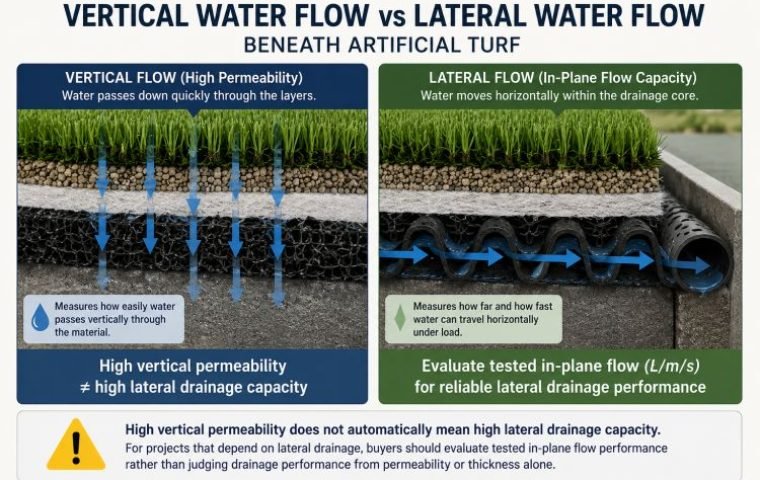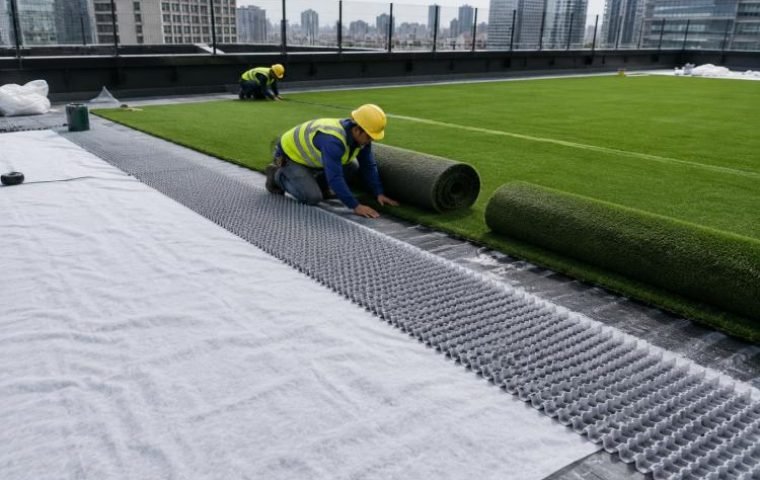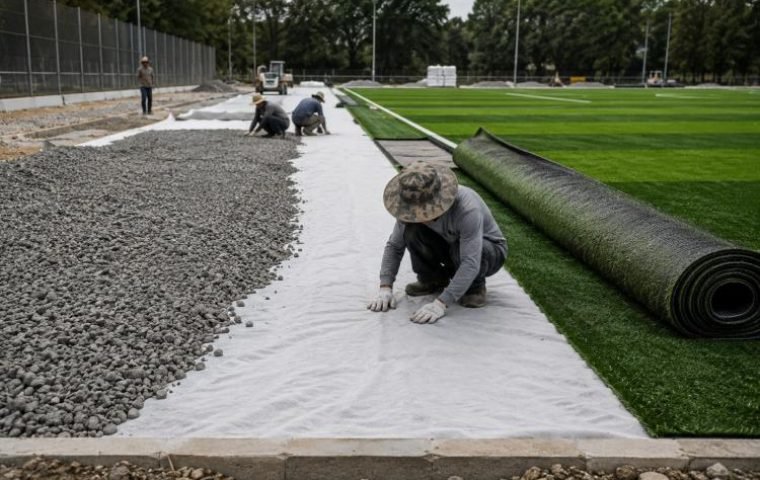


Kuna tsara tsarin layi don gangara mai gangarewa ko madatsar ruwa mai ma'adinai. Daidaitaccen geomembrane mai santsi zai zama kamar shimfiɗa faifan filastik a kan tudu-ƙasar ƙasa za ta zame daidai, wanda zai haifar da gazawar bala'i.
Geomembrane da aka zayyana jigon layi ne tare da ingantacciyar ƙasa wanda aka ƙera don ƙara juzu'i. Wannan ƙarin riko yana hana ƙasa da sauran geosynthetics daga zamewa, yana tabbatar da kwanciyar hankali na tsarin layi akan tudu masu tudu inda masu santsi ba su da aminci.
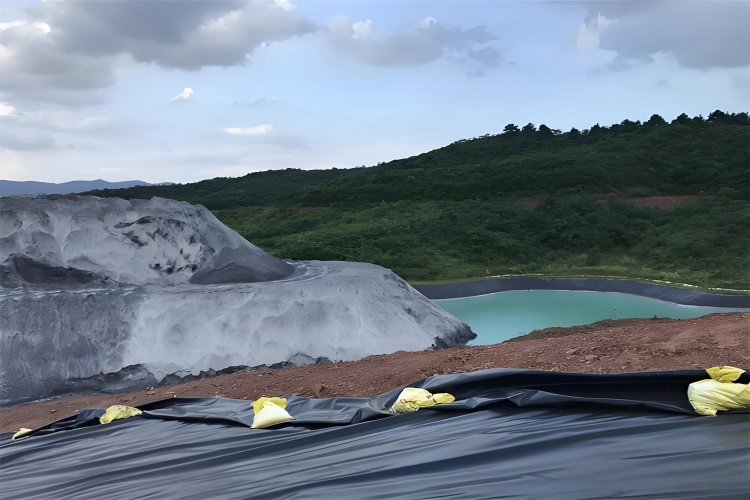
A matsayin mai siyar da kayan aikin geosynthetics, ɗayan mafi mahimmancin tattaunawa da nake yi tare da abokan ciniki shine game da zabar tsakanin sassauƙa da rubutu na geomembrane. Yin amfani da layi mai santsi inda ake buƙatar rubutu ɗaya shine ɗayan mafi haɗari da kurakurai masu tsada a cikin ƙira. Rubutun ba kawai tsari ba ne; siffa ce ta injiniya daidai da ke haifar da juzu'in da ake buƙata don haɗa tsarin gaba ɗaya akan tudu masu ƙalubale. Fahimtar nau'ikan laushi daban-daban, ƙayyadaddun su, da yadda ake auna su yana da mahimmanci ga kowane mai shigo da kaya ko ɗan kwangila don tabbatar da amincin aikin da nasara.
Mene ne rubutun geomembrane kuma ta yaya m samansa ke inganta aikin gogayya?
You know a textured liner provides "grip," amma ta yaya hakan yake fassara zuwa kwanciyar hankali? Rashin fahimtar wannan aikin na iya haifar da ƙayyadaddun layin layi wanda bai da ƙarfi sosai ga takamaiman gangaren aikin ku da yanayin ƙasa.
Ƙaƙƙarfan sararin sama yana ƙara ƙarar kusurwar mu'amala tsakanin geomembrane da kayan kusa kamar ƙasa ko geotextiles. Wannan ƙarar juzu'i yana haifar da ƙarfin birki mai ƙarfi wanda ke ƙin ja da nauyi akan tudu masu tudu.

Bayan Sauƙaƙan Ƙarƙashin Sama
Geomembrane mai santsi da ƙasa kamar rigar robobi ne akan yumɓu mai yumɓu-yana da ɗan ƙaramin kusurwa, yana mai da shi slim sosai. A kan kowane gangare mai mahimmanci, nauyin murfin ƙasa ko wasu yadudduka zai iya shawo kan wannan ƙaramin juzu'i cikin sauƙi, yana haifar da zamewa. Fuskar da aka yi rubutu tana canza wannan ƙarfin gaba ɗaya.
-
Kimiyyar Riko: Matsalolin Juyawar Matsala
A cikin aikin injiniya na geotechnical, ana auna kwanciyar hankali ta hanyar "kusurwar juzu'i." Babban kusurwa yana nufin ƙarin riko. Yayin da layin HDPE mai santsi zai iya samun kusurwar juzu'i na digiri 10-15 kawai a kan geotextile, layin HDPE mai laushi zai iya ƙara wannan kusurwa zuwa digiri 30-40 ko fiye. Wannan shi ne bambanci tsakanin tsarin da aka tabbatar ya gaza da kuma wanda aka kulle shi cikin aminci. Ƙananan kololuwa da kwaruruka na rubutun suna yin cuɗanya ta hanyar injiniya tare da ɓangarorin ƙasa ko filayen geotextile, suna ƙirƙirar haɗin gwiwa mai ƙarfi wanda ke ƙin ƙarfin ƙarfi. -
Haɗu da Ka'idojin Masana'antu
Wannan aikin ba kawai zato ba ne. Ma'auni daga Cibiyar Nazarin Geosynthetic (GRI), musamman GRI-GM13 don rubutu HDPE, saita mafi ƙarancin buƙatu don kaddarorin kamar ƙarfin ƙarfi, juriya, da dorewa. Mahimmanci, masu zanen kaya sun dogara da gwaje-gwajen gwaje-gwaje na takamaiman aikin (ASTM D5321) waɗanda ke auna daidai kusurwar juzu'i tsakanin layin da kuka zaɓa da ainihin ƙasa ko geotextile da zaku yi amfani da su. Wannan bayanan yana da mahimmanci don ƙira mai aminci da kwanciyar hankali.
Wadanne nau'ikan nau'ikan layukan geo liners ne bisa la'akari da tsarin ƙirar ƙasa da hanyar masana'anta?
You've decided on a textured liner, but now you see options like "nitrogen-blown," "column-point," or "sprayed." Choosing based on price alone is risky, as each manufacturing method creates a different texture with unique performance characteristics.
The three main manufacturing methods are blow film texturing (using nitrogen gas), column-point texturing (using a studded mold), and spray-on texturing. Each method produces a distinct surface profile that affects friction and liner thickness.

How Texture is Made Matters
As a supplier, I always clarify the manufacturing process with my clients because it impacts both performance and cost. Here's a breakdown of the methods, based on what we see in our factories.
-
Blow Film Texturing (Nitrogen Gas Method)
Wannan yana daya daga cikin mafi yawan hanyoyin. A lokacin aikin masana'antu, narkakkar resin HDPE ana fitar da shi cikin babban kumfa. Ana shigar da iskar Nitrogen a cikin robobin da aka narkar da su, kuma yayin da kumfa ke fadadawa da sanyi, iskar gas din yana haifar da rubutu mara tsari, kamar yashi a saman. Wannan hanyar tana da tasiri sosai don ƙirƙirar saman ƙasa mai jujjuyawa kuma ana amfani dashi ko'ina don aikace-aikace masu mahimmanci kamar masu cika shara. Rubutun wani sashi ne mai mahimmanci na takardar. -
Fesa-A Rubutun
This is a two-step process. First, a standard smooth geomembrane is produced. Then, a machine sprays fine, molten plastic filaments onto the smooth surface. These filaments cool and bond to the liner, creating a very aggressive, high-friction texture. This method allows for a very rough surface but adds a secondary process to production. -
Column-Point Texturing
This method uses a special mold or roller with evenly spaced studs or "columns" to press a uniform pattern onto the geomembrane surface as it's made. The result is a liner with clean, consistently shaped bumps. This type looks very neat and performs well. A key point for importers to watch: with this method, the thickness of the base liner and the height of the texture points are sometimes calculated separately. You must verify that the base liner meets your specified thickness kafin the texture points are added.
What is the difference between single-sided and double-sided textured geomembranes?
You have a quote for a textured liner, but it offers single-sided and double-sided options, with the double-sided being 20-30% more expensive. Choosing the wrong one means either over-paying for friction you don't need or creating a hidden slip plane in your design.
A single-sided liner has texture on one face and is smooth on the other, for when friction is needed only on one side. A double-sided liner has texture on both faces, providing maximum grip when sandwiched between two other materials.
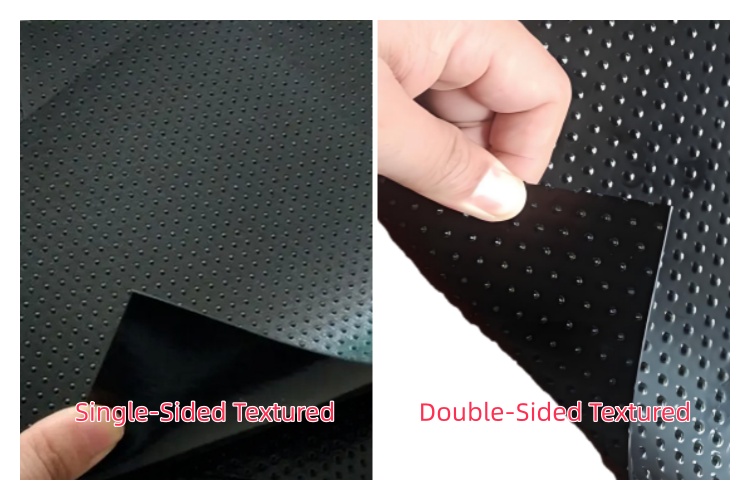
One Side or Two? Matching the Liner to Your System
The choice between single and double-sided is entirely dependent on what layers are above and below your geomembrane.
-
Single-Sided Textured Geomembrane
This is the most common choice. It is used when you need friction against one material but not another. In a typical slope design, the geomembrane is placed on a prepared soil or GCL subgrade. You need friction between the geomembrane and the top cover soil or drainage geocomposite. In this case, you would place the liner with the textured side facing up to grip the cover material, while the smooth side lies against the subgrade. This is a cost-effective solution for many standard applications. -
Double-Sided Textured Geomembrane
This is a specialized product for high-stakes, multi-layer systems. It's essential when the geomembrane is sandwiched between two other geosynthetics that both require high friction. For example, in a landfill cap, you might have a GCL below the geomembrane and a drainage geocomposite above it. To prevent slippage at duka biyu interfaces, you need texture on both sides of the geomembrane. While it costs more, it provides the ultimate stability for complex designs on the steepest slopes.
What are the typical thickness specifications, material options, and common applications of textured HDPE liners?
You know you need a 1.5 mm textured HDPE liner. But when the material arrives, your caliper measures 1.75 mm. Is the product wrong? Or did you just get a bonus?
Textured geomembranes typically range from 0.75mm to 3.0mm thick and are made from HDPE for its chemical resistance. A key detail is that the specified thickness refers to the core liner; the final measured thickness will be higher due to the texture height.
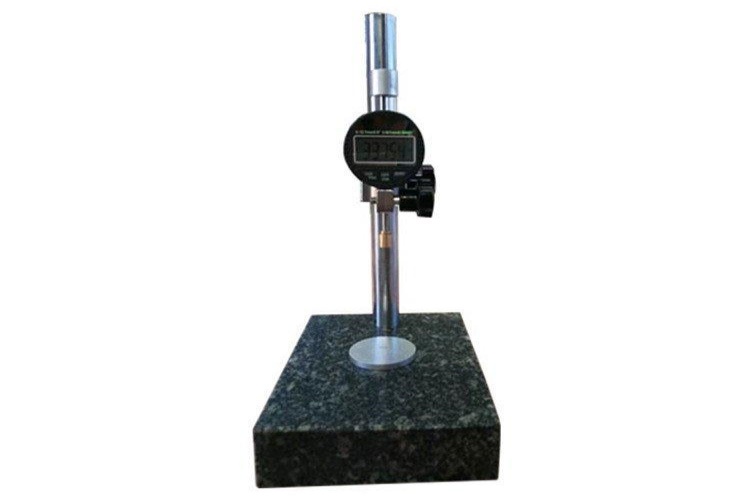
A Spec Sheet Deep Dive
Understanding the key specifications is crucial for sourcing the right material and verifying quality upon delivery. Here are the ares I focus on with my B2B clients.
-
Material: HDPE is King
Polyethylene Mai Girma (HDPE) is the go-to material for most textured liner applications. Its excellent durability, chemical resistance (crucial for landfills and mines), and UV stability (when properly formulated with carbon black) make it the most reliable choice for long-term containment. LLDPE is sometimes used for its greater flexibility if significant settlement is expected. -
Thickness: A Critical Importer Tip
This is a point that often confuses new buyers. The industry standard, like GRI-GM13, specifies the nominal core thickness. The texture itself adds height. For example, if you order a 1.5 mm textured liner, the smooth, untextured part of the sheet must be 1.5 mm. The tiny peaks of the texture add height, typically at least 0.25 mm per side.- A 1.5 mm single-sided liner should measure ~1.75 mm at the peaks.
- A 1.5 mm double-sided liner should measure ~2.0 mm at the peaks.
Always bring a caliper to the job site. If your 1.5 mm liner measures only 1.5 mm at its peaks, you have been supplied with an underspecified product.
-
Aikace-aikace gama gari
You will find textured geomembranes specified for any project involving steep slopes, including:- Landfill Liners and Caps: For lining the side slopes of waste cells and for the final cover systems.
- Ma'adinai: Tailings dams and heap leach pads, which involve massive, steep structures.
- Reservoirs and Canals: For lining steep embankments to prevent erosion and ensure stability.
- Vertical Cut-Off Walls: Where liners are hung vertically to block groundwater flow.
Ƙarshe
Textured geomembranes are an essential safety component for steep slope projects. By understanding the types, recognizing the difference between single and double-sided, and verifying the core thickness, you can import and install with confidence.