

If a landfill's liner is its shield, the leachate collection layer is its safety valve. A blocked or inefficient drainage system can cause toxic liquid to build up, placing immense pressure on the liner and risking a catastrophic failure.
This guide provides a practical comparison of the three primary materials used for leachate collection layers: traditional gravel, modern geonets, and integrated geocomposites. I will explain how to select the right material based on your landfill's specific design, waste type, and long-term performance goals.
Choosing the right drainage material is a critical decision that impacts not only environmental safety but also construction efficiency and the valuable airspace of your facility. Let's start by defining the exact role this crucial layer plays in a modern landfill.
Role of the Leachate Collection Layer in Landfill Systems
The leachate collection layer, officially called the Leachate Collection and Removal System (LCRS), is an engineered layer of highly permeable material placed directly on top of the primary geomembrane liner. Its function is absolutely critical and serves three main objectives.
First, it is designed to quickly collect and transport leachate away to a sump or collection point for treatment. By removing the liquid efficiently, it prevents it from ponding and accumulating on top of the liner system.
Second, it must limit the hydraulic head. Environmental regulations strictly limit how deep the leachate can get on top of the liner, often to a maximum of 30 cm (1 foot). High liquid pressure, or "head," can dramatically increase the rate of leakage through any potential pinholes or defects in the geomembrane. An efficient LCRS keeps this pressure at a safe, minimal level.
Finally, it plays a role in protecting the liner system. Depending on the material, it can act as a cushion, shielding the geomembrane from being punctured by the initial layers of waste or construction equipment, thus preserving the integrity of the entire containment system.
Key Performance Requirements for Leachate Collection Materials
To perform these functions reliably for decades under a mountain of waste, the materials used in an LCRS must meet several key performance requirements.
- Hydraulic Conductivity: This is a measure of how easily a fluid can pass through the material. A high conductivity is essential for efficient drainage.
- Transmissivity under Load: More important than just conductivity is the material's in-plane flow capacity, or transmissivity, after it has been compressed by the immense weight of the overlying waste. A material might drain well in a lab, but its performance can decrease significantly once it is subjected to real-world pressures.
- Clogging Resistance: The LCRS must resist clogging from fine soil particles, biological growth (bio-clogging), and chemical precipitates over its entire design life. Clogging reduces flow capacity and can lead to system failure.
- Chemical Durability: The material must be chemically inert and not degrade when exposed to the aggressive chemical cocktail of landfill leachate.
- Long-Term Stability: The material must maintain its structural integrity and drainage performance for many decades without significant compression, creep, or degradation.
Gravel Drainage Layers: Traditional Solution and Design Considerations
Gravel has been the traditional material of choice for leachate collection layers for many years. A typical design involves a thick layer, often 300-500 mm (12-20 inches), of clean, rounded stones of a specific size gradation, embedded with a network of perforated collection pipes.
Its primary advantage is its high hydraulic conductivity and excellent performance under load, as the stones create a highly porous, robust structure that is difficult to compress. However, gravel has significant drawbacks in modern landfill design.
First, it is a major consumer of valuable landfill airspace; a 500 mm layer of gravel across a large landfill cell represents thousands of cubic meters that could have been used for waste. Second, the cost of sourcing, washing, and transporting suitable gravel can be very high. Finally, and most critically, it poses a significant risk to the underlying geomembrane. In my experience, the sharp edges of gravel are a leading cause of liner damage during construction. Some industry studies suggest that over 70% of all geomembrane punctures are directly caused by the placement of the gravel drainage layer. This risk requires the use of a thick protective geotextile, adding to the cost and complexity.

Geonet Drainage Layers: High Transmissivity Synthetic Option
A geonet is a geosynthetic material made from polietileno de alta densidade (HDPE) ribs that are extruded to form a net-like structure. This structure creates open channels that allow for high in-plane flow of liquids and gases. Geonets are a modern alternative to gravel, designed specifically for drainage applications.
The key advantage of a geonet is its extremely high flow capacity (transmissivity) within a very thin profile, typically only 5-8 mm thick. This saves an enormous amount of airspace compared to a gravel layer. Being made of HDPE, geonets are chemically resistant and durable.
However, the performance of a geonet is highly dependent on its compressive behavior. Under the immense pressure of a deep landfill, the ribs can compress, and the flow channels can get smaller. It is crucial to select a geonet that is rated to perform under the specific maximum load of your landfill design. Furthermore, a geonet used alone is susceptible to clogging from fine particles, so it must be used in conjunction with geotextile filters on both sides.
Geocomposite Drainage Layers: Geonet + Geotextile Systems
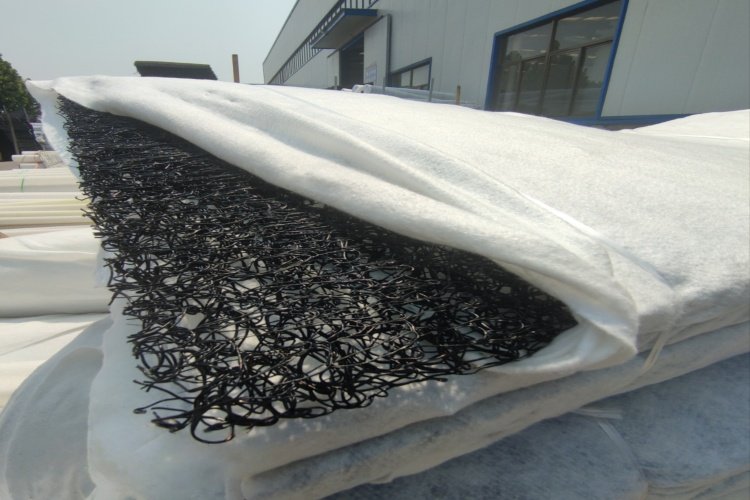
UM geocomposite is the logical evolution of the geonet. It is a factory-manufactured product that bonds a geonet core with one or two layers of nonwoven geotextile. This creates an all-in-one drainage, filtration, and protection system.
A typical three-layer geocomposite works like this:
- Upper Geotextile: Acts as a protective cushion and initial filter.
- Geonet Core: Provides the high-flow drainage channels.
- Lower Geotextile: Functions as the primary filter to prevent fine particles from the waste from clogging the geonet, and also provides protection for the geomembrane below.
The advantages are significant. It provides the same space-saving and high-flow benefits of a geonet while also solving the clogging and protection issues. Installation is fast and efficient, as a single roll of material provides multiple functions, reducing labor and machinery time. This integrated system is now the standard for high-performance leachate collection in many modern landfill designs.
Comparison of Gravel, Geonet, and Geocomposite Drainage Systems
Choosing between these three options involves a trade-off between performance, cost, and construction efficiency. This table summarizes the key differences to help guide your decision.
| Recurso | Gravel | Geonet (with Geotextiles) | Geocompósito |
|---|---|---|---|
| Thickness / Airspace | Very thick (300-500mm), high airspace consumption. | Very thin (6-10mm total), excellent airspace savings. | Very thin (6-10mm), excellent airspace savings. |
| Performance Under Load | Excellent, very resistant to compression. | Good, but flow can decrease under very high loads (>400 kPa). Requires careful selection. | Good, same performance as geonet core, but fabric layers help distribute load. |
| Liner Protection | Poor. High risk of puncture without a very robust protective geotextile. | Moderate. Requires separate protective layers. | Excellent. The integrated geotextile provides built-in protection. |
| Installation Efficiency | Slow, labor-intensive, requires heavy machinery. | Moderate. Requires placement of multiple separate layers. | Excellent. Fast and efficient installation of a single product. |
| Clogging Resistance | Good, but can be susceptible to mineral clogging over time. | Requires separate geotextile filters to prevent particle clogging. | Excellent. Integrated filter fabric is designed to prevent clogging. |
| Material & Transport Cost | Can be very high, especially if suitable gravel is not available locally. | Lower material cost than geocomposite, but requires separate geotextile purchase. | Higher initial material cost, but often lower total installed cost. |
Design Factors Affecting Material Selection
The optimal choice is not the same for every project. As a supplier, we always advise clients to consider several key design factors before making a final selection.
- Landfill Depth and Load: The higher the waste stack, the greater the compressive load. For very deep landfills (>40 meters), the long-term compressive strength of a geonet/geocomposite is a critical design parameter. Loads over 400 kPa may require a hybrid design with a thin geocomposite layer plus a protective gravel layer on top to help distribute the load.
- Waste Type: Leachate from MSW, hazardous waste, and industrial sludge has different chemical compositions and clogging potential, which may influence the choice of polymer (e.g., HDPE) and the geotextile filter's properties.
- Slope Angle: Placing and maintaining a thick gravel layer on steep side slopes (e.g., 2.5H:1V) is extremely difficult and unsafe. Geocomposites are the clear choice for slope drainage as they are easy to anchor and install at any angle.
- Requisitos Regulatórios: Local environmental regulations may mandate specific drainage layer thicknesses or performance standards (e.g., for hazardous waste facilities), which can dictate the material choice.
- Cost and Availability: The total project cost must be considered. While a geocomposite may have a higher upfront material cost, it can lead to significant savings in gravel purchase, transportation, installation labor, and, most importantly, revenue from increased landfill airspace.
Application Scenarios and Recommended Material Choices
Here are some common scenarios and the typical material solutions we see in the field.
Hazardous Waste Landfills
These facilities require the highest level of safety, often with double liner systems and strict limits on leachate head. The typical design is a high-performance geocomposite placed directly on the geomembrane, sometimes supplemented with a 150-250mm gravel layer and a dense network of pipes to ensure maximum drainage efficiency and redundancy.
Municipal Solid Waste (MSW) Landfills
For the base of a modern MSW landfill, a hybrid approach is very effective. We often recommend a geocomposite layer to provide liner protection and filtration, topped with a thinner-than-traditional gravel layer (e.g., 250mm instead of 500mm). This balances cost, performance, and airspace savings. For the side slopes, a geocomposite alone is almost always the best solution.
Construction & Demolition (C&D) Landfills
Since C&D waste generates less hazardous leachate and regulatory requirements are often less strict, a traditional gravel drainage layer (with a protective geotextile) can be a sufficient and cost-effective solution.
Integration with Geomembranes and GCLs
The leachate collection layer is not an isolated component; it is part of an integrated system. Its design must be compatible with the layers below it, primarily the HDPE geomembrane and potentially a Geosynthetic Clay Liner (GCL).
The most important consideration is protection. Using a geocomposite in direct contact with the geomembrane is an excellent way to provide a protective cushion against damage from overlying materials or construction traffic. The bottom geotextile of the composite prevents sharp stones or particles from coming into contact with the primary liner. This compatibility ensures that the selection of the drainage layer enhances, rather than compromises, the performance of the entire containment system.
Conclusão
The modern trend in landfill design is a clear shift away from thick, traditional gravel layers toward more efficient and reliable geosynthetic solutions. Geocomposites, in particular, offer a superior balance of drainage performance, liner protection, airspace savings, and installation efficiency. By carefully evaluating your project’s specific loads, slopes, and regulatory needs, you can select a leachate collection system that ensures environmental safety and maximizes the economic value of your landfill.