

In the engineering design of a Tailings Storage Facility (TSF), the geomembrane is often the star of the show. It provides the impermeable barrier that keeps toxic leachate away from the groundwater.
However, even the highest quality High-Density Polyethylene (HDPE) geomembrane has a weakness: it is susceptible to physical damage. Sharp rocks in the subgrade, angular tailings particles, and the heavy tracks of bulldozers during installation can easily puncture the liner.
If the liner is punctured, the chemical containment fails, regardless of the resin quality.
This is where the protection layer becomes critical.
The standard industry choice for a tailings pond protection layer is a heavy-weight, needle-punched nonwoven geotextile (typically polyester or polypropylene). It acts as a mechanical cushion, absorbing point loads and preventing the geomembrane from being punctured by sharp objects in the subgrade or the tailings overliner.
In this guide, we will break down exactly how to select the right geotextile, how to determine the correct GSM (gram weight), and the common engineering mistakes we see in global mining projects.
What Is a Protection Layer in a Tailings Pond System?
A tailings pond typically functions as a "composite liner system." It is rarely just a single sheet of plastic laid on the ground.
The protection layer (often called a cushion geotextile) is installed immediately adjacent to the primary geomembrane barrier. Depending on the site conditions, it can be placed:
- Below the Geomembrane: To protect against sharp stones or unevenness in the subgrade.
- Above the Geomembrane: To protect against the granular drainage layer or the tailings themselves being dumped on top.
The Four Core Functions
While many engineers think of geotextiles primarily for filtration, in a TSF liner system, their roles are distinct:
- Cushioning & Stress Distribution: The geotextile acts as a shock absorber. When a heavy load (like a 30-ton truck or a 50-meter pile of tailings) presses a sharp stone against the liner, the thick, fibrous structure of the geotextile deforms. It redistributes this "point load" over a wider area, reducing the localized stress on the HDPE.
- Puncture Resistance: It increases the energy required to punch a hole through the system.
- Friction Enhancement: Nonwoven geotextiles have a rough surface texture that increases the interface friction angle between the soil and the smooth geomembrane, which is vital for slope stability.
- In-Plane Drainage: Under high compression, heavy nonwovens can still transmit fluids/gas laterally, helping to relieve hydrostatic pressure buildup under the liner.
What Type of Geotextile Is Used?
When specifying a protection layer for mining, you generally have two material categories: Tecido e Não tecido.
For protection applications, Nonwoven is the only correct choice.
3.1 Nonwoven Geotextile (The Mainstream Choice)
Specifically, we recommend Needle-Punched Nonwoven Geotextiles.
These materials are made by mechanically interlocking fibers using thousands of barbed needles. This process creates a thick, felt-like material with a complex 3D structure.
- Filament vs. Staple Fiber:
- Continuous Filament Nonwoven: Made from endless fibers. It generally has higher tensile strength and puncture resistance per unit weight. It is the preferred choice for critical Category 1 Tailings Dams.
- Staple Fiber Nonwoven: Made from short fibers. It is more cost-effective and provides excellent cushioning thickness. It is widely used in standard containment projects.
3.2 Why Not Woven Geotextile?
We often see procurement officers ask, "Woven geotextiles have higher tensile strength, so aren't they better?"
The answer is No.
Woven geotextiles are thin and flat. They lack the "loft" or thickness required to cushion a sharp object. Imagine trying to protect a balloon from a needle. Would you wrap the balloon in a thin, strong nylon sheet (Woven), or a thick wool blanket (Nonwoven)? The blanket works better because it absorbs the object.
| Recurso | Nonwoven (Needle Punched) | Woven (Slit Film/Filament) |
|---|---|---|
| Função Primária | Protection (Cushion) & Filtration | Reinforcement & Separação |
| Grossura | Thick (2mm – 8mm+) | Thin (<1mm) |
| Alongamento | High (50% – 80%) | Low (<15%) |
| Puncture Defense | Excellent (Absorbs energy) | Moderate (Resists but transmits load) |
| Suitability for TSF | Recommended | Not Recommended for Protection |
Recommended GSM for Tailings Pond Protection Layers
This is the most common question we receive from EPC contractors: "What gram weight (GSM) should I buy?"
There is no universal answer. The selection depends entirely on the Subgrade Particle Size and the Overburden Load. As a manufacturer, we see a direct correlation: heavier cloth = thicker cushion = higher safety factor.
Here is a practical selection guide based on our export project data:
1. Light Duty: 200 – 300 g/m²
- Application: Base of the pond where the subgrade is sand or compacted clay with no stones.
- Condition: The overburden load is low to moderate.
- Protection Level: Basic. It prevents abrasion but offers limited protection against sharp rocks.
2. Standard Mining Grade: 300 – 400 g/m²
- Application: This is the "workhorse" spec for 70% of our mining orders.
- Condition: Used on slopes and floors where the subgrade has been prepared but may still contain small gravel (up to 10-20mm).
- Protection Level: Good. The thickness (typically 2.5mm – 3.5mm) provides a substantial buffer against puncture.
3. Heavy Duty / High Risk: 500 – 800 g/m²
- Application: Primary protection for High-Density Polyethylene (HDPE) on rough subgrades, rockfill dams, or areas with heavy equipment traffic.
- Condition: Essential for "heap leach pads" or tailings dams where the crushed ore is placed directly on the liner.
- Protection Level: Excellent. At 600gsm, the geotextile is like a heavy carpet (4.5mm+ thick). It allows the liner to deform around a rock without yielding.
Key Technical Parameters to Check
When evaluating a datasheet from a supplier, do not just look at the price. You must verify these critical engineering parameters for protection applications.
1. CBR Puncture Strength (ASTM D6241 / ISO 12236)
This is the most critical value. It leads the specification. It measures the force required to push a 50mm flat-ended plunger through the fabric.
- For mining, we typically look for CBR values > 3000 N (for ~400gsm) and > 5000 N (for ~600gsm).
2. Thickness (ASTM D5199)
Thickness provides the volume for the geomembrane to deform into.
- Note: Thickness is measured under 2kPa pressure. Be aware that under the immense weight of a tailings pile (200kPa+), the geotextile will compress. However, a heavier starting GSM retains more residual thickness under load than a lighter one.
3. Elongation at Break
The protection layer must be compatible with the geomembrane. HDPE is a flexible material that yields. If the geotextile snaps before the geomembrane stretches, the protection is lost.
- We require elongation > 50% to ensure the geotextile stretches with the liner during settlement.
4. UV Resistance
Even though it will eventually be buried, the geotextile might be exposed to high-altitude UV radiation for months during installation.
- Ensure the material has Carbon Black or UV stabilizers added to retain >70% strength after 500 hours of exposure.
Typical Protection Structure in Mining Projects
In a robust tailings management facility, the protection is rarely a single layer. We frequently supply materials for "Double Layer Protection" systems.
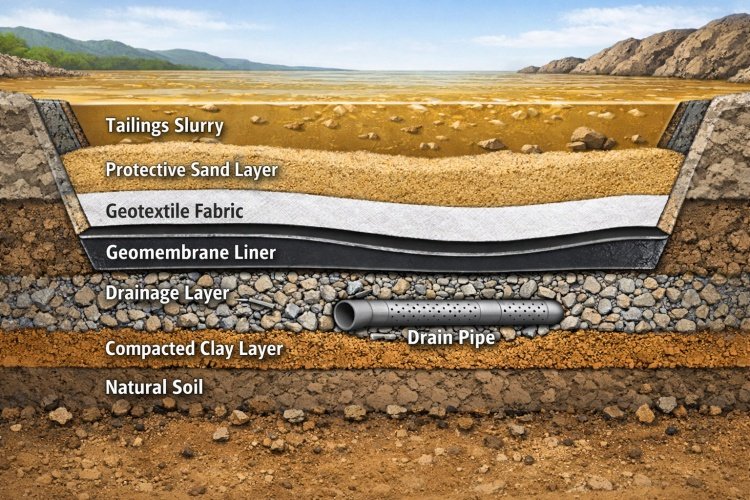
The typical stratification from bottom to top involves:
- Prepared Subgrade: Compacted soil.
- Bottom Geotextile (Cushion): Usually 300–400 gsm. This protects the liner from the ground below.
- HDPE Geomembrane: The primary barrier (1.5mm or 2.0mm).
- Top Geotextile (Protection): Usually 400–600 gsm. This is often heavier than the bottom layer because it takes the direct impact of the drainage gravel or tailings placement.
- Drainage Layer: Gravel or a Geocomposite Drainage Net.
- Tailings: The waste material.
In some ultra-critical projects (like Uranium or Gold tailings), engineers may specify a Forro de argila geossintética (GCL) instead of the bottom geotextile, providing both cushioning and a secondary sealing effect.
Common Design Mistakes to Avoid
As a supplier reviewing tender documents, we often see specifications that introduce unnecessary risks.
Mistake 1: Selecting GSM Solely on Price
"The budget is tight, let's switch the 500gsm to 200gsm."
This is a false economy. The cost of a geotextile is a fraction of the liner cost. If you down-spec the protection layer and rocks puncture the liner, you have wasted 100% of the liner budget.
Mistake 2: Ignoring Particle Size Compatibility
There is a specific engineering calculation to determine the required mass per unit area based on the maximum particle size of the subgrade. Using a 300gsm fabric over 50mm sharp rocks is a guaranteed failure. The rock will poke right through.
Mistake 3: Overlooking Installation Damage
The period of highest risk for a liner is not during operation, but during installation. Heavy trucks driving over the cover material create massive dynamic point loads. A heavy-duty geotextile (600gsm+) acts as a safety buffer against construction negligence.
Mistake 4: Clogging Risks in the Protection Layer
Risk Warning: While we focus on protection, remember the geotextile also acts as a filter. If you choose a nonwoven with an Apparent Opening Size (AOS) that is too small for the tailings particle size, the geotextile will clog/blind. This stops drainage, increases pore pressure, and can destabilize the dam walls. The protection layer must be designed for both Puncture e Permeability.
How to Choose the Right Geotextile Supplier for Mining Projects
Mining projects require more than just a roll of fabric; they require logistical certainty and quality assurance.
When establishing our export division, we aligned our production specifically for heavy civil works. Here is what you should look for in a partner:
- Wide-Width Rolls (6m – 8m): Standard agricultural fabric is 2m or 4m wide. For a 50-hectare tailings pond, narrow rolls mean thousands of meters of extra sewing and installation time. We produce rolls up to 6m–8m wide to reduce installation seams by 30-50%.
- Third-Party Testing: Do they test per roll? We provide Minimum Average Roll Value (MARV) data, not just "typical" values. In mining, an average isn't good enough; the weakest point is where the failure happens.
- Custom Mass Production: Can they produce 1200gsm if the design calls for it? Standard factories stop at 400gsm. A specialized mining supplier should offer heavyweight protection up to 1500gsm.
- Supply Chain Capability: A TSF project might need 100 containers delivered in 6 weeks to beat the rainy season. Does the manufacturer have the output capacity to meet this timeline without delaying the earthworks contractor?
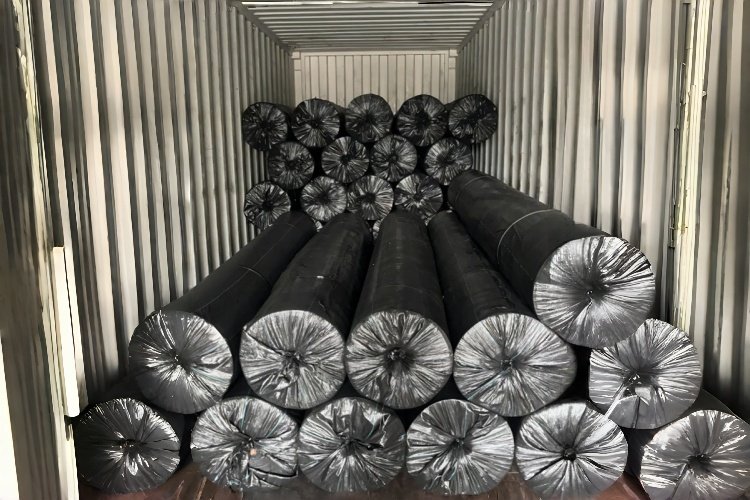
Case Study: Copper Mine TSF in South America
Project Context:
Last year, we supplied the liner system for a TSF expansion in a high-altitude region of Peru. The subgrade was blasted rock, meaning it was impossible to achieve a perfectly smooth surface. The engineers were concerned about the 2.0mm HDPE liner being punctured by the subgrade rock.
The Solution:
Instead of importing expensive fine sand for a bedding layer (which was logistically impossible), the design was adapted to use a heavy-duty geotextile cushion.
- Bottom Layer: 800 g/m² Filament Nonwoven Geotextile (High puncture resistance).
- Liner: 2.0mm HDPE Geomembrane.
- Top Layer: 400 g/m² Nonwoven Geotextile (Protection against drainage gravel).
O resultado:
The electrical leak location survey (dipole method) conducted after installation showed zero defects. The 800gsm geotextile successfully absorbed the irregularities of the rock subgrade, saving the client approximately $200,000 in sand importation costs while providing a superior safety factor.
Conclusão
The protection layer is the unsung hero of the tailings pond system. It is the cheapest component in the trench, yet it bears the responsibility of preserving the integrity of the entire facility.
Summary of Key Takeaways:
- Material: Always use Nonwoven Needle-Punched Geotextile. Avoid Woven fabrics for protection layers.
- Weight (GSM): This translates directly to protection thickness. Use 300-400gsm for standard conditions and 500-800gsm for rocky subgrades or high traffic areas.
- System: Consider a double-layer approach (underliner and overliner) for maximum security.
Engineering a tailings pond leaves no room for error. The cost difference between a "good enough" geotextile and the "correct" geotextile is negligible compared to the cost of an environmental breach.
If you are currently designing a TSF or sourcing materials for a mining project, contact our technical team today. We can assist with puncture resistance calculations, sample testing, and providing a quotation for high-performance mining-grade geotextiles tailored to your site conditions.