


Building a reliable containment system with traditional compacted clay is slow, expensive, and notoriously difficult to control. Project delays and inconsistent field quality can compromise the integrity of your entire project. Geosynthetic Clay Liners (GCLs) offer a modern, factory-controlled solution that accelerates construction and ensures high performance.
This guide provides a detailed overview of Geosynthetic Clay Liner (GCL) applications, from their fundamental structure to complex design considerations. We will cover how GCLs work, compare them to other lining systems, and outline best practices for installation and long-term durability, empowering you to specify and deploy them effectively.

A GCL is more than just a roll of material; it's a precisely engineered hydraulic barrier system. To leverage its full potential, we first need to understand its components and how they work together to stop water.
Structure and Function of Geosynthetic Clay Liners
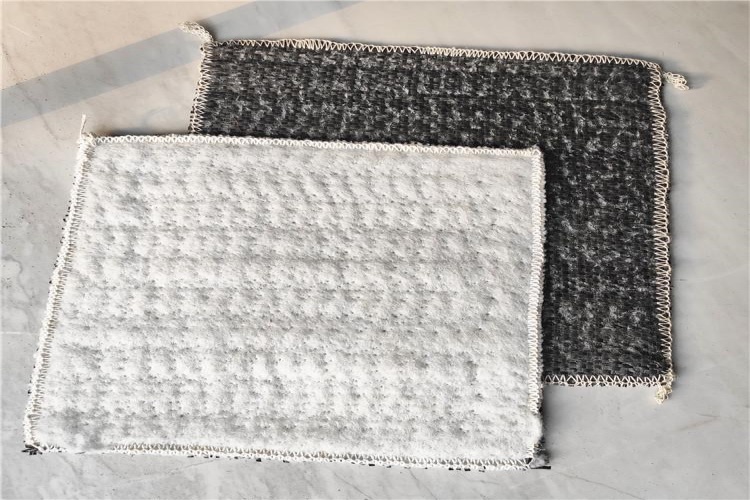
At its core, a Liner de argila geossintética is a factory-manufactured hydraulic barrier. It consists of a thin layer of high-swelling sodium bentonite clay positioned between two geotextile layers. These components are then needle-punched together, a mechanical process where barbed needles are pushed through all three layers. This interlocks the geotextile fibers, creating a strong composite material that provides internal shear strength and encapsulates the bentonite.
The primary function of a GCL is to provide a low-permeability barrier to liquids and gases. The magic happens when the bentonite clay is exposed to water, a process called hydration. As the bentonite absorbs water, it swells to many times its original volume. When this swelling occurs under the confining pressure of cover soil or other materials, the bentonite grains expand to fill all the voids, forming a dense, uniform clay liner. This creates an extremely effective seal with a condutividade hidráulica (permeability) as low as 5 x 10⁻¹¹ m/s, which is significantly lower than what can be reliably achieved with thick layers of compacted natural clay.
2. Key Material Components and Mechanisms of Hydraulic Performance
The exceptional performance of a GCL is a direct result of its carefully selected components and the way they interact. Understanding each part reveals why GCLs are so effective as a barrier.
Sodium Bentonite
The engine of the GCL is the sodium bentonite clay. This naturally occurring clay has a unique molecular structure that allows it to absorb a massive amount of water, causing it to swell up to 15 times its dry volume. This swelling property is what gives the GCL its self-sealing or "self-healing" capability. If a small puncture occurs from a sharp rock, the surrounding hydrated bentonite can swell into the void to close the opening, maintaining the barrier's integrity.
Geotextiles
The geotextile layers (typically nonwoven) serve several vital functions. First, they act as the carrier for the bentonite, protecting it during transport and installation. Second, the needle-punching process gives the composite GCL its tensile strength and internal shear resistance. Third, the outer surfaces of the geotextiles provide the interface friction needed to ensure stability when placed on slopes or against other geosynthetic materials. The type of geotextile used can be tailored to the application's specific strength and friction requirements.
The mechanism of hydraulic performance depends on both hydration and confinement. Without adequate confinement from overlying soil or another structure, the bentonite would simply swell outwards without forming a dense seal.
3. Comparison of GCLs vs. Compacted Clay Liners and Geomembranes
For engineers and project managers, choosing the right lining system involves balancing performance, cost, and constructability. GCLs offer a compelling alternative to traditional Compacted Clay Liners (CCLs) and are often used in combination with geomembranes.
Here’s a direct comparison of the key features:
| Recurso | Forro de argila geossintética (GCL) | Compacted Clay Liner (CCL) | Geomembrane (GM) |
|---|---|---|---|
| Grossura | Very thin (5–10 mm) | Very thick (600–900 mm) | Extremely thin (1–3 mm) |
| Installation | Fast, large rolls, few machines | Slow, water content control, heavy machinery | Technical welding, weather-dependent |
| Controle de qualidade | Factory-controlled, highly consistent | Field-dependent, highly variable | Seam testing is critical |
| Performance | Excellent, self-healing | Susceptible to cracking, inconsistent | Excellent, but relies on seam integrity |
| Space Usage | Maximizes airspace/volume | Consumes significant volume | Maximizes airspace/volume |
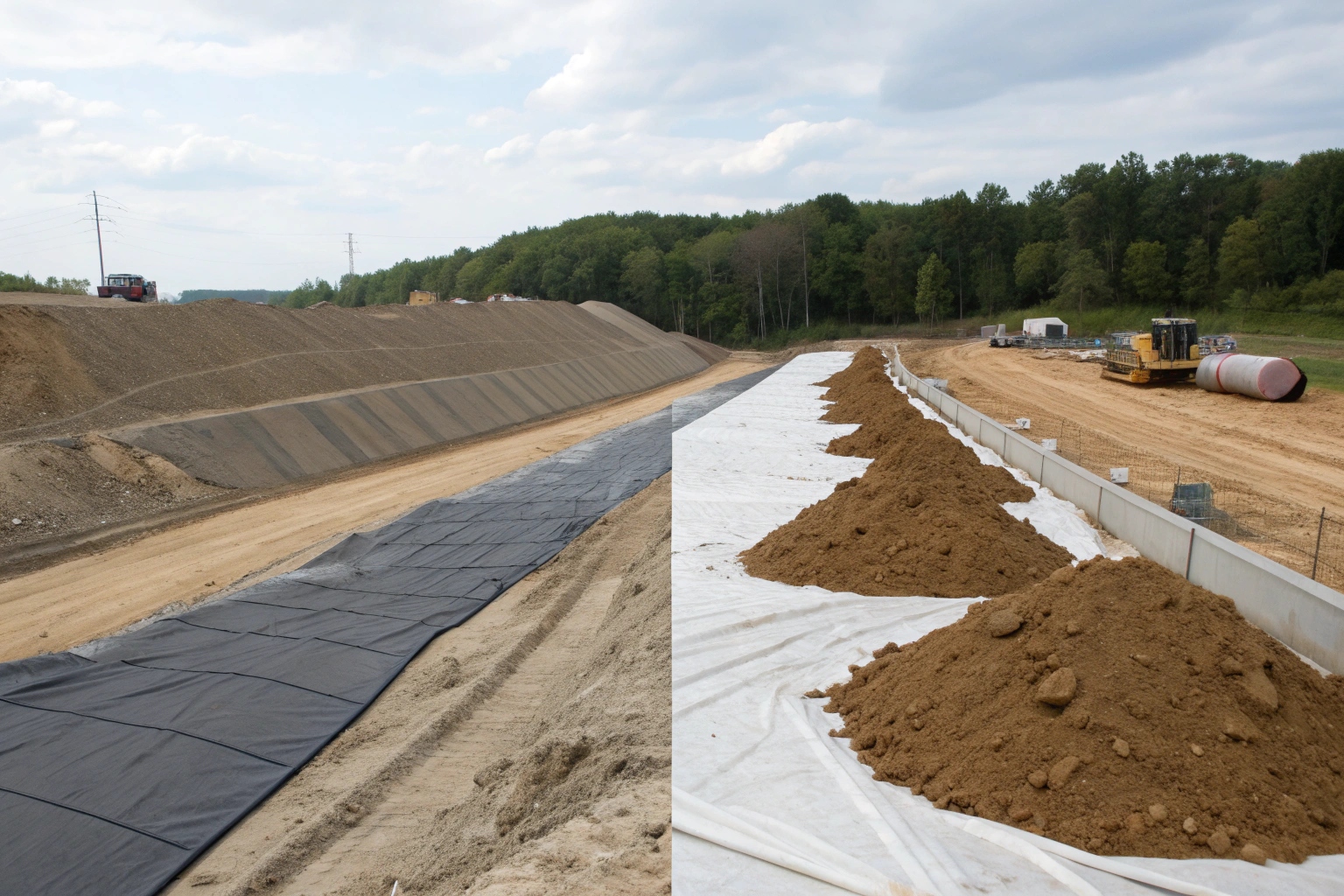
The most significant advantage of a GCL over a CCL is efficiency. A single truckload of GCLs can cover over 3,000 square meters (0.75 acres), whereas achieving the same coverage with a 60 cm thick CCL would require hundreds of truckloads of suitable clay soil. This saves enormous amounts of time, fuel, and project costs. While a geomembrane offers the lowest permeability, it has no self-healing ability. For this reason, the most robust lining systems are composites that place a geomembrane over a GCL. This combines the impermeability of the geomembrane with the self-healing cushion of the GCL, providing unparalleled containment security.
4. Design Considerations: Slope Stability, Seepage Control, and Interface Shear
Specifying a GCL is not as simple as just picking a product from a catalog. A successful design requires a careful engineering analysis of site-specific conditions to ensure long-term stability and performance.
Slope Stability
When used on slopes, such as in landfills or reservoirs, the GCL's ability to remain stable is the primary design concern. Stability depends on two main factors: the internal shear strength of the GCL itself (provided by the needle-punching) and the interface shear strength between the GCL and the materials above and below it. Geotechnical engineers must perform laboratory tests to determine the friction angles of these interfaces to calculate a factor of safety against sliding. For steeper slopes, reinforced GCLs with higher internal strength may be required.
Seepage Control
While a GCL's permeability is extremely low, a small amount of seepage will still occur. Engineers must calculate this expected seepage rate to ensure it meets regulatory limits. The key factors influencing seepage are the GCL's hydraulic conductivity, the height of the liquid being contained (hydraulic head), and the quality of the seam overlaps.
Chemical Compatibility
The designer must also consider the chemistry of the liquid the GCL will contain. Certain aggressive leachates with high concentrations of salts can inhibit the bentonite's ability to swell through a process called cation exchange. For these applications, a leachate sample should be tested with the GCL to confirm its long-term performance.
5. Common Applications: Landfills, Ponds, Tunnels, and Environmental Containment
Thanks to their versatility and high performance, GCLs are used across a wide range of industries. We supply GCLs for projects in nearly every sector of civil and environmental engineering.
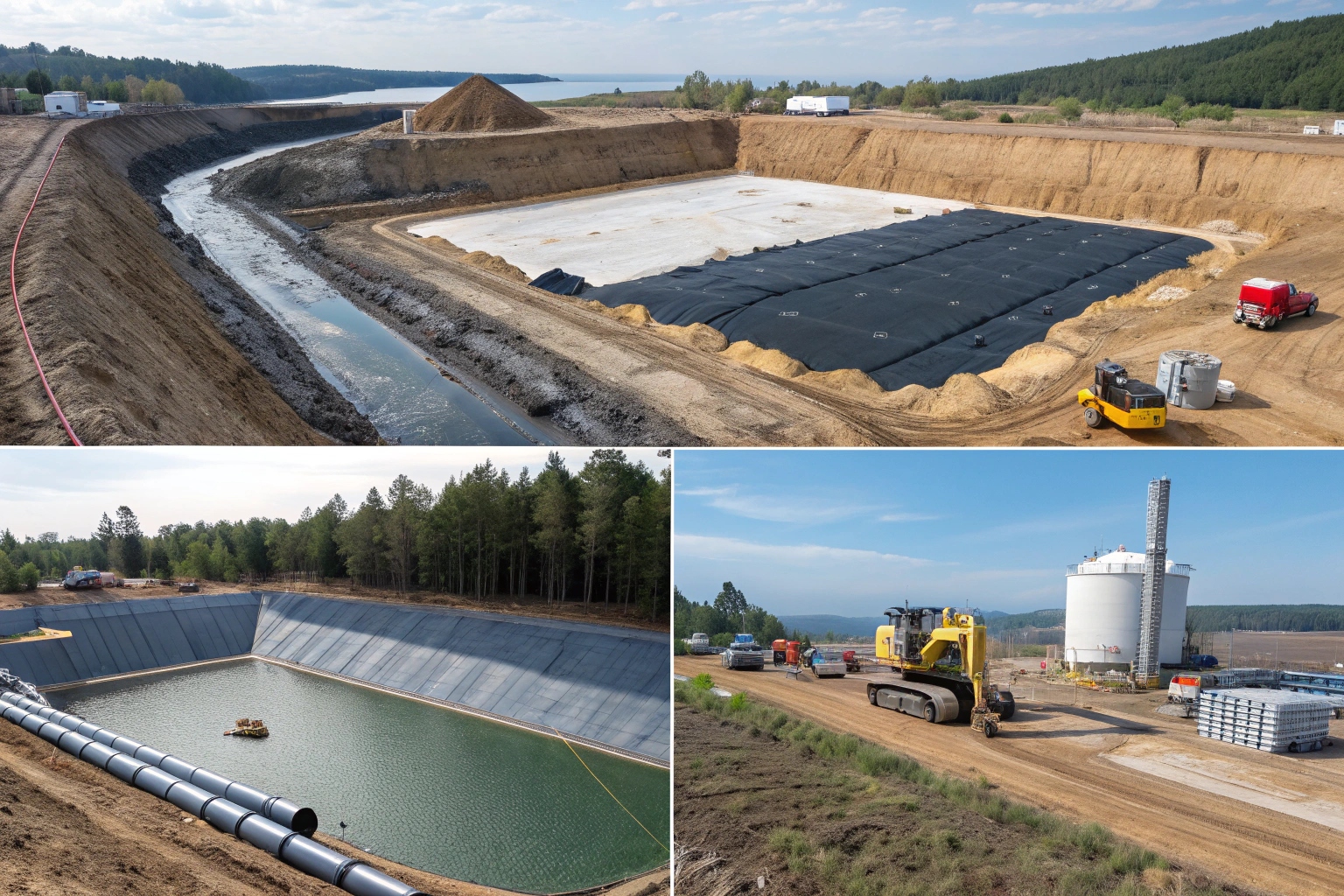
- Aterros sanitários: This is one of the largest applications. GCLs are used in base liner systems (often as part of a composite liner with a geomembrane) to contain leachate and in final closure caps to prevent water infiltration. Their efficiency allows landfill owners to maximize valuable air space.
- Water Containment: GCLs are ideal for lining irrigation canals, reservoirs, stormwater management ponds, and decorative lakes. Their rapid installation makes them more cost-effective than CCLs or concrete, especially for large areas.
- Mineração: In mining operations, GCLs are used to line heap leach pads and tailings impoundments, preventing the release of contaminated process water into the environment.
- Contenção Secundária: They provide an impermeable barrier beneath large fuel or chemical storage tanks, ensuring that any potential spills are safely contained.
- Infrastructure & Tunnels: GCLs are used as a waterproofing layer in underground construction, such as tunnels and building foundations, to prevent groundwater intrusion.
6. Installation Guidelines and Field Handling Best Practices
A high-quality GCL can only perform as well as it is installed. As a supplier, we stress that following proper installation procedures is critical to achieving the designed lifespan and performance of the lining system.
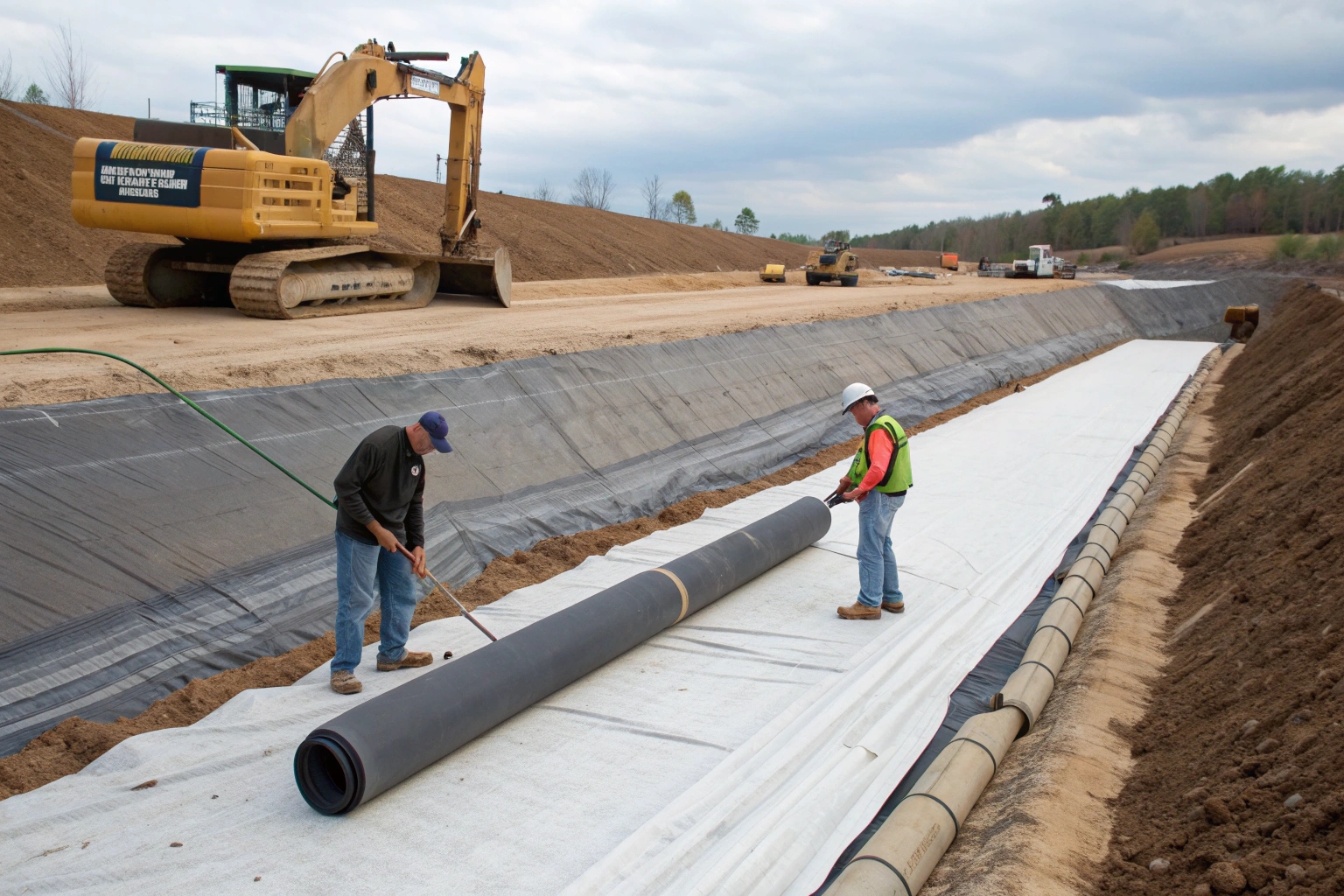
First, subgrade preparation is essential. The surface must be smooth, firm, and free of any stones, sticks, or debris larger than a few millimeters in diameter that could damage the GCL.
Second, the GCL rolls should be deployed using a spreader bar attached to an excavator or other equipment to prevent dragging and creasing. The panels are unrolled with a minimum overlap of 150-300 mm at the seams, depending on the project specification. To ensure a continuous seal, a line of granular bentonite is often placed along the overlap just before the next panel is laid.
The most critical step is to cover the GCL promptly. GCLs should be covered with at least 30 cm of soil or other material by the end of each working day. This protection is vital for three reasons:
- It provides the necessary confining stress for the bentonite to swell correctly.
- It protects the GCL from UV radiation and mechanical damage.
- It prevents premature hydration from rainfall, which can cause the bentonite to become slippery and difficult to cover.
7. Factors Affecting Long-Term Performance and Durability
While GCLs are extremely durable, several factors must be managed to ensure their performance over many decades. Careful design and material selection can mitigate these risks.
The most significant factor is chemical compatibility. As mentioned, highly concentrated ionic solutions (like very salty water) can reduce the swelling capacity of sodium bentonite. If the site's groundwater or leachate is aggressive, a special polymer-treated bentonite may be necessary to ensure long-term, low permeability.
Desiccation, or the drying out of the bentonite, can also be a concern. If a GCL in a landfill cap, for example, is subjected to long dry periods and root penetration from vegetation, it could potentially shrink and crack. This is managed by ensuring the protective cover soil is thick enough to hold moisture.
Finally, while GCLs accommodate differential settlement far better than a rigid CCL, extreme settlement can still place the material under high strain. This should be accounted for in the design stage, particularly when building over soft or variable ground conditions.
8. Testing Standards, Quality Assurance, and Regulatory Compliance
One of the great strengths of GCLs is that they are a factory-produced geosynthetic. This allows for a very high level of Manufacturing Quality Assurance (MQA), ensuring that every roll delivered to the site meets consistent, verifiable specifications.
Reputable GCL manufacturers test their products against established industry standards, such as those developed by the Geosynthetic Institute (GRI). Key performance properties outlined in standards like GRI-GCL3 e GRI-GCL5 include:
- Swell Index: A measure of the bentonite's ability to swell.
- Fluid Loss: A test that measures the permeability of the bentonite under pressure.
- Mass per Unit Area: Ensures the correct amount of bentonite is in the product.
- Peel Strength: Measures the bond strength between the geotextile layers.
From a regulatory standpoint, environmental agencies like the U.S. EPA widely accept GCLs as an equivalent or superior alternative to compacted clay liners for applications like municipal solid waste landfills under RCRA Subtitle D regulations. This acceptance is typically based on an engineered design that demonstrates the GCL system meets or exceeds the performance of a prescriptive CCL.
9. Case Studies and Lessons Learned from Real-World GCL Projects
Over the years, we've seen firsthand how GCLs can make or break a project. The lessons learned from the field are often more valuable than any data sheet.
A powerful positive example was for a large irrigation reservoir project in a region with no access to good quality clay. The cost of importing and placing a traditional CCL was going to make the project economically unfeasible. By switching to a GCL, the contractor was able to reduce the liner construction schedule from months to just a few weeks. The material cost was higher, but the savings on machinery, fuel, and labor were immense, ultimately saving the entire project.
On the other hand, we consulted on a project where a contractor failed to cover the installed GCL for several days, during which a heavy rainstorm occurred. The exposed bentonite hydrated prematurely, creating a very slippery surface. When they tried to drive equipment on it to place the cover soil, they caused significant rutting and damage to the liner. This cautionary tale reinforces our most important installation rule: always cover the GCL promptly. These real-world experiences show that a GCL's success depends equally on its inherent quality and the quality of its installation.
Conclusão
Geosynthetic Clay Liners represent a significant advancement in containment technology, offering a faster, more reliable, and often more cost-effective solution than traditional methods. When designed with site-specific conditions in mind and installed according to best practices, GCLs provide a robust and durable hydraulic barrier for the most critical environmental and civil infrastructure projects.