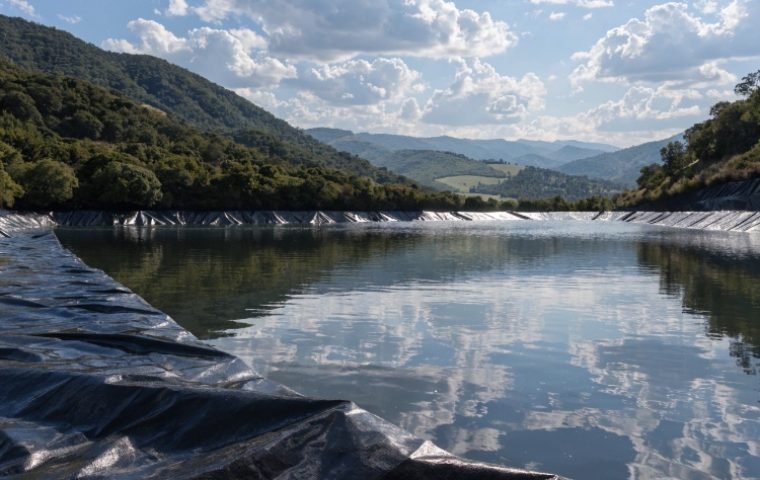
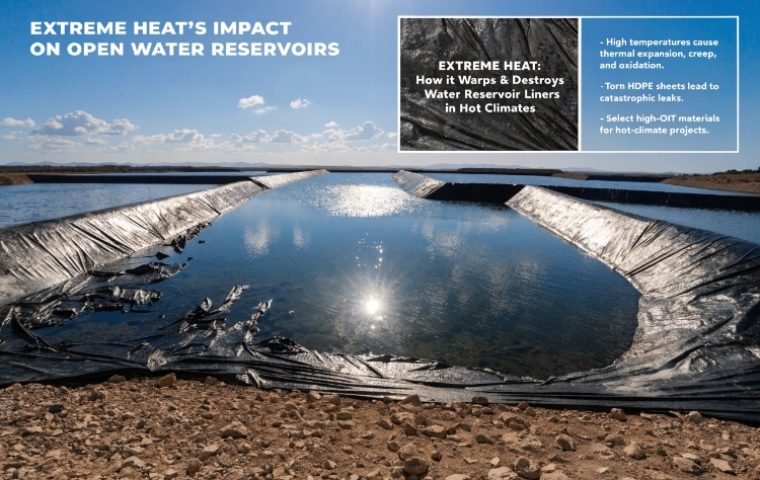
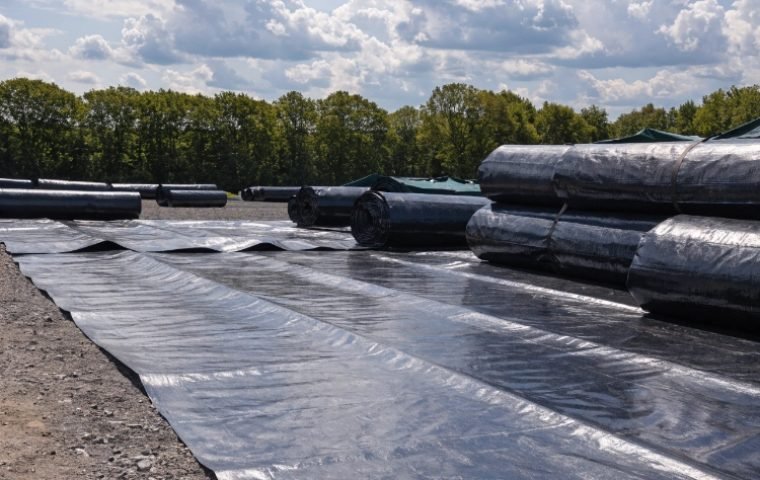
Lined reservoir slopes are notorious for causing catastrophic sliding failures. When heavy soil or protective cover slides down a slick geomembrane, it tears the liner, destroys the embankment, and halts the entire project. Are you using the correct liner surface to hold your engineering design together?
This guide explains when to use textured geomembranes versus standard smooth liners on reservoir slopes. It covers interface friction, engineering slope formulas, and real-world project criteria to help you specify the right material and avoid costly slope failures.

In reservoir lining projects, high-density polyethylene (HDPE) geomembranes are widely used to prevent water seepage and protect valuable resources. While lining the flat bottom of a reservoir is a straightforward mechanical process, the slopes present an entirely different set of engineering challenges. Gravity never sleeps, and how your geomembrane interacts with the materials above and below it on a slope will determine the lifespan of your installation.
The Critical Challenges of Installing Geomembranes on Slopes
Installing an impermeable barrier on an inclined surface introduces complex geotechnical forces. Flat area design does not simply translate to slope design. In our export and supply experience, we see many engineers treat slopes as an afterthought, only to face severe problems during or immediately after installation.
The primary engineering challenge is managing sheer stress and gravitational pull. When you place a geomembrana on a slope, it wants to slide down into the basin. This tendency to slide is countered by the anchor trench at the top of the slope and the friction between the liner and the subgrade below it.
If the reservoir design requires a protective soil cover over the liner—perhaps to protect it from UV exposure or mechanical damage—the challenge multiplies. A standard smooth HDPE geomembrane has practically zero friction. It is effectively a sheet of black ice. If you place 30 centimeters of soil on a smooth liner sitting on a 3:1 slope, the soil will eventually liquefy during heavy rain and slough off into the bottom of the pond, potentially tearing the liner with it.
Furthermore, installation safety becomes a huge liability. Workers must walk on these slopes to deploy material, perform wedge welding, and conduct quality assurance testing. A wet, steep, smooth geomembrane is a serious hazard for construction crews. Understanding these slope mechanics is the first step in realizing why surface texture is heavily scrutinized in professional civil engineering.
Real Project Case: The "One-Size-Fits-All" Dilemma in Panama
To understand how these decisions play out in the real world, I want to share a recent conversation we had with a procurement manager in Panama. This case perfectly illustrates the confusion surrounding smooth versus textured materials.
The client was developing several agricultural reservoirs to support local plantations across an area with highly variable, hilly topography. When we began discussing the material specifications, I asked him directly: "Do your engineering drawings call for a smooth or a textured geomembrane?"
His response was entirely typical for buyers without deep geotechnical experience: "I am not sure. Just quote me a liner that is suitable for all terrains so we don't have to worry about it."
I had to stop him there and explain that in the geosynthetics industry, there is no such thing as a "universal" liner for all terrains. Usually, standard smooth HDPE geomembranes account for about 85% to 90% of global agricultural projects. They are the cost-effective workhorses of the industry.
However, suggesting that he use textured geomembrane everywhere simply as a safety precaution would have been a massive disservice. I explained that textured liners are specialized materials designed for specific high-friction and steep-slope applications. If he purchased textured material for the flat bottoms and gentle slopes of his reservoirs, he would not only overpay for manufacturing costs, but he would also drastically slow down his installation crew due to the complex welding requirements of textured sheets. We ended up segmenting his order: smooth liner for the flat basins, and single-sided textured liner exclusively for his steepest embankments.
How Surface Texture Improves Slope Stability
When we talk about slope stability in relation to geomembranes, we are primarily talking about one metric: the interface friction angle.
Textured geomembranes are manufactured with a rough, sandpaper-like surface structure. Depending on the manufacturing process—whether it is co-extrusion or nitrogen gas injection—the surface is covered in tiny, protruding asperities. These microscopic bumps are designed to aggressively interlock with adjacent materials.
When a textured geomembrane is placed against a non-woven geotextile cushion, or directly against compacted soil, those asperities "bite" into the opposing surface.
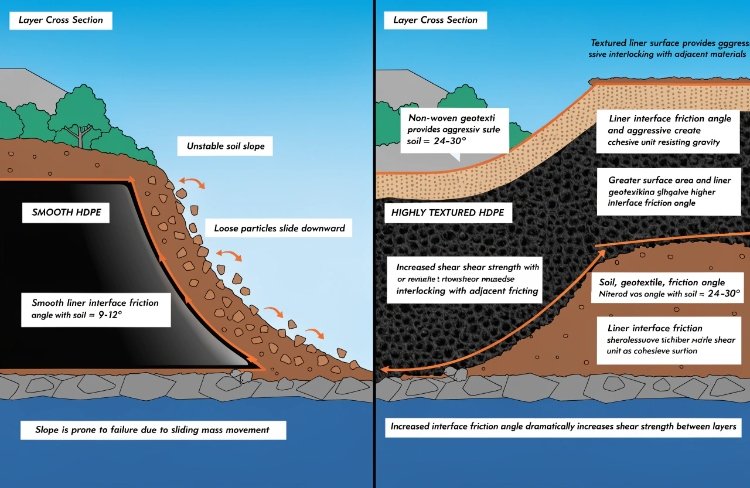
In geotechnical terms, a smooth HDPE liner might have an interface friction angle with soil of roughly 9 to 12 degrees. If your slope is steeper than 12 degrees, the soil covering it will simply slide off. By contrast, a highly textured HDPE liner can achieve an interface friction angle of 24 to 30 degrees (or higher depending on the specific soil and testing conditions). This massive increase in shear strength allows the entire multi-layered system—soil, geotextile, and geomembrane—to act as a cohesive unit that resists gravity.
It is important to understand that this is entirely an engineering function, not a durability feature. Texture does not make the liner more waterproof; it simply forces the liner to grip its environment so the system remains structurally sound under load.
When Textured Geomembrane Is Typically Recommended
Since textured geomembrane is a specialized product that commands a premium price, you should only specify it when the engineering conditions demand it. In our consulting with B2B contractors, we generally recommend textured liners in the following specific scenarios.
1. Steep Reservoir Slopes
If your reservoir embankment design features slopes steeper than 1:3 (approximately 18.4 degrees), placing smooth liner becomes highly risky. A textured surface—often single-sided textured with the rough side facing down against the subgrade—prevents the liner itself from sliding down the slope and reducing the pull-out force on the anchor trench.
2. Slopes Requiring Soil or Concrete Cover
Many environmental regulations require liners to be buried under soil to prevent UV degradation, or covered with concrete for physical protection. If you are placing a cover layer on an incline, a double-sided textured geomembrane is mandatory. The bottom texture grips the subgrade to hold the liner in place, while the top texture grips the soil or geotextile cover to prevent the earthen layer from sloughing off during a rainstorm.
3. Landfill and Tailings Dam Embankments
While this guide focuses on agricultural reservoirs, it is worth noting that mining tailings ponds and solid waste landfills almost exclusively mandate textured liners. These sites deal with immense, shifting dead loads (thousands of tons of waste or wet sludge) that generate massive sheer stress. Smooth liners cannot survive this internal friction.
4. Safe Egress Points for Personnel and Wildlife
In open agricultural ponds, standard smooth HDPE is incredibly dangerous if someone falls in. The slick surface makes it nearly impossible to climb out. Even if the overall project uses a smooth liner, we often recommend installing strips of textured geomembrane at designated corners or access ramps to provide a high-friction egress path for maintenance workers or trapped wildlife.
Engineering Factors to Consider in Slope Design
Choosing between smooth and textured material is only one part of the equation. To ensure a reservoir slope does not fail, the entire system must be harmonized. When reviewing project specifications, professional engineers look at several interacting variables.
Slope Angle and Subgrade Properties
The angle of the embankment directly dictates the gravitational force acting on the liner. But the property of the soil beneath it is equally critical. Is it highly compacted clay, or loose, sandy loam? Textured liner grips well against cohesive soils or non-woven geotextiles, but if the subgrade itself is unstable or prone to internal erosion, the liner's texture cannot save the slope from collapsing beneath it.
Required Anchorage Capacity
Even with textured material, the top of the geomembrane must be secured in an trincheira de âncora. The depth and run-out length of this trench must be calculated based on the dead weight of the liner on the slope. textured liners grip the backfill dirt in the anchor trench far better than smooth liners, drastically increasing the pull-out resistance and securing the installation.
Water Drawdown Rates
In irrigation reservoirs, water levels fluctuate wildly. Rapid drawdown is a hidden danger. When a reservoir is full, the hydraulic pressure pushes the liner against the slope, aiding stability. But when water is pumped out rapidly, the protective soil cover on the slope remains saturated and heavy. This sudden imbalance of forces is exactly when soil sloughing occurs. Proper interface friction calculations must account for the saturated weight of the cover soil during rapid drawdown events.
Best Practices for Reservoir Liner Installation on Slopes
The best material in the world will still fail if installation protocols are ignored. Working with textured geomembranes on embankments requires specific deployment strategies that differ from flat-ground mechanics.
Deployment Direction
Liners must always be unrolled vertically down the slope, never horizontally across it. Horizontal seams on a steep slope are unacceptable because they bear the full brunt of the gravitational tension. By deploying vertically, the load is transferred continuously up to the anchor trench, and seams run parallel to the slope direction, minimizing stress on the welds.
Managing Temperature Variations
Black HDPE expands and contracts significantly under solar radiation. If an installation crew places and tightly anchors a textured liner during the hottest part of the day, it will contract violently at night. Because the textured bottom grips the subgrade, the liner cannot easily slide to adjust its tension. This can result in "trampolining" at the toe of the slope or massive stress cracking over time. Installers must leave carefully calculated slack during daytime deployment and finalize anchor trenches during cooler morning hours.
Proper Integration with Geotextiles
When a textured liner is used alongside a non-woven geotextile cushion, the grip is instantaneous and unforgiving. Unlike smooth liner, which can be dragged around into place, once a textured sheet touches a geotextile, it locks in like hook-and-loop fasteners. Installers must use smooth "slip sheets" (temporary plastic layers) to maneuver the textured geomembrane into its final position before pulling the slip sheet out.
Risk, Limitations, and When Textured Liner is NOT Recommended
This is exactly where textbook theory meets field reality. Textured geomembrane is not a magic solution. Upgraded friction comes at a distinct cost to other mechanical properties, and buyers must be fully aware of the trade-offs.
First, the primary physical limitation of a textured geomembrane is its lower elongation and tensile properties. The manufacturing process that creates the rough asperities inherently disrupts the smooth polymer chain alignment on the surface. Consequently, when subjected to immense stretching forces, a textured liner will break sooner than a smooth liner of the exact same core thickness. If your project sits on ground expected to suffer massive differential settlement (like sinkholes), a smooth liner's ability to stretch up to 700% is far more important than surface friction.
Second, welding textured liners is significantly more difficult. Automated wedge welders rely on consistent surface contact to melt and fuse the HDPE. The rough bumps of a textured sheet prevent a perfect air-tight seal unless the edges are managed. High-quality manufacturers produce textured rolls with a "smooth edge" margin (usually 10 to 15 centimeters wide) specifically to allow for wedge welding. If you purchase fully textured material without a smooth edge, the installation crew must manually grind the texture off the edges with angle grinders before they can weld. This adds massive labor costs and drastically increases the risk of damaging the liner prior to welding.
Finally, there is the financial limitation. Textured geomembranes cost more to manufacture and handle. Recommending a textured liner for a flat pond basin with zero soil cover is an unethical waste of a client’s budget, as they gain nothing from the increased interface friction.
| Parameter | Smooth Geomembrane | Textured Geomembrane | Practical Impact |
|---|---|---|---|
| Interface Friction Angle | Low (< 12°) | High (> 24°) | Determines if cover soil will slide off a slope. |
| Elongation at Break | Very High (700%+) | Moderate (100% - 300%) | Smooth is better for ground settlement/subsidence. |
| Welding Difficulty | Standard | Alto | Textured requires smooth-edge margins or edge grinding. |
| Custo de materiais | Baseline | Premium (+15-30%) | Drives overall project budget on large surface areas. |
Conclusão
Reservoir slopes require careful, deliberate stability design that accounts for gravity, water pressure, and subgrade interaction.
While a smooth geomembrane remains the foundational material for flat basin lining, a textured geomembrane is a strict engineering requirement when you deploy on steep slopes or intend to place soil cover over your barrier. By matching the correct surface texture to your specific embankment angles and project conditions, you eliminate the risk of catastrophic sliding, protect your installation crew, and ensure your agricultural water system performs dependably for decades.