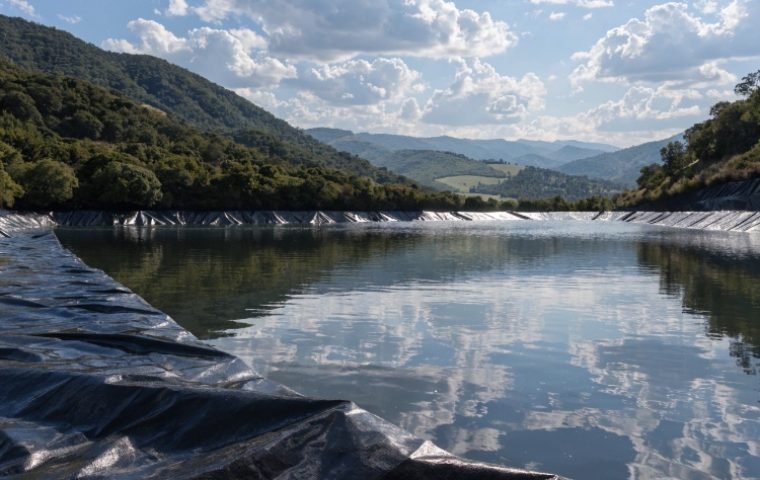
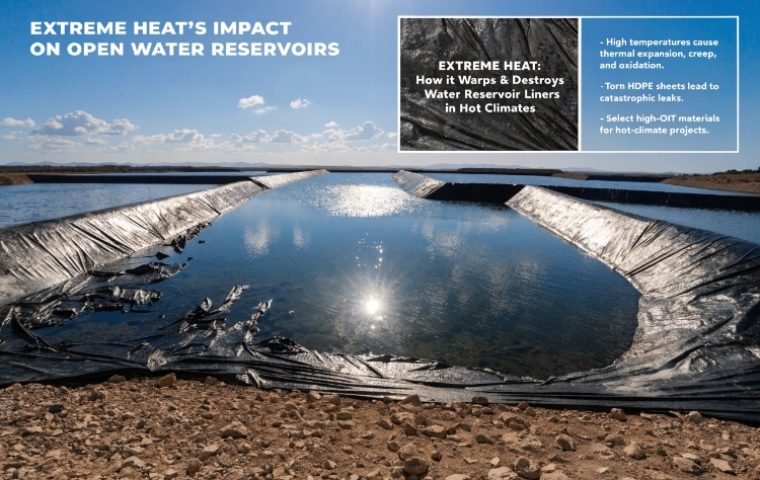
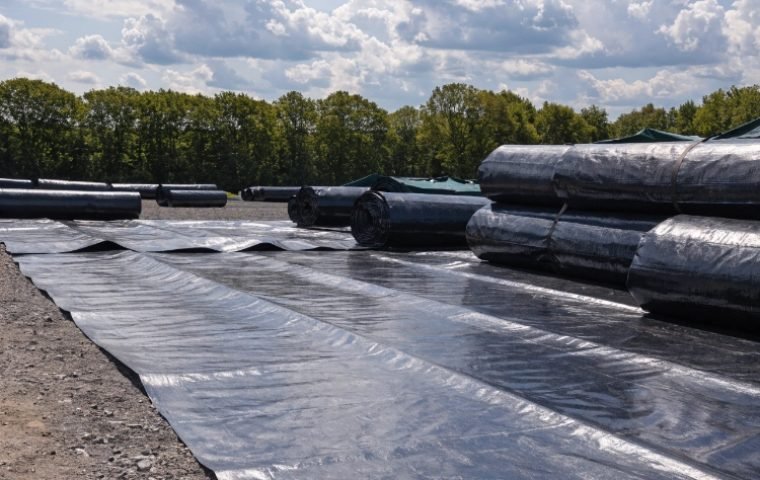
Water is one of the most critical assets in industrial and agricultural operations. Whether you are managing a vineyard irrigation reservoir or a heap leach pad for a copper mine, keeping that water inside the storage system is essential for operational efficiency and cost control.
However, open water storage systems are inherently vulnerable. Unlike closed tanks, large reservoirs are exposed to the elements and the ground beneath them. We frequently see operators pumping thousands of liters daily just to maintain levels, often unaware that they are losing significant volume through invisible channels.
If you are managing an Open Water Storage System, you are likely fighting two enemies: Evaporation e Seepage.
While evaporation is often dictated by the climate, seepage is a structural failure that can be engineered out of the equation. This guide explains why water loss occurs and how professional lining systems provide the most effective solution for retention.

Understanding Water Loss in Open Water Storage Systems
Open reservoirs and ponds are the standard for large-scale water storage because they are cost-effective to build. However, their sheer size and exposure make them susceptible to environmental and geological factors.
When we analyze water loss in a reservoir, we look at the interaction between the water surface above and the soil interface below.
- Surface: The water is exposed to solar radiation, wind, and ambient heat.
- Subsurface: The water exerts hydrostatic pressure on the soil, trying to find a path downward.
In many regions, particularly in arid agricultural zones or remote mining sites, uncontrolled water loss can reduce the effective capacity of a system by 30% or more annually. This forces operators to over-pump groundwater or purchase expensive water to compensate.
Proper design and engineering solutions are therefore necessary to minimize these losses and ensure sustainable water use.
Evaporation: A Natural Source of Water Loss
Evaporation occurs when water transforms into vapor due to heat and exposure to air. In any open water storage system, this process is inevitable and is influenced by four main factors:
- High Temperatures: Ambient heat accelerates the phase change from liquid to gas.
- Strong Winds: Wind removes the saturated air layer directly above the water, allowing more evaporation to occur.
- Direct Sunlight: Solar radiation heats the water body.
- Surface Area: The larger and shallower the pond, the faster the rate of loss.
In hot climates like the Middle East, Australia, or the Western United States, evaporation losses can be substantial. A single hectare of water can lose massive amounts of volume in a summer month.
The Engineering Reality:
While floating covers exist, they are often Capital Expenditure (CAPEX) prohibitive for very large reservoirs (10+ hectares). For most projects, evaporation is treated as a calculated natural loss. Engineers typically design the reservoir to be deeper with a smaller surface area to mitigate this, but completely eliminating evaporation is rarely economically practical.
Therefore, most reservoir management strategies focus primarily on controlling seepage losses, which can be completely eliminated with the right technology.
Seepage: The Major Controllable Cause of Water Loss
While you cannot easily stop the sun from shining, you can stop the ground from draining your reservoir.
Seepage refers to the movement of water from the reservoir into the surrounding soil or ground. This typically occurs when the reservoir base or side slopes are composed of permeable materials such as sand, gravel, or fractured soil. Even compacted clay, often used as a natural liner, has a permeability rate ($1 \times 10^{-7}$ cm/sec) that allows slow leakage over time.
Without a proper impermeable lining system, stored water will follow the path of least resistance into the ground.
Common causes of seepage include:
- Permeable Soil Conditions: Sandy or loamy soils drain water rapidly.
- Geological Shifting: Small ground movements can crack natural clay liners.
- Poor Construction: Uneven compaction creates weak points where water breaks through.
The Risk Beyond Volume Loss:
Seepage does more than just waste water.
- Structural Instability: Water flowing through an earthen embankment causes "piping" (internal erosion), which can lead to the collapse of the dam wall.
- Environmental Contamination: In mining or wastewater applications, seepage allows toxic fluids to enter the groundwater aquifer, leading to severe regulatory fines.
For these reasons, effective seepage control is the number one priority in modern water storage system design.
Using Geomembrane Liners to Prevent Seepage
If seepage is the problem, Geomembrane Liners are the solution.
Geomembranes are impermeable synthetic membranes used to line reservoirs, ponds, canals, and other water containment structures. Unlike clay or concrete, which can crack or allow absorption, a high-quality geomembrane creates an absolute barrier that prevents water from contacting the soil entirely.
Among the various materials available, High-Density Polyethylene (HDPE) Geomembrane is the industry standard for 90% of water storage projects.
Key benefits of HDPE Geomembrane liners include:
- Excellent Impermeability: HDPE has extremely low permeability. It effectively effectively "zeroes out" seepage loss, ensuring that the only water leaving your pond is via the pump or evaporation.
- High Chemical Resistance: Whether you are storing fresh irrigation water, brine, or chemically treated wastewater, HDPE is chemically inert. It does not react, rot, or degrade in aggressive water conditions.
- Strong Durability: HDPE is a tough material. It withstands the immense weight of deep water columns and resists tears from installation equipment better than thinner materials.
- Resistência UV: High-quality HDPE contains carbon black, allowing it to remain exposed to the sun for decades without becoming brittle.
Common Applications:
- Agricultural Irrigation Reservoirs: Ensuring valuable water is available for crops during dry seasons.
- Mining Heap Leach & Tailing Ponds: Preventing the loss of pregnant solution (gold/copper) and protecting the environment.
- Wastewater Lagoons: Containing hazardous waste securely.
By installing a properly designed geomembrane lining system, project owners can immediately halt subsurface water loss.
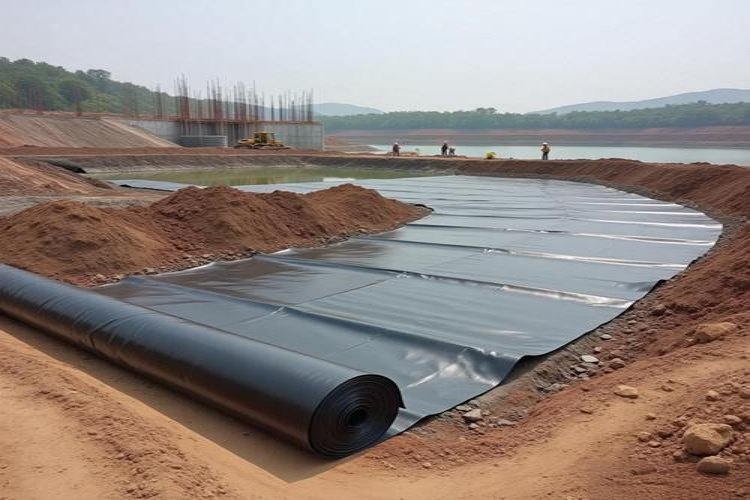
Best Practices for Reservoir Liner Installation
Buying a high-quality liner is only half the battle. To achieve optimal performance, the installation must be executed with engineering precision. A liner with a hole in the seam is no better than no liner at all.
Based on our project experience, here are the key practices for a successful installation:
-
Proper Subgrade Preparation:
The reservoir base and slopes must be smooth, compacted to 95% Proctor, and—most importantly—free of sharp rocks. We often recommend installing a Geotextile protection layer underneath the liner to cushion it against puncture from the soil. -
Professional Geomembrane Welding:
HDPE panels are joined using thermal fusion welding (wedge welding). This creates a double track seam with an air channel in the middle, allowing installers to pressure test the seam on-site to guarantee it is watertight. -
Secure Anchoring Systems:
The liner must be locked into an anchor trench dug around the perimeter of the reservoir. This prevents the liner from slipping down the slopes when the water level fluctuates or during heavy winds. -
Regular Inspection:
Once operational, periodic inspections of the exposed liner (above the water line) help detect potential mechanical damage from animals or equipment, ensuring the long-term integrity of the system.
Conclusão
Open water storage systems are essential infrastructure for agriculture and industry, but they are prone to significant efficiency losses if not managed correctly.
While evaporation is a natural adversary that is difficult to completely neutralize in large-scale projects, seepage is a specific failure of containment that can be fixed. It is the "low hanging fruit" of water conservation.
Geomembrane liners, particularly HDPE Geomembrana, provide the most reliable and cost-effective method for eliminating seepage. By decoupling your water from the permeable ground, you protect your investment, stabilize your infrastructure, and ensure that your water storage system actually stores water.