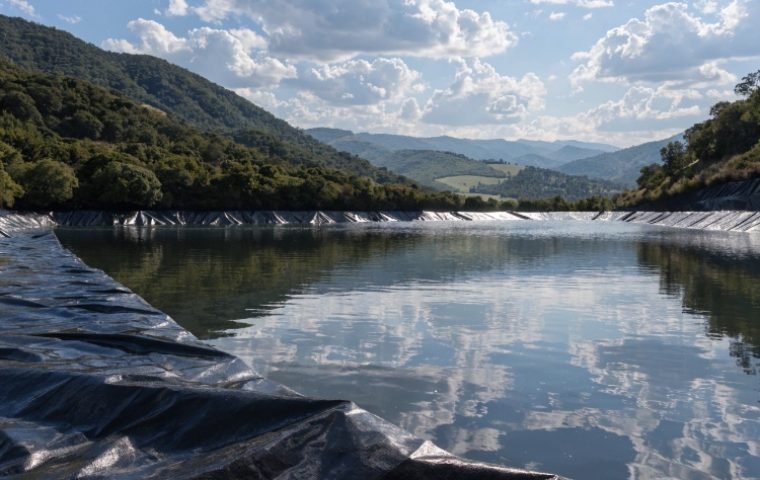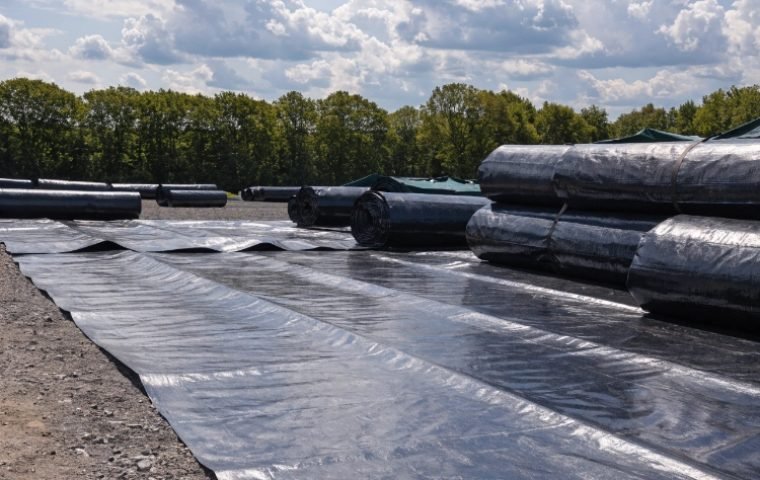


Extreme heat in open reservoirs does not just evaporate water; it physically warps and destroys poorly specified liners. When temperatures spike, your geomembrane stretches, wrinkles, and ages prematurely, risking catastrophic leaks and project failure.
This guide explains how high temperatures degrade HDPE liners through thermal expansion, creep, and oxidation. You will learn how to select high-OIT materials, manage site installation to prevent severe wrinkling, and protect your open water storage assets in hot climates from premature failure.
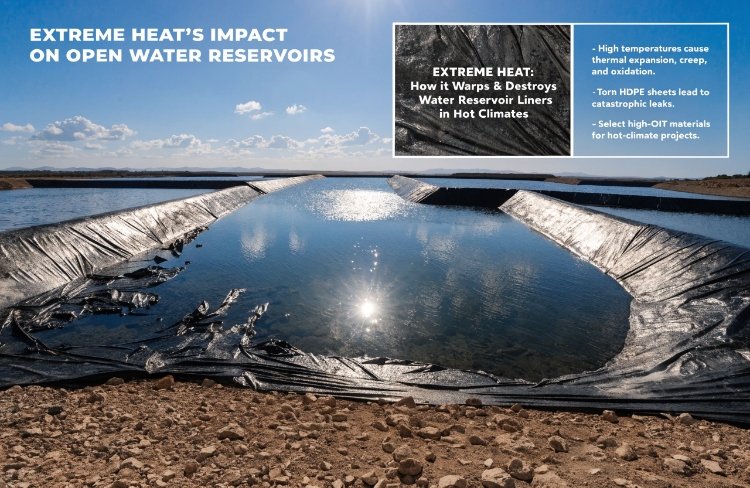
Based on my experience shipping geosynthetics to equatorial and desert projects, managing heat is just as critical as managing water pressure. Here is what happens to the plastic when temperatures rise and how professional contractors solve it.
Why Temperature Is Critical in Open Reservoirs
When a buyer in Europe asks me for a standard reservoir liner, the specification is straightforward. But when a buyer in the Middle East or North Africa asks for the same material, the conversation must immediately pivot to temperature management.
In an open reservoir, the ambient air temperature is only half of the problem. Because high-density polyethylene (HDPE) liners are deeply black to resist UV rays, they act like massive solar panels. They absorb solar radiation at an alarming rate. On a day where the air temperature is 40°C (104°F), the surface of an exposed black geomembrane can easily hit 75°C to 80°C (167°F to 176°F).
Furthermore, the water in the reservoir acts as a mirror. The surface of the water reflects harsh sunlight directly onto the exposed slopes—the "drawdown zone" where the water level fluctuates. This creates a highly localized, super-heated environment along the banks. If the procurement team just looks at average weather data and ignores the black-body heat absorption of the liner, they will drastically underestimate the thermal stress placed on the containment system.
How High Temperature Affects HDPE
How High Temperature Affects HDPE
Heat damages plastic on a molecular level. As a supplier, I often have to explain to project managers that melting is not their primary concern; continuous thermal degradation is. High temperatures attack HDPE liners through three distinct mechanisms.
Thermal Oxidation Aging
Heat acts as an engine that accelerates chemical reactions. Premium HDPE contains antioxidant additives designed to protect the polymer chains from oxygen and sunlight. However, high temperatures cause these antioxidants to deplete much faster. Once the antioxidant package is burned away by continuous extreme heat, the plastic begins to oxidize, turn brittle, and crack.
Polymer Creep
HDPE is a thermoplastic, meaning its physical strength is tied directly to its temperature. At 20°C, the liner is tough and rigid. But as the temperature climbs past 60°C on the slopes, the plastic softens. If the liner is holding back a heavy load or is pulled tightly across a steep embankment, the softened polymer will begin to stretch permanently under the tension. This slow, irreversible stretching is called "creep," and it significantly thins the liner at stress points.
Environmental Stress Cracking (ESC)
When you combine softening plastic (creep) with the harsh chemical exposure of some wastewaters or highly saline water, the liner becomes highly susceptible to Environmental Stress Cracking. Sharp microscopic cracks will spontaneously form, usually around the anchor trenches or extrusion welds where the material is already under mechanical tension.
Thermal Expansion and Wrinkling Issues
The most immediate and visible effect of high temperature is thermal expansion. HDPE has a high coefficient of thermal expansion, meaning it grows significantly when it gets hot and shrinks when it cools down.
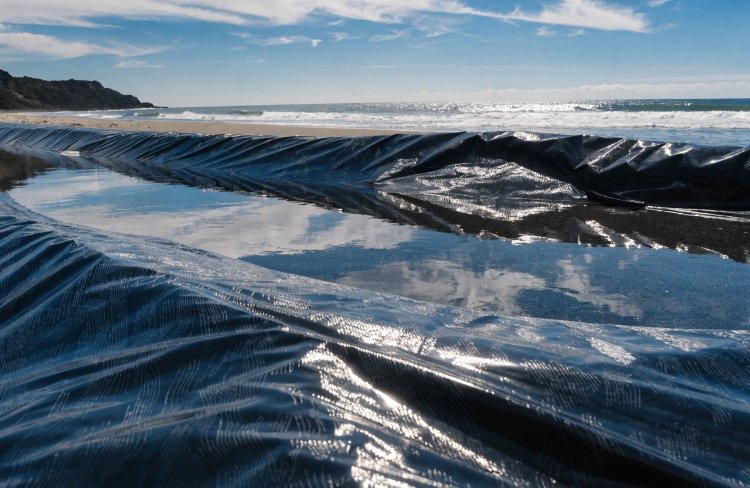
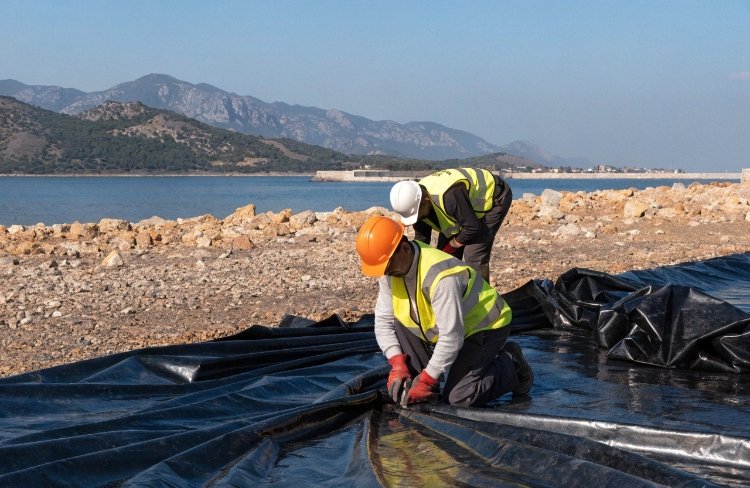
This is a massive headache for field engineers. If a contractor unrolls a pristine, flat sheet of geomembrane at 7:00 AM, by 2:00 PM under the desert sun, that same sheet will have expanded and formed large, rolling wrinkles across the subgrade.
Wrinkles are not just an aesthetic problem; they are a severe engineering and installation risk. If a welding technician tries to run a wedge welder over a wrinkled seam, the excess plastic will fold over on itself, creating a "fish mouth." A fish mouth is a direct hole in the liner that guarantees seepage.
Conversely, when the sun goes down and the temperature drops rapidly, the liner forcefully contracts. If it was welded while fully expanded and wrinkled, it will pull so tight during the cold night that it can act like a trampoline, pulling out of the anchor trenches or snapping the fresh welds entirely. Controlling these thermal dimension changes is the hardest part of installing a hot-climate reservoir.
Risk, Limitations, and The Combined Effect: UV + Heat
Here, I must be completely clear about the limitations of standard exposed geomembranes. Heat alone degrades plastic, and UV rays alone destroy molecular bonds. But when you combine them, the effect is synergistic. Heat acts as a catalyst, exponentially accelerating UV degradation.
When is exposed HDPE NOT recommended?
If you are designing an evaporation pond, brine basin, or emergency overflow reservoir in a desert environment that will sit empty and dry for most of the year, standard 1.0 mm HDPE is frankly a terrible choice. Without water to act as a heat sink and cool the bottom of the liner, the entire basin will bake at 75°C daily. The thermal cycling will cause massive wrinkles every afternoon and severe tension every night. The combination of peak UV and peak heat will burn through standard antioxidant packages in a fraction of their normal lifespan.
In these extreme scenarios, you must accept the trade-offs of a different approach. You either need to upgrade to a specially formulated high-temperature resin, or you must legally mandate a protective soil or water cover. Leaving standard geomembranes exposed in dry, extreme-heat conditions without water cooling guarantees premature failure.
Design Considerations for Hot Climates
To combat high-temperature failure, we do not just ship standard material and hope for the best. Good engineering requires adapting the material specifications and the installation methods to the environment.
1. Specify High-OIT Materials
Standard GRI-GM13 material requires a Standard OIT (Oxidation Induction Time) of 100 minutes. For extreme heat projects, I strongly advise B2B buyers to request High-OIT formulations. We add specialized, heat-resistant antioxidant packages that push the HP-OIT (High-Pressure OIT) to over 400 minutes minimum. This creates a massive chemical buffer against thermal aging.
2. Increase Material Thickness
In hot climates, thickness is your fail-safe. A 1.0 mm liner will soften and creep much faster than a 1.5 mm liner. Thicker materials have a higher thermal mass, meaning they do not heat up quite as fast, and they contain more total antioxidants to resist thermal oxidation. Upgrading from 1.5 mm to 2.0 mm (80 mil) is standard practice for exposed desert slopes.
3. Modify Installation Timing
You cannot weld hot, aggressively expanding plastic. In high-temperature regions, we advise contractors to restrict their welding windows. Deploy the liner during the day, but only perform wedge welding and extrusion welding in the early morning or late evening when the material has contracted and is lying relatively flat against the subgrade.
| Design Parameter | Standard Climate | High-Temperature Climate | Practical Field Notes |
|---|---|---|---|
| Espessura do Material | 1.0 mm – 1.5 mm | 1.5 mm – 2.0 mm | Thicker liners resist heat creep on slopes. |
| OIT Specification | Standard OIT | High-Pressure OIT | Essential for long-term thermal oxidation defense. |
| Welding Window | All day | Early morning / Late evening | Prevents welding over massive thermal wrinkles. |
Case Scenarios: Supplying to Extreme Hot Climates
Over the years, we have exported thousands of tons of geomembranes. The shipping destination dictates the technical advice we provide. Here is how high-temperature environments dictate totally different purchasing decisions.
The Middle East (UAE, Saudi Arabia, Oman)
For desalination brine ponds and municipal water storage in the Gulf, ambient temperatures exceed 45°C in summer. Buyers here rarely use anything thinner than 2.0 mm HDPE. Furthermore, because of the bright, blinding sun, installers often request white-surfaced geomembranes. A thin white co-extruded layer on top of the black HDPE reflects the sun's energy, dropping the surface temperature of the liner by up to 20°C, drastically reducing thermal wrinkles and worker fatigue.
Australia (Mining Sector)
Australian mining projects feature severe heat combined with brutal UV indexes. For tailings and evaporation ponds in the Outback, clients demand strict High-OIT testing certs before we even load the containers. Because these reservoirs often sit partially empty, the exposed drawdown zones undergo intense thermal cycling. We often recommend adding a heavy geotextile cushion below the liner to prevent the softened plastic from being punctured by sharp local subgrade rock under the heavy weight of the water.
Africa (Equatorial Agriculture)
In agricultural reservoir projects in Kenya or Nigeria, the budgets are usually tighter. While a 2.0 mm High-OIT liner is ideal, it is often unaffordable for private farms. In these high-heat scenarios, we advise buyers to purchase a standard 1.5 mm liner but strictly mandate that the slopes be backfilled with soil. By burying the liner, we use the earth as a natural temperature regulator, keeping the HDPE cool and completely eliminating the threat of UV-catalyzed thermal oxidation.
Conclusão
High temperatures do more than test the patience of an installation crew; they actively degrade the physical properties and the chemical lifespan of an open water storage liner. By anticipating thermal expansion, specifying high-OIT and appropriately thick materials, and controlling your welding schedules, you can mitigate the harsh effects of extreme heat.
If you are planning a reservoir in a desert or tropical region, do not rely on standard specifications meant for mild climates. Request liner recommendations for high-temperature environments from Waterproof Specialist today. We will analyze your site conditions and provide the exact material formulations required to keep your project secure for decades.