

Choosing between two similar-looking fabrics can feel trivial, but making the wrong choice can lead to complete project failure. Use a lightweight landscape fabric where an engineered geotextile is needed, and you could face a collapsing retaining wall. Use a heavy-duty geotextile in a garden bed, and you might suffocate your plants.
This guide provides a definitive comparison between geotextile and landscape fabric, often called a weed barrier or weed mat. We'll break down the key differences in material, strength, and function, explore the ideal uses for each, and help you select the right material to ensure your project is a long-term success, not a costly mistake.
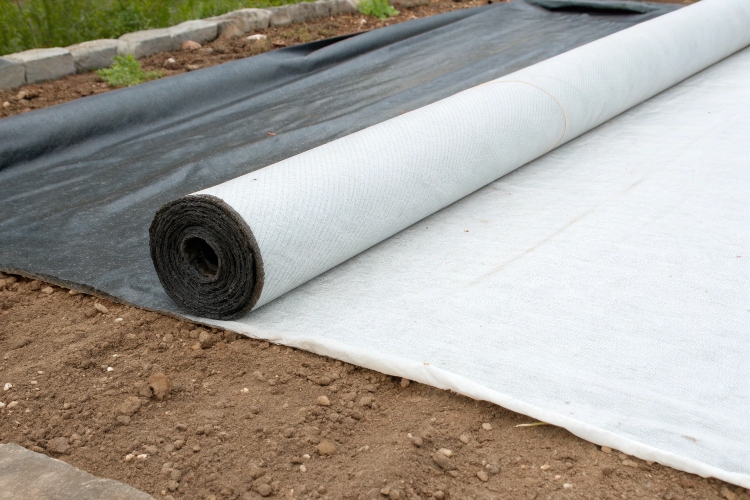
Let's begin by defining what each of these engineered materials is designed to do, starting with the heavy-duty option.
What Is a Geotextile Fabric?
A geotextile is a high-performance engineering material designed for use in civil and environmental construction projects. It is not intended for simple gardening. Its primary purpose is to improve soil stability and manage water. Geotextiles are typically made from robust synthetic polymers like polypropylene or polyester and are manufactured in two main types, each with a distinct purpose.
Woven vs. Nonwoven Geotextiles
- Woven Geotextiles: These are manufactured by interlacing polymer tapes, creating a stiff, strong sheet with high tensile strength but relatively low water permeability. They are primarily used for separation (keeping a gravel road base from mixing with the soft subgrade below) and reforço (adding strength to steep slopes or retaining walls).
- Nonwoven Geotextiles: These are made by needle-punching or heat-bonding fibers together, creating a thick, felt-like fabric. They are highly permeable and are engineered for filtration (letting water pass through while holding back soil particles), drenagem, e cushioning (protecting a geomembrane liner from punctures).
The main takeaway is that geotextiles are a crucial structural component in construction, designed to last for decades while buried under heavy loads.
What Is a Landscape Fabric (Weed Barrier)?
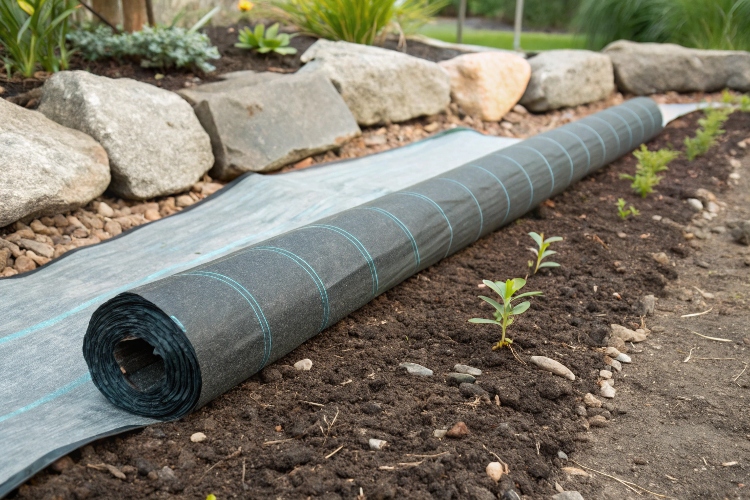
Landscape fabric is a thin, lightweight material designed specifically for gardening and landscaping applications. While it shares a similar material base (polypropylene), it is not engineered for structural loads. You will often hear it called by other names depending on its primary use, such as weed barrier, weed mat, ou weed control fabric.
Its main function is to suppress weed growth by blocking sunlight, which prevents weed seeds from germinating. A good landscape fabric is designed to be permeable to both water and air, allowing the soil and plant roots beneath it to stay healthy. It is typically used in flower beds, under decorative rock or mulch paths, and around trees and shrubs. While it provides a minor separation function, it does not have the strength or durability to handle anything more demanding than foot traffic. Its lifespan is also considerably shorter, typically lasting 5-10 years before it needs replacement due to UV degradation or clogging.
Geotextile vs Landscape Fabric: A Detailed Comparison Table
So, is geotextile the same as landscape fabric? The answer is a definitive no. They are engineered for completely different worlds. This table breaks down the critical differences.
| Recurso | Geotextile Fabric | Landscape Fabric / Weed Barrier / Weed Mat |
|---|---|---|
| Função Primária | Engineering: Separation, Filtration, Reinforcement, Drainage, Cushioning | Landscaping: Weed suppression, moisture retention, light separation |
| Material Composition | Heavy-duty virgin polypropylene or polyester | Lightweight polypropylene or polyester, often with UV inhibitors |
| Grossura & Strength | High tensile strength (100–500 g/m²), designed to bear heavy structural loads | Low tensile strength (80–150 g/m²), designed for foot traffic at most |
| Permeability | Engineered for specific flow rates (high for drainage, low for reinforcement) | Moderate permeability for water/air, but can clog with fine soil over time |
| Durability & Lifespan | 25 to 50+ years, even when buried under heavy loads | 5 to 10 years, degrades with UV exposure and soil contact |
| Primary Cost | Higher initial cost ($1.00 – $5.00+ per sq. ft.) | Lower initial cost ($0.50 – $2.00 per sq. ft.) |
| Best Use Scenarios | Roads, retaining walls, French drains, erosion control, landfill liners | Garden beds, under mulch or gravel paths, around trees and shrubs |
When Should You Use Geotextile Fabric Instead of Landscape Fabric?
You must use a geotextile whenever the project involves structural integrity, heavy loads, or critical water management. Using landscape fabric in these scenarios is not a cost-saving measure; it is a guarantee of failure.
Key Applications for Geotextiles:
- Roads and Driveways: A woven geotextile placed between the native soil and the gravel base separates the layers, preventing the gravel from sinking into the mud. This maintains the structural integrity and extends the life of the road.
- French Drains and Drainage Systems: A nonwoven geotextile is used to wrap perforated pipes and drainage gravel. It allows groundwater to enter the drain freely but stops sand and silt from clogging the system, ensuring it functions for years.
- Muros de contenção: Woven geotextiles are layered within the backfill behind a retaining wall to reinforce the soil, increasing its strength and preventing slope failure.
- Controle de Erosão: On steep slopes or shorelines, geotextiles are used to hold soil in place, preventing it from being washed away by rain or wave action while allowing vegetation to establish.
In short, if the fabric needs to hold something up, hold something back, or ensure water can flow without clogging, you need a geotextile.
When Is Landscape Fabric a Better Choice?
Landscape fabric is the correct and more cost-effective choice for surface-level, non-structural landscaping projects where the primary goal is weed control. Its design supports plant health while reducing garden maintenance.
Key Applications for Landscape Fabric:
- Garden and Flower Beds: Laying down landscape fabric and cutting holes for your plants before adding mulch on top is an effective way to keep weeds from competing for water and nutrients.
- Under Pathways: For gravel or decorative stone pathways, landscape fabric prevents the stones from sinking into the soil and stops weeds from growing through the path.
- Around Trees and Shrubs: It helps maintain a clean, weed-free area around the base of trees, protecting them from damage from lawnmowers or string trimmers.
One common question is, what's better than landscape fabric for weed control? For gardeners who prefer organic methods, alternatives like a thick layer of cardboard or wood chips can also be effective, but they decompose much faster. For long-term, low-maintenance weed suppression, a quality landscape fabric is a reliable choice.
Geotextile vs Landscape Fabric: Cost and Lifespan
When comparing costs, it's crucial to think about the total cost of ownership, not just the price per square foot.
Landscape fabric is significantly cheaper upfront, but its 5–10 year lifespan means it is a recurring expense for any long-term landscape. It will eventually need to be pulled up and replaced as it clogs, tears, or degrades.
Geotextile has a much higher initial cost due to its advanced engineering, thicker material, and robust properties. However, in its intended applications, it is a permanent solution. A geotextile installed under a driveway is designed to last for the life of the driveway itself (30+ years). The cost of not using a geotextile in a structural project—which could involve a complete rebuild—is infinitely higher than the initial material investment. Trying to save money by using landscape fabric for a structural job will always cost more in the long run.
Common Mistakes to Avoid When Choosing Between Them
Making the right choice comes down to understanding the application. Here are the most common errors we see:
- Using Landscape Fabric for Drainage: This is a critical mistake. Landscape fabric is not designed for subsurface filtration. In a French drain, it will quickly clog with fine silt, turning your drainage system into an underground dam.
- Using Geotextile in a Vegetable Garden: Can geotextile be used for weed control? Yes, its physical barrier will block weeds. However, it's a poor choice for a garden. It is extremely expensive for this purpose, and a heavy-duty woven geotextile may not allow enough water or air exchange, harming soil health. While a nonwoven geotextile can work, it's still over-engineered for the task.
- Choosing Based on Color or Feel: A thick, white nonwoven geotextile may feel similar to a thick landscape fabric, but its internal structure is engineered for filtration under load. A thin black fabric might be a durable, UV-stabilized landscape fabric or a low-grade material that will fall apart in one season. You must choose based on the manufacturer's technical data sheet, not appearance.
Final Verdict: Which Fabric Is Right for You?
The choice is simple when you define your project's primary goal. These two materials are not in competition; they are designed for completely different jobs.
-
Choose a Geotextile if your project involves:
- Supporting heavy loads (roads, driveways, foundations).
- Reinforcing soil (retaining walls, steep slopes).
- Critical subsurface drainage and filtration.
- Long-term erosion control.
-
Choose a Landscape Fabric (Weed Barrier) if your project involves:
- Suppressing weeds in garden beds or flower beds.
- Creating a stable base for mulch or gravel paths.
- Reducing landscape maintenance around trees and shrubs.
By matching the product's engineered purpose to your application's demands, you ensure performance, safety, and long-term value.