

A specified geotextile can look perfect on paper but fail prematurely on site. This happens when hidden factors—from UV exposure to soil chemistry—are ignored, turning a long-term infrastructure investment into a short-term liability. Understanding what truly determines a geotextile's lifespan is critical for project success.
This guide provides a comprehensive breakdown of the key factors that control the actual service life of geotextiles. We will explore how material composition, environmental exposure, mechanical stress, and installation practices interact, giving you the practical knowledge to select and protect your materials for maximum longevity and performance.

Before we can analyze the service life of a geotextile, we must first be clear about its job. Its expected lifespan is directly tied to the function it is designed to perform, which can range from temporary erosion control to permanent structural reinforcement.
Functional Role and Lifespan Expectations of Geotextiles
A geotextile's "service life" is defined as the period during which it continues to perform its intended engineering function effectively. This is a crucial distinction, as a fabric may physically exist in the ground long after it has ceased to be useful. The primary functions—separation, filtration, drainage, and reinforcement—each come with different performance demands and, therefore, different lifespan expectations.
For example, a lightweight nonwoven geotextile used for temporary erosion control on a construction slope may only need to function for one or two seasons until vegetation is established. In contrast, a high-strength woven geotextile used to reinforce the base of a highway is a permanent structural component expected to perform for 50 to 100 years or more. As a supplier, we always begin a consultation by asking about the application. This allows us to align the material's inherent durability with the project's required design life, ensuring you don't pay for 50 years of performance when you only need five, or vice-versa.
1. Material Composition and Polymer Degradation Mechanisms
The foundation of a geotextile's durability is its base polymer. The two most common materials used are Polyester (PET) and Polypropylene (PP), each with distinct properties that make them suitable for different applications and service lives.
Polyester (PET)
PET is known for its excellent long-term performance, particularly in reinforcement applications. Its key advantages are high tensile strength, superior resistance to UV degradation, and low creep (the tendency to deform slowly under a constant load). When properly specified with UV stabilizers, an exposed PET geotextile can have a service life of 5-8 years. When buried in soil or placed underwater, away from direct sunlight, its service life can easily extend beyond 50 years.
Polypropylene (PP)
PP is a versatile and cost-effective polymer known for its exceptional chemical resistance across a wide pH range. This makes it an excellent choice for separation and filtration in most soil environments. However, its primary weakness is its poor resistance to UV radiation. Unprotected PP can lose a significant portion of its strength within a few months of sun exposure. For this reason, PP geotextiles are almost exclusively used in buried applications where their service life can be substantial. Additives, such as carbon black (typically at 2-3%), are essential for providing UV protection during the construction and installation phases.
2. Environmental Exposure: UV Radiation, Temperature, and Moisture Effects
Once installed, a geotextile is in a constant battle with its surrounding environment. The intensity of this battle, and the geotextile's ability to withstand it, is a primary determinant of its functional lifespan.
UV Radiation
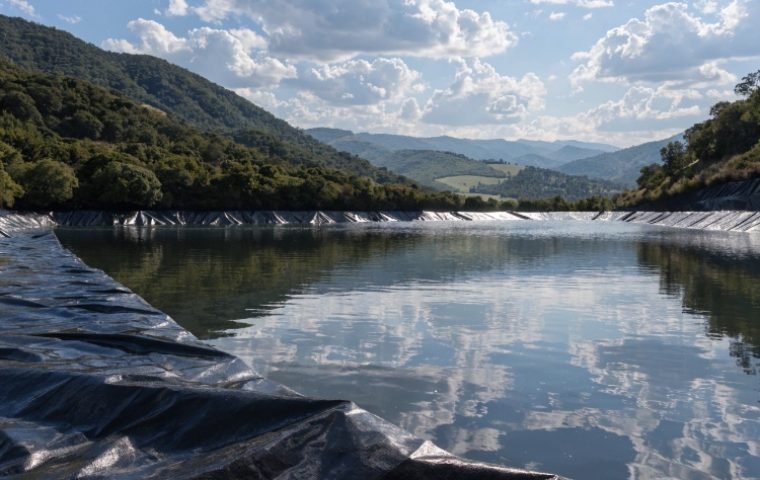
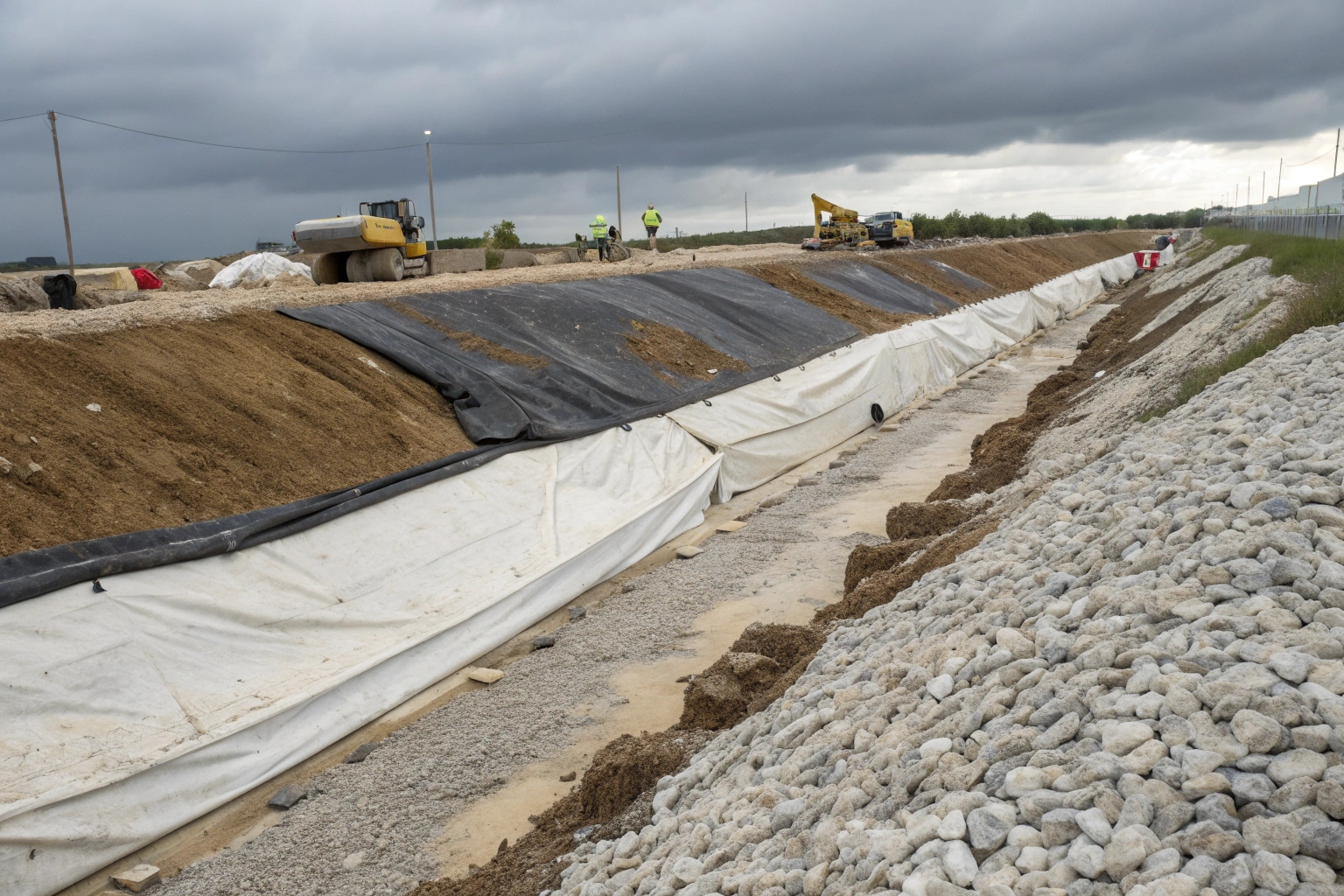
For any exposed or partially exposed geotextile, ultraviolet (UV) radiation is the single most destructive factor. UV rays break down the polymer chains that give the fabric its strength, a process called photodegradation. Without adequate UV stabilization, a geotextile's strength can plummet in a matter of weeks. The addition of stabilizers like carbon black can increase UV resistance dramatically, but the best defense is always to minimize exposure by covering the geotextile with soil, gravel, or another protective layer as soon as possible.
Temperature
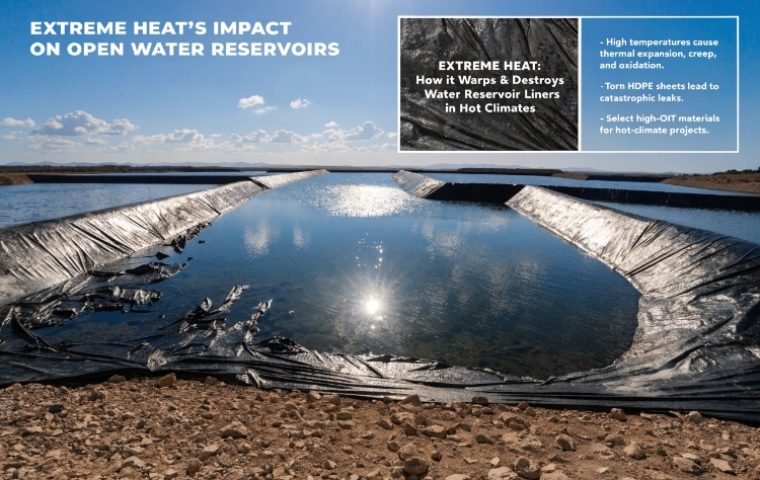
High temperatures accelerate the rate of chemical degradation, particularly oxidation, which makes the polymer brittle. We've seen data showing that a geotextile's strength decay rate at 60°C can be three times faster than at 25°C. In colder climates, freeze-thaw cycles present a different challenge. Water trapped within the fabric's structure can freeze, expand, and create micro-cracks, leading to a gradual loss of strength. After 100 freeze-thaw cycles, a geotextile can lose 10-30% of its initial strength.
Moisture
The effect of moisture depends on the polymer. PET can be susceptible to hydrolysis (degradation from reaction with water) in highly alkaline environments (pH > 10). PP, on the other hand, is highly resistant to hydrolysis, making it a reliable choice for saturated conditions.
3. Mechanical Stresses: Installation Damage, Puncture, and Abrasion
A geotextile can be perfectly specified for its environment but fail because it doesn't survive the construction process. Mechanical stresses, especially during installation, are a major threat to long-term performance.
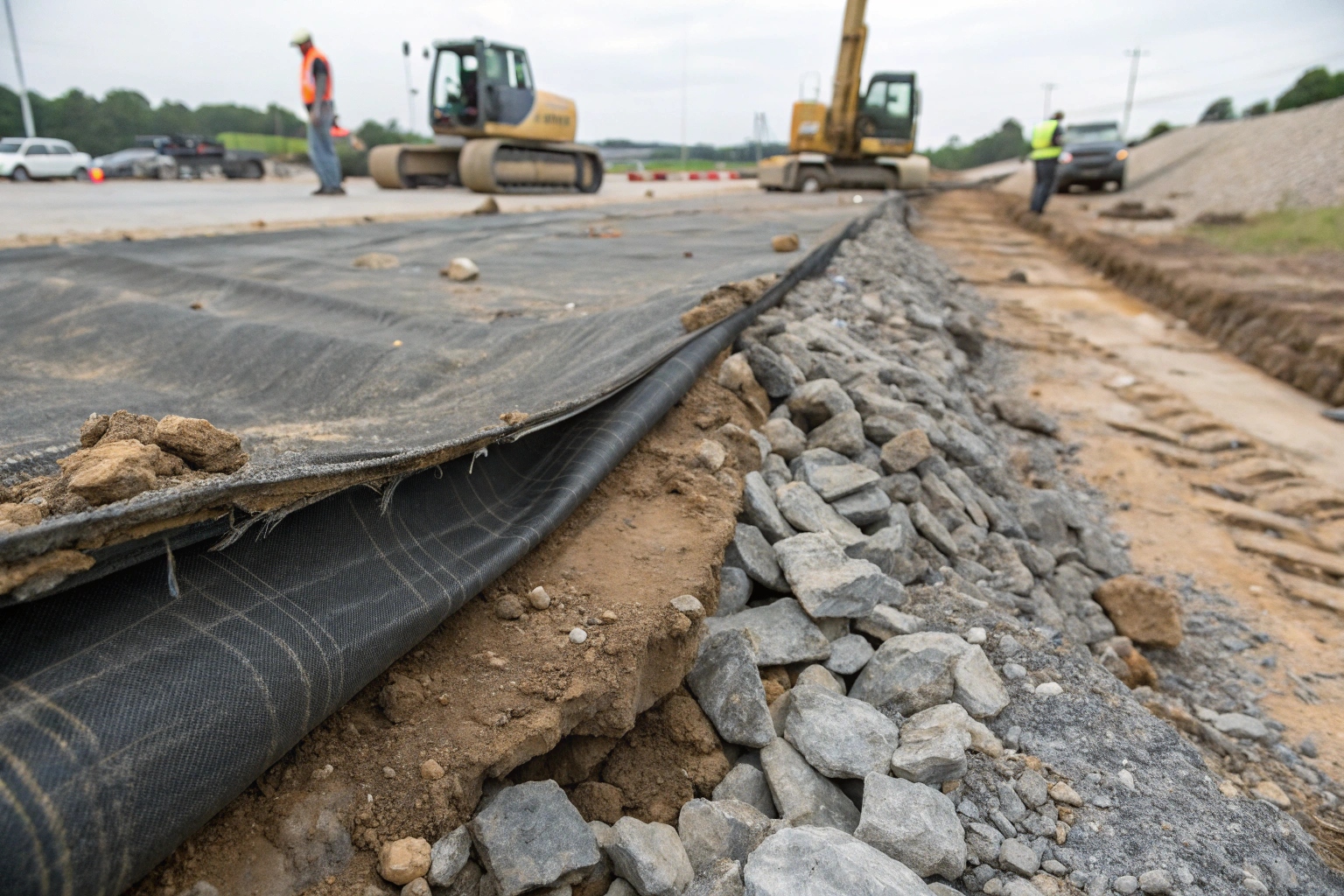
The most common issue we see is installation damage. Dropping sharp rocks, driving tracked vehicles directly on the fabric, or laying it over an unprepared subgrade full of sharp stones can cause punctures and tears. Every one of these damage points becomes a weakness where stress can concentrate, potentially leading to a larger failure over time. For example, a sharp fold or crease can reduce the local tensile strength by over 50%.
Once installed, the geotextile must withstand ongoing mechanical stresses. In separation applications under roads, the repeated pressure from vehicle traffic can cause abrasion against aggregate particles. In reinforcement applications, the fabric is placed under a constant tensile load, which requires it to have good long-term creep resistance to prevent deformation. The design must account for these loads to ensure the fabric retains sufficient strength for its entire service life.
4. Chemical and Biological Degradation in Different Soil Environments
The ground is a complex chemical and biological reactor, and its properties can have a significant impact on a geotextile's longevity.
Chemical Degradation
Soil pH is a critical factor. Most soils are relatively neutral (pH 6-8), where both PP and PET are very stable. However, in industrial waste sites or certain natural soil deposits, conditions can be highly acidic or alkaline. In these aggressive environments (e.g., pH < 3 or pH > 10), the rate of polymer degradation can increase significantly, potentially cutting the service life in half if the wrong material is chosen. As noted, PP generally offers broader chemical resistance than PET, especially against alkaline hydrolysis.
Biological Degradation
One of the great advantages of synthetic geotextiles is that they are not a food source for microorganisms. They are essentially inert to biological decay, unlike natural fiber geotextiles (like coir or jute) which are designed to biodegrade. The primary biological threat comes from plant roots. While they don't "eat" the fabric, vigorous roots can and will penetrate nonwoven geotextiles, potentially compromising their filtration function or creating tears over time.
5. Impact of Design, Overlap, and Cover Protection on Longevity
A high-quality material can still fail if the system it's part of is poorly designed or installed. The details of how a geotextile is incorporated into a project are just as important as the material itself.
Proper overlaps and seams are non-negotiable. If adjacent panels are not overlapped correctly (typically 30-50 cm, depending on the application), a gap can form under stress, allowing soil to pass through and undermining the separation or filtration function. For critical applications, panels should be sewn or thermally bonded to ensure a continuous, strong connection.
However, the most important strategy for maximizing service life is providing adequate cover protection. Promptly burying a geotextile is the single most effective way to protect it from its worst enemies: UV radiation and mechanical damage. Based on project data, a geotextile that is backfilled within 24 hours of being laid can have a 20% longer service life than one left exposed for an extended period. The cover material (soil, sand, or aggregate) acts as a permanent shield, allowing the geotextile to focus on its intended engineering job for decades.

6. Quality Control, Testing Standards, and Certification Requirements
The theoretical service life of a geotextile is meaningless if the product delivered to your site does not meet the specified quality standards. As a supplier, we place immense emphasis on quality control because it is the guarantee that the material will have the properties needed to last.
Key quality indicators include the use of 100% virgin polymer resin, as recycled content can introduce inconsistencies that compromise long-term performance. The manufacturing process itself is also critical; the fabric must have a uniform weight and thickness, and any additives like UV stabilizers must be evenly dispersed.
Reputable manufacturers adhere to international testing standards, such as those from ASTM or ISO. These standards provide a common language to define properties like tensile strength (ASTM D4595), puncture resistance (ASTM D4833), and UV resistance (ASTM D4355). When you receive a material certificate, it should show that the product meets or exceeds these standardized values. This documentation is your assurance that you are getting a durable material capable of achieving its designed service life.
Strategies to Extend Geotextile Service Life Through Proper Design and Maintenance
Maximizing the return on your investment in geotextiles comes down to a holistic approach that integrates smart choices at every stage of the project. Here are the key strategies we recommend to our clients:
During Design and Specification
- Match the Polymer to the Application: Specify PET for long-term, high-load reinforcement. Choose PP for general separation, filtration, and applications requiring high chemical resistance.
- Specify for the Environment: If the geotextile will be exposed, even temporarily, ensure it has a robust UV stabilization package.
- Don't Underspecify Strength: Use appropriate reduction factors to account for potential installation damage, creep, and degradation to ensure the geotextile's long-term design strength is sufficient.
During Installation
- Prepare the Subgrade: Remove sharp rocks, stumps, and debris to minimize the risk of punctures.
- Handle with Care: Do not drag rolls or drop them from height. Use appropriate equipment for placement.
- Cover Promptly: Minimize the time the geotextile is exposed to sunlight. Plan your work sequence to allow for backfilling as soon as practical.
Post-Installation
- Conduct Regular Inspections: For any permanent exposed applications (e.g., under riprap), periodically check for signs of damage or degradation.
- Perform Repairs: If damage is found, repair it with patches or by replacing the section to prevent the problem from worsening.
Conclusão
The service life of a geotextile is not a single number on a data sheet. It is the outcome of a complex interplay between material science, environmental conditions, mechanical stresses, and construction quality. By understanding these factors, you can move beyond simply specifying a product to designing a robust system, ensuring that your geotextile performs its critical function reliably for its entire intended design life.