

You're reviewing a geomembrane spec sheet, but it's filled with confusing acronyms like GRI-GM13 and ASTM D5397. Choosing the wrong material based on a misunderstanding could lead to catastrophic leaks, environmental damage, and costly project overruns.
The most crucial standards are from the Geosynthetic Research Institute (GRI), especially GRI-GM13 for HDPE, and ASTM International. These define the minimum physical, mechanical, and endurance properties a geomembrane must meet. ISO provides broader durability guidelines and international context.
 "Geomembrane Quality Testing in a Laboratory")
As a geosynthetics supplier, I live and breathe these standards every day. They are not just numbers on a page; they are the language of quality and trust in our industry. They provide a clear, objective benchmark to ensure the material you buy is fit for purpose and will perform for its entire design life. Let’s break down what they mean for you.
What are the key ASTM, GRI, and ISO standards that define geomembrane quality requirements?
You're comparing two suppliers. One claims their product is "high quality," while the other provides a data sheet citing GRI-GM13 and various ASTM test methods. It's impossible to make a sound decision without a common benchmark for comparison.
The key standard for HDPE geomembranes is GRI-GM13, which acts as a master specification. It references specific ASTM International test methods for each property. ISO standards offer complementary guidelines, especially on long-term durability and testing principles.
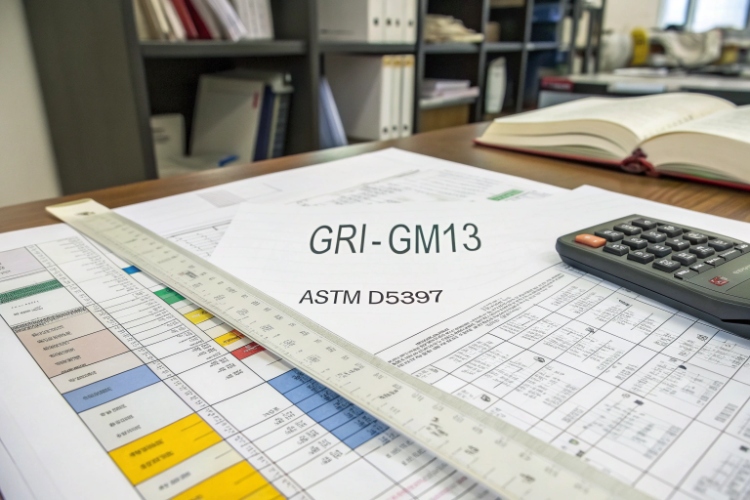
These three bodies work together to create a comprehensive quality framework. From my perspective as a supplier, here’s how they fit together:
| Standard Body | Role & Key Standard Example | What It Tells You As a Buyer |
|---|---|---|
| GRI (Geosynthetic Research Institute) | Sets comprehensive product specifications. Example: GRI-GM13 for HDPE. | Defines the minimum acceptable values for a specific geomembrane. Think of it as the primary pass/fail checklist for strength, durability, and aging resistance. |
| ASTM International | Creates the specific test methods. Example: ASTM D6693 for tensile testing. | This specifies how to perform the test—the equipment, procedure, and calculations. GRI-GM13 tells you the required strength; ASTM tells you how to measure it correctly. |
| ISO (International Organization for Standardization) | Provides broad, international frameworks. Example: ISO 13822 for durability. | ISO offers principles for assessing long-term performance and aging. It also ensures harmony with other international standards, like EN 13361 in Europe or GB/T 17643 in China. |
In short, GRI sets the target, ASTM provides the measuring tape, and ISO helps ensure a globally understood approach to quality and durability.
What performance parameters are specified in standards like GRI-GM13?
A spec sheet lists "Tensile Strength: 24 N/mm" and "Standard OIT: 100 min." These numbers are meaningless without context. You need to know what they actually measure and why they matter for your landfill, pond, or mining project.
GRI-GM13 specifies parameters that measure strength (tensile, puncture), long-term durability (stress crack resistance), and resistance to aging (Oxidative Induction Time - OIT). Each test directly relates to how the geomembrane will perform both during installation and over decades of service.

When I review a test report for a client, I focus on these critical properties. They tell the real story of the material's quality.
| Performance Parameter | ASTM Test Method | Why It Matters for Your Project | Typical GRI-GM13 Value (1.5mm HDPE) |
|---|---|---|---|
| Resistência à tracção | D6693 | Measures the force to pull the sheet apart. High tensile strength is essential for handling stresses during installation and resisting ground settlement. | 24 N/mm |
| Resistência à perfuração | D4833 | Simulates a stone or sharp object pushing against the liner. This is critical for protecting the liner from damage during installation on the subgrade. | 480 N |
| Resistência a fissuras por estresse | D5397 | Measures resistance to slow crack growth while under long-term stress. This is a key indicator of high-quality polymer and long-term durability. | > 500 hours |
| Tempo de Indução Oxidativa (OIT) | D3895 | Measures the antioxidant "fuel tank." This is the primary indicator of how long the geomembrane will resist degradation from heat and oxygen (aging). | > 100 minutes |
These values aren't arbitrary. They are the result of decades of research and fieldwork, designed to ensure the material can withstand real-world conditions.
How are laboratory and field tests conducted to verify geomembrane compliance?
The geomembrane passed all the lab tests and the MQC certificate looks perfect. But now it is on your site, and an installer's poor welding technique is creating weak seams. A quality product can be ruined by poor installation.
Compliance is verified in two stages. First, Manufacturing Quality Control (MQC) happens at the factory. Second, Construction Quality Assurance (CQA) happens on-site, focusing on verifying the integrity of seams with non-destructive and destructive tests.
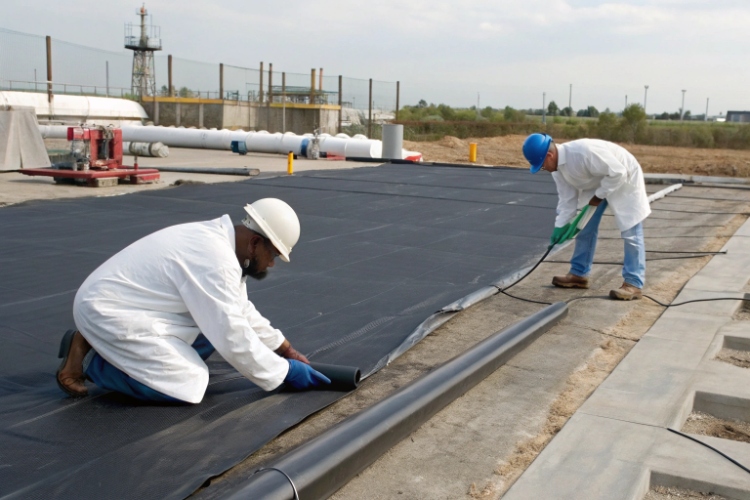
A complete quality plan covers the material from factory to final installation.
-
Manufacturing Quality Control (MQC)
This is our responsibility as the manufacturer. We perform tests on the geomembrane rolls at specified frequencies (e.g., for every 100,000 lbs of resin) to ensure they meet the project standard, like GRI-GM13. We provide these MQC certificates with every shipment. It’s the first link in the chain of quality. -
Construction Quality Assurance (CQA)
This is done on-site by the installation contractor and a third-party inspector. It is just as critical as MQC.- Non-Destructive Testing (NDT): This is used to test 100% of the field seams without damaging them. Common methods include the air channel test (for dual fusion welds) and the vacuum box test (for extrusion welds). If a test fails, the area is located and repaired.
- Destructive Testing (DT): A small sample is cut from the actual seam (e.g., one every 500 feet). The sample is tested on-site with a portable tensiometer to measure its strength in peel and shear. The goal is to achieve a "Film Tear Bond" (FTB), where the geomembrane sheet itself tears before the weld separates. This proves the weld is stronger than the parent material.
How can quality engineers ensure geomembranes meet international specifications?
You are responsible for signing off on a multi-million dollar containment project. A mistake in verifying the material or installation could have serious professional and financial consequences. You need a reliable, step-by-step process to ensure compliance.
Engineers can ensure compliance by demanding a complete documentation package and executing a rigorous CQA plan. This includes verifying MQC reports against roll numbers, reviewing welder and lab certifications, and systematically auditing on-site testing records.

Here is the checklist I recommend to the quality engineers I work with:
-
Demand Full MQC Reports
Don't accept just a summary. Request the full Manufacturing Quality Control (MQC) data for the specific batch and rolls being delivered to your site. Cross-reference the roll numbers and check that every value meets or exceeds the project specification (e.g., GRI-GM13). -
Review the Contractor's CQA Plan
Before any liner is unrolled, review the installer's CQA plan. It must detail the testing methods, the frequency of destructive tests, the procedure for all NDT, and how repairs and test failures will be handled and documented. -
Verify Certifications
Check that the field welders are certified and experienced. Also, confirm that any third-party testing laboratory is accredited (e.g., to ISO 17025) to perform the required geosynthetic tests. -
Audit the Final Documentation
At the end of the project, you should receive a complete quality assurance report. This must include panel layout drawings, MQC certificates for every roll, all NDT and DT results, and a log of every repair. This package provides a permanent record of quality.
Conclusão
Geomembrane standards like GRI-GM13 and ASTM test methods are the universal language of quality. They ensure that projects are built safely, reliably, and with materials proven to last.