

In the high-stakes world of infrastructure tendering, Geocell systems are rarely selected based on brand loyalty. They are selected based on compliance.
Whether for a highway embankment in Southeast Asia or a mining slope in South America, the tender document is the law. If a supplier fails to prove compliance with a single technical clause—be it seam peel strength or carbon black dispersion—they are disqualified.
This guide analyzes the critical technical requirements found in modern infrastructure tenders for geocell systems. It explains what these clauses mean, why engineers specify them, and how procurement teams can verify compliance to avoid site rejection.

Most engineers and procurement officers treat these specifications as a simple checklist. However, understanding the intent behind each parameter is crucial for risk management. A compliant datasheet does not always guarantee a functional product if the testing standards or manufacturing consistency are misunderstood.
2. Typical Technical Clauses Found in Geocell Tender Specifications
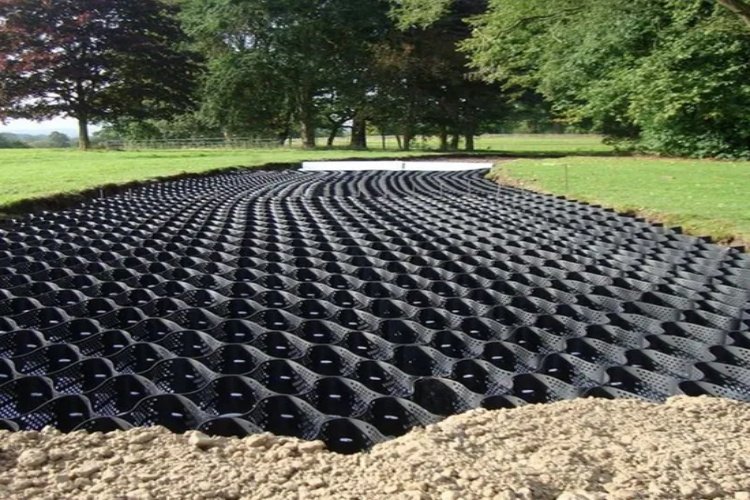
When you open a tender package for a Cellular Confinement System (Geocell), you are not just looking for "plastic honeycombs." You are looking for a defined engineering system.
Based on my experience analyzing hundreds of tender documents, technical specifications generally fall into three categories:
- Mechanical Performance: How strong is the system? (Tensile strength, Seam strength).
- Material Durability: How long will it last? (Resin density, Carbon black, ESCR).
- Dimensional Accuracy: Will it fit? (Cell depth, Expanded size, Wall thickness).
These clauses are not independent variables. For example, a manufacturer can easily increase wall thickness to meet a tensile strength requirement, but if they use low-quality recycled resin, the Environmental Stress Crack Resistance (ESCR) will fail.
A robust tender specification is designed to filter out manufacturers who cannot balance these competing properties.
3. Minimum Welding Strength: A Critical Structural Requirement
Of all the parameters in a tender, Resistência ao descascamento da costura is the most critical. It is the number one reason for product rejection during factory acceptance tests (FAT).
3.1 Why Welding Strength Is Always Specified
The geocell functions as a coherent mattress. This functions relies entirely on the thousands of ultrasonic welds connecting the HDPE strips. If a single row of welds fails, the confinement is lost, and the entire system unzips.
Tenders specify this because installation puts massive stress on these seams. When crews expand the sections and stake them out, or when an excavator dumps tons of stone infill, the seams act as the primary load-bearing points.
3.2 Common Minimum Values in Tenders
You will typically see wording like this:
"The seam peel strength shall be ≥ 1420 N for a 100mm cell depth, tested in accordance with ISO 13426-1 or ASTM D4437."
The "Minimum" vs. "Average" Armadilha:
Strict infrastructure tenders (especially for government highways) will specify a Minimum Average Roll Value (MARV) or a strict minimum.
- Weak Specification: "Average seam strength 1400N." (This allows some welds to be 800N as long as others are 2000N).
- Strong Specification: "Minimum seam strength 1400N." (This ensures every tested weld holds the load).
3.3 Practical Implications for Suppliers
To meet a strict "Minimum" requirement, the manufacturer must have precise ultrasonic welding calibration. A "cold weld"—where the plastic didn't fuse deeply enough—will snap instantly during peel testing.
As a supplier, I ensure my production line monitors the dwell time and pressure of the ultrasonic horn for every batch. If a tender requires high seam strength, we often have to adjust the welding parameters specifically for that order, rather than using a standard "stock" setting.

4. Carbon Black Content: Durability and UV Resistance Considerations
While seam strength dictates whether the geocell works today, Carbon Black content dictates whether it will work ten years from now.
4.1 Why Carbon Black Is Specified in Geocell Tenders
High-Density Polyethylene (HDPE) is naturally sensitive to Ultraviolet (UV) radiation. Without protection, sunlight breaks down the polymer chains, causing the plastic to become brittle and crack within months.
Carbon black is added to the resin as a UV stabilizer. It absorbs the UV radiation before it can attack the polymer bond.
4.2 Typical Carbon Black Ranges
Almost every rigorous tender I see specifies:
"Carbon Black Content: 1.5% to 2.5% (by weight)."
Why this specific range?
- < 1.5%: Insufficient protection. The material will degrade prematurely.
- > 3.0%: The plastic becomes brittle. Excessive carbon black acts as a contaminant rather than a stabilizer, potentially reducing the weld strength.
4.3 What Procurement Teams Should Verify
It is not enough to just add soot. The tender should also specify Carbon Black Dispersion. Even if you have 2.5% content, if it is clumped together rather than microscopically dispersed, the protection is spotty.
We use specific compounding extruders to ensure the black masterbatch is homogenized. When reviewing test reports, always check for "Dispersion Category" (usually Cat. 1 or 2 is required).
5. Test Standards Referenced in Infrastructure Tenders
One of the most confusing aspects for buyers is the alphabet soup of testing standards. Tenders usually reference ASTM (American), ISO (International), or EN (European) standards.
5.1 Role of Test Standards
Standards ensure that we are comparing apples to apples.
For example, testing the tensile strength of a strip of plastic at a speed of 50mm/min yields a different result than testing it at 300mm/min. The standard defines the speed, the grip type, and the sample size.
5.2 Commonly Referenced Standards
- ISO 13426-1: The gold standard for Geocell Connection Strength. It simulates real-world failure modes better than generic tests.
- ASTM D4437: The standard practice for determining the integrity of field seams (often adapted for factory seams).
- ASTM D1693 / D5397: These measure Environmental Stress Crack Resistance (ESCR). This is crucial. It measures how the plastic handles stress in aggressive soil environments.
5.3 Type Tests vs. Routine Tests
A good tender distinguishes between:
- Type Tests: Comprehensive tests done once per formulation (e.g., 5000-hour durability tests).
- Routine (QC) Tests: Tests done on every batch (e.g., Dimensions, Seam Strength).
If a tender asks for a "5000-hour UV resistance test" for every batch, it shows the writer doesn't understand the timeline. That test takes 7 months! Bidders usually submit a generic Type Test report for durability and specific Batch Reports for mechanical properties.
6. Acceptance Criteria: From Factory Inspection to Site Delivery
The specifications are meaningless if nobody checks the product. The Inspection and Acceptance section of a tender dictates how the buyer verifies quality.
6.1 Factory Acceptance Requirements (FAT)
For large export projects, we often host third-party inspectors (like SGS or Bureau Veritas). The tender will define the Sampling Frequency (e.g., "Take one sample for every 10,000 sqm").
- Warning: If the tender doesn't specify sampling frequency, a shady supplier might test only the absolute best roll they produced.
6.2 Site Acceptance and Compliance Risks
Once the container arrives, the site engineer will check:
- Strip Thickness: Using a micrometer. (Common issue: The textured surface makes it look thick, but the core thickness is too thin).
- Expanded Dimensions: Does the cell opening match the drawing?
- Visual Defects: Are the welds consistent? Are there holes?
6.3 Common Reasons for Non-Acceptance
The most frequent cause of rejection I see is dimensional non-compliance.
If a tender specifies a "356mm weld spacing" and the product arrives with "445mm spacing," the cell density is lower, and the structural confinement is weaker. This is often an automatic rejection, requiring the supplier to ship the containers back at their own cost.
7. Risks and Limitations in Tender Specifications
While tenders are designed to protect the project, rigid adherence to poorly written specs can also straightforwardly cause issues.
1. The "Copy-Paste" Risk:
I often see tenders in tropical regions that copy specifications from cold-climate projects, requiring low-temperature brittleness tests that are irrelevant to the user, driving up costs unnecessarily.
2. Over-Specification:
Asking for "Virgin Resin Only" is good, but asking for extreme tensile strengths (e.g., >30 MPa) might force manufacturers to use stiffer, more brittle resins that are harder to weld. The best geocells balance flexibility with strength.
3. Ignoring System Accessories:
Many tenders possess 10 pages on the geocell plastic but zero pages on the Connectors ou Tendons. A geocell system is only as strong as the connection key that holds the panels together. If the tender ignores this, you might get a premium panel held together by cheap zip ties (which will fail).
Conclusion: Compliance as a System, Not a Single Parameter
In infrastructure tenders, technical requirements are not suggestions—they are the definition of the product.
For the engineer, writing clear clauses regarding Minimum Seam Strength, Carbon Black content, and specific Test Standards is the only way to ensure the geocell performs as designed for the next 50 years.
For the procurement team, success lies in verifying these parameters through rigorous Factory Acceptance Testing.
A compliant geocell system is built on consistency—in design, production, and testing. When evaluating bidders, look beyond the price. Look for the supplier who asks questions about the testing method and the loading conditions. That is the supplier who understands the technical reality behind the tender documents.