

In the geosynthetics industry, "Geocell" is often treated as a commodity. Buyers look at a specification sheet, see "HDPE," check the price, and place the order.
However, as a China-based manufacturer who has supplied projects ranging from desert roads in the Middle East to slope protection in rainy Southeast Asia, I can tell you that not all Geocells are created equal. The specification sheet tells you what the product should be, but the manufacturing process determines what the product actually is.
Geocell is a structural product. It relies entirely on the integrity of its material strips and, more importantly, the strength of its ultrasonic welds. If the manufacturing process is inconsistent, the cellular confinement system will burst under load.
This article takes you inside the factory floor of Especialista em Impermeabilidade. We will walk through the step-by-step production journey—from the raw polymer pellet to the finished, palletized panel—to explain how true manufacturing control lowers your project risk.
A consistent product does happen by accident. It is the result of a controlled, in-house manufacturing ecosystem.
2. Raw Material Management – Controlled Input, Consistent Output
Great cooking requires great ingredients; great manufacturing requires pristine raw materials. The biggest hidden risk in the cheap geocell market is the use of uncontrolled recycled material or "off-spec" resin.
2.1 Incoming Material Inspection
Our process begins long before the machines start running. We source Polietileno de alta densidade (HDPE) resins from Tier-1 petrochemical suppliers. We do not buy "spot market" mystery resins.
Upon arrival, every batch of resin goes through an incoming quality check (IQC). We verify:
- Density: Ensuring it meets the ≤0.94 g/cm³ standard for genuine HDPE.
- Melt Flow Index (MFI): To ensure the material will flow consistently through our extruders without degrading.
- Contamination Check: Ensuring no moisture or foreign particles are present.
2.2 Storage & Handling System
Contamination is the enemy of a strong weld. If dust or moisture gets into the resin, it creates microscopic voids in the final sheet.
We utilize a Silo-to-Hopper closed feeding system. The raw material is stored in dedicated silos and transported via pneumatic tubes directly to the extruder. This prevents the resin from ever touching the open factory floor, eliminating the risk of dust contamination that causes "weak spots" in the final product.
2.3 Batch Traceability
We assign a unique internal Lot Number to every delivery of resin and masterbatch (Carbon Black). This number travels with the material. If a client reports an issue three years later, we can trace the product back to the specific day of production and the specific batch of resin used.
3. Extrusion – Continuous Sheet Production Under Controlled Conditions
Many smaller suppliers buy ready-made HDPE sheets from third parties and simply weld them. We do not. We operate in-house extrusion lines. Vertical integration allows us to control the most critical parameter: Sheet Thickness Uniformity.
3.1 Automated Extrusion Lines
Our sheet production lines are designed for continuous operation. The HDPE resin is melted at precise temperatures (typically between 200°C and 240°C) and extruded through a flat T-die.
- Por que isso é importante: If the temperature fluctuates, the polymer chains degrade. Our lines use automated PID temperature controllers to keep heat variance within ±1°C.
3.2 In-Line Monitoring
As the sheet exits the die, it passes through a series of calendering rollers. Here, we texture the sheet (if required) and set the thickness.
We utilize automated thickness gauges that scan the sheet width continuously. If the thickness deviates from the tolerance (e.g., 1.5mm ±5%), the system alerts the operator immediately. This prevents the "thin spot" issue where a geocell strip might fail under tension.
3.3 Cooling & Winding
After sizing, the sheet travels through a cooling zone to stabilize its dimensions. It is then wound into large "mother rolls."
These rolls are tagged and moved to a quarantine zone for a 24-hour stabilization period. This allows the internal stresses in the plastic to relax before we cut it, ensuring the strips don't warp during the welding phase.
4. Perforation – Precision Processing for Structural Consistency
Once we have a high-quality HDPE sheet, we must process it into strips. Most geocell applications require specific textures and perforations to improve friction and water drainage.
4.1 Automated Perforation Equipment
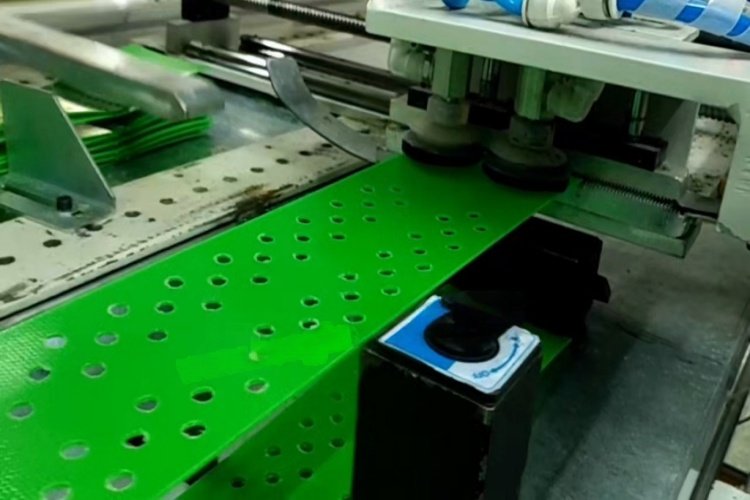
We do not use manual drilling. We use CNC-controlled perforation lines. The mother rolls are fed into the machine, which punches holes in precise patterns.
- The Engineering Logic: The holes allow water to flow horizontally through the cell system, preventing pore water pressure buildup. However, too many holes weaken the strip. Our equipment ensures the "Open Area" percentage matches the design spec exactly (usually <18%).
4.2 Mold & Pattern Management
Different projects require different connections. We maintain a library of perforation molds. Whether the client needs a standard diamond pattern or a specific hole diameter for a unique tendon system, we can swap molds in under an hour. This flexibility allows us to serve custom engineering requests without massive lead times.
4.3 Production Consistency Control
During this stage, we also slit the large rolls into the specific strip heights (e.g., 100mm, 150mm, 200mm). The cutting knives are calibrated daily. If the strip height varies, the final installed geocell surface will be uneven, making it difficult for the contractor to compact the infill material. Our tolerance is strict: ±2mm on strip height.
5. Ultrasonic Welding – The Heart of Geocell Strength
This is the most critical section of this article. A geocell is only as strong as its weld. If the weld peels, the system fails. We use Ultrasonic Welding, not thermal heating or glue.
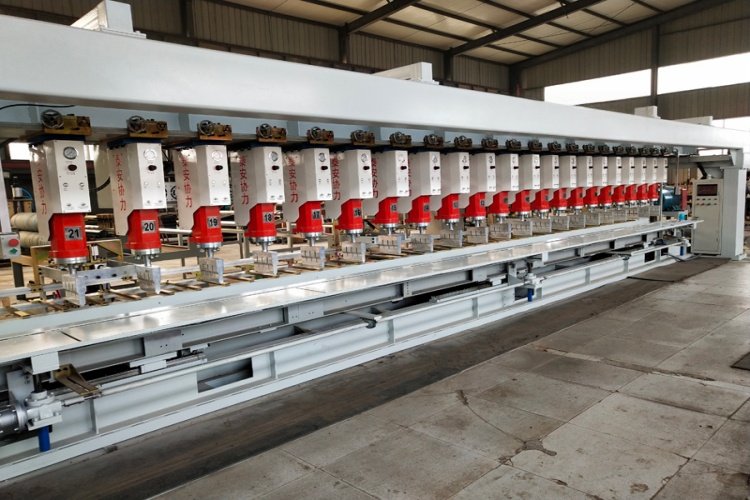
5.1 Multi-Station Welding Lines
We operate multiple semi-automated welding lines.
The process works by stacking the HDPE strips and inserting a welding horn (sonotrode). High-frequency sound waves create localized friction heat, melting the plastic interface instantly and fusing the molecules.
- The Advantage: The heat is generated inside the material, not applied from the outside. This creates a bond that is often stronger than the parent material itself.
5.2 Controlled Bonding Process
Consistency is key here. If the weld time is too short, the bond is weak (Cold Weld). If it's too long, the plastic burns and becomes brittle.
Our machines controls:
- Weld Time: Measured in milliseconds.
- Hold Time: The cooling duration under pressure.
- Pressão: The force applied by the horn.
These parameters are locked in. An operator cannot arbitrarily speed up the machine to hit a quota. The machine dictates the quality.
5.3 Panel Assembly Workflow
The machine automatically advances the strips based on the required Weld Spacing (e.g., 330mm, 356mm, 445mm, 660mm). This distance determines the eventual "Expanded Cell Size."
Because we use automated stepping motors, the error in weld spacing is less than 1%. This ensures that when the contractor expands the panel on-site, the cells are uniform, not distorted.
6. Quality Checkpoints – Multi-Level Inspection System
Manufacturing is nothing without verification. We employ a Three-Tier Quality Control System.
6.1 Tier 1: Incoming Inspection
As mentioned, we test the resin density and melt flow index before it enters the silo. If the raw material is bad, no amount of processing can fix it.
6.2 Tier 2: In-Process Control (The "Patrol")
QC inspectors patrol the floor every hour. They perform "Peel Tests" right at the welding line.
- The Test: They take a welded strip and pull it apart. The failure must occur in the material, not the weld. If the weld snaps cleanly, the line is stopped immediately, and the machine is recalibrated.
- This real-time feedback loop minimizes waste and prevents bad batches from being finished.
6.3 Tier 3: Final Inspection & Laboratory
Before packing, we take random samples from the finished pallets to our internal lab. We test:
- Seam Peel Strength (ASTM D4437): Ensuring the weld meets the specific N/cm requirement.
- Carbon Black Content: Verifying UV resistance levels.
- ESCR (Environmental Stress Crack Resistance): Ensuring long-term durability.
6.4 Documentation & Reporting
For every order, we generate a Certificate of Analysis (COA) that includes the actual test data for that specific batch, not just generic "datasheet" numbers.
7. Production Capacity & Scalability
For large infrastructure projects (like a 50km highway or a massive mining leach pad), capacity is just as important as quality. You cannot afford to wait 6 months for materials.
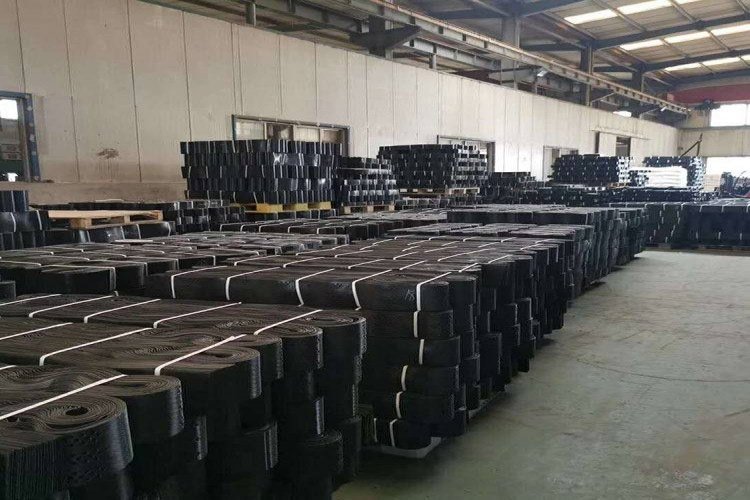
- Scalability: Our facility is designed for volume. We run multiple extrusion and welding lines simultaneously.
- Shift Management: During peak export seasons, we operate on a 24-hour rotating shift basis.
- Monthly Output: We measure our capacity in containers per month. We have the logistics capability to stage and load multiple 40HQ containers daily.
This scalability means we can serve a small distributor ordering one pallet and a government contractor ordering 100 containers with the same level of professionalism.
8. Risk, Limitations, and When Manufacturing Capability Isn't Enough
As a manufacturer, I must also be honest about the limitations of production.
Manufacturing consistency cannot fix bad engineering.
Even if we produce a mathematically perfect Geocell with the highest weld strength, the project will fail if:
- Wrong Spec Selection: You choose a large-cell geocell (designed for slope protection) for a heavy-load road base application. The geometry is wrong for the load.
- Má instalação: The best manufacturing is useless if the contractor does not expand the cells fully or uses poor-quality infill material.
- No Subgrade Preparation: Geocell reinforces the layer above it; it does not magically dry out a swamp below it.
Therefore, while we guarantee the manufacturing quality, we always advise clients to consult with geotechnical engineers regarding the application of the product.
Conclusion – A Reliable Manufacturing Partner
The difference between a successful project and a failed one often starts at the factory gate.
When you choose a Geocell supplier, you are validly asking: "Do you control your process?"
No Especialista em Impermeabilidade, the answer is yes.
- We control the Raw Material input to ensure longevity.
- We control the Extrusion to ensure thickness uniformity.
- We control the Soldagem to ensure structural integrity.
- We control the Testing to verify performance.
We are not just moving boxes; we are engineering plastic into infrastructure.
Looking for a stable geocell manufacturer with controlled production and scalable capacity? Contact our team today for detailed manufacturing specs and factory audit opportunities.