

Choosing your landfill liner is a high-stakes decision. The wrong choice can lead to containment failure, environmental disaster, and massive liability, but the options—GCL and HDPE—have completely different strengths.
Neither is universally "better"; they excel in different roles. HDPE offers superior impermeability and chemical resistance, making it the best primary barrier. GCL provides self-healing properties, making it an excellent secondary or supporting layer. The most effective solution is often using them together.

Como um geosynthetics supplier, I often explain to clients that this isn't a simple "either/or" question. It's about understanding how these two advanced materials function and using them strategically. An HDPE geomembrane is like a perfect plastic shield, while a Geosynthetic Clay Liner (GCL) is like a smart, self-healing sponge. A modern, high-security landfill leverages the best qualities of both to create a containment system that is far more reliable than either material could be on its own.
What technical differences between GCL and HDPE geomembranes directly affect their performance in landfill containment systems?
Confusing the roles of GCL and HDPE is a common and costly mistake. You might specify a material that can't handle the site's chemical waste or one that could fail on a steep slope.
The core difference is their sealing mechanism. HDPE is a solid, non-porous plastic barrier, while a GCL is a fabric sandwich containing powdered bentonite clay that swells when wet to form a low-permeability layer.
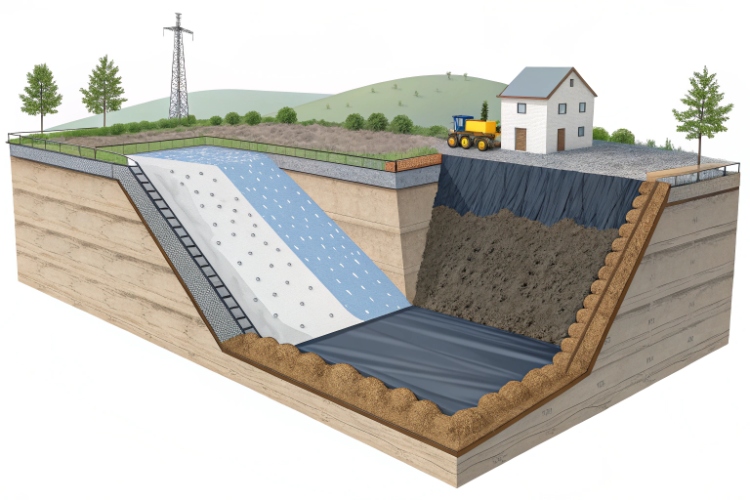
This fundamental difference in how they work creates a cascade of other performance variations. I always start by explaining these core mechanics before moving on to project specifics. Understanding this is the key to designing a system that is both safe and cost-effective.
| Recurso | HDPE Geomembrana | Liner de argila geossintética (GCL) |
|---|---|---|
| Core Material | High-Density Polyethylene (a solid plastic) | Sodium Bentonite Clay between two geotextiles |
| Sealing Action | Acts as an absolute physical barrier to liquid | Clay hydrates and swells to fill voids, creating a seal |
| Autocura | None. Any puncture is a permanent leak until repaired. | Excellent. Bentonite swells to seal minor punctures. |
| Resistência química | Extremely high. Stable in pH 1-14. Ideal for hazardous waste. | Moderate. Can be damaged by aggressive chemicals or high salt concentrations. |
| Installation | Large panels are joined by thermal welding, requiring skilled technicians. | Panels are overlapped. Requires careful handling to protect the bentonite. |
These differences mean you cannot simply swap one for the other. HDPE is your frontline defense against aggressive chemicals, while GCL adds a layer of redundancy and a unique ability to self-repair minor damage.
How can I determine which material—GCL or HDPE—offers better hydraulic barrier efficiency?
A liner's only job is to stop leaks, so choosing the one with lower permeability seems obvious. But lab values don't always tell the whole story of real-world performance.
In perfect lab conditions, an HDPE geomembrane is vastly more impermeable (1x10⁻¹³ cm/s) than a GCL (1x10⁻⁹ cm/s). However, a GCL's ability to self-heal small punctures can make a composite system more effective in practice than a single HDPE liner alone.
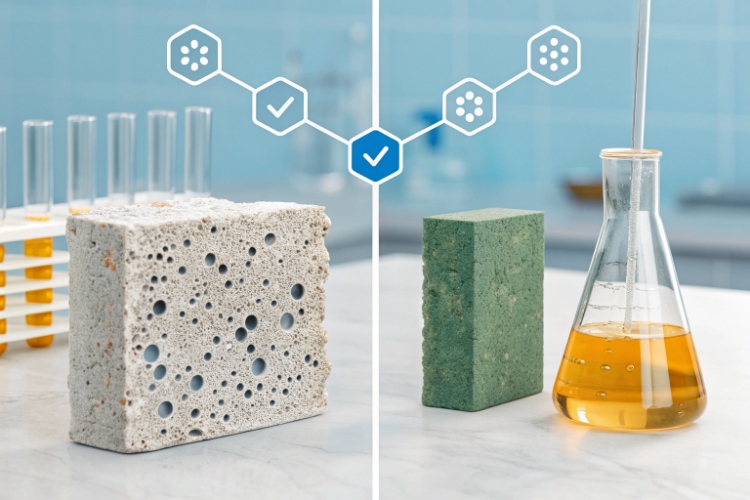
This is one of the most important concepts I discuss with civil engineers. While an intact HDPE sheet is hundreds or even thousands of times less permeable than a GCL, what happens when it gets a small hole from a sharp stone during installation? The barrier efficiency at that point drops to zero. That hole becomes a direct conduit for leachate.
This is where the GCL, placed directly beneath the HDPE, becomes invaluable. When that concentrated jet of leachate leaks through the HDPE, it hits the GCL. The GCL's bentonite hydrates at that exact spot, swelling to plug the leak from below. This "self-healing" attribute provides a level of security that a single plastic sheet cannot match. In fact, field data from hundreds of landfill cells shows that a composite system (HDPE on top of a GCL) has the lowest leakage rates of any liner configuration, far outperforming single HDPE or HDPE/compacted clay systems. The GCL needs adequate pressure from soil cover (a minimum of 30-80 cm) to ensure the bentonite remains compressed and effective, but when designed correctly, the synergy is undeniable.
In what landfill application scenarios does a GCL perform more effectively than an HDPE geomembrane, and vice versa?
Using the wrong liner for the job site leads to failure. A GCL on a hazardous waste slope is a recipe for disaster, just as using only HDPE without a secondary liner in a high-risk water protection zone is a big risk.
HDPE is superior as the primary liner for hazardous waste and on steep slopes due to its chemical resistance and shear strength. GCL excels as a clay-replacement secondary liner and on complex terrain where welding is difficult.

The choice is all about playing to each material's strengths and avoiding its weaknesses. Based on the hundreds of projects I've supplied materials for, the application breakdown is clear.
Usar HDPE Geomembrana When:
- It is the Primary Hazardous Waste Barrier: Its unmatched chemical resistance is non-negotiable for containing aggressive leachate.
- On Steep Slopes: Hydrated GCL can be slippery, creating a plane of weakness. Textured HDPE offers much higher interface friction, which is critical for maintaining slope stability.
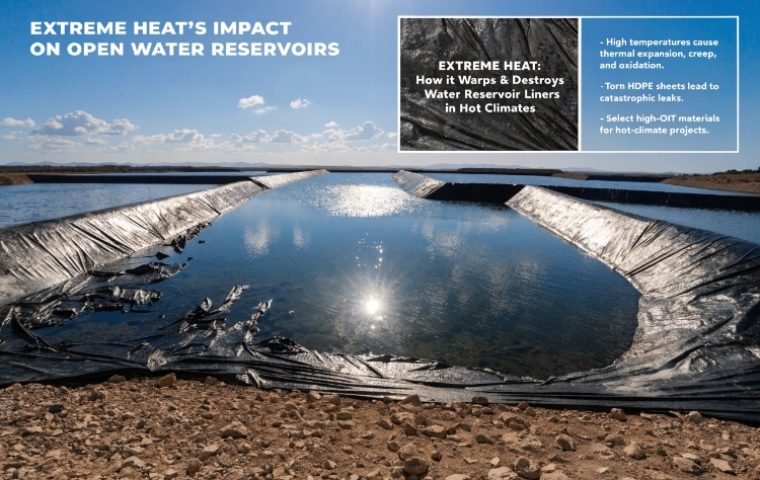
- In Exposed Applications: For leachate ponds or temporary covers, HDPE’s superior UV resistance and durability are essential. GCL degrades quickly in sunlight and must be buried.
- High Puncture Risk: HDPE's toughness provides better resistance to sharp objects compared to the fabric layers of a GCL.
Use um Forro de argila geossintética (GCL) When:
- Replacing Compacted Clay: A GCL provides equivalent or better hydraulic performance than a thick compacted clay liner, but is much thinner, faster to install, and more consistent in quality. This is its most common use.
- As a Secondary Liner in a Composite System: Its self-healing ability makes it the perfect backup layer beneath a primary HDPE geomembrane, catching any minor leaks.
- On Complex or Uneven Subgrades: The flexibility of a GCL allows it to conform better to uneven ground than the more rigid HDPE sheets.
- In Vertical Cut-Off Walls: GCL panels can be used to create underground barriers to stop the lateral migration of contaminated groundwater.
How can I evaluate long-term stability to select the most suitable liner for a specific landfill design?
A liner that fails after 20 years is a total failure. Your selection must be based on a material’s ability to withstand site conditions for a century or more.
For long-term stability, prioritize HDPE for its chemical and UV resistance, with a service life of 50-70+ years. For a GCL, you must ensure it will remain hydrated and under sufficient pressure, as drying out is its primary long-term failure mode.
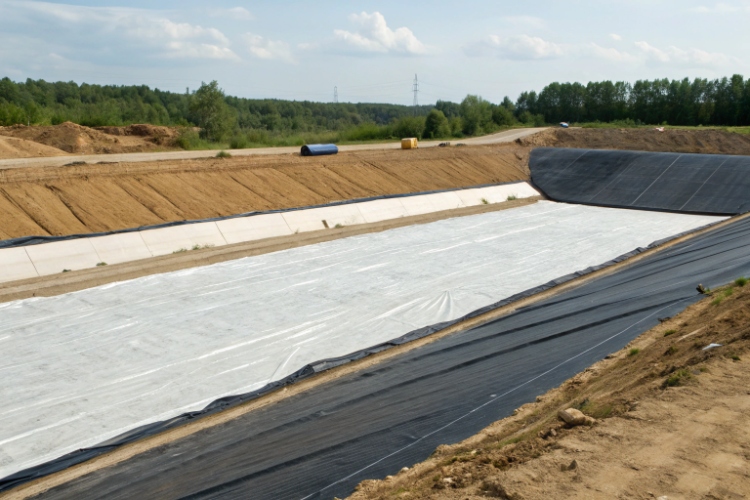
When advising on a project's liner system, the long-term view is everything. You have to anticipate all the ways the system could degrade over its multi-decade lifespan.
Long-Term Stability of HDPE
The longevity of HDPE is well-proven. Its primary vulnerabilities are UV exposure and oxidation. In a buried landfill application, protected from sunlight, its design life is exceptionally long. Its chemical stability ensures that even aggressive leachate will not break it down. As long as it is not mechanically damaged, its performance remains constant.
Long-Term Stability of GCL
A GCL's stability is more complex. Its entire function depends on the bentonite remaining hydrated.
- Desiccation Risk: If the GCL is not protected by sufficient cover soil and a reliable water source (like a primary liner above it), it can dry out. Desiccation causes the bentonite to shrink and crack, creating a network of pathways for liquid to flow through, rendering it useless. This is the single biggest risk to a GCL's long-term performance.
- Ion Exchange: The chemistry of the leachate matters. High concentrations of certain salts can change the structure of the bentonite clay, reducing its ability to swell. This is another reason GCL is not recommended as a primary barrier for complex chemical waste.
- Shear Strength: On slopes, the low internal shear strength of hydrated bentonite can be a long-term stability concern. This is why textured geomembranes and even reinforced GCLs are often required.
Ultimately, the most stable and reliable system for most modern MSW landfills combines both: an HDPE geomembrane as the robust, impermeable primary barrier, and a GCL beneath it as a self-healing, redundant secondary barrier.
Conclusão
The best landfill liner is not GCL or HDPE, but a composite system that uses both. This design leverages HDPE's impermeability and GCL's self-healing properties for maximum long-term security.