

When players step onto a pristine golf course, they see the manicured turf, the challenging bunkers, and the shimmering water hazards. As an industry supplier and engineering partner, however, I see something entirely different. I see a massive, complex hydraulic machine.
A golf course is one of the most demanding civil engineering projects to execute correctly. It requires the ability to handle massive amounts of irrigation and rainfall without becoming boggy, the strength to Support heavy maintenance machinery on cart paths, and the capacity to retain water in artificial lakes without leaking precious resources.
If the underlying engineering fails, the grass dies, the bunkers wash out, and the maintenance budget explodes.
Therefore, geosynthetic materials are not just "optional extras" in golf course construction; they are the invisible infrastructure that makes the playability possible. In this guide, I will break down the specific geosynthetics used in modern course design, from the perspective of material selection and long-term performance.
1. Engineering Requirements of Golf Course Construction
Why do we need advanced polymer materials to grow grass? It comes down to control.
In a natural field, soil conditions are inconsistent. Water drains quickly in one spot and pools in another. In a golf course, consistency is the product.
An EPC contractor building a course faces four critical challenges:
- Strict Drainage Requirements: The "Green" must be firm enough to walk on shortly after a rainstorm. This requires engineered soil profiles (USGA specification) that drain rapidly but need separation from the natural subgrade.
- Complex Subgrade Conditions: Courses are often built on reclaimed land, landfills, or unstable soils. Uneven settlement on a putting green renders it unplayable.
- Durability Under Traffic: While we think of golf as a walking sport, the maintenance equipment (mowers, aerators, spreaders) is heavy. Cart paths and service roads need reinforcement.
- Water Management: In many regions, water is expensive and regulated. Artificial lakes cannot rely on natural clay retention; they require absolute seepage control.
Geosythetics provide the engineering certainty effectively separating the unstable natural ground from the precision-engineered playing surface.
2. Commonly Used Geosynthetic Materials in Golf Course Construction and Their Functions
We typically supply four main categories of geosynthetics for these projects. Each serves a distinct function in the "layer cake" of the course construction.
2.1 Geotextiles Used in Golf Courses
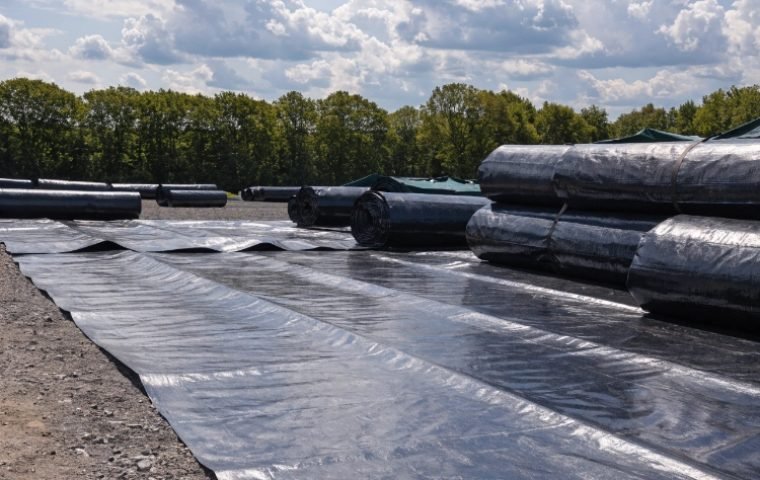
Geotextiles, particularly non-woven needle-punched varieties, are the workhorses of the golf course. They are primarily used for separation and filtration.
The "Sand-Soil" Conflict:
Golf greens and bunkers use expensive, specific sand particle sizes. If this sand mixes with the underlying clay or silt subgrade, the drainage pores clog, and the feature fails. A geotextile layer acts as a permeable barrier, allowing water to pass while keeping the expensive sand clean and separate from the subgrade.
Typical Specifications:
For golf courses, we rarely use woven geotextiles (which are for reinforcement) under the grass. We use non-woven fabrics because of their superior water flow rates.
| Parameter | Typical Range Specified | Practical Notes |
|---|---|---|
| Material | Polypropylene (PP) or Polyester (PET) Non-woven | PP is preferred for chemical resistance (fertilizers). |
| Weight | 150 g/m² – 300 g/m² | Light enough for flow, heavy enough to resist puncture by aggregate. |
| Permeability | > 0.1 cm/sec | Must exceed the infiltration rate of the soil profile. |
| Grab Tensile Strength | 600 N – 1000 N | Needs to survive installation traffic (skid steers). |
Problems Without Geotextiles:
I have seen older courses where geotextiles were skipped to save money. After 3-5 years, the bunker sand becomes contaminated with mud (turning it brown and hard), and the drainage pipes in the greens clog with silt, leading to "dead spots" of turf rot.
2.2 Drainage Geosynthetics and Drainage Boards
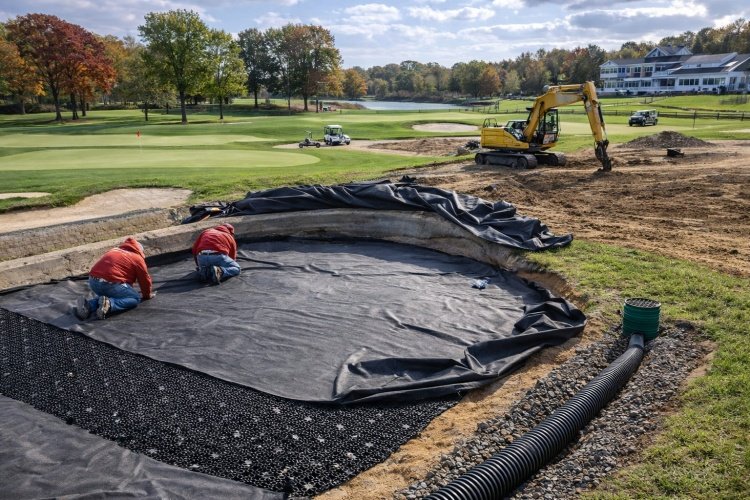
Traditional drainage relies on French drains—trenches filled with gravel and a pipe. However, gravel is heavy to transport and labor-intensive to install. Modern courses are shifting toward Geocomposite Drainage Layers.
These are typically a 3D plastic core (dimpled or net) sandwiched between two layers of geotextile.
Typical Application Areas:
- Bunker Liners: Rapidly evacuating water from sand traps to prevent "washouts" (where sand slides down the face of the bunker after rain).
- Subsurface Drainage on Greens: Placed directly under the root zone in low-lying areas.
- Retaining Walls: Behind landscape walls to prevent hydrostatic pressure buildup.
Performance Advantage:
A 5mm thick geocomposite often carries as much water as 300mm of crushed stone. This allows designers to maintain the contours of the course without excavating deep trenches for gravel.
2.3 Geogrids for Subgrade Reinforcement
While geotextiles separate, geogrids fit the "stabilization" role. They are used in the non-playing areas that support the infrastructure.
Typical Application Areas:
- Cart Paths: To prevent rutting and reduce the thickness of the aggregate base.
- Parking Areas: For the clubhouse and maintenance facility.
- Steep Slopes: Reinforcing soil veneers on steep embankments or artificial hills.
Functions:
The geogrid locks the aggregate in its apertures, creating a stiffened composite layer. This distributes the load of heavy mowers or golf carts over a wider area, preventing the subgrade from deforming.
| Parameter | Common Specification | Application note |
|---|---|---|
| Type | Biaxial (PP) or Triaxial | Biaxial is standard for distributing load in two directions. |
| Tensile Strength | 20 kN/m – 40 kN/m | Higher strength used for soft subgrades (CBR < 3). |
| Aperture Size | 25mm – 40mm | Must match the size of the aggregate used in the road base. |
2.4 Geomembranes in Artificial Lakes and Water Features
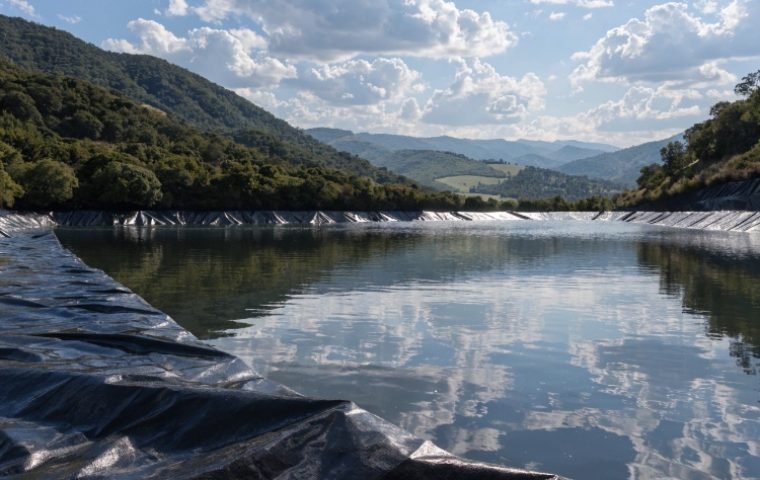
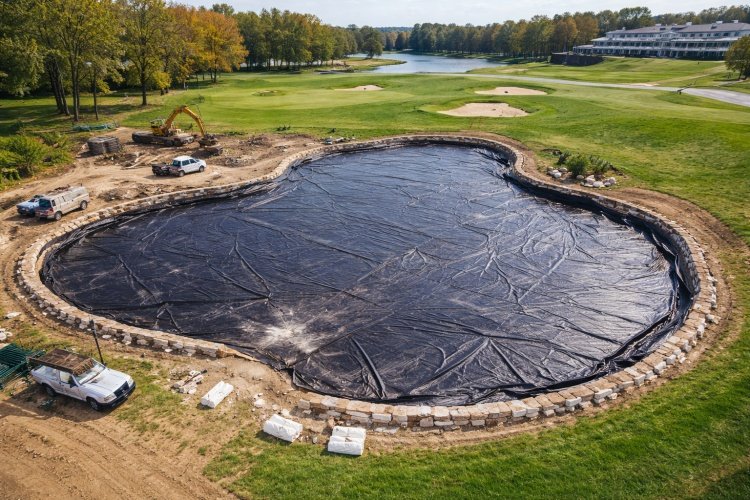
Water hazards are aesthetically pleasing, but operationally, they are reservoirs. A typical 18-hole course might have 3 to 5 hectares of water surface. Without a liner, water loss into the ground can be financially ruinous.
Material Selection:
Unlike landfill projects where chemical resistance is king, golf course liners prioritize flexibility and puncture resistance (for irregular shapes).
- HDPE (High-Density Polyethylene): The cheapest option, excellent durability, but stiff. Hard to install in small, curvy ponds. Best for large, simple reservoirs.
- LLDPE (Linear Low-Density Polyethylene): More flexible than HDPE. It conforms better to the complex bottom contours of natural-looking lakes.
- PVC (Polyvinyl Chloride): Highly flexible, easy to pre-fabricate into large panels, but less UV resistant. Must be covered with soil.
Typical Specs:
- Thickness: 0.75mm – 1.0mm is common for decorative ponds; 1.5mm for deep irrigation storage.
- Surfacing: Textured surfaces are often used on the slopes to hold soil cover (so the black plastic is hidden).
3. Combined Use of Geosynthetic Materials in Golf Course Projects
In high-standard projects, we rarely supply a single material in isolation. The materials work as an integrated system. Understanding these combinations is what separates a professional supplier from a generic trader.
Common Combined Solutions:
-
The "Liner Sandwich" (For Lakes):
- Bottom: Non-woven Geotextile (Cushion against stones).
- Middle: LLDPE Geomembrane (Waterproofing).
- Top: Non-woven Geotextile (Protection against cover soil sliding).
- Function: This prevents punctures from below and above, ensuring a 20+ year lifespan for the lake.
-
The "Bunker System":
- Base: Geocomposite Drainage Layer (to move water).
- Top: Specialized Bunker Liner (often a polymer-sprayed geotextile or synthetic turf).
- Function: This keeps the sand clean, drains it instantly, and prevents the maintenance crew from digging up the subgrade when raking the sand.
Why Integration Matters:
Using a liner without a cushion geotextile often leads to leaks during the first year. Using a drainage board without a filter fabric leads to clogging in the second year. The initial savings are lost to repair costs almost immediately.
4. Risks, Limitations, and When NOT to Use Certain Materials
As a practitioner, I must be honest about where geosynthetics can fail if misapplied in golf courses.
1. Exposed Liners and UV Degradation
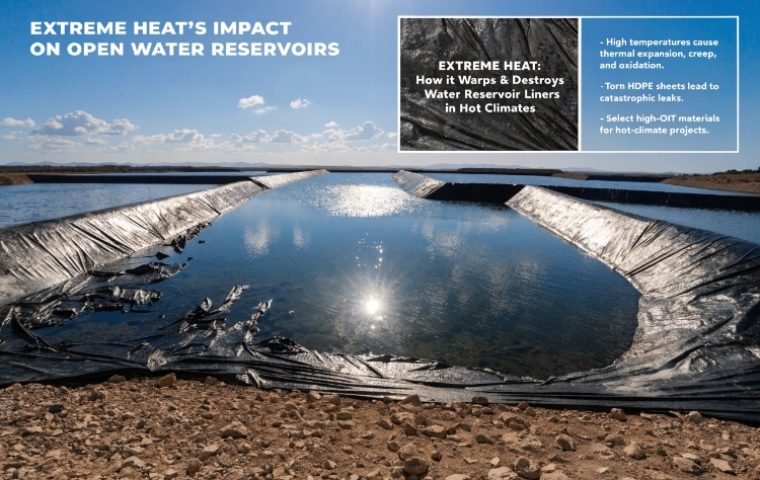
It is tempting to leave geomembranes exposed at the water's edge to save money on rock or soil cover. However, standard liners (especially PVC or thin PE) degrade under UV radiation. Furthermore, exposed black plastic looks terrible and gets slippery, creating a safety hazard for players retrieving balls.
- Advice: Always design a "safety shelf" with soil cover or rock armor over the liner.
2. The "Impermeable Bunker" Trap
Some designers use heavy geotextiles in bunkers to separate sand. If the geotextile is too thick or gets clogged with organic fines (grass clippings), it turns into a bowl.
- Advice: Use purpose-built, high-flow bunker liners, not generic road-building geotextiles.
3. Root Penetration
While geomembranes stop water, aggressive tree roots (like Willow or Poplar) can puncture thinner liners (0.5mm - 0.75mm) over time.
- Advice: If trees are planted near the water feature, use a root barrier or increase liner thickness to 1.5mm HDPE.
5. Reference Value of Golf Course Projects for Other Applications
The engineering solutions developed for golf courses are highly transferable. A golf course is essentially a masterful landscape design combined with heavy-duty stormwater management.
We often apply "Golf Course Grade" solutions to:
- Luxury Resorts: Large biological pools and landscape features.
- Municipal Parks: High-traffic lawn areas that need to resist compaction.
- Roof Gardens: Where lightweight drainage (geocomposites) is critical to reduce structural load.
If a material system can withstand the scrutiny of a televised PGA tournament, it is more than capable of handling the demands of residential or commercial landscaping.

Conclusion
Golf course construction is an art form supported by rigorous engineering. The selection of geosynthetic materials—whether it is a 300g geotextile for separation or a 1.0mm LLDPE liner for a lake—depends entirely on the site-specific soil conditions and the budget for long-term maintenance.
Summary of Best Practices:
- Don't Skimp on Filtration: Protecting the sand profile is the most important investment for turf health.
- Match Liner to Shape: Use flexible materials (LLDPE/PVC) for intricate water features, not stiff HDPE.
- Think in Systems: Always pair drainage products with filtration fabrics and liners with protective cushions.
At Waterproof Specialist, we understand that you aren't just buying rolls of plastic; you are building a playing surface that needs to perform perfectly rain or shine. By selecting the right combination of materials early in the design phase, you ensure that the course remains playable and profitable for decades to come.