

When players step onto a pristine golf course, they see the manicured turf, the challenging bunkers, and the shimmering water hazards. As an industry supplier and engineering partner, however, I see something entirely different. I see a massive, complex hydraulic machine.
A golf course is one of the most demanding civil engineering projects to execute correctly. It requires the ability to handle massive amounts of irrigation and rainfall without becoming boggy, the strength to Support heavy maintenance machinery on cart paths, and the capacity to retain water in artificial lakes without leaking precious resources.
If the underlying engineering fails, the grass dies, the bunkers wash out, and the maintenance budget explodes.
Therefore, geosintetiese materiale are not just "optional extras" in gholfbaankonstruksie; hulle is die onsigbare infrastruktuur wat die speelbaarheid moontlik maak. In hierdie gids sal ek die spesifieke geosintetika wat in moderne kursusontwerp gebruik word, uiteensit, vanuit die perspektief van materiaalkeuse en langtermynprestasie.
1. Ingenieursvereistes van gholfbaankonstruksie
Hoekom het ons gevorderde polimeermateriaal nodig om gras te laat groei? Dit kom neer op beheer.
In 'n natuurlike veld is grondtoestande inkonsekwent. Water dreineer vinnig op een plek en poele op 'n ander. In 'n gholfbaan is konsekwentheid die produk.
'n EPC-kontrakteur wat 'n kursus bou, staar vier kritieke uitdagings in die gesig:
- Streng dreineringsvereistes: The "Green" must be firm enough to walk on shortly after a rainstorm. This requires engineered soil profiles (USGA specification) that drain rapidly but need separation from the natural subgrade.
- Complex Subgrade Conditions: Courses are often built on reclaimed land, landfills, or unstable soils. Uneven settlement on a putting green renders it unplayable.
- Durability Under Traffic: While we think of golf as a walking sport, the maintenance equipment (mowers, aerators, spreaders) is heavy. Cart paths and service roads need reinforcement.
- Waterbestuur: In many regions, water is expensive and regulated. Artificial lakes cannot rely on natural clay retention; they require absolute seepage control.
Geositetika verskaf die ingenieurssekerheid wat die onstabiele natuurlike grond effektief van die presisie-gemanipuleerde speeloppervlak skei.
2. Algemeen gebruikte geosintetiese materiale in gholfbaankonstruksie en hul funksies
We typically supply four main categories of geosynthetics for these projects. Each serves a distinct function in the "layer cake" van die kursus konstruksie.
2.1 Geotekstiele Word gebruik in gholfbane
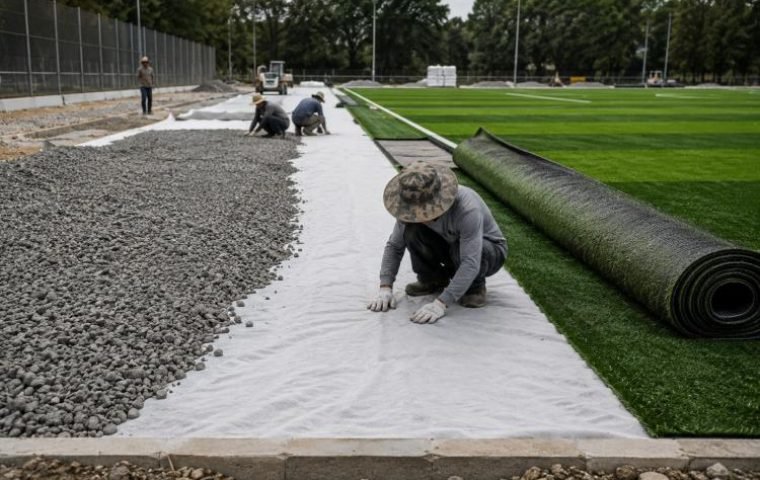
Geotekstiele, veral nie-geweefde naald-geponste variëteite, is die werkesels van die gholfbaan. Hulle word hoofsaaklik gebruik vir skeiding en filtrasie.
The "Sand-Soil" Konflik:
Gholf setperke en bunkers gebruik duur, spesifieke sanddeeltjiegroottes. As hierdie sand met die onderliggende klei- of slikondergrond meng, verstop die dreineringporieë en misluk die kenmerk. ’n Geotekstiellaag dien as ’n deurlaatbare versperring wat water toelaat om deur te gaan terwyl die duur sand skoon en apart van die ondergrond gehou word.
Tipiese spesifikasies:
Vir gholfbane gebruik ons selde geweefde geotekstiele (wat vir versterking is) onder die gras. Ons gebruik nie-geweefde materiaal vanweë hul uitstekende watervloeitempo's.
| Parameter | Tipiese reeks gespesifiseer | Praktiese notas |
|---|---|---|
| Materiaal | Polipropileen (PP) of Polyester (PET) Nie-geweefde | PP word verkies vir chemiese weerstand (kunsmis). |
| Gewig | 150 g/m² – 300 g/m² | Lig genoeg vir vloei, swaar genoeg om punksie deur aggregaat te weerstaan. |
| Deurlaatbaarheid | > 0.1 cm/sek | Moet die infiltrasietempo van die grondprofiel oorskry. |
| Gryp treksterkte | 600 N – 1000 N | Moet installasieverkeer (slipsteers) oorleef. |
Probleme sonder geotekstiele:
I have seen older courses where geotextiles were skipped to save money. After 3-5 years, the bunker sand becomes contaminated with mud (turning it brown and hard), and the drainage pipes in the greens clog with silt, leading to "dead spots" van turfvrot.
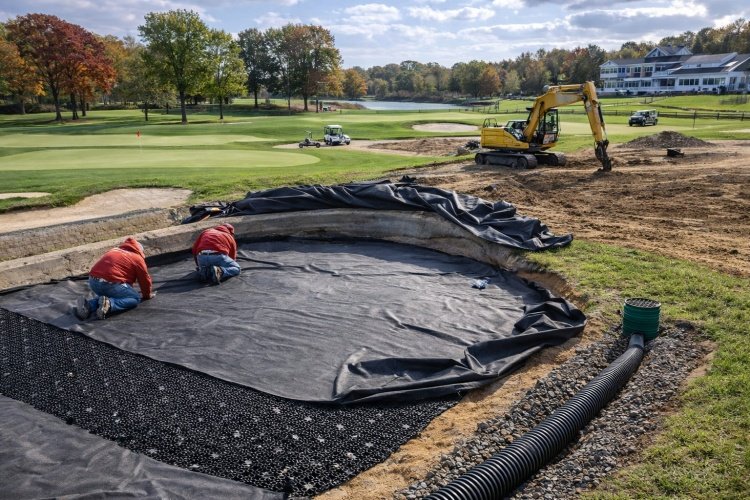
2.2 Dreineringsgeosintetiese middels en dreineringsborde
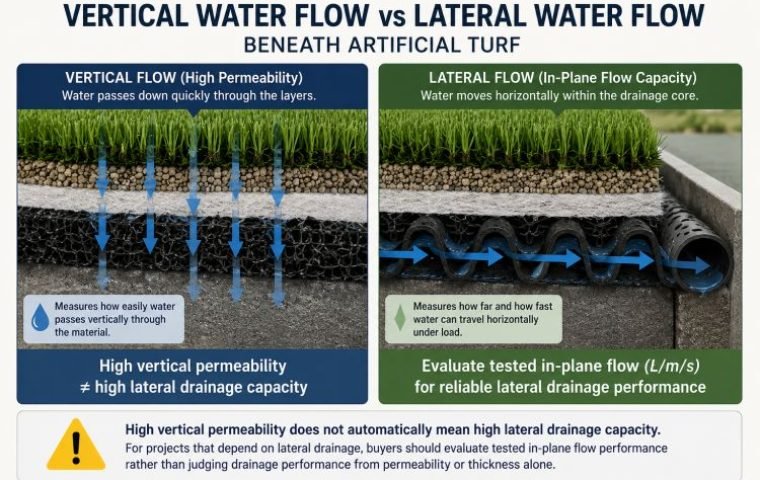
Tradisionele dreinering maak staat op Franse dreine - loopgrawe gevul met gruis en 'n pyp. Gruis is egter swaar om te vervoer en arbeidsintensief om te installeer. Moderne kursusse skuif na Geosaamgestelde dreineringlae.
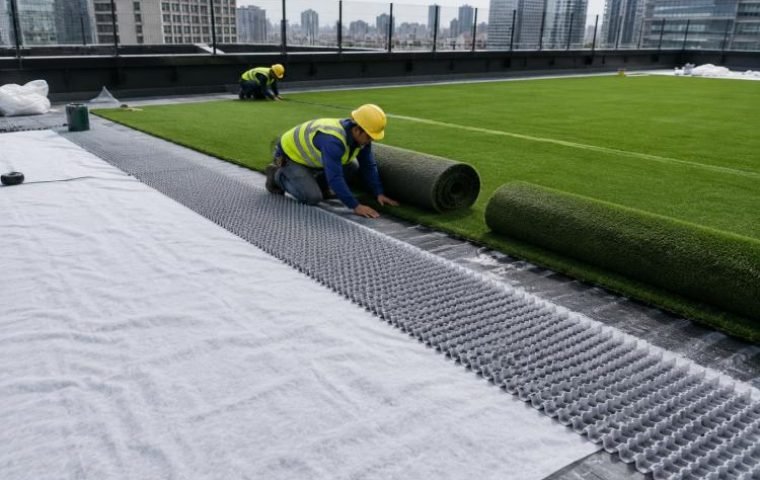
Dit is tipies 'n 3D-plastiekkern (kuiltjies of net) wat tussen twee lae geotekstiel vasgemaak is.
Tipiese toepassingsgebiede:
- Bunker Liners: Rapidly evacuating water from sand traps to prevent "washouts" (waar sand na reën teen die gesig van die bunker afgly).
- Ondergrondse dreinering op setperke: Geplaas direk onder die wortelsone in laagliggende gebiede.
- Keermure: Agter landskapmure om hidrostatiese drukopbou te voorkom.
Prestasievoordeel:
’n 5 mm dik geosamestelling dra dikwels soveel water as 300 mm gebreekte klip. Dit laat ontwerpers toe om die kontoere van die baan te behou sonder om diep slote vir gruis uit te grawe.
2.3 Geogrids vir subgraadversterking
Terwyl geotekstiele skei, geonetwerke fit the "stabilization" rol. Hulle word gebruik in die nie-speel areas wat die infrastruktuur ondersteun.
Tipiese toepassingsgebiede:
- Karretjie paaie: To prevent rutting and reduce the thickness of the aggregate base.
- Parking Areas: For the clubhouse and maintenance facility.
- Steil hellings: Reinforcing soil veneers on steep embankments or artificial hills.
Functions:
The geogrid locks the aggregate in its apertures, creating a stiffened composite layer. This distributes the load of heavy mowers or golf carts over a wider area, preventing the subgrade from deforming.
| Parameter | Algemene spesifikasie | Application note |
|---|---|---|
| Tik | Biaxial (PP) or Triaxial | Biaxial is standard for distributing load in two directions. |
| Treksterkte | 20 kN/m – 40 kN/m | Higher strength used for soft subgrades (CBR < 3). |
| Aperture Size | 25mm – 40mm | Must match the size of the aggregate used in the road base. |
2.4 Geomembranes in Artificial Lakes and Water Features
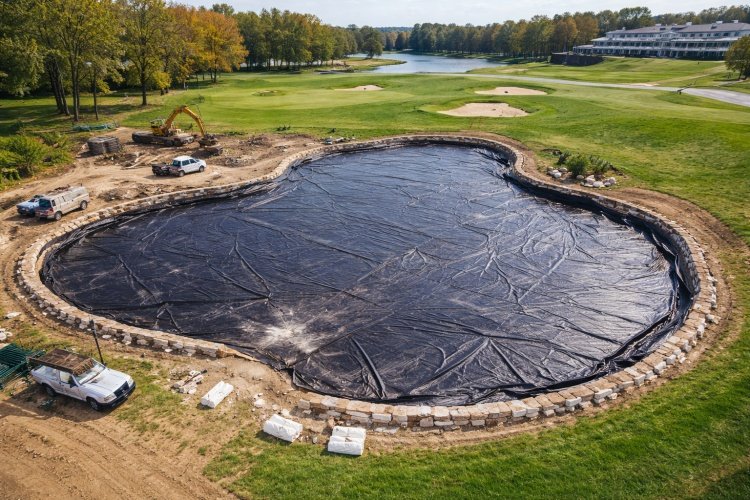
Water hazards are aesthetically pleasing, but operationally, they are reservoirs. A typical 18-hole course might have 3 to 5 hectares of water surface. Without a liner, water loss into the ground can be financially ruinous.
Material Selection:
Unlike landfill projects where chemical resistance is king, golf course liners prioritize flexibility en punksie weerstand (for irregular shapes).
- HDPE (hoëdigtheid poliëtileen): The cheapest option, excellent durability, but stiff. Hard to install in small, curvy ponds. Best for large, simple reservoirs.
- LLDPE (lineêre lae-digtheid poliëtileen): More flexible than HDPE. It conforms better to the complex bottom contours of natural-looking lakes.
- PVC (Polyvinyl Chloride): Highly flexible, easy to pre-fabricate into large panels, but less UV resistant. Must be covered with soil.
Typical Specs:
- Dikte: 0.75mm – 1.0mm is common for decorative ponds; 1.5mm for deep irrigation storage.
- Surfacing: Textured surfaces are often used on the slopes to hold soil cover (so the black plastic is hidden).
3. Combined Use of Geosynthetic Materials in Golf Course Projects
In high-standard projects, we rarely supply a single material in isolation. The materials work as an integrated system. Understanding these combinations is what separates a professional supplier from a generic trader.
Common Combined Solutions:
-
The "Liner Sandwich" (For Lakes):
- Bottom: Non-woven Geotextile (Cushion against stones).
- Middle: LLDPE Geomembraan (Waterproofing).
- Top: Non-woven Geotextile (Protection against cover soil sliding).
- Funksie: This prevents punctures from below and above, ensuring a 20+ year lifespan for the lake.
-
The "Bunker System":
- Basis: Geo-saamgestelde dreineringslaag (to move water).
- Top: Specialized Bunker Liner (often a polymer-sprayed geotextile or synthetic turf).
- Funksie: This keeps the sand clean, drains it instantly, and prevents the maintenance crew from digging up the subgrade when raking the sand.
Why Integration Matters:
Using a liner without a cushion geotextile often leads to leaks during the first year. Using a drainage board without a filter fabric leads to clogging in the second year. The initial savings are lost to repair costs almost immediately.
4. Risks, Limitations, and When NOT to Use Certain Materials
As a practitioner, I must be honest about where geosynthetics can fail if misapplied in golf courses.
1. Exposed Liners and UV-afbraak
It is tempting to leave geomembranes exposed at the water's edge to save money on rock or soil cover. However, standard liners (especially PVC or thin PE) degrade under UV radiation. Furthermore, exposed black plastic looks terrible and gets slippery, creating a safety hazard for players retrieving balls.
- Advice: Always design a "safety shelf" with soil cover or rock armor over the liner.
2. The "Impermeable Bunker" Trap
Some designers use heavy geotextiles in bunkers to separate sand. If the geotextile is too thick or gets clogged with organic fines (grass clippings), it turns into a bowl.
- Advice: Use purpose-built, high-flow bunker liners, not generic road-building geotextiles.
3. Root Penetration
While geomembranes stop water, aggressive tree roots (like Willow or Poplar) can puncture thinner liners (0.5mm - 0.75mm) over time.
- Advice: If trees are planted near the water feature, use a root barrier or increase liner thickness to 1.5mm HDPE.
5. Reference Value of Golf Course Projects for Other Applications
The engineering solutions developed for golf courses are highly transferable. A golf course is essentially a masterful landscape design combined with heavy-duty stormwater management.
We often apply "Golf Course Grade" solutions to:
- Luxury Resorts: Large biological pools and landscape features.
- Municipal Parks: High-traffic lawn areas that need to resist compaction.
- Roof Gardens: Where lightweight drainage (geocomposites) is critical to reduce structural load.
If a material system can withstand the scrutiny of a televised PGA tournament, it is more than capable of handling the demands of residential or commercial landscaping.

Gevolgtrekking
Golf course construction is an art form supported by rigorous engineering. The selection of geosynthetic materials—whether it is a 300g geotextile for separation or a 1.0mm LLDPE liner for a lake—depends entirely on the site-specific soil conditions and the budget for long-term maintenance.
Summary of Best Practices:
- Don't Skimp on Filtration: Protecting the sand profile is the most important investment for turf health.
- Match Liner to Shape: Use flexible materials (LLDPE/PVC) for intricate water features, not stiff HDPE.
- Think in Systems: Always pair drainage products with filtration fabrics and liners with protective cushions.
By Waterdigte Spesialis, we understand that you aren't just buying rolls of plastic; you are building a playing surface that needs to perform perfectly rain or shine. By selecting the right combination of materials early in the design phase, you ensure that the course remains playable and profitable for decades to come.