

Containing municipal solid waste is a challenge; containing hazardous waste is a different order of magnitude entirely. The chemical aggression is higher, the environmental risks are more severe, and the long-term liability is absolute. In this high-stakes environment, liner failure is not an option.
This engineering guide outlines the best practices for selecting landfill liner materials specifically for hazardous waste containment. I will explain why these facilities require specialized, redundant systems, cover the core performance requirements for materials like HDPE, and detail the regulatory and quality assurance frameworks that ensure long-term security.
Having supplied materials for critical containment projects, I know that the design philosophy for hazardous waste must be built on a foundation of zero tolerance for leakage. It requires a more robust approach to material selection, system design, and quality control from start to finish. Let's explore why these specialized systems are non-negotiable.
Why Hazardous Waste Landfills Require Specialized Liner Systems
While both MSW and hazardous waste landfills use geomembranes, the similarity ends there. The nature of the contained material dictates a far more conservative and robust engineering approach for hazardous waste facilities.
Chemical Complexity of Hazardous Waste Leachate
Unlike the relatively predictable organic leachate in an MSW landfill, hazardous waste leachate can be a complex and aggressive chemical cocktail. It may contain a wide mix of acids, alkalis, industrial solvents, hydrocarbons, oxidizers, and heavy metals. Furthermore, the chemistry of this leachate can change unpredictably over the facility's life as different waste streams interact. The liner material must be able to resist this prolonged, multi-front chemical attack without degrading.
Higher Risk Profile Compared to Conventional Landfills
The potential environmental impact of a leak from a hazardous waste landfill is far greater than from an MSW facility. The contaminants are often more toxic, more persistent, and can cause irreversible damage to groundwater and ecosystems. Consequently, the design principle is absolute containment with zero tolerance for leakage. This mission extends for decades beyond the landfill's active life, creating a long-term liability that demands the most reliable containment system possible.
Regulatory Framework Governing Hazardous Waste Landfill Liners
Given the high risks, regulatory bodies worldwide have established strict, non-negotiable standards for hazardous waste landfill design. These regulations are not guidelines; they are mandatory requirements.
International Regulatory Principles for Hazardous Waste Containment
Across the globe, the core principles are consistent: defense in depth and long-term performance verification. The design must assume that a single liner could eventually fail, and therefore, it mandates containment redundancy. This ensures that a backup system is always in place to catch any potential leaks from the primary liner.
U.S. Hazardous Waste Landfill Liner Requirements
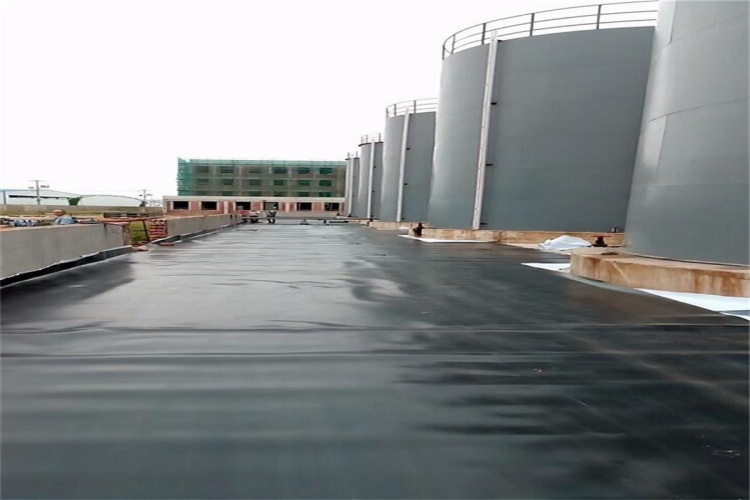
In the United States, the Resource Conservation and Recovery Act (RCRA) Subtitle C provides the legal framework. The core of this regulation is the mandatory requirement for a double liner system. This consists of a primary (top) liner and a secondary (bottom) liner, separated by a leak detection, collection, and removal system (LCRS). This design ensures that any failure in the primary liner is immediately detected and contained by the secondary system before any contaminants can escape into the environment.
European and Global Regulatory Expectations
Similar principles are enforced in Europe and other developed regions. Standards like China's GB 18598-2001 or Germany's BAM specifications for hazardous waste projects also mandate double liner systems. These regulations place a heavy emphasis on proving chemical compatibility through rigorous testing and ensuring long-term containment integrity through meticulous post-closure monitoring, often for 30 to 50 years after the facility stops accepting waste.
Core Performance Requirements for Hazardous Waste Landfill Liners
To meet these stringent demands, the geomembrane material itself must exhibit superior performance characteristics under the most challenging conditions.
High Chemical Resistance Under Aggressive Conditions
This is the number one priority. The polymer must be inherently resistant to the full spectrum of chemicals expected in the leachate, including strong acids, organic solvents, and hydrocarbons. The material must remain stable and not swell, soften, or embrittle after decades of continuous chemical exposure.
Ultra-Low Permeability and Contaminant Migration Control
The liner must function as a near-absolute barrier to liquids. Its permeability must be so low that the advective flow of leachate through the membrane is virtually zero. This is crucial for preventing the transport of dissolved chemical contaminants into the underlying soil and groundwater.
Durability and Aging Resistance
The liner must be engineered for a multi-decade lifespan in a harsh, buried environment. This means it needs exceptional resistance to oxidative degradation. A key metric we use to specify this is the وقت الحث التأكسدي (OIT). For standard MSW projects, a high-pressure OIT of over 400 minutes (or standard OIT of 100 minutes) is considered good. For hazardous waste, we specify materials with a standard OIT exceeding 200 minutes to provide a much higher factor of safety against long-term aging. Similarly, superior stress crack resistance is essential to handle long-term settlement stresses without failure.
High Chemical Resistance Liner Materials for Hazardous Waste Landfills
Given these demanding requirements, the choice of material is extremely focused.
HDPE Geomembranes as the Benchmark Material
High-Density Polyethylene (HDPE) is the universally accepted benchmark material for hazardous waste containment. Its tightly packed, linear molecular structure provides the best all-around chemical resistance of any common geomembrane. It is particularly resistant to the inorganic acids and bases found in many industrial waste streams.
For hazardous waste applications, we always recommend a minimum thickness of 2.0 mm (80 mil) for the primary liner و 1.5 mm (60 mil) for the secondary liner. Some stringent specifications, like the BAM standard in Germany, may even require a minimum of 2.5 mm. Using high-quality HDPE made from 100% virgin resin is non-negotiable.
Limitations of Alternative Polymeric Liners in Hazardous Environments
While other geomembranes exist, they are generally not suitable for primary hazardous waste containment.
- البولي إثيلين المنخفض الكثافة الخطي: While more flexible, Linear Low-Density Polyethylene generally has lower chemical resistance compared to HDPE, especially against certain organic compounds.
- PVC: Polyvinyl Chloride is vulnerable to a wide range of industrial solvents and hydrocarbons, which can extract the plasticizers from the sheet, causing it to become brittle and fail.
Composite and Multi-Layer Liner Systems
The regulations mandate a نظام, not just a material. The standard hazardous waste double liner system is a sophisticated, multi-layer assembly:
- Primary Liner: A composite of a 2.0 mm HDPE geomembrane over a Geosynthetic Clay Liner (GCL) or a thick compacted clay liner (CCL).
- Leak Detection Layer: A geonet or other drainage material placed between the primary and secondary liners to rapidly collect and convey any leakage to a sump for detection.
- Secondary Liner: A second composite liner, typically 1.5 mm HDPE over another GCL or CCL, providing the final layer of containment.
Chemical Compatibility Assessment for Hazardous Waste Liners
Even with HDPE, you cannot assume compatibility. For any hazardous waste project, specific chemical compatibility testing is a critical step in the design verification process.
Importance of Compatibility Testing Before Material Selection
The project's engineers must identify the types and concentrations of chemicals expected in the waste. Samples of the proposed HDPE liner are then immersed in a fluid that simulates the site-specific leachate, often for extended periods at elevated temperatures (e.g., U.S. EPA Method 9090A). Technicians then measure any changes in the material's properties, such as swelling, strength, and elasticity, to confirm its long-term suitability.
Long-Term Exposure Versus Short-Term Laboratory Testing
It's important to recognize that these accelerated lab tests, while essential, are just an indicator. Real-world exposure lasts for decades. Therefore, engineers must combine test results with historical performance data and sound engineering judgment when selecting the final material. Choosing a manufacturer with a long track record of performance in similar applications provides an added layer of confidence.
Installation, Quality Assurance, and Risk Management
A high-quality material can be rendered useless by poor installation. For hazardous waste projects, Construction Quality Assurance (CQA) is a rigorous, documented process that governs every step of liner deployment.
Welding Integrity and Seaming Performance
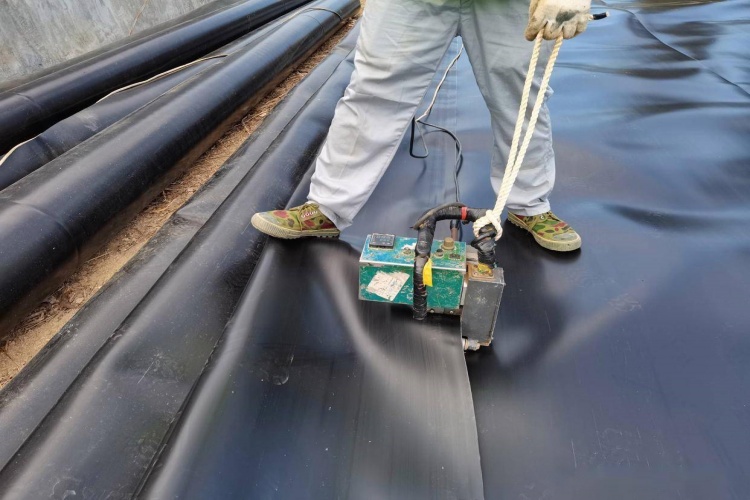
Seams are the most critical part of any liner installation. All field welds, whether dual-track fusion welds or extrusion welds, must be performed by certified technicians under controlled conditions. The integrity of every inch of the seam must be verified through non-destructive testing (such as air pressure testing or vacuum box testing) and confirmed through destructive testing of sample coupons in a lab.
Construction Quality Assurance (CQA) for Hazardous Waste Liners
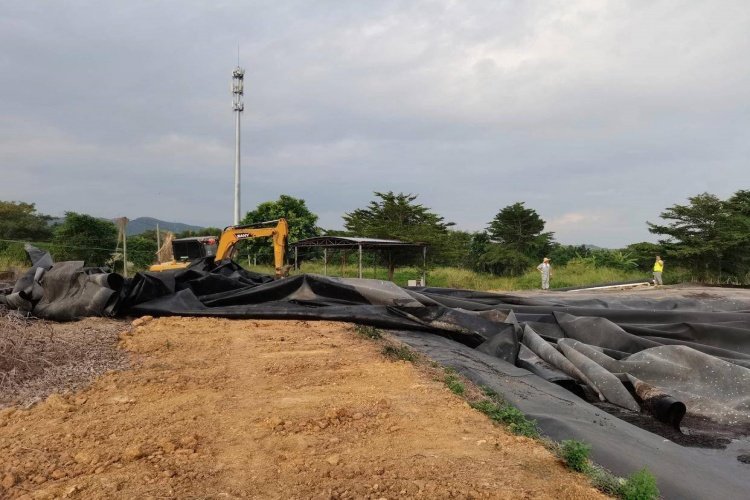
A third-party CQA firm is typically present on-site throughout the installation. Their role is to observe, test, and document every aspect of the process, from subgrade acceptance and panel deployment to final seam testing. This ensures that the installed liner system complies perfectly with the design specifications and regulatory requirements.
Long-Term Monitoring and Post-Closure Responsibility
The containment mission continues long after the last truckload of waste arrives. The leak detection system between the primary and secondary liners must be monitored for the entire post-closure period (30 years or more). This system serves as a permanent early warning mechanism, providing operators with concrete proof that the primary liner is performing as designed and allowing them to manage their long-term environmental liability effectively.
خاتمة
In summary, protecting our environment from hazardous waste demands a specialized, no-compromise approach to liner design. The industry standard—a double composite liner system built with high-performance, chemically resistant HDPE geomembrane—is not just a best practice; it is a regulatory and ethical necessity. The selection of these materials must be driven by a fundamental requirement for high chemical resistance, backed by rigorous compatibility testing, and executed with meticulous installation quality control to ensure secure containment for decades to come.