Once a landfill is in operation, its geomembrane liner is buried under tons of waste, making it impossible to see. So, what happens when you suspect a leak? An invisible problem can quickly become an environmental disaster if not detected early.
This guide explains practical methods for testing geomembrane integrity in active landfills, long after the construction phase is over. I will cover the primary techniques used to find leaks under soil and waste, the limitations you should expect, and the response strategies to manage leakage risks effectively.

ك مورد المواد الاصطناعية الجيولوجية, I know that even the best-installed liners can face challenges during operation. Detecting these issues early is key to protecting our groundwater and ensuring long-term compliance.
Challenges of Integrity Testing in Operating Landfills
Testing a geomembrane for leaks during construction is relatively straightforward because the liner is exposed and accessible. However, once a landfill is active, the game changes completely. The liner is now covered, often by a thick drainage layer and waste, creating several major challenges.
Access is severely limited, and the waste load itself can interfere with testing signals. Active leachate generation means the entire site is electrically conductive, which can mask the specific signals of a leak. Unlike the clean and controlled environment of CQA testing, an operating landfill is a complex, dynamic, and potentially hazardous site. These factors require specialized testing methods that are fundamentally different from those used on exposed liners.
Why Integrity Testing Remains Essential During Landfill Operation
Despite the difficulties, periodic integrity testing remains crucial for responsible landfill management. The most significant leaks often develop during the initial operational phase. In regions where waste sorting is still developing, sharp objects like rebar or concrete blocks can get mixed in with the waste. During initial compaction, these objects can be forced through the protective layer and puncture the geomembrane. This risk decreases as the waste depth increases, creating a cushioning effect.
Early detection of these punctures is vital for three reasons:
- Groundwater Protection: Identifying and locating a leak before it releases a significant volume of leachate protects the surrounding soil and water resources.
- Regulatory Compliance: Many environmental permits require ongoing proof of liner integrity. Proactive testing demonstrates due diligence and helps avoid fines or penalties.
- Liability Reduction: Finding and addressing a small leak today is far less costly than a full-scale environmental remediation project years from now.
Principles of Integrity Testing for In-Service Geomembranes
Most integrity testing methods for covered geomembranes are based on a simple electrical principle. The الغشاء الجيومومومبرين HDPE itself is an excellent electrical insulator. In contrast, the leachate, soil, and waste above and below the liner are electrically conductive, especially when moist.
The test works by creating an electrical potential (voltage) across the geomembrane. If the liner is intact, it acts as an insulator, and very little current will flow. However, if there is a hole, leachate will pass through it, creating a conductive path. This creates a "short circuit" in the electrical field, which sensitive instruments can detect at the surface. By mapping these electrical anomalies, we can pinpoint the location of the leak, even under a significant thickness of cover material.
Primary Integrity Testing Methods for Operating Landfills
Several methods have been developed to apply these electrical principles to active landfills. The choice of method depends on the landfill's design and existing monitoring infrastructure.
Dipole Method for Soil- and Waste-Covered Liners
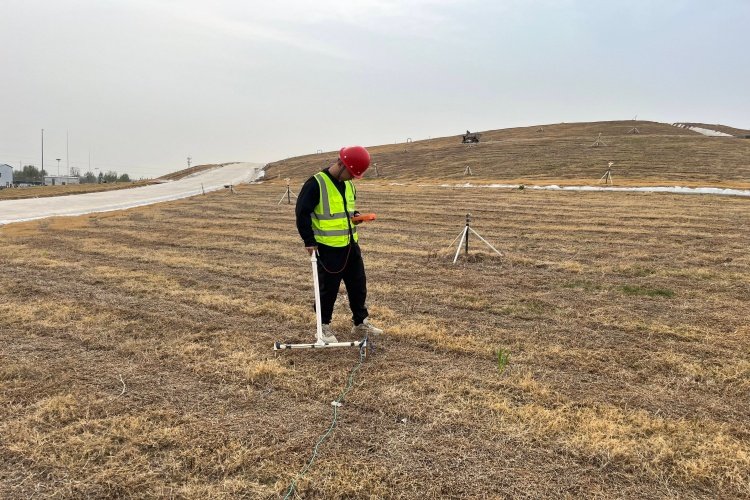
This is the most common and widely used technique for liners covered by soil or a limited thickness of waste. It involves placing a current source electrode in the leachate above the liner and a remote ground electrode. Technicians then walk across the surface with a pair of probes (a dipole) connected to a sensitive voltmeter, measuring the electrical potential gradient. A sudden spike or anomaly in the voltage reading indicates a leak in the immediate vicinity.
Fixed-Grid Method for Proactive Monitoring
For critical sites, a permanent monitoring system can be pre-installed. This involves placing a grid of electrodes or a conductive geotextile beneath the primary geomembrane during construction. By periodically applying a current and measuring the response across the grid, the system can continuously monitor for new leaks in real-time. This provides the most accurate and immediate warning but requires planning during the landfill's design phase.
Leak Detection via Leachate Collection System
In a double-lined landfill, the most direct method is monitoring the Leak Detection System (LDS) or secondary leachate collection pipe. The presence of significant liquid flow in this layer is a direct indication that the primary liner has been breached. Analyzing the chemical signature of this liquid can confirm its origin and help assess the severity of the leak.
Applicability and Limitations of Each Method
No single method is perfect for every situation. The dipole method is excellent for surveys under soil cover or shallow waste but loses accuracy as the waste thickness increases. The signal can be influenced by waste heterogeneity, moisture content, and buried metal objects.
Fixed-grid systems offer precise, real-time data but represent a significant upfront investment and cannot be retrofitted into existing landfills. Monitoring the secondary collection system is definitive proof of a leak, but it only tells you that a leak exists somewhere above it—it does not pinpoint the exact location. It's often the combination of these methods that yields the most conclusive results.
Pre-Testing Conditions and Site Requirements
Before conducting an electrical survey on an active landfill, the site must be properly prepared to ensure accurate results.
- Clear the Area: The first, and most disruptive, step may involve excavating and temporarily relocating the waste from the suspected leakage area. This is done with extreme care to avoid causing new damage.
- تنظيف السطح: The drainage gravel beneath the waste is often clogged with sludge and biological matter. This must be thoroughly cleaned, typically by pressure washing, to remove conductive residues that could interfere with the test signals.
- Ensure Moisture: The cover material (soil or drainage gravel) must be uniformly moist to ensure good electrical conductivity. This often requires spraying the area with water before and during the test.
- Isolate Conductors: Any metallic objects that penetrate the liner, such as pipes or pumps, must be electrically isolated so they do not interfere with the survey.
These preparatory steps are critical. Without them, the background electrical noise can be too high to distinguish a true leak signal, rendering the test ineffective.
Interpreting Test Results in Operating Landfills
Interpreting the data from an in-service survey requires significant expertise. The technician is looking for characteristic signal patterns that indicate a leak, such as a sharp "bullseye" anomaly. However, they must also be able to differentiate these signals from background noise caused by variations in soil moisture, buried debris, or geological features.
The results are often presented as a confidence level rather than an absolute certainty. A strong, clear signal in a high-consequence area will be flagged as a high-priority leak, while a weak, ambiguous signal may be marked for further monitoring.
Leak Localization, Verification, and Risk Assessment
Once a potential leak is identified, the work isn't over. The next step is to verify the finding. This may involve cross-referencing the location with "as-built" drawings to see if there is a pipe penetration or seam nearby. Data from nearby groundwater monitoring wells can also help confirm if contaminants are appearing where the model predicts they should.
If a leak is confirmed, it must be prioritized. A small leak in the center of a massive cell, far from any groundwater receptors, poses a different level of risk than a major leak on a side slope directly above a sensitive aquifer. This risk assessment helps determine the urgency and scale of the response.
Response Strategies After Leak Identification
Discovering a leak in an operating landfill prompts a tiered response strategy.
- Operational Controls: An immediate short-term response might be to lower the leachate level in that area of the landfill. If the leak is on a side slope, reducing the hydraulic head can significantly decrease the leakage rate while a permanent solution is planned.
- Targeted Repair: For significant, accessible leaks, the only permanent solution is excavation and repair. This involves carefully removing the overlying waste and soil, exposing the damaged area of the geomembrane, and performing a patch repair according to industry standards. The area is then re-tested before being covered again.
- Enhanced Monitoring: If a repair is not immediately feasible due to the leak's location under a massive amount of waste, the strategy may shift to containment and enhanced monitoring. This could involve installing new downstream monitoring wells to track the plume and developing a contingency plan for future action.
Integrating Integrity Testing into Long-Term Landfill Management
Geomembrane integrity testing should not be a one-time emergency procedure. It should be integrated into a landfill's long-term operational and environmental management plan. This involves scheduling periodic surveys, especially after events that could potentially damage the liner, such as major storms or changes in operational procedures.
The data from integrity testing should be used in concert with the results from the leachate and groundwater monitoring programs. Together, these data sets provide a comprehensive picture of the landfill's containment performance, allowing operators to manage risks proactively and demonstrate ongoing compliance to regulators.
Conclusion:
Identifying leaks in an active landfill is a complex but necessary task for ensuring long-term environmental protection. By selecting the appropriate electrical testing methods, properly preparing the site, and using expert interpretation, operators can effectively locate and assess leakage risks. This proactive approach allows for targeted repairs and informed management decisions, ultimately safeguarding our groundwater and ensuring the integrity of the facility for its entire operational life.