

Your beautiful new retaining wall is bulging after just a few years. All that time and money you invested is now at risk, as the immense pressure from the soil behind it threatens a total collapse.
Geogrids work by transforming loose soil into a solid, reinforced block. This composite mass acts as part of the wall itself, transferring the immense pressure away from the wall face and deep into the reinforced soil, preventing failures and allowing for taller, stronger walls.
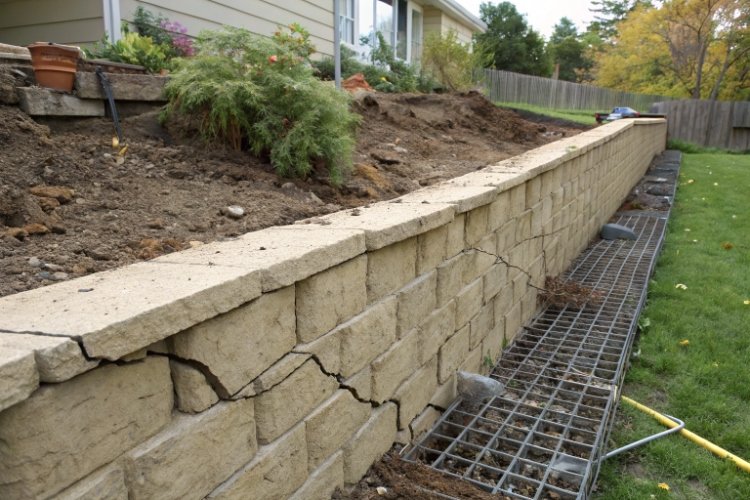
From my experience shipping geogrids to landscape contractors, the most common mistake is thinking of a retaining wall as just the blocks you can see. The real strength of a modern wall isn't in the face; it’s hidden in the soil behind it. Geogrid is the technology that unlocks this hidden strength, turning a simple stack of blocks into a powerful, gravity-defying structure that can last a lifetime.
What role do geogrids play in reinforcing landscaped retaining walls?
You're stacking heavy concrete blocks, so you assume the wall's weight is what holds the soil back. This works for very short walls, but as you go higher, this logic quickly leads to failure.
Geogrids don't just "prop up" the wall. They are laid in layers to interlock with the backfill, creating a large, stable, composite block of reinforced earth that resists failure as a single, massive unit.
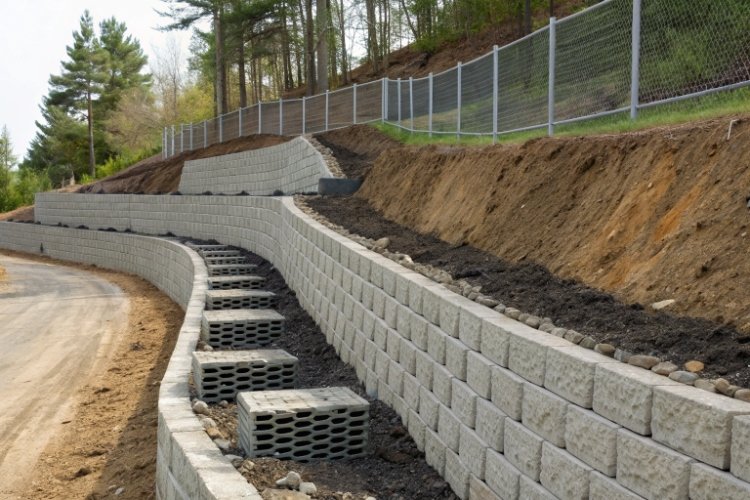
The concept is similar to how steel rebar reinforces concrete. Loose soil has very little tensile strength—it can't resist being pulled apart. The geogrid acts like a net, giving the soil that missing tensile strength.
Creating a Composite Soil Mass
When you lay a sheet of geogrid and compact soil over it, the soil particles punch through the grid's openings. This creates a powerful mechanical interlock. The friction between the soil and the grid's ribs also helps lock it in place. When you do this in multiple layers, you are no longer dealing with a pile of loose dirt. You have created a single, coherent, reinforced soil mass. This new, heavier mass is now so stable that it becomes the retaining structure, and the decorative blocks on the front are just the face.
How do geogrids enhance soil stability and load distribution behind walls?
The ground behind your wall is always pushing. After a heavy rain, that pressure can double, becoming an unstoppable force that causes your beautiful wall to bulge, crack, or even topple over.
Geogrids intercept the horizontal pressure from the soil and transfer it deep into the backfill. This dramatically reduces the force pushing directly on the wall face by up to 60%, preventing bulging and catastrophic failure.
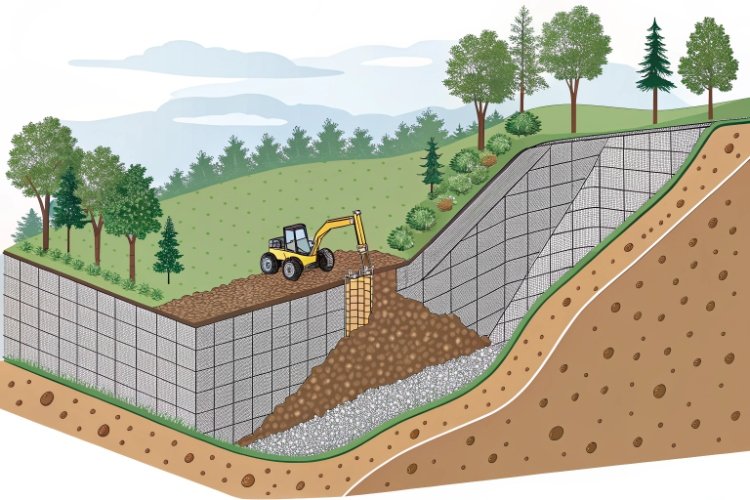
Think of the geogrid layers as anchors extending deep into the hillside. When the soil tries to push forward against the wall, it's not just pushing against the blocks; it's now forced to pull against these long, strong, anchored layers. This fundamentally changes the physics of the entire system.
Quantifying the Pressure Reduction
Studies have shown just how effective this is. The lateral earth pressure is the force trying to knock your wall over. Adding geogrid has a direct and measurable impact on this force.
| Geogrid Reinforcement Level | Average Reduction in Earth Pressure |
|---|---|
| Single Layer | 35% - 40% |
| Three Layers | 40% - 60% |
This means a wall that would have otherwise failed is now well within its safety limits. The pressure isn't gone; it's just been redirected. Instead of concentrating all its force on the back of the wall blocks, the stress is now distributed horizontally along each geogrid layer, safely dissipating it into the large, stable soil mass you created.
In which landscaping retaining wall designs are geogrids most effective?
You want to build a tiered garden on a steep slope, or maybe a wall to support the edge of your new driveway. A simple gravity wall is too weak and a solid concrete wall is too expensive and ugly.
Geogrids are essential for any segmental block wall over 3-4 feet (about 1 meter) tall. They are also critical for walls supporting heavy loads like driveways, for building tiered walls, and for constructing any wall on poor or unstable soil.
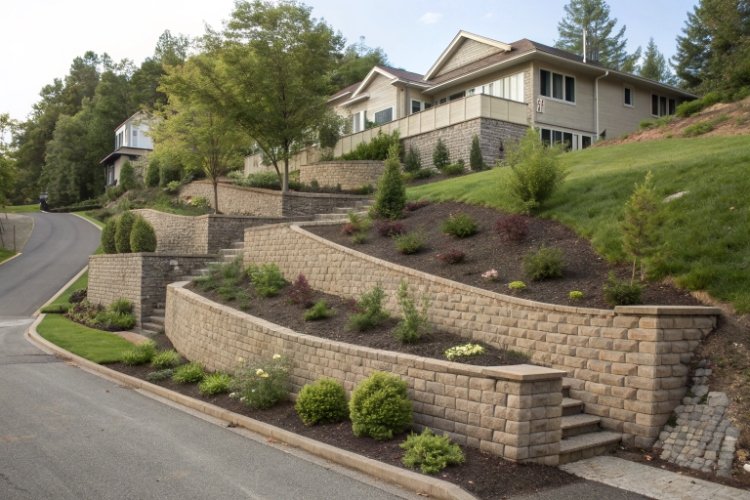
Geogrids make ambitious landscape designs safe, affordable, and practical. I've seen them used in a wide range of applications where traditional walls would simply not be feasible.
Here are the most common scenarios where geogrids are not just an option, but a necessity:
- Tall Walls: Any segmental retaining wall (the kind made from interlocking concrete blocks) over 3-4 feet high requires geogrid reinforcement to be stable. Geogrids allow these walls to be built to heights of 15 feet or more.
- Tiered Walls: For creating level terraces on a steep hillside, each level of a tiered wall system must be properly reinforced to ensure the upper wall doesn't put too much pressure on the lower one.
- Walls with Surcharges: A "surcharge" is any extra weight on top of the soil behind the wall. This includes things like driveways, patios, or even just a steep slope behind the wall. Geogrids are required to handle this additional pressure.
- Poor Soil Conditions: If you are building on sandy or weak soil, geogrids create the necessary stability to ensure a long-lasting wall.
How can proper geogrid selection improve durability and service life of landscape walls?
You're building this wall to last a lifetime, not just a decade. But using the wrong type of reinforcement can lead to slow, gradual stretching and an eventual failure that happens so slowly you don't see it until it's too late.
Select a geogrid with high tensile strength at low elongation, often called "low creep." This ensures the grid won't stretch over time under the constant load of the soil, maintaining the wall's integrity for a design life of over 100 years.
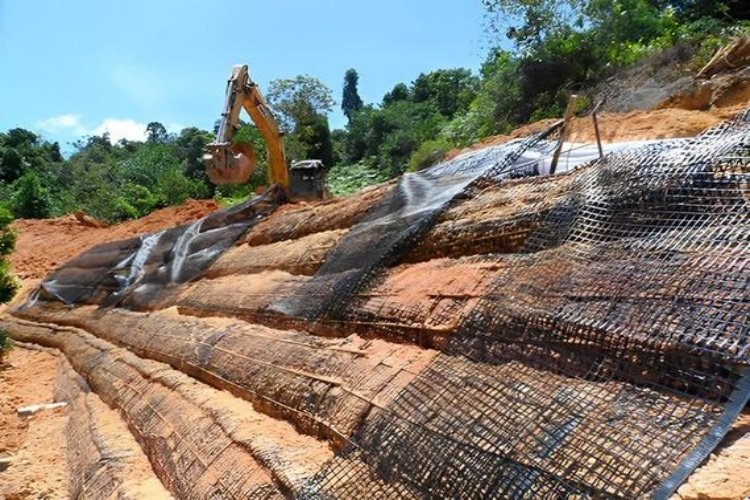
When I consult with engineers and contractors, we always focus on two key properties that determine long-term performance. It isn't just about raw strength.
Key Properties for Durability
- Material: Look for grids made from high-strength polymers like polypropylene (PP) or polyester (PET). These materials are inert and will not rot or degrade in the soil, ensuring a design life that often exceeds 100 years.
- قوة الشد & Creep: Tensile strength is how much force the grid can take before it breaks. But more important for a retaining wall is زحف. This is the material's tendency to slowly and permanently stretch when under a constant load. A high-quality geogrid will have very low creep, meaning it holds its shape and keeps the wall stable for decades. A cheaper material might stretch over time, allowing the wall to slowly bulge and fail.
By choosing a rigid, low-creep geogrid, you are locking in the wall's stability for the long term. It's a one-time investment that guarantees peace of mind and structural integrity for generations.
خاتمة
Geogrids create a strong, stable soil mass behind your wall. This reduces pressure, allows for taller and more creative designs, and ensures your landscape wall is built to last a lifetime.