

In the diverse world of geosynthetics, Geocells (Cellular Confinement Systems) are unique. Unlike a geogrid or a geotextile which function as 2D planar reinforcements, a geocell is a 3D structure. However, a common mistake we see in project inquiries is treating the geocell as a magic "standalone" solution.
Engineers and contractors often ask us, "Will this geocell hold up a 50-ton truck on this swamp?" The honest answer is: The geocell alone will not. The نظام will.
In reality, a geocell is merely a container. Its performance depends entirely on what is underneath it, what is inside it, and how these layers interact. A 150mm deep geocell placed directly on aggressive clay without separation will fail just as fast as no geocell at all.
This article explains how different geocell-based configurations—Single-Layer, Multi-Layer, and Composite Systems (with Geotextiles or Geogrids)—function to solve specific ground improvement challenges. We move beyond product specifications to discuss the system architecture that actually carries the load.
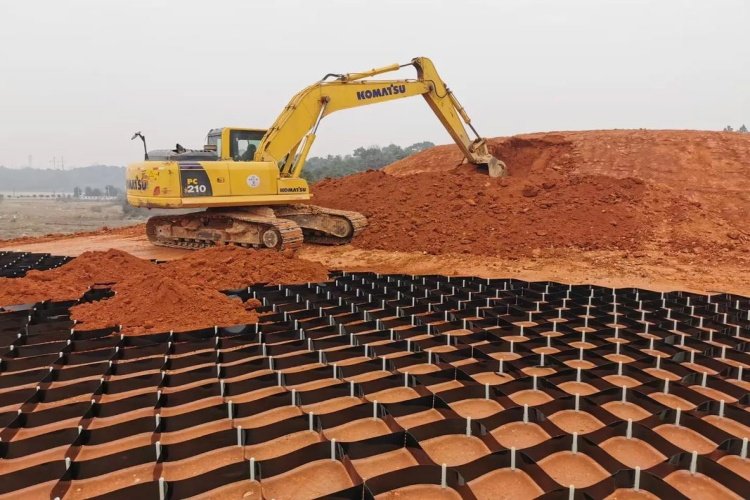
Ground improvement is not about buying the strongest plastic; it is about designing the correct interaction between soil and structure. Here is how professional engineers configure these systems.
Understanding Geocell-Based Design Configurations
Before selecting a cell depth or weld spacing, we must correct a fundamental concept: The difference between a "product" and a "configuration."
What Does “Design Configuration” Mean in Ground Improvement?
A "Design Configuration" refers to the specific stack-up of materials (the stratigraphy) used to achieve a required bearing capacity or modulus improvement.
If you buy a high-quality HDPE geocell with a 20kN/m seam strength but install it with rounded river gravel on a subgrade with a CBR (California Bearing Ratio) of 1%, the system will fail. The stones will rotate like ball bearings, and the soft subgrade will swallow the cell.
Conversely, a "weaker" geocell installed with angular crushed stone over a robust woven geotextile might perform perfectly.
Configuration distinguishes the amateur from the professional. It involves deciding:
- Do we need separation?
- Do we need basal reinforcement (grid)?
- Do we need multiple layers of confinement?
- What is the specific friction interface between layers?
Geocell as Part of a Confinement System
The core value of a geocell is Confinement.
When a vertical load is applied, the soil tries to spread laterally (Poisson's ratio effect). The geocell walls continuously push back against this spread. This creates "Hoop Stress," effectively increasing the shear strength of the infill material through apparent cohesion.
However, confinement is a relationship.
- "Up and Down" Constraints: The cell needs a floor (subgrade or geotextile) to prevent the infill from punching through the bottom.
- "Interaction" Constraints: The cell walls must have enough texture to lock into the soil.
Therefore, we never sell "just a geocell." We supply a "Confinement Mechanism" that relies on the surrounding layers to function.
Single-Layer vs Multi-Layer Geocell Systems
The most basic configuration question is verticality: Do we place one layer, or do we stack them?
Single-Layer Geocell System
This is the most common configuration for road base stabilization, parking lots, and erosion control.
- Structure: A single mattress of geocells (typically 100mm, 150mm, or 200mm deep) filled with aggregate.
- Function: It acts as a semi-rigid slab or a "beam." It distributes concentrated wheel loads over a wider area of the subgrade, effectively reducing the contact pressure.
- Target Application: Moderate soft soils (CBR 1.5% - 3.0%), unpaved access roads, and pavement base reduction.
In a single-layer system, the mechanics are defined by the "Beam Effect." The confined layer creates a stiffened mattress that resists bending. The key design goal here is to ensure the mattress is thick enough so that the stress transferred to the subgrade is lower than the subgrade's bearing capacity. Only using a 75mm cell for a heavy truck road is a common failure—it simply isn't thick enough to distribute the load.
Multi-Layer Geocell System
Sometimes, one layer is not enough. A multi-layer system involves stacking geocells directly on top of one another, often with an offset pattern (like bricklaying).
- Why Stack? You are essentially building a gravity structure or a massive, ultra-deep beam.
- The Benefit: A multi-layer system creates a structure with massive bending stiffness. It is also used to build vertical retaining walls or steep embankments where the face of the cell is exposed.
- Concept Misconception: Stacking layers is not always better for flat ground. If the subgrade is decent, adding a second layer of geocell might be a waste of budget compared to just using a better aggregate. Multi-layer is reserved for extreme geometry or extreme loads.
How to Decide: Single or Multi-Layer?
We generally guide clients using this logic:
- التحكم في التشوه: If the allowable settlement is very low (e.g., under a railway line), a single layer might flex too much. A multi-layer system acts like a rigid foundation block.
- Topography: If you are building a vertical wall or a slope steeper than 45 degrees, you are automatically in the realm of Multi-Layer configurations (step-walls).
- extreme Loads vs. Weak Soil: If you have a 100-ton axle load on a swamp, a single 200mm layer is likely insufficient to prevent punching shear. A double-layer system (400mm total confinement) provides the necessary rigidity to bridge the soft spots.
Geocell + Geotextile Composite Systems
In 95% of ground improvement projects involving geocells, a geotextile is required. However, its role is frequently misunderstood.
Role of Geotextile in Geocell Applications
The geotextile is not there to reinforce the structure; it is there to protect the confinement mechanism.
If you place a geocell filled with clean stone directly onto a muddy clay subgrade, traffic vibration will cause "pumping." The wet clay will rise into the geocell, and the heavy stone will sink into the clay.
Once clay mixes with your aggregate, the friction angle drops. The confinement effect is destroyed. The geocell essentially becomes a bag of mud.
- Function: Separation and Filtration. The geotextile acts as a permeable barrier that allows water to drain out of the cell while preventing subgrade fines from migrating up.
- Secondary Function: Interface Friction. A rough non-woven geotextile provides a good friction surface for the bottom edge of the geocell to "bite" into, preventing lateral sliding during installation.
Typical Configuration for Soft Subgrades
For a standard access road over soft soil, the configuration is strictly:
- Subgrade
- Non-Woven Geotextile (High permittivity, adequate puncture strength)
- Geocell (Expanded and pinned)
- Infill Material (Angular aggregate)
- Running Surface
Omit the geotextile, and you reduce the lifespan of the road by 70%. We have seen projects where contractors saved $0.50/sqm by removing the geotextile, only to spend $20/sqm repairing the road six months later when the aggregate contaminated.
Common Design Errors in Geocell–Geotextile Systems
- using Woven instead of Non-Woven: While high-strength woven geotextiles are strong, they often have poor water permeability (flow rate). If water gets trapped under the road, pore pressure builds up, and the road becomes a "waterbed."
- Lack of Separation at Edges: The geotextile must wrap up the sides of the geocell installation (encapsulation). If you leave the sides open, mud will enter from the flanks.
- Ignoring Puncture Integrity: During the infilling process, rocks are dropped on the cell. If the geotextile is too thin (e.g., <150gsm), it tears. A torn separator is a useless separator.
Geocell + Geogrid Composite Systems
For the most challenging sites—peat bogs, marshes, or areas with potential voiding—we introduce a third player: The Geogrid.
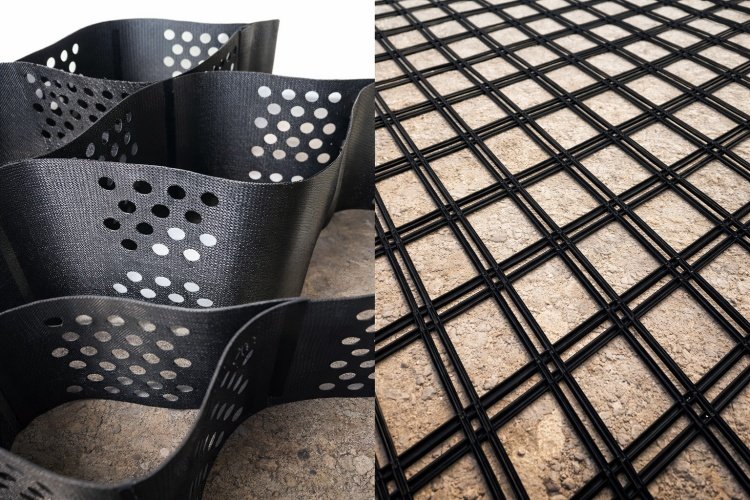
Different Functions: Geocell vs Geogrid
It is crucial to understand the distinction:
- Geogrids work through Tension. They act like a hammock or a tensioned membrane that holds the soil up.
- الخلايا الجغرافية work through Compression/Confinement. They act like a stiff slab.
Why Combine Geocell and Geogrid?
We combine them when the subgrade is so weak (CBR < 0.5%) that the geocell mattress itself might sink locally or tilt.
In this "Composite Configuration":
- أ Biaxial or Triaxial Geogrid is placed at the very bottom (sometimes over a geotextile). This provides the "Tensor Membrane Effect," bridging large soft spots or voids.
- The Geocell is placed on top of the grid. The geocell provides the stiffness to run vehicles, while the grid prevents the whole system from global failure.
This uses the strengths of both: The grid handles the deep global stability, and the cell handles the local wheel loads and rutting resistance.
Typical Heavy-Duty Applications
We see this configuration frequently in:
- Port Container Yards: Where massive stackers create point loads that would punch through a geocell, but the subgrade is reclaimed silt.
- Railway Ballast Reinforcement: The grid prevents lateral spread of the ballast foundation, while the cell confines the ballast to prevent particle attrition.
- Mining Haul Roads: Where 300-ton trucks operate. The Geogrid absorbs the tensile strains at the base of the embankment, allowing the Geocell to focus on confining the running surface.
Confinement System Thinking in Ground Improvement Design
As exporters and technical consultants, our job involves more than shipping pallets of HDPE. We review designs to ensure the "System" is viable.
From Material Selection to System Performance
The biggest failure in our industry is the "Catalog Specification" mindset. Engineers pick a geocell from a catalog based on seam strength but ignore the system context.
A high-spec geocell filled with rounded river sand will perform worse than a mid-spec geocell filled with crushed angular granite.
Why? Because the system relies on the interlock of the infill. The material choice implies a system design choice.
Key Components of a Geocell-Based Confinement System
When we propose a solution, we define the entire vertical slice:
- The Subgrade: What is the bearing capacity? Do we need to pre-consolidate?
- The Separation Layer: Ensuring the integrity of the fill.
- The Confinement Layer (Geocell): The height and weld spacing determines the beam stiffness.
- The Infill: The "skeleton" of the system.
- The Anchoring System: How is the system held in tension during installation?
Why System-Level Design Matters
Focusing on the configuration protects the buyer. If you only specify "Geocell parameters," a contractor might buy the right cell but install it without a geotextile separator to save money. By specifying a "Confined Soil System Configuration," you mandate the interaction of layers.
Ultimately, the geocell is only as good as the layers above and below it.
خاتمة
Geocells are powerful tools for ground improvement, but they are not magic wands. They derive their strength from Confinement, and confinement is a result of a system, not a single product.
- Single-Layer Systems work by distributing loads like a beam.
- Multi-Layer Systems work by building massive gravity blocks.
- Composite Systems (with Geotextiles) ensure long-term functionality by preventing contamination.
- Composite Systems (with Geogrids) add tensile capacity for the weakest soils.
For engineers and contractors, the success of a project lies in selecting the correct Typical Design Configuration for the specific site conditions. It is not about simply asking for "the strongest geocell," but asking, "what system configuration creates the stable platform I need?"
At Waterproof Specialist, we help clients configure these layers to ensure that the material we ship becomes the solution they need.