

Earth structures fail when extreme pressures push outward. Without proper anchoring, retaining walls and steep earth slopes face catastrophic collapse. Uniaxial geogrids solve this by locking soil in place against immense, one-directional forces, ensuring structural integrity even under massive loads.
This guide helps infrastructure buyers and engineers understand exactly when to specify uniaxial geogrids. It covers core applications like MSE retaining walls, steep slopes, and bridge abutments, explaining how directional tensile strength secures heavy loads and when these materials out-perform alternatives in real-world construction.
Selecting the right geogrid requires matching the material’s structural behavior with the precise physical forces acting on your project site.
Why Uniaxial Geogrids Are Designed for Directional Reinforcement
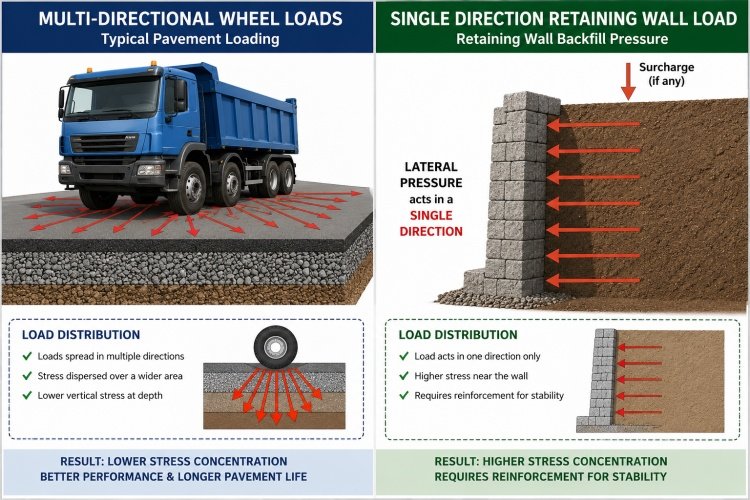
To make the right purchasing decision, you first must understand how earth pressure interacts with synthetic materials. When a massive volume of soil is piled vertically—whether behind a concrete wall or on a hillside—gravity and internal shearing forces push horizontally against the face of that structure. The pressure is strictly directional; it desperately wants to push outward and spill down.
Uniaxial geogrids are manufactured specifically to counteract this single-direction force. During production, polymer sheets (typically High-Density Polyethylene or Polyester) are punched and then stretched heavily in the longitudinal direction. This stretching process physically aligns the long-chain polymer molecules, generating extraordinary tensile strength and stiffness along the length of the roll, known as the Machine Direction (MD).
In my experience supplying export markets, purchasing managers sometimes wrongly assume that a geogrid must be equally strong in all directions to be effective. This is a costly misunderstanding. If a retaining wall is only experiencing thrust forcing it away from the hillside, any significant strength engineered into the cross-direction of the grid is essentially wasted plastic. Uniaxial geogrids represent a highly optimized reinforcement strategy. By concentrating almost 100% of the material’s structural strength against the exact vector of the soil load, they provide maximum anchoring power at a highly efficient cost point.
Retaining Wall Applications
The single largest sector we supply uniaxial geogrids to is the global retaining wall market. As usable land becomes scarcer, especially in mountainous regions and dense urban centers, developers are forced to build massive vertical earth structures. Uniaxial grids act as the primary structural tie-backs that make these vertical ascents safe and permanent.
Mechanically Stabilized Earth (MSE) Walls
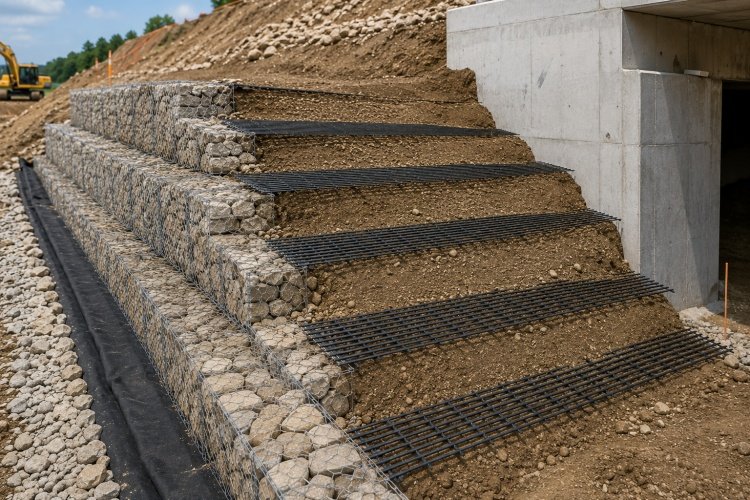
In major infrastructure projects—like highway expansions or port developments—MSE walls are the standard. Instead of relying purely on a massive, expensive concrete foundation to hold back the soil, MSE systems use the internal weight of the soil itself to create stability. Layers of uniaxial geogrids are placed horizontally between lifts of compacted aggregate and firmly connected to large concrete facing panels.
When the earth behind the wall tries to push the panels outward, the soil particles lock into the apertures of the geogrid. The directional tensile strength of the uniaxial grid resists this movement, effectively transforming loose backfill into a solid, cohesive, massive block of earth. I frequently review bills of quantities for MSE walls requiring grids with ultimate strengths ranging from 80 kN/m all the way up to extreme 200 kN/m specifications, depending on the wall height.
Segmental Retaining Walls (SRW)
Similar to MSE walls but generally utilizing smaller, dry-stacked modular concrete blocks, SRWs are extremely common in commercial and residential developments. Here, the grid must not only reinforce the earth behind the wall but must also maintain a phenomenally strong connection directly with the concrete blocks.
A common issue we resolve for buyers is matching the geogrid aperture size to the block type. If a buyer purchases a uniaxial grid with cross-ribs that are too thick or apertures that do not align with the friction pins of the segmental blocks, the connection will fail under load. Proper procurement requires confirming that the specified uniaxial grid is compatible with the block system the engineering team has selected.
High Retaining Structures
When structures exceed 10 or 15 meters in continuous height, the lateral active earth pressure at the base of the wall becomes astronomical. In high retaining structures, settlement and continuous stress are massive concerns.
For these extreme loads, we supply heavy-duty HDPE or highly coated PET uniaxial geogrids. Often, project teams face budget pressure and attempt to save money by shortening the embedment length of the geogrid layers behind the wall. This is dangerously incorrect. The industry standard usually dictates that the grid length must extend back into the soil at least 70% of the total wall height to maintain internal friction. Cutting corners on grid length will cause the entire reinforced soil block to overturn.
Reinforced Slopes and Embankments
When natural topography limits construction space, project engineers must build earth embankments steeper than the soil’s natural angle of repose. Left alone, most soil will naturally slump to an angle of roughly 30 to 45 degrees. With the inclusion of uniaxial geogrids, engineers can safely design slopes up to 70 degrees, saving massive amounts of required fill material and reducing costly land acquisition.
Steepened Slopes
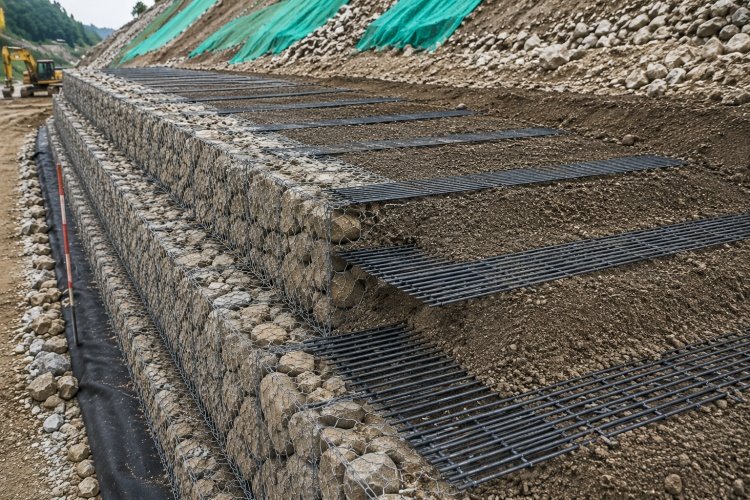
In steep slope applications, layers of uniaxial geogrid are laid horizontally back into the hill. Rather than vertical concrete panels, the slope facing is typically wrapped with the geogrid itself or protected by a turf reinforcement mat combined with hydroseeding to establish deep-rooted vegetation.
We recently exported materials for a major highway widening project cutting through a mountainous terrain. The contractor faced a severe drop-off and lacked the right-of-way space to build a gently sloping embankment. By specifying varying strengths of uniaxial geogrids stacked at rigid vertical intervals, they successfully constructed a near-vertical reinforced slope. The geogrid intercepts the internal slip planes of the packed earth, preventing deep-seated rotational failure while allowing vegetation to grow naturally on the outward face.
Highway and Railway Embankments
Heavy infrastructure embankments face continuous stress. Uniaxial geogrids play a key role in stabilizing railway and highway embankments over variable terrain. When building up high earth ramps to approach overpasses, the longitudinal strength of the geogrid locks the soil matrix tight. This stops the embankment shoulders from slowly bulging outward outward over decades of exposure to seasonal rain and high-frequency traffic vibration.
Bridge Abutments and Heavy Load Structures
Bridge abutments must support immense, unforgiving weight. Traditionally, engineers have relied entirely on deep-driven steel or poured concrete piles to carry the load of the bridge deck down to bedrock. This process is highly expensive and adds months to a construction schedule.
Increasingly, transportation departments globally are adopting Geosynthetic Reinforced Soil - Integrated Bridge Systems (GRS-IBS). In these applications, bridge abutments are constructed precisely like high-density MSE walls. Extremely closely spaced layers of high-strength uniaxial geogrid are sandwiched between thoroughly compacted granular backfill.
Because the spacing between the geogrid layers is so tight—often only 20 to 30 centimeters—the granular soil becomes a rock-solid, continuously reinforced composite structure. The bridge beams are then seated directly on top of this reinforced soil block.
When supplying materials for heavy load abutments, we have to ensure the selected uniaxial grid features ultimate creep resistance. The static load of the concrete bridge, combined with the extreme dynamic loads of heavy freight trains or thousands of commercial trucks, means the geogrid will face permanent, unrelenting downward and outward pressure. Using inferior resins that stretch over time will result in the bridge deck settling and fracturing. Buyers on these projects rigorously verify long-term design strength before issuing a purchase order.
Why Uniaxial Geogrid Performs Better in These Applications
When industrial buyers reach the procurement phase, they must justify specific material purchases over traditional reinforcement methods like heavy steel mesh ladders or relying purely on enormous concrete foundations. Understanding why uniaxial geogrids excel in vertical and steep earth structures guarantees you are securing the most reliable material for your site.
Directional Reinforcement Efficiency
As highlighted earlier, the cost-to-performance ratio is superior. You are not purchasing expensive biaxial cross-ribs that provide zero benefit to a retaining wall facing one direction. All of the raw polymer weight is maximized to fight the exact earth pressure attempting to knock the structure down.
Long-Term Stability and Absolute Creep Resistance
In civil engineering, structures are designed to last 75 to 120 years. Extruded HDPE and custom-coated PET uniaxial geogrids are chemically inert and highly resistant to biological degradation. In environments with aggressive, high-chloride soils or changing water tables, traditional steel reinforcement straps rust, decay, and ultimately snap. Premium uniaxial geogrids ignore these harsh chemical conditions. More importantly, when specifically formulated to prevent creep (the slow elongation of plastic under permanent load), they maintain dimensional stability for a century.
Soil Interlocking Capability
Uniaxial geogrids do not rely on friction alone; they rely on direct mechanical interlocking. When high-quality crushed rock is compacted onto the grid, those jagged stones wedge violently into the open apertures. The thick longitudinal ribs block the stones from moving horizontally. This physical interlock transfers the extreme stress out of the weak backfill soil and directly into the incredibly strong tensile bands of the geogrid.
| Reinforcement Material | Primary Benefit | Common Application Issue |
|---|---|---|
| Uniaxial Geogrid (HDPE) | High chemical resistance, zero rust, excellent creep limits | Stiffer rolls can be difficult to manage in sub-zero winter construction |
| Uniaxial Geogrid (PET) | Extremely high tensile strength, flexible installation | Vulnerable to hydrolysis in highly alkaline (pH > 9) soil environments |
| Galvanized Steel Strips | Non-stretch, very high initial stiffness | Prone to severe corrosion in coastal or high-chloride fill dirt |
Applications Where Uniaxial Geogrid May Not Be the Best Choice
Understanding material limitations is critical to preventing on-site failure. Uniaxial geogrids are built to counter forces acting strictly in one direction. You should never purchase a uniaxial geogrid for horizontal subgrade stabilization or road base reinforcement.
If an engineer is designing an access road, a heavy equipment parking lot, or industrial pavement over soft, muddy soil, the traffic loads act completely differently. When a loaded haul truck drives over a road base, its massive tire weight pushes down and spreads the weak soil outward in 360 degrees.
If you place a uniaxial geogrid beneath a road, it will successfully stop the soil from moving in the machine direction, but the soil will instantly push out in the unsupported cross-direction. The road will rut deeply and fail laterally. For pavement stabilization and multi-directional traffic loads, a rigid biaxial or triaxial geogrid is strictly required. Matching the grid geometry to the load direction is the most fundamental rule of geosynthetic procurement.
Gevolgtrekking
Uniaxial geogrids are the non-negotiable structural anchor for modern MSE walls, steepened earth slopes, and heavy-duty bridge abutments. Understanding their directional tensile strength allows buyers to optimize project safety while drastically reducing earthwork and land footprint costs. If your project faces extreme, single-directional earth pressures, selecting the correct uniaxial material specification is the single most critical procurement decision you will make.