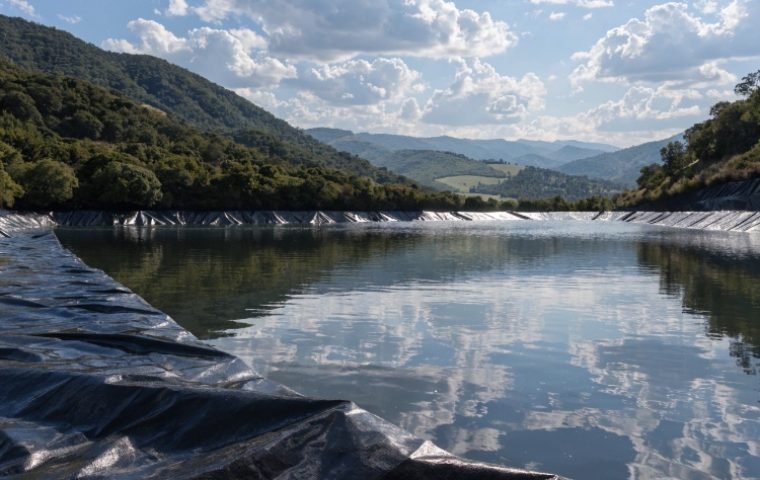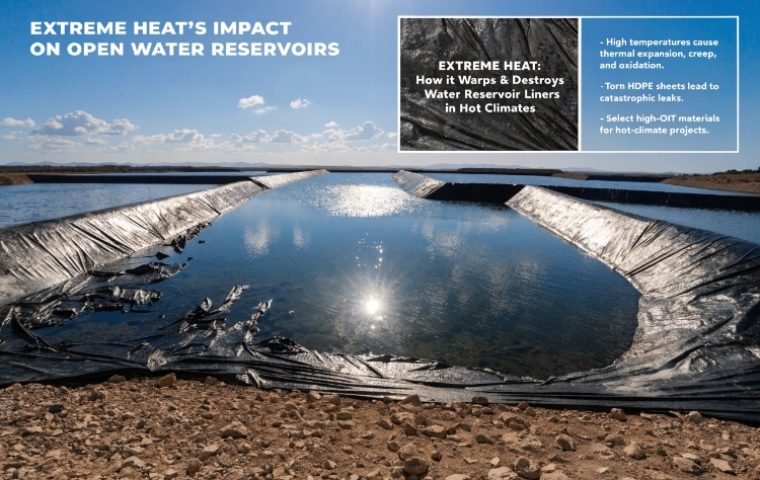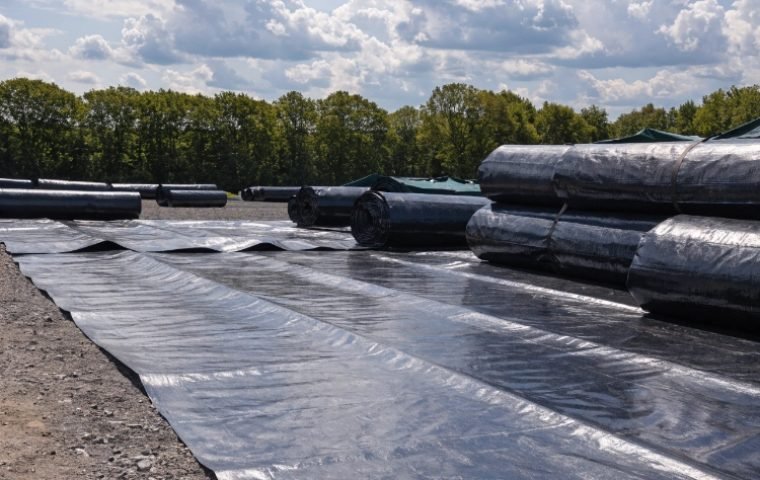


Pushing anaerobic digester temperatures maximizes methane yield, but it comes at a hidden cost: your liner's lifespan. While biology thrives in heat, standard polyethylene rapidly degrades. A geomembrane that lasts 50 years in a cool pond may fail in just 15 years inside a hot, aggressive biogas reactor.
Temperature is the most critical factor in biogas liner longevity. Operating even 10°C above standard limits can cut material life by 50%. This guide explains thermal aging, stress cracking risks, and how to select High-Temperature (PE-HT) geomembranes to ensure your containment system survives the full project lifecycle.
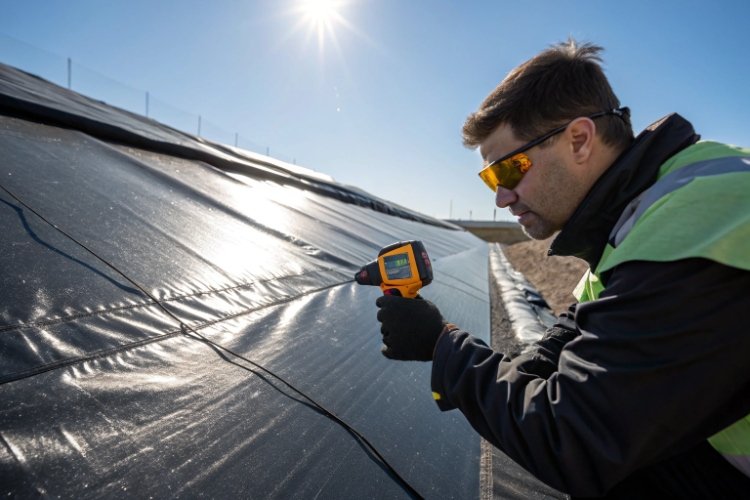
Understanding the relationship between heat and polymer performance is the first step toward preventing premature failure.
Why Temperature Matters in Anaerobic Digestion Applications
In the world of geosynthetics, we often treat temperature as a static environmental variable. In landfill or reservoir applications, the temperature is dictated by the climate and the soil. However, in anaerobic digestion (AD), temperature is an engineered process variable. It is deliberately elevated and controlled.
This fundamental difference changes how we must approach liner selection. We are no longer designing for a passive environment; we are designing for an active, heated chemical reactor.
Typical Operating Temperatures in Anaerobic Digesters
Anaerobic digestion relies on specific bacterial cultures that thrive in narrow temperature bands. The choice of temperature regime dictates the efficiency of the plant, but it also dictates the stress level on the geomembrane.
- Psychrophilic (≤20°C): These are essentially ambient temperature systems, common in simple covered lagoons in varying climates. From a liner perspective, these are low-stress environments. The methane generation is slow (0.05–0.1 m³/day), and the thermal degradation of the liner is minimal.
- Mesophilic (30–40°C): This is the global standard for industrial biogas. By heating the substrate to approximately 35°C, operators achieve a good balance of stability and output (0.3–0.5 m³/day). For standard HDPE geomembranes, this is the upper limit of "comfortable" operation. The material will age, but at a predictable rate.
- Thermophilic (45–60°C): High-performance plants often push temperatures to 50–55°C to maximize throughput and pathogen kill rates (0.4–0.6 m³/day). While biologically efficient, this is an extreme environment for polyethylene. Without specialized resin formulations, standard liners can degrade rapidly in this zone.
Localized High-Temperature Zones in Biogas Systems
A common mistake in design is assuming the temperature is uniform throughout the digester. Thermal modeling might show an average bulk temperature of 38°C, but the reality inside the tank is often different.
We frequently see "hot spots" where the geomembrane is subjected to temperatures far exceeding the design average. These occur near:
- Heating Coil Interfaces: Where the liner is in close contact with hot water or thermal oil pipes.
- Mixer Dead Zones: Areas where heated substrate accumulates and does not circulate, potentially creating localized heat pockets.
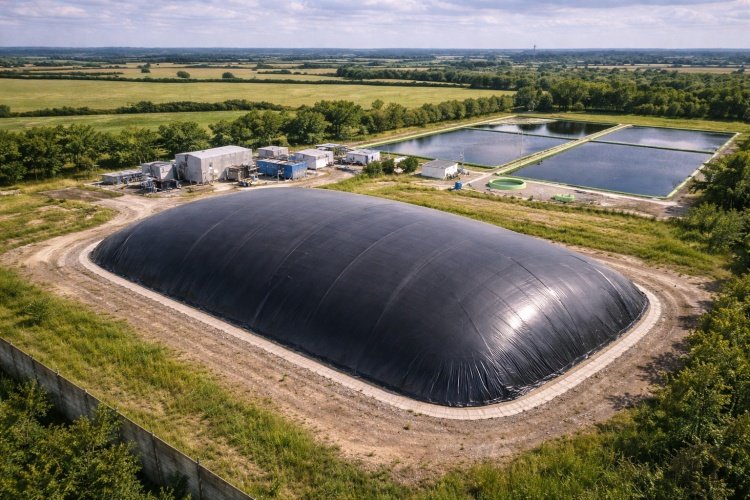
- Gas Headspace: In floating covers, the black surface absorbs solar radiation from above while receiving heat from the biogas below. On a hot summer day, the material temperature of a cover can easily exceed 70°C, even if the liquid below is only 35°C.
Why “Design Temperature” ≠ “Operating Temperature”
When an Engineering, Procurement, and Construction (EPC) firm sends us a specification, it often lists "Design Temperature: 35°C." However, we always ask for the maximum excursion temperature.
Biology is messy. Reactions can "run away," leading to temperature spikes. Heating systems can malfunction. A system designed for 35°C might spend weeks at 45°C during a system upset. If the geomembrane was selected with zero margin for error based strictly on the average temperature, these operational spikes consume the material's lifespan disproportionately fast. The "operating temperature" for liner selection should always be the worst-case scenario, not the best-case average.
Thermal Aging of Geomembranes: What Happens Over Time
To understand why heat kills liners, we have to look at the molecular level. A geomembrane doesn't just "melt" in a digester; it chemically ages. This process is invisible to the naked eye until the moment the material cracks.
Definition of Thermal Aging in Polymeric Geomembranes
Thermal aging is the irreversible change in the chemical and physical properties of a polymer due to exposure to heat. For Hoë-digtheid poliëtileen (HDPE), this is primarily an oxidation process. Heat provides the energy for free radicals to form, which then attack the polymer chains.
Once the polymer chains begin to break (chain scission) or cross-link (forming rigid networks), the material loses its essential properties. It stops being a flexible, tough barrier and becomes a brittle, wax-like sheet that can be snapped by hand.
Antioxidant Depletion Under Elevated Temperatures
High-quality geomembranes are fortified with a package of stabilizers and antioxidants (AO). Think of these antioxidants as "sacrificial soldiers." Their job is to intercept free radicals and neutralize them before they can attack the polymer backbone.
However, the supply of these soldiers is finite.
- Stage 1 (Depletion): During the first years of operation, the physical properties of the liner remain perfect. However, inside the material, the antioxidant reservoir is being drained. Heat accelerates this depletion exponentially.
- Stage 2 (Induction): Once the antioxidants are effectively gone, the polymer is left defenseless. This is the "induction period" where degradation begins but isn't yet catastrophic.
- Stage 3 (Failure): The physical properties plummet. Spanningskraakweerstand (SCR) drops to zero, and the liner fails.
In a 20°C environment, Stage 1 might last 100 years. In a 50°C environment, without specialized AOs, Stage 1 might be over in 5–7 years.
Impact of Thermal Aging on Mechanical Properties
The most dangerous aspect of thermal aging is that strength often remains high while ductility vanishes. A thermally aged liner might still have high tensile strength, meaning it is hard to pull apart. But it loses its elongation at break.
New HDPE acts like taffy; it can stretch 700% before breaking. Aged HDPE acts like glass; it might stretch only 10% before shattering. In a biogas lagoon, where the liner must flex with gas production and settle with the subgrade, this loss of ductility is fatal.
Long-Term Service Life vs. Short-Term Heat Resistance
Buyers often confuse "heat resistance" (melting point) with "thermal stability" (aging resistance). HDPE melts at around 135°C. Therefore, a buyer might think, "My digester is only 40°C, so I'm nowhere near the limit."
This is a dangerous fallacy. The material is structurally stable at 40°C, but it is chemically dying. We are not worried about the liner turning into a puddle; we are worried about how many years it can resist oxidation. Short-term heat resistance is irrelevant; long-term oxidative stability is everything.
Effects of Temperature Fluctuations and Thermal Cycling
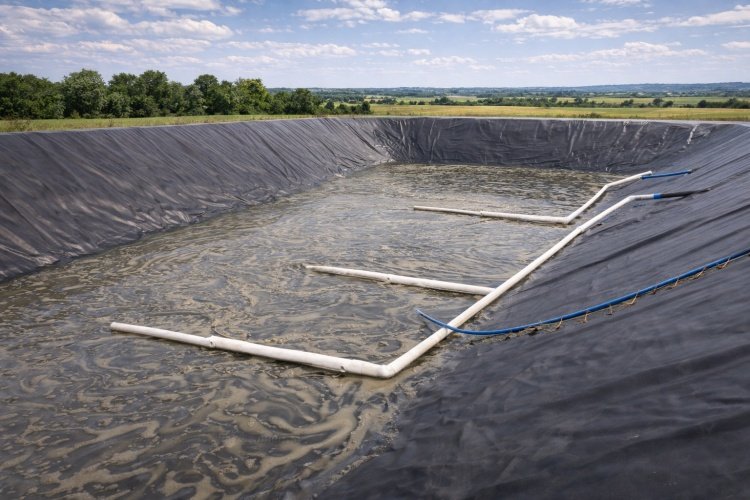
While constant high heat is a problem, fluctuating heat creates a mechanical nightmare. Biogas systems are dynamic, and the liner is constantly expanding and contracting.
Daily and Seasonal Temperature Variations
Biogas covers are subjected to a brutal thermal cycle.
- Internal Source: The digester liquid provides a constant baseline heat.
- External Source: The sun heats the black surface during the day, and the ambient air cools it at night.
In many regions, a cover can cycle from 15°C at night to 70°C at noon. In winter, the differential is even more extreme: the underside is bathed in 35°C gas, while the top side is covered in snow at -10°C. This creates a massive thermal gradient through the thickness of the sheet.
Thermal Expansion and Contraction of Geomembranes
Polyethylene has a very high coefficient of thermal expansion. For every 10°C change in temperature, a 100-meter long sheet of HDPE will expand or contract by approximately 12–15 cm.
Consider a hot summer day: the cover expands, forming large wrinkles and waves. At night, it cools and contracts, pulling tight like a drumskin. This daily movement—"The Accordion Effect"—physically fatigues the material.
Fatigue Stress on Seams and Welded Joints
The victims of this expansion and contraction are the seams and connections. A seamless sheet can handle this movement easily. But a welded seam acts as a rigid point in a flexible system.
When the sheet contracts at night, it generates tension (shear stress) across the welds. When it expands during the day, it generates compressive stress and bending forces as wrinkles form. Repeating this cycle over 365 days a year for 10 years results in thousands of stress cycles. If the weld has even a minor localized imperfection, this thermal fatigue will propagate it into a crack.
Why Thermal Cycling Often Causes Early Failures
We often see failures where the material itself analyzes as "healthy" (high retained antioxidants), but the liner has cracked along a wrinkle or a seam. This is Stress Cracking driven by thermal cycling.
Thermal cycling is particularly dangerous for "cristalline" materials like HDPE. The repeated bending at the top of a wrinkle, combined with surface oxidation from UV and heat, leads to brittle cracking along the ridge of the wrinkle. This is why managing thermal expansion through design is just as important as selecting the right chemistry.
Material Performance at Elevated Temperatures
Not all polyethylene is created equal when it comes to heat. The choice between resin types (HDPE vs. LLDPE) and formulations (Standard vs. High-Temp) defines the project's destiny.
HDPE Geomembranes in High-Temperature Digesters
Standard HDPE (High-Density Polyethylene) is the workhorse of the industry because of its chemical resistance and impermeability.
- Voordele: excellent resistance to the acids in condensate; low gas permeability.
- Nadele: Lower flexibility; susceptible to Environmental Stress Cracking (ESC) if not formulated correctly; rapid antioxidant depletion above 40°C.
For standard mesophilic digesters (≤35°C), high-quality GM13 HDPE is usually sufficient. However, for thermophilic systems (>45°C), standard HDPE is a risky choice unless specifically stabilized.
LLDPE and Flexible Polyolefin (fPP) Alternatives
LLDPE (Linear Low-Density Polyethylene) or fPP (Flexible Polypropylene) are often considered for covers due to their flexibility.
- LLDPE: Much better at handling thermal expansion/contraction without wrinkling as sharply as HDPE. However, its lower density means it is inherently more permeable to methane and slightly less resistant to chemical attack.
- High-Temp Resistance: Generally, LLDPE has lower thermal stability than HDPE. It softens at lower temperatures. While it handles the physical stress of cycling better, it may not handle the chemical stress of high-temperature oxidation as well as a premium HDPE.
Comparing Stiffness, Creep, and Thermal Fatigue Resistance
Stiffness is a double-edged sword. HDPE is stiff, which creates sharp wrinkles (bad for fatigue) but resists "creep" (stretching under load) well. LLDPE is soft, avoiding wrinkles, but it is prone to creep.
At 50°C, the creep rate of polyethylene increases significantly. If a floating cover is under tension, high temperatures will cause it to permanently elongate and thin out over time. This thinning weakens the barrier. For high-temperature, high-tension covers, a reinforced material or a highly crystalline HDPE is often preferred to resist this creep.
Material Selection for Liners vs. Covers
A common industry best practice is a hybrid approach:
- Bottom Liner: Gebruik HDPE. It is supported by the ground, so flexibility is less critical. The priority here is maximum chemical resistance against the leachate/sludge and high puncture resistance.
- Top Cover: Gebruik LLDPE of PE-HT (High-Temp Polyethylene). The cover needs to move, flex, and inflate. LLDPE handles the dynamics, while PE-HT handles the solar and process heat.
Temperature Effects on Seams and Installation Details
The impact of temperature begins before the plant is even turned on. The conditions during installation set the baseline for the liner's future performance.
Heat-Induced Stress Concentration at Welded Seams
A weld creates a "Heat Affected Zone" (HAZ) adjacent to the seam. During welding, the polymer structure in this zone is altered—crystallinity changes. This HAZ is typically the most brittle part of the liner.
When a digester heats up, the stress from thermal expansion accumulates at this transition zone between the flexible sheet and the rigid weld. If the operational temperature is high, the "tie molecules" holding the crystalline structures together in the HAZ are under constant attack, making seams the first place to fail.
Importance of Seam Design for Thermal Movement
In high-temperature applications, we cannot simply overlap and weld. We must design for movement.
- Slack: We intentionally install "slack" or extra material. A liner installed tight at 20°C will be under massive tension when it cools, but interestingly, in biogas, the risk is often expansion. A liner installed flat at 20°C will look like a wrinkled mess at 50°C.
- Compensation Loops: For pipe penetrations, we use "compensation loops" or flexible boot connections that allow the liner to expand away from the pipe without ripping the weld.
Installation Temperature Windows and Their Long-Term Impact
Installing geomembrane in extreme weather is a recipe for disaster.
- Welding too hot: If installing on a 40°C day with the sun beating down, the sheet temperature can be 70°C. Welding at this temperature risks "overcooking" the polymer, degrading the antioxidants right at the seam before the project starts.
- Welding too cold: Welding below 5°C risks brittle welds.
Manufacturers provide strict "weather windows." Ignoring them to rush a schedule compromises the 20-year thermal stability of the seam for a 2-day schedule gain.
Common Installation Mistakes in Biogas Projects
The most frequent error we see is bridging. This happens when the liner is installed across a corner or a slope change without being fully pushed into the corner. When the digester fills and heats up, the liquid pressure and softening material cause the liner to stretch into that void.
At 40–50°C, the material yields (stretches) much easier. Bridging that might hold at ambient temperature can lead to a catastrophic tear largely due to the reduced yield strength at operating temperatures.
Laboratory Testing and Standards Related to Thermal Performance
How do we prove a liner will last 30 years at 40°C? We can't wait 30 years to find out. We rely on accelerated laboratory testing.
Thermal Aging Tests for Geomembranes (ASTM & EN Methods)
The standard test is ASTM D5721 (Oven Aging). Samples are placed in a forced-air oven at 85°C for 90 days. After this "baking" period, they are tested to see how much antioxidant is left (OIT retention) and if they have retained their mechanical strength.
For standard applications, 90 days @ 85°C is sufficient. But for biogas, we often recommend extended testing—up to 180 days or at higher temperatures—to simulate the aggressive thermophilic environment.
Oxidative Induction Time (OIT) and Temperature Resistance
OIT (ASTM D3895) is the speedometer of liner life. It measures (in minutes) how long the material resists oxidation in pure oxygen at 200°C.
- Standard OIT: Measures fast-acting antioxidants.
- High-Pressure OIT (HP-OIT): Measures long-term stabilizers (HALS).
For biogas, High-Pressure OIT (ASTM D5885) is the more critical metric. It tells us about the "marathon runner" antioxidants that will protect the liner in year 15 and year 20. A liner with high Standard OIT but low HP-OIT might look good on a spec sheet but fail prematurely in the field.
Interpreting Accelerated Aging Data for Real Projects
We use the Arrhenius Equation to extrapolate lab data to the field. The general rule of thumb derived from this physics is: For every 10°C rise in temperature, the reaction rate doubles (and service life is halved).
If a liner is tested to last 100 years at 20°C:
- At 30°C: ~50 years.
- At 40°C: ~25 years.
- At 50°C: ~12.5 years.
This simple math explains why standard liners fail so quickly in thermophilic digesters.
Limitations of Laboratory Tests vs. Field Conditions
Lab tests are "dry" tests. They bake the liner in hot air. But in a digester, the liner is immersed in hot, acidic, biologically active liquid.
Liquid immersion accelerates antioxidant depletion. The antioxidants don't just react; they physically migrate out of the plastic and dissolve into the liquid. This "leaching" effect means that real-world biogas lifespans are often shorter than the dry Arrhenius prediction suggests.
Design Strategies to Mitigate Temperature-Related Degradation
Knowing the risks, how do we engineer a solution? We cannot change the temperature of the biology, so we must upgrade the system design.
Allowing for Thermal Expansion and Contraction
Designers must stop drawing liners as tight, straight lines.
- Wrinkle Management: On bottom liners, induce controlled wrinkles during installation to provide slack.
- Floating Cover Ballast: Use ballast weights that allow the cover to move up and down and expand laterally without putting tension on the perimeter anchor trench.
Proper Anchorage and Stress Relief Design
The anchor trench is where the liner is locked in place. If the liner shrinks in winter, the pullout force on the trench is massive. We recommend:
- Rounded Edges: Concrete edges should be radiused to prevent the liner from snapping over a sharp 90-degree corner when under thermal tension.
- Mechanical locks: In high-temp tanks, use mechanical batten bars that distribute stress evenly, rather than relying solely on soil friction.
Role of Color, Thickness, and Surface Finish
- Color: For exposed covers, Green or White surfaces are superior to Black. A white surface can be 20–30°C cooler than a black one on a sunny day. This simple change can double the life of the top surface by reducing thermal load and cycling.
- Thickness: Thicker is generally better for heat. A 2.0mm liner has a larger "core" that is protected from surface oxidation than a 1.0mm liner. The diffusion path for antioxidants is longer, keeping them in the material longer.
Balancing Thermal Performance with Chemical Resistance
Sometimes there is a trade-off. Some additives that boost flexibility (for thermal cycling) can lower chemical resistance. The goal is a resin blend that balances Environmental Stress Crack Resistance (ESCR) with Oxidative Stability. We recommend high-grade resins (PE 100 type) that offer >5000 hours of ESCR, providing a safety net against the combined effects of heat and stress.
Expected Service Life of Geomembranes in Anaerobic Digesters
Based on our global supply data and accelerated aging models, here is what you can realistically expect.
Factors That Most Strongly Influence Service Life
- Bedryfstemperatuur: The dominant factor.
- Chemical Environment: Presence of H₂S and surfactants.
- Resin Formulation: Standard vs. High-Temp package.
- Thickness: 1.5mm vs 2.0mm+.
Typical Service Life Ranges Under Different Temperature Regimes
-
Scenario A: Mesophilic (35°C), Standard HDPE.
- Expectation: 25–35 years.
- Notes: This is the standard operational window. Good maintenance is required.
-
Scenario B: Thermophilic (55°C), Standard HDPE.
- Expectation: 5–8 years.
- Notes: This is a failure zone. Standard material will become brittle and crack rapidly.
-
Scenario C: Thermophilic (55°C), High-Temp (PE-HT) HDPE.
- Expectation: 15–25 years.
- Notes: Using specialized resins recovers much of the lost lifespan.
Why “20–30 Years” Depends on Temperature Assumptions
Warranties are tricky documents. Most standard geomembrane warranties (e.g., 20 years) have fine print excluding continuous service above 40°C. If you run a thermophilic plant and your liner fails in year 6, the manufacturer may void the warranty based on temperature logs. Always clarify the temperature definition in your warranty.
Importance of Conservative Temperature Design
Smart engineers apply a safety factor. If the process is designed for 45°C, specify the liner for 60°C. The incremental cost of a higher-grade stabilizer package is negligible compared to the cost of emptying a digester and re-lining it 10 years early.
Key Takeaways for Engineers and Project Owners
High Temperature Does Affect Geomembrane Longevity
Heat is not neutral. Every degree above 30°C accelerates the clock on your liner's life. Acknowledge this reality in your OPEX (Operating Expense) models.
Thermal Cycling Is Often More Critical Than Peak Temperature
While peak heat depletes chemistry, the daily swing of expansion and contraction breaks the mechanics. Design slack and flexible details to handle this "accordion" movement.
Material Selection and Design Are Equally Important
You cannot fix a bad design with good plastic, and you cannot fix the wrong plastic with good design. You need both: a PE-HT material specification AND a stress-free installation design.
Making Informed Decisions for Long-Term Performance
At Waterproof Specialist, we have seen the difference between projects that plan for heat and those that ignore it. The former run smoothly for decades; the latter face leak shutdowns before the financing is even paid off.
If you are planning a thermophilic plant or operate in a high-temperature zone, move beyond the standard spec. Invest in High-Temp stabilized resins and expert thermal design. It is the cheapest insurance you will ever buy.
Gevolgtrekking
Temperature is the silent accelerator of aging in biogas systems. By understanding the combined threats of antioxidant depletion, thermal fatigue, and chemical synergy, you can successfully navigate the challenges of high-temperature anaerobic digestion.
Whether you choose to lower your operating temperature, upgrade to a specialized PE-HT liner, or improve your cover design, the key is to be proactive. Treat the liner as a critical engineered component, not a commodity, and your biogas system will deliver safe, leak-free energy for decades to come.