

One of the most frequent and critical questions I get from engineers and project managers is, "What geomembrane thickness should I use for my heap leach pad?" It's a question where the stakes are incredibly high. The common misconception is that "thicker is always better," but this oversimplification can lead to over-engineered, costly designs or, worse, a false sense of security.
This guide provides a rational, risk-based approach to selecting the optimal geomembrane thickness. We'll move beyond simple rules of thumb to explore how factors like heap height, subgrade conditions, liner material, and system design should drive your decision for a safe, compliant, and cost-effective containment system.

Typical Geomembrane Thicknesses Used in Heap Leach Pads
In the world of heap leach mining, a few standard thicknesses have become industry benchmarks. For HDPE (Polietilen visoke gustoće), these are:
- 1.5 mm (60 mil): A common choice for many standard heap leach applications, especially those with moderate heap heights and well-prepared subgrades.
- 2.0 mm (80 mil): Often considered the industry standard for large, permanent heap leach pads. It offers a significant increase in puncture resistance and long-term durability over 1.5 mm.
- 2.5 mm (100 mil): Typically reserved for the most demanding conditions, such as extremely high ore stacks or when dealing with very angular ore and a high-risk subgrade.
Historically, the trend was to simply use thicker HDPE. However, modern engineering practice has become more nuanced, considering the benefits of more flexible materials like LLDPE in certain high-stress scenarios. In double-lined systems, it's also common to see different thicknesses. For example, a robust 2.0 mm primary liner might be paired with a 1.5 mm secondary liner, as the secondary liner is not subjected to the direct load of the ore.
Regulatory and Specification Requirements
The first filter for your decision is often a non-negotiable one: regulations. Many jurisdictions have specific minimum thickness requirements for mining containment systems. For example, some regions may mandate a minimum of 1.5 mm for any primary heap leach liner.
However, it's crucial to understand that regulatory compliance is the starting point, not the final design. These minimums are set to establish a baseline level of safety and often do not account for the specific risks of your project, such as a 150-meter-high ore stack or a challenging subgrade.
Beyond government regulations, project owners and the financial institutions backing them often have their own internal specifications, which may be even more stringent. Your role as an engineer is to meet these baseline requirements and then determine if additional thickness or other protective measures are necessary to ensure the long-term integrity of the facility based on sound engineering judgment.
Mechanical Design Considerations
The physical forces acting on the liner are the primary driver for selecting its thickness. A thicker liner provides a greater safety margin against mechanical damage.
Puncture and Indentation Resistance
The liner is squeezed between the ore heap above and the subgrade below. Any sharp, angular material in the drainage layer or the subgrade creates a point load that can puncture or cause long-term indentation stress on the liner. Liner thickness is your first line of defense. A 2.0 mm liner has significantly more resistance to puncture than a 1.5 mm liner.
However, thickness alone is not the solution. The most effective way to manage puncture risk is by using a protective "cushion" geotextile, typically a thick, nonwoven a material, placed directly on top of the geomembrane, below the drainage layer. This geotextile layer protects the liner from sharp stones in the drainage aggregate.
Heap Height and Applied Loads
This is the single most critical factor in modern heap leach design. As heaps get taller, the stress on the liner increases dramatically, and the failure mode can shift from simple puncture to long-term stress cracking. Here is a practical, risk-based approach that considers both thickness and material type:
| Heap Design Height | Materijal & Thickness Recommendation | Obrazloženje |
|---|---|---|
| < 60 meters | 1.5 mm HDPE | At moderate heights, HDPE's chemical resistance and strength are sufficient. Stress cracking is a lower risk. |
| 60m – 100m | 1.5 mm to 2.0 mm LLDPE or HDPE | This is a transitional zone. HDPE is still viable, but LLDPE's flexibility becomes attractive to accommodate strain. |
| 100m – 150m | 2.0 mm LLDPE | At these high loads, LLDPE's superior flexibility and stress crack resistance provide a greater safety margin than HDPE. |
| > 150 meters | 2.0 mm to 2.5 mm LLDPE | For extreme heap heights, the thickest possible LLDPE is recommended to manage the immense and prolonged mechanical stress. |
As you can see, for deeper heaps, the industry is shifting from a "thicker is better" mindset to a "more flexible is better" one, favoring LLDPE's ability to handle strain over HDPE's rigidity.
Uvjeti podloge
A perfectly smooth, well-compacted subgrade of sand or fine-grained soil distributes the load evenly across the liner. A poor subgrade with protruding rocks or uneven compaction creates high-stress points. You must account for this. If you are dealing with a challenging subgrade that cannot be perfectly prepared, increasing the liner thickness (e.g., from 1.5 mm to 2.0 mm) or, more effectively, adding a protective geotextile cushion pod the geomembrane is a necessary precaution.
Chemical and Environmental Factors
While mechanical forces often dictate thickness, chemical and environmental resistance cannot be ignored. The liner must survive decades of exposure to aggressive leach solutions and climatic conditions.
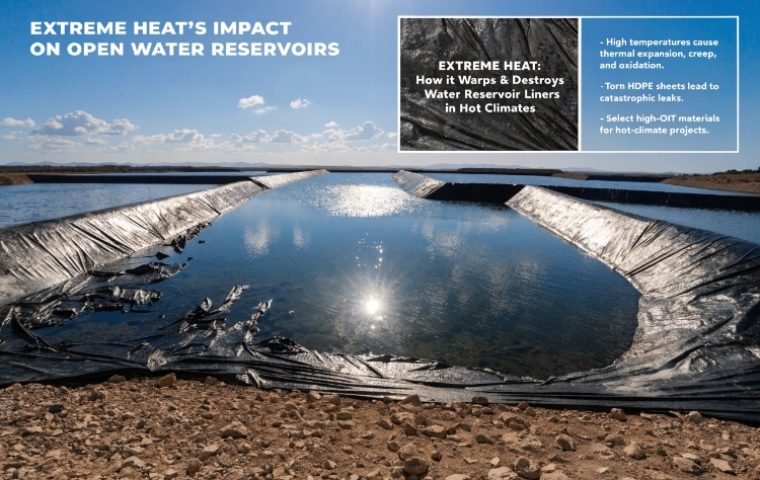
A thicker geomembrane provides a longer pathway for chemical or oxygen diffusion, which can marginally extend the service life by slowing the rate of antioxidant depletion. If you are designing for a very hot climate or a particularly aggressive chemical environment, opting for a thicker product (e.g., 2.0 mm instead of 1.5 mm) provides an additional safety factor for long-term durability.
Furthermore, during the construction phase, the liner is exposed to UV radiation. While all quality liners contain carbon black for UV protection, a thicker liner has more "sacrificial" material and is more resistant to handling damage before it is covered by the ore.
Construction and Quality Control Considerations
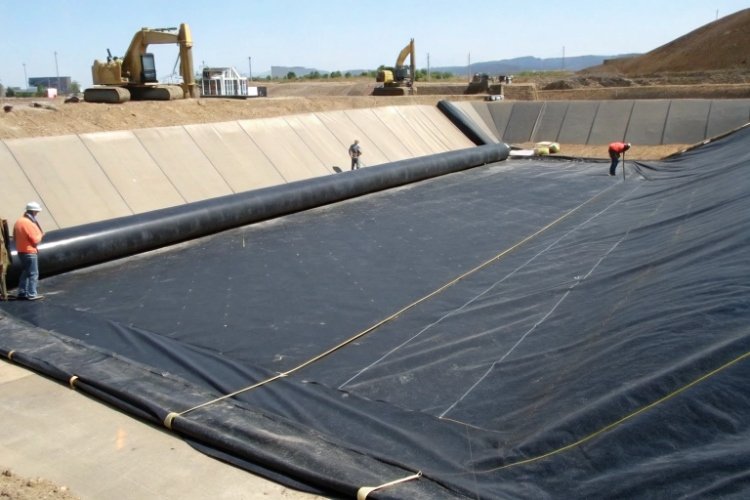
From a construction standpoint, thickness has practical implications. Thicker geomembranes (2.0 mm and above) require more energy and slower welding speeds to achieve a proper fusion weld. While this is not inherently a problem for experienced technicians, it does require more careful process control.
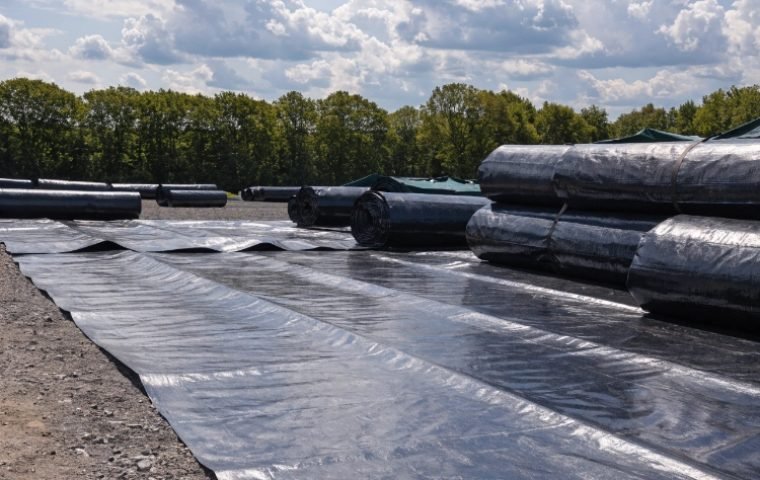
Thicker rolls are also significantly heavier and more difficult to maneuver on site, which can increase the risk of handling damage if crews are not careful. However, these challenges are easily managed by a qualified installation contractor. The most important point is that rigorous QA/QC, including testing every inch of seam, is absolutely essential regardless of the thickness you choose. A perfect 1.5 mm installation is far superior to a sloppy 2.5 mm installation.
Single vs. Double Liner Systems: Implications for Thickness Selection
The choice between a single or double liner system also influences thickness selection.
- Single Liner Systems: In a single liner system, all your containment security rests on one layer. There is no room for error. This demands a conservative approach, typically favoring a thicker membrane (2.0 mm or more) combined with robust protection geotextiles.
- Double Liner Systems: A double liner system provides redundancy. If the primary liner develops a leak, the secondary liner contains it. This redundancy is a safety feature, not a justification for cutting corners. While some may argue for using a thinner primary liner in a double system, I advise against it. The primary liner still bears the full mechanical and chemical load. A common, robust design is a 2.0 mm primary liner and a 1.5 mm secondary liner, ensuring both layers provide a high level of security.
Cost and Risk Trade-Offs
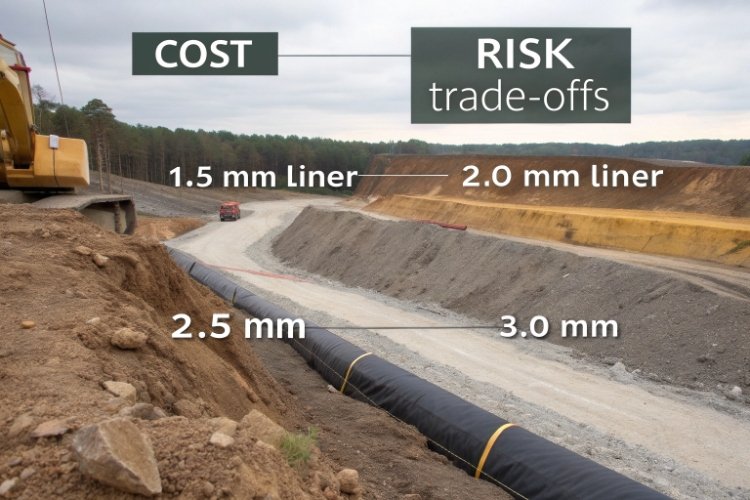
It is easy to look at the per-square-meter cost and see that a 2.0 mm liner is more expensive than a 1.5 mm liner. However, this only tells part of the story. The real analysis is a trade-off between initial capital cost and long-term risk.
There is a point of diminishing returns. The performance gained by going from 1.5 mm to 2.0 mm is significant. The incremental benefit of going from 2.5 mm to 3.0 mm may be much smaller for a substantial increase in cost.
The key is to view the additional cost of a thicker liner as an insurance policy. For a long-life, high-value heap leach operation, where the cost of a liner failure is in the millions of dollars due to lost production and environmental cleanup, spending an extra 20-30% on a more robust liner system is one of the smartest investments you can make.
Common Design Mistakes and Misconceptions
In reviewing countless project designs, I've seen a few common mistakes repeatedly.
- Using Thickness as a Crutch: Specifying a very thick liner (e.g., 2.5 mm) to compensate for poor subgrade preparation is a flawed strategy. It is always more effective and reliable to properly prepare the foundation first.
- Assuming Thickness Eliminates the Need for Protection: Even a 2.5 mm liner can be punctured by a sharp, angular drainage aggregate under the immense load of a heap. A protective cushion geotextile is almost always a necessary component.
- Confusing Regulatory Compliance with Optimal Design: Choosing the thinnest possible liner that meets the local code, without conducting a project-specific risk analysis, is not sound engineering. The code is the floor, not the ceiling.
Conclusion: A Project-Specific, Integrated Approach
There is no universal "correct" thickness for a heap leach pad geomembrane. The optimal choice is always project-specific. It is a calculated decision based on a holistic assessment of heap height, liner material type, subgrade quality, chemical environment, and regulatory requirements.
Remember that thickness is only one component of a successful containment strategy. Real security comes from an integrated design that combines the right liner thickness and material with proper subgrade preparation, robust protective layers, effective drainage, and, most importantly, a rigorous construction quality assurance program.