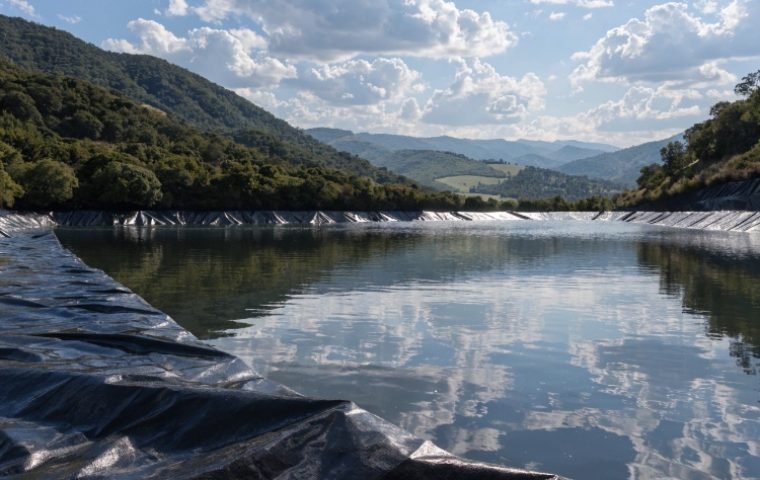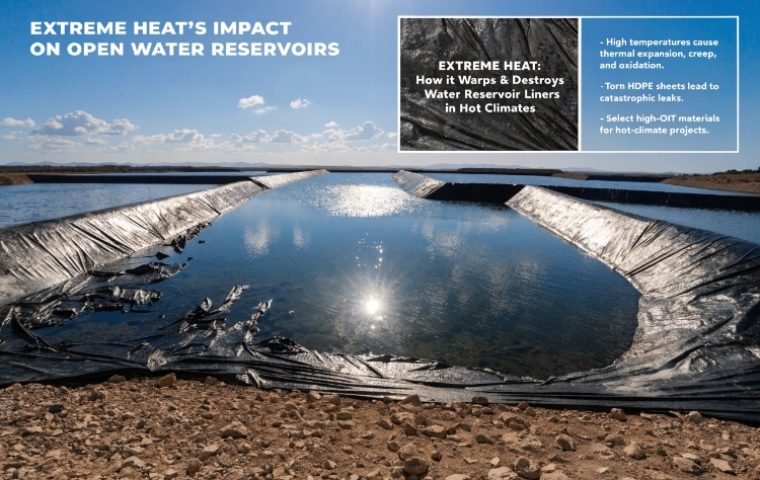


Leaving a geomembrane liner sitting uncovered on a sunny job site is a massive financial risk. UV rays silently degrade the plastic before it even hits the ground, causing premature cracking and weld failures during installation.
High-quality HDPE geomembranes engineered to GRI-GM13 standards can be safely exposed to sunlight for 30 to 50 years after installation. However, during site storage, unrolled liners should generally not be exposed to direct UV and intense heat for more than a few weeks without protective tarps to prevent thermal oxidation.
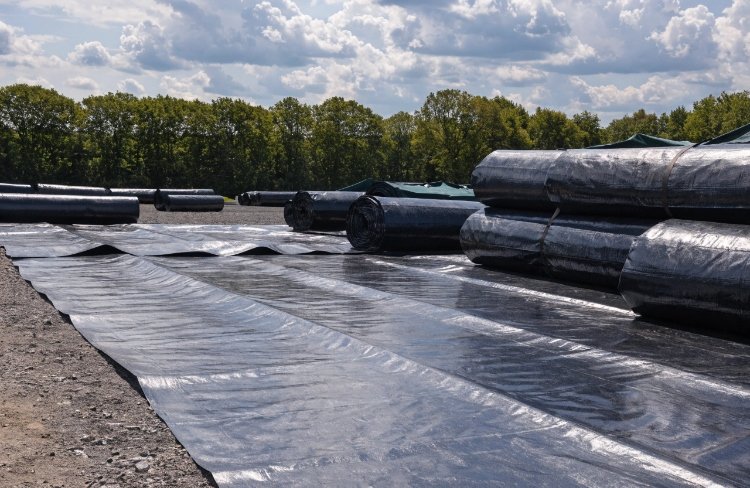
In my years of exporting geosynthetics and coordinating with site engineers globally, I have seen perfectly good material ruined not by poor manufacturing, but by terrible site management. Here is how professional contractors calculate and control HDPE sun exposure from the moment the rolls arrive.
The Short Answer: Typical Exposure Limits
When buyers ask me how long their liner can handle the sun, I always split the answer into two distinct phases: uninstalled and installed. The tolerances for each are completely different.
If the geomembrane is still rolled up and sitting in your laydown yard, the clock is ticking differently than if it were deployed in a reservoir. For high-quality, virgin resin HDPE liners formulated with 2% to 3% carbon black and standard antioxidant packages, an uninstalled roll can safely sit fully exposed to the elements for a few weeks to a couple of months. However, the exact duration depends heavily on the ambient temperature.
Once properly installed, anchored, and operating as a primary containment barrier, that same GRI-GM13 HDPE liner is designed for continuous, long-term UV exposure. In an open reservoir, a 1.5 mm liner can easily withstand direct sunlight for 30 to 50 years.
The major caveat here is material quality. The timeline drastically shortens if you purchase cheap, off-spec materials made from recycled plastics. Recycled liners lack the proper UV stabilizers and will begin to turn brittle in just three to six months of direct sun. I always warn contractors that assuming all black plastic acts the same under the sun is the fastest way to fail a project.
Critical Factors That Affect UV Exposure Time
Not all sunlight is equal, and not all geomembranes react to it the same way. When we review project specifications for overseas buyers, we look at several interconnected variables to determine the safe exposure window for their materials.
UV Intensity and Geographic Location
The physical location of your project dictates the rate of polymer degradation. A liner exposed to sunlight in Northern Europe degrades at a fraction of the speed of a liner installed in the high-altitude Andes or the deserts of the Middle East. High UV index environments accelerate the breakdown of the carbon-carbon bonds within the polyethylene structure.
Ambient Temperature and Heat Absorption
Because HDPE liners are black, they absorb immense amounts of solar radiation. On a day where the air temperature is 35°C (95°F), the surface of the black geomembrane can easily exceed 75°C (167°F). This extreme heat accelerates thermal oxidation. The hotter the plastic gets, the faster the protective antioxidant additives are consumed.
Material Quality and Carbon Black
The primary defense mechanism in an HDPE liner is carbon black. Industry-standard material must contain between 2.0% and 3.0% carbon black, dispersed evenly throughout the sheet. If a manufacturer cuts corners and uses less than 2%, or if the dispersion is clumpy, UV rays will quickly penetrate the polymer matrix and destroy the structural integrity of the plastic within months.
Kauri na Abu
Thickness acts as a physical buffer against UV decay. A 2.0 mm liner will naturally survive direct sun exposure significantly longer than a 0.75 mm liner simply because it has more sacrificial plastic mass and a larger reserve of antioxidants to burn through before the structural core is compromised.
Exposure During Storage vs. After Installation
The most overlooked aspect of UV management happens before a single weld is made. Understanding the difference between storage exposure and operational exposure is where smart EPC contractors save thousands of dollars in wasted material.
The Danger of Storage Exposure
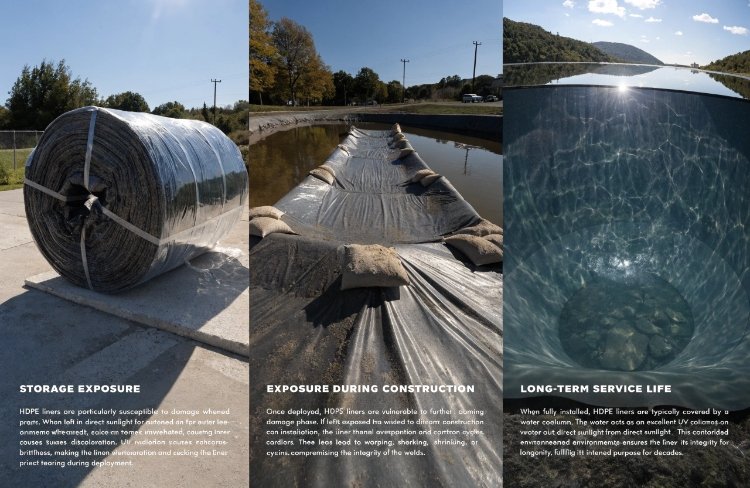
When a tightly wound roll of HDPE sits in a laydown yard under the baking sun, the outermost layers absorb all the heat. Unlike a deployed liner that can radiate heat into the subgrade, a rolled-up liner traps that heat. The temperature bakes the outer wraps for weeks. By the time the installation crew finally unrolls it, the outer 10 to 15 meters of the liner may be stiff, oxidized, and nearly impossible to weld. We frequently see deployment teams forced to cut off and throw away the start of every roll due to pure negligence in storage.
Exposure During the Construction Phase
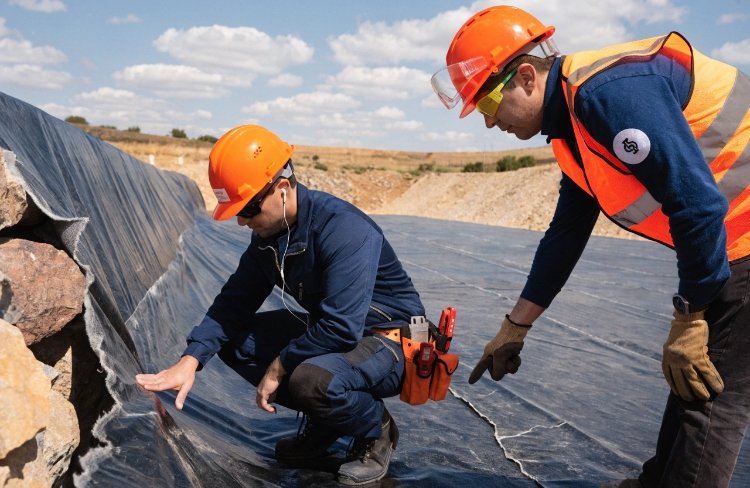
During deployment, the liner must be unrolled, positioned, and welded. It is perfectly fine for virgin HDPE to sit exposed for the days or weeks it takes to complete the installation. However, if your design calls for the liner to be buried under a soil cover, it becomes a race against time. The longer the liner sits deployed but uncovered, the more it goes through violent thermal expansion and contraction cycles. This movement puts immense strain on the fresh welds.
Long-Term Service Life
After installation, if the liner is designed to remain exposed (like in a water reservoir), it is in its final state. The bottom is anchored to the cool earth, and the top is often covered by water, which acts as an excellent UV filter. In this state, the 30+ year design life truly applies.
Industry Standards and Engineering Recommendations
Professional civil engineers do not guess how long a liner can remain exposed; they rely on established international testing standards. The most critical standard we adhere to as a manufacturer is GRI-GM13, published by the Geosynthetic Research Institute.
GRI-GM13 dictates exactly how much UV resistance a high-density polyethylene liner must possess. To pass this standard, the material must undergo High-Pressure Oxidation Induction Time (HP-OIT) testing (ASTM D5885) and standard OIT testing (ASTM D3895). These tests measure the exact amount of antioxidant additives present in the plastic. Furthermore, the material is subjected to accelerated UV weathering tests (ASTM D7238), where it is bombarded with UV light in a laboratory for over 1,600 hours to ensure it retains its baseline strength and elongation properties.
When engineers draft site specifications, they use these standards to set strict rules for the general contractor. For reservoirs designed to be buried under soil or concrete, the specification will almost always mandate: "The geomembrane must be covered within 30 days of deployment." This is not because the sun will destroy the plastic in 31 days, but because minimizing exposure time prevents unnecessary consumption of the antioxidants, preserving them for the decades of service ahead.
Best Practices to Minimize UV Damage on Site
You cannot control the sun, but you can control your construction site. In my experience providing field support for large export projects, contractors who follow a few simple protective measures rarely complain about environmental stress cracking or welding failures.
- Keep the Factory Packaging Intact: Good suppliers ship rolls wrapped in white or light-colored UV-resistant woven bags. Do not strip this packaging off the roll when it arrives at the port or the site. Leave it on until the exact moment the excavator hooks the roll for deployment.
- Use Light-Colored Tarps for Staging: If rolls must be staged near the pond area for more than a few days, cover the staging area with white or silver tarps. These tarps reflect the sun's energy, keeping the core temperature of the rolls substantially lower and preventing the outer layers from baking.
- Deploy Only What You Can Weld: Never allow your deployment crew to unroll thirty panels on a Monday if your welding technicians can only complete ten seams that day. Unwelded panels left exposed to the wind and sun will shrink, expand, and shift, making them incredibly difficult to align and weld properly the next day.
- Cover Quickly If Required by Design: If the project requires a protective soil cover or a geotextile cushion layer over the geomembrane, place it as soon as the QA/QC testing for the welds is approved. Do not leave a liner that is meant to be buried sitting naked for six months while waiting for the next phase of construction to begin.
Risk, Limitations, and When Leaving HDPE Exposed is NOT Recommended
This is a critical distinction that many buyers miss. While high-quality HDPE is highly UV resistant, there are specific environmental and mechanical combinations where leaving the liner exposed permanently is a terrible engineering decision.
I strongly advise against leaving a liner exposed in dry, empty reservoirs subject to massive daily temperature swings.
If you construct an evaporation pond or an emergency overflow basin in a desert environment, and it sits completely dry for 11 months out of the year, the liner is taking maximum punishment. During the day, the black plastic will reach 75°C and expand outward, creating massive wrinkles. At night, the temperature drops to 5°C, and the plastic violently contracts, pulling against the anchor trenches.
Over time, this relentless thermal cycling—combined with harsh UV rays—will cause stress fatigue at the welds and corners. If the basin cannot be kept partially filled with water to regulate the temperature, the liner should not be left exposed. It must be covered with a protective layer of soil or tire-derived aggregate to shield it from both the UV radiation and the extreme temperature spikes.
Similarly, if your site expects heavy animal traffic, sharp windblown debris, or frequent manual maintenance via tractors or skid steers, relying on an exposed HDPE liner is severely limiting. UV exposure makes the surface slightly more brittle over the decades; adding impact stress on top of an aging exposed liner almost guarantees a puncture. In these cases, bury the liner.
Frequently Asked Questions (FAQ) About UV Exposure
Can an HDPE liner stay exposed for 6 months on a job site before being covered?
If you are using a 100% virgin resin, GRI-GM13 certified liner, yes. An open, deployed liner will easily survive six months of exposure without losing its core structural integrity. However, it will consume a portion of its antioxidant package. If the design requires burial, cover it as quickly as possible. If you are using a recycled or non-standard liner, six months of high UV exposure will likely render the material dangerously brittle.
Does thickness affect how long a liner lasts in the sun?
Yes, thicker liners handle UV exposure better. UV degradation begins at the surface and slowly works its way down into the polymer matrix. A 2.0 mm liner has double the mass of a 1.0 mm liner. It holds more carbon black and a larger total volume of antioxidants, allowing it to withstand the environment for a significantly longer period before the damage reaches the critical core.
Why did the ends of my geomembrane roll crack when unrolling?
This is the textbook result of improper storage. If rolls are stacked in direct sunlight without protective UV bags or tarps for months, the extreme heat oxidizes the outer wraps and the exposed edges. The plastic loses its elongation capacity and becomes brittle, inevitably cracking when forced flat during unrolling.
Project Phase vs. UV Exposure Tolerance
To help project managers visualize the risk profile, we summarize the exposure tolerances into three distinct phases.
| Project Phase | Material State | Safe Exposure Window | Practical Field Action |
|---|---|---|---|
| Site Storage | Rolled up, dense mass | Weeks to a few months | Keep factory UV bags on. Cover staging area with light-reflective tarps. |
| Construction | Unrolled, unwelded/welding | Weeks to months | Only unroll what can be welded quickly. Avoid leaving loose edges to flap in the wind. |
| Operation | Welded, anchored, in use | 30 to 50+ years | Ensure water covers the basin if possible. Inspect the exposed drawdown zone annually. |
Ƙarshe
Understanding how long your HDPE liner can be exposed to sunlight is about managing the entire lifecycle of the material, from the moment it leaves our shipping container to its final day of operation. While high-quality virgin HDPE is exceptionally durable against UV rays, poor site storage and delayed installation schedules will needlessly strip away the liner's lifespan before it even holds a single drop of water.
Protect your investment by prioritizing quality material and smart site management. Ask us how long your project liner can be exposed safely. Contact Waterproof Specialist today with your site environment details, and we will provide the exact material specifications and construction guidelines over UV exposure you need to ensure success.