

A major oil spill at a refinery instantly creates an environmental emergency. If that oil breaches the topsoil and reaches the groundwater aquifer, cleanup costs multiply exponentially, and regulators will immediately shut down operations. The only foolproof defense is capturing the spill securely at the source.
This guide details the critical geosynthetic materials used in industrial oil spill containment. By understanding how geomembranes, geotextiles, and composite liners work together, facility managers and procurement teams can properly specify materials to ensure environmental compliance and permanent risk mitigation.
Selecting the right barrier materials is not just about passing a routine site inspection; it is about permanently eliminating catastrophic financial liability.
Introduction: Why Oil Spill Containment Matters in Industrial Sites
When working with global importers constructing refineries, massive oil storage depots, and chemical industrial parks, the conversation inevitably turns to risk management. In these towering facilities, millions of gallons of hydrocarbons are processed and stored under high pressure. Pipes age, valves fail, and human error during loading operations is inevitable.
When a spill occurs, the primary threat is not the visible puddle of oil on the surface. Surface oil is easily contained and pumped away. The true, catastrophic risk is subsurface infiltration. When crude oil or diesel fuel seeps deep into the soil matrix, it acts as a toxic plume that steadily travels toward local water tables or rivers.
The financial difference between surface pumping and deep-earth soil remediation is staggering. Cleaning contaminated groundwater can cost tens of millions of dollars and drag on for decades. Compared to these staggering remediation penalties, the upfront cost of an engineered prevention layer is minimal. In modern industrial operations, high-performance geosynthetic materials serve as the core defense line, ensuring that spilled hydrocarbons never touch the raw earth below.
What Makes an Effective Oil Spill Containment System?
An industrial oil spill containment zone is rarely just a concrete wall built around a tank. It is an engineered structural system designed to capture, hold, and manage massive volumes of hazardous fluids safely.
A complete and effective containment system relies on three interconnected layers functioning together seamlessly. First, surface control structures—such as earthen berms, concrete bund walls, and dikes—provide the necessary volumetric capacity to hold the physical displacement of a ruptured tank. Second, specialized drainage networks must deal with routine rainwater without accidentally discharging captured base-layer oil into municipal sewers.
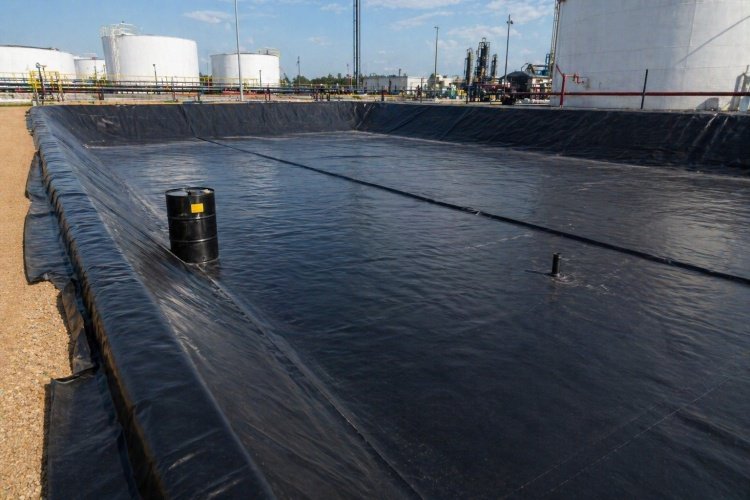
Third, and most importantly, the system requires an absolute impermeable liner layered across the entire floor and up the interior walls of the bund. This layer seals the bathtub, so to speak. Among these components, the liner system plays the most critical role. Without a robust chemical barrier, the walls only serve to hold the oil while it slowly soaks downward into the ground.
Geomembranes: The Primary Barrier Against Oil Contamination
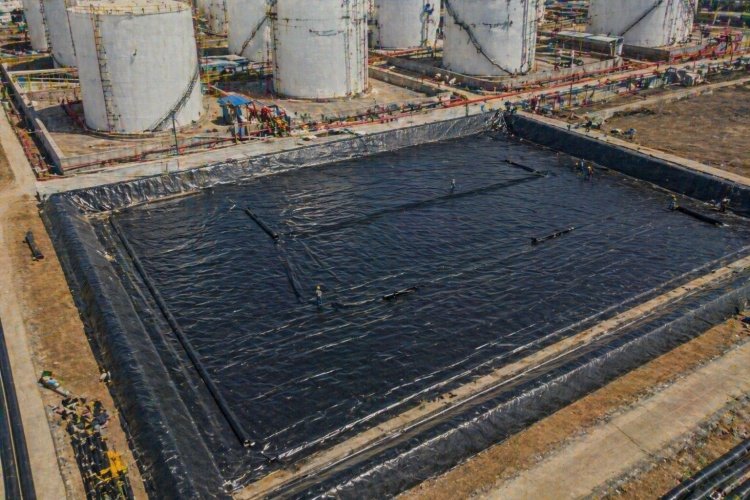
When discussing containment materials, geomembranes are not just one of the materials used; they are the primary barrier preventing oil infiltration. A geomembrane is a highly impermeable, synthetic plastic sheet manufactured to hold back aggressive liquids.
Why HDPE is the Industry Standard
For petroleum and chemical containment, Polyethylene Mai Girma (HDPE) is the absolute dominating material in the global market. Unlike standard PVC or thin agricultural plastics, HDPE possesses a highly dense molecular structure that makes it practically impenetrable to hydrocarbons. It does not swell, rot, dissolve, or degrade when heavily soaked in crude oil, diesel, or refined chemicals.
Key Performance Attributes
When supplying these containment liners to international projects, we evaluate them against three core metrics:
- Impermeability: The primary job of an HDPE geomembrane is to provide a near-zero permeability rate. When joined using thermal welding, it forms a monolithic barrier that traps oil indefinitely.
- Juriya na Chemical: HDPE naturally deflects the chemical attack of organic solvents and petroleum products. This ensures the liner does not lose its tensile strength even if the spill sits in the bund for weeks before cleanup crews arrive.
- Durability and Lifespan: Industrial sites operate for decades. Premium HDPE geomembranes are blended with specific carbon black and antioxidant additives. This allows the material to withstand intense ultraviolet (UV) radiation and severe thermal cycling, easily providing a 20+ year service life even in exposed desert environments.
Aikace-aikace na yau da kullun
You will see HDPE geomembranes utilized extensively as the baseline barrier under massive tank farms, within active refinery containment zones, beneath truck loading/unloading bays, and acting as the floor for heavy equipment wash-down pads. In all these scenarios, specifying a 1.5mm or 2.0mm HDPE liner is the recognized standard for structural safety.
Geotextiles: Protection, Filtration, and Drainage Support
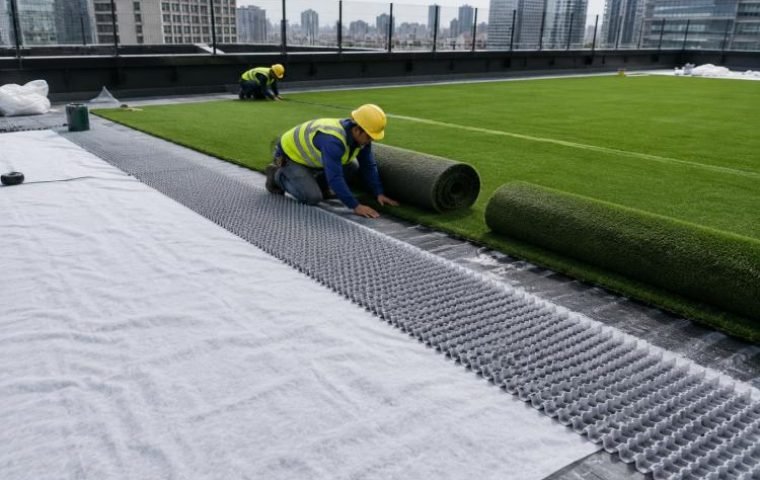
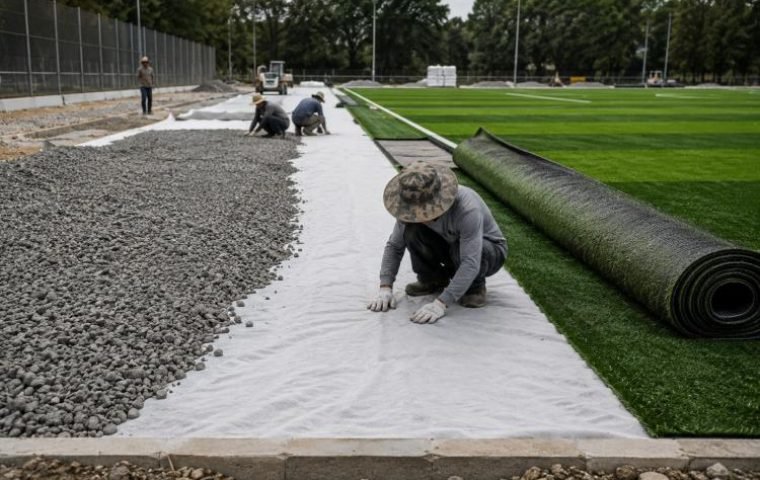
While the geomembrane is the star of the containment system, it cannot survive alone. Placing a rigid plastic sheet directly onto crushed rock or uneven soil is an engineering mistake. This is where heavy-duty nonwoven geotextiles become strictly necessary.
Geotextiles are permeable, synthetic fabric layers typically made of polypropylene or polyester. In containment design, they are deployed immediately beneath, and sometimes above, the geomembrane to perform three distinct functions.
Protection (Puncture Resistance)
The primary role of a geotextile is to act as a thick shock-absorber. Subgrades at industrial sites are rarely perfect. They contain sharp rocks, leftover construction debris, and compacted gravel. When a massive steel tank leaks, the hydraulic weight of the oil pushes the geomembrane aggressively into the ground. A thick nonwoven geotextile (typically 300g/m² to 500g/m²) cushions the plastic, entirely preventing sharp point-load punctures.
Filtration (Preventing Blockages)
In containment areas designed with sub-surface drainage pipes, geotextiles act as a critical filter. They allow water and fluids to pass through their matrix while trapping fine sand, silt, and clay particles. This ensures that the drainage pipes do not clog with mud over years of heavy rainfall.
Drainage Support
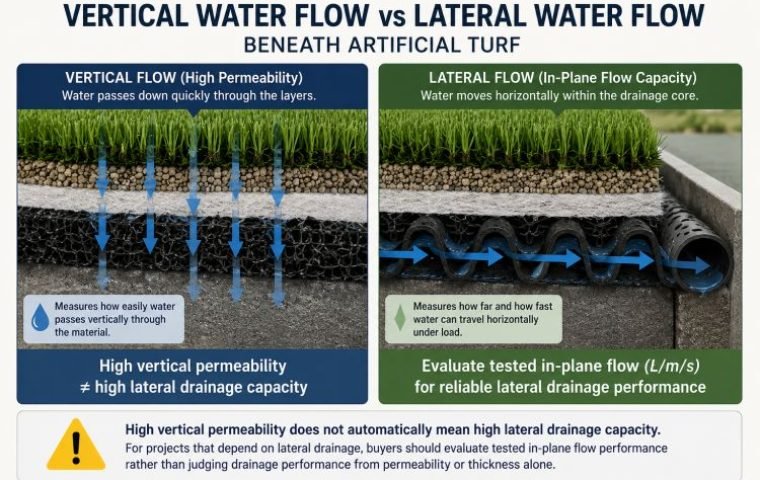
Because nonwoven geotextiles are porous, they can channel fluids horizontally along their plane. This helps relieve the buildup of trapped groundwater pressure underneath the liner, preventing the geomembrane from lifting or bubbling.
Geotextiles extend the service life of geomembrane systems. Without them, the risk of early-stage mechanical failure during construction multiplies enormously.
Composite Liner Systems (Geomembrane + GCL)
For exceptionally high-risk projects—such as a refinery located directly adjacent to a sensitive river or municipal water supply—engineers will not rely on a single barrier. They upgrade to a composite liner system, combining an HDPE geomembrane with a Geosynthetic Clay Liner (GCL).
A GCL is a manufactured factory roll consisting of a layer of highly swelling sodium bentonite clay sandwiched between two layers of geotextiles. When hydrated, bentonite clay aggressively expands, forming a dense, paste-like barrier with incredibly low permeability.
The Double-Defense Strategy
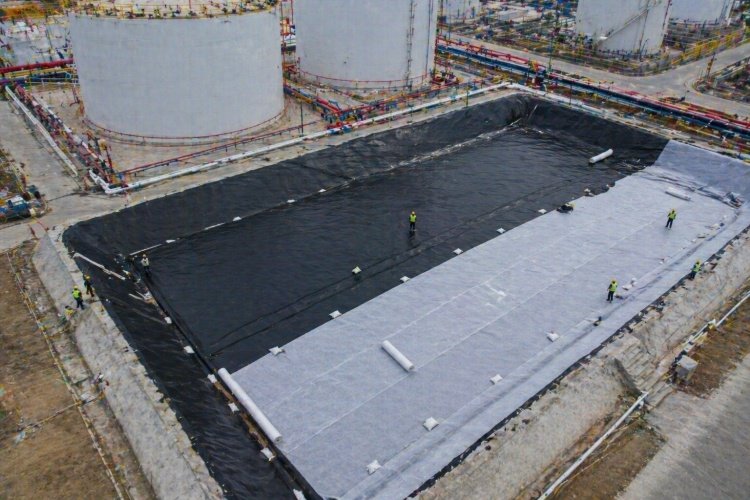
In a composite system, the GCL is rolled out directly over the subgrade, and the HDPE geomembrane is installed tightly on top of it. The HDPE holds the primary responsibility for stopping hydrocarbons. However, if a sharp piece of metal drops and punctures the plastic, the oil will seep down and hit the GCL. The bentonite clay instantly reacts and swells against the puncture, effectively 'self-healing' the leak.
This dual-layer redundancy is the pinnacle of environmental safety. A typical high-level industrial containment structure consists of the raw earthen subgrade at the bottom, topped by the GCL as a backup layer, sealed by a 2.0mm HDPE geomembrane, and finally covered by a protective geotextile and crushed stone.
Other Supporting Materials in Spill Containment
Beyond the buried infrastructural barriers, facility managers must also procure emergency response materials. When you walk through a loading dock, you will frequently see designated spill control stations.
These include:
- Absorbent Pads and Booms: Polypropylene pads designed specifically to repel water while rapidly soaking up surface oil.
- Containment Booms: Floating barriers used to trap spilled oil on the surface of retention ponds or coastal waters.
- Emergency Spill Kits: Mobile bins containing granular absorbents, temporary drain covers, and cleanup tools.
However, these materials are mainly used for temporary spill control, while geosynthetics provide long-term environmental protection. Absorbents manage the immediate surface mess of a small, localized drip. Geomembranes manage the catastrophic, facility-threatening volume of a structural failure.
Risks, Limitations, and When Certain Materials Fail
To provide practical value, we must acknowledge that no material works flawlessly in every single condition. Applying standard geosynthetics blindly without considering site limitations leads to expensive failures.
You must not use thick, rigid HDPE geomembranes in highly unstable or swampy subgrades. If an industrial park is built on reclaimed land that is guaranteed to suffer massive differential settlement, rigid HDPE will eventually bridge over the sinking voids. Once stretched beyond its yield point, it will suffer environmental stress cracking and fail completely. In these specific soft-soil situations, buyers are better served using Polyethylene Low-Density Linear (LLDPE), which offers much higher elongation and flexibility, allowing it to stretch safely as the earth shifts.
Furthermore, relying purely on a GCL in areas with highly saline groundwater is a critical error. Heavy saltwater neutralizes the swelling properties of bentonite clay. If the local groundwater is overly salty, the GCL cannot activate properly, rendering the "backup" layer useless. In such coastal environments, you must pivot exclusively to thicker HDPE/geotextile combinations. Be honest about your site conditions to select the system that will actually survive.
How to Choose the Right Materials for Your Site
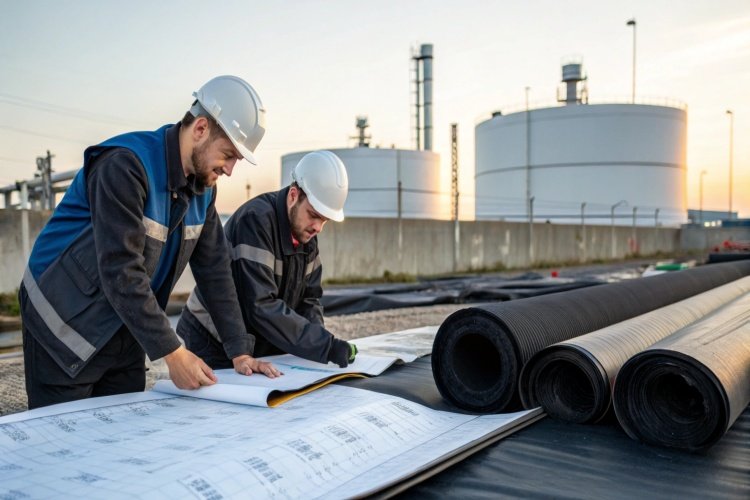
Procurement is about matching the engineering parameters to the material's strengths. Here is a practical framework we use to guide industrial buyers based on their active zones.
| Industrial Application Zone | Recommended Geosynthetic Strategy | Hankali Mai Aiki |
|---|---|---|
| Primary Oil Tank Farms | 1.5mm–2.0mm HDPE Geomembrane + Nonwoven Geotextile | Provides maximum oil resistance and high puncture defense against tank weight. |
| High-Risk Refinery Areas | Composite Liner (GCL + HDPE) | Delivers 'self-healing' redundancy over critical groundwater supplies. |
| Active Loading Bays | LLDPE Liner + Heavy Cushion Geotextile | Flexible enough to wrap around complex drain sumps and withstand surface vibrations. |
| Emergency Response Zones | Absorbents + Temporary Booms | Deployed entirely for surface-level routine maintenance drips. |
When in doubt, prioritize thickness and protection layers where heavy equipment will be present, and focus on chemical inertness where harsh, highly concentrated variants of hydrocarbons are stored.
Compliance and Environmental Regulations
Ultimately, the choice of containment materials is heavily supervised by state and global regulatory agencies. You cannot just use whatever plastic is available locally.
In the United States, industrial sites must adhere to the Environmental Protection Agency (EPA) regulations, particularly the Spill Prevention, Control, and Countermeasure (SPCC) rule. This mandates that the secondary containment system must be sufficiently impervious to the materials stored within it. Utilizing standardized HDPE geomembranes that meet internationally recognized testing criteria (such as GRI-GM13) proves to regulators that you have installed an actively protective barrier, shielding operators from massive negligence fines in the event of an audit.
Conclusion: Permanent Solutions Over Temporary Fixes
Effective industrial spill containment requires distinguishing between a quick cleanup and permanent infrastructure. Absorbents and booms are essential tools for temporary, localized control. However, geomembranes and properly engineered composite liners provide the permanent, structural solution that guarantees environmental compliance for decades.
Are you looking to secure your industrial facility against catastrophic leakage? Material specification makes all the difference. Hulɗa Waterproof Specialist to request material samples, obtain detailed technical datasheets, or consult directly with our engineering support team to find the exact containment system designed for your operational risks.