

I receive dozens of inquiries every week from engineers and purchasing managers asking for "Standard Geocells." Yawancin lokaci suna haɗa takardar ƙayyadaddun bayanai da ke lissafin zurfin tantanin halitta, ƙarfin kwasfa, da kaddarorin ɗaure.
Amma kusan ba su taɓa haɗa takarda mafi mahimmanci ba: Rahoton Binciken Kasa.
Zaɓin geocell bisa ƙayyadaddun kayan aikin filastik kawai ba tare da fahimtar yanayin ƙasa ba shine dalili na ɗaya na yawan kasafin kuɗi ko gazawar aiki. Geocell wanda ke aiki daidai akan yashi maras kyau na iya yin kasala sosai akan yumbu mai laushi, koda ƙayyadaddun samfurin iri ɗaya ne.
Wannan jagorar yana bayanin yadda ake zaɓar tsarin geocell daidai ta hanyar nazarin takamaiman halayen ƙasan ƙasa-daga yumɓu mai laushi da yashi zuwa ƙasa mai faɗi da ƙasa mai faɗi-tabbatar da siyan mafita, ba kawai takardar filastik ba.
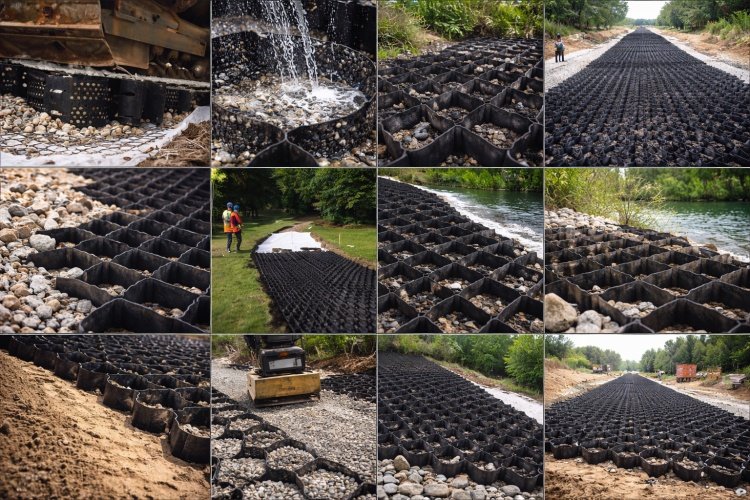
Don yanke shawara mai kyau, dole ne mu dakatar da kallon geocell a matsayin samfuri na tsaye kuma mu fara kallonsa azaman hanyar gyara ƙayyadaddun ƙarancin ƙasa.
1. Me yasa Dole ne zaɓin Geocell ya fara da Yanayin ƙasa maimakon ƙayyadaddun samfur?
In the geosynthetics industry, there is a dangerous misconception that a "stronger" geocell (mafi girman ƙarfi) yana da kyau koyaushe. A matsayina na mai kaya, cikin sauƙi zan iya siyar da mafi tsada, samfur mafi girma ga kowane abokin ciniki. Amma wannan ba aikin injiniya ba ne; wato tallace-tallace.
Gaskiyar ita ce Geocells aiki daban-daban dangane da abin da ke ƙarƙashinsu.
- A cikin Sand: Geocell yana aiki azaman a ganga. Hanya ta farko ita ce kamewa don hana yaɗuwar gefe.
- A ciki Laka mai laushi: Geocell yana aiki azaman a katifa. Hanya na farko shine rarraba kayan aiki na tsaye akan wani yanki mai fadi don rage matsa lamba.
Idan kayi amfani da geocell da aka ƙera don tsarewa (yashi) akan rukunin yanar gizon da ke buƙatar rarraba nauyi mai zurfi (laka), wataƙila tsarin zai yi kasala, ba tare da la'akari da ƙarfin walda na HDPE ba.
A cikin gwaninta na fitarwa zuwa ayyuka a kudu maso gabashin Asiya (sau da yawa yumbu mai laushi) da Gabas ta Tsakiya (sau da yawa yashi mai laushi), ƙirar ƙira ta bambanta. Rashin gazawar da muke gani ba kasafai ake karya robobin ba; shi ne gazawar tsarin don magance takamaiman yanayin gazawar ƙasa.
By understanding the "Soil Behavior" first, we can identify the "Primary Engineering Problem," and only then define the "Geocell System Role."
2. Ta yaya Muka Zaba Geocell Systems don Laka mai laushi Matsakaicin matsayi?
Ƙarƙashin yumbu mai laushi (CBR < 1-2%) sune mahalli mafi ƙalubale don gina hanyoyi da dandamali. Waɗannan ƙasa-yawanci ana samun su a yankunan bakin teku, deltas, ko ciyayi masu dausayi - suna yin kama da man goge baki a ƙarƙashin kaya.
Physics na Matsala
The core issue with soft clay is not just "low strength." Yana da nakasar filastik da ƙarfafawa.
- Ruwan Filastik: Lokacin da babbar mota mai nauyi ta hau kan yumbu mai laushi, ƙasa ba kawai ta datse ba; yana matsewa a gefe daga lodi.
- Rutting: Wannan motsi na gefe yana haifar da ɓarna mai zurfi.
- Wuri: Lambu yana riƙe ruwa. A tsawon lokaci, yayin da aka matse ruwa, ana samun bambance-bambance daban-daban.
A standard stone base on soft clay will punch right through (the "punching shear" sakamako) ko bace a cikin laka a cikin 'yan lokutan damina.
The Geocell Strategy: The "Stiff Mattress" Tasiri
Lokacin zabar geocell don yumbu mai laushi, burin ku shine canza tunanin injiniya daga Haɓaka Tsari ku Sarrafa nakasa.
You are essentially building a semi-rigid floating raft (the "mattress") that sits on top of the weak liquid-like soil.
Zabi & Dabarun ƙira
- Zurfin Yafi Muhimmanci: A kan yumbu mai laushi, tantanin halitta 75mm ko 100mm sau da yawa ba shi da amfani. Mu yawanci muna ba da shawara 150mm ko 200mm zurfin. Why? Because the stiffness of the "mattress" daidai yake da murabba'in zurfinsa. Kuna buƙatar tasirin katako mai zurfi don yada kaya mai faɗi sosai don kiyaye matsa lamba a ƙasa da iyakacin gazawar yumbu.
- Ƙarfin Kafa Yana da Muhimmanci: Tun da takamaiman yanayin rashin gazawa ya haɗa da ƙaddamarwa na ƙoƙarin cire tsarin a gefe, ana sanya nauyin akan ginshiƙan weld. Idan kabuwar bawo, katifar ta rasa mutuncinta.
- Na'urorin haɗi da ake buƙata: Ƙarfin Geotextile mai ƙarfi: Kai ba zai iya ba sanya geocell kai tsaye akan yumbu mai laushi. Laka za ta shiga cikin sel, ta gurɓata cikewar dutse mai tsada. Yawanci kuna buƙatar babban madaidaicin saƙa na geotextile a ƙarƙashin geocell don yin aiki azaman membrane na tashin hankali, yayin da geocell yana ba da taurin lanƙwasa.
Hankalin mai bayarwa: Ga abokan cinikina suna gina hanyoyin shiga sama da peat ko marshland, Ina ba da shawarar ba da fifiko Zurfin Cell a kan Yawan Tantanin halitta. Tantanin halitta mai zurfi da ke cike da tari mai sauƙi sau da yawa ya fi tasiri fiye da tantanin halitta mara zurfi tare da babban dutse mai yawa.
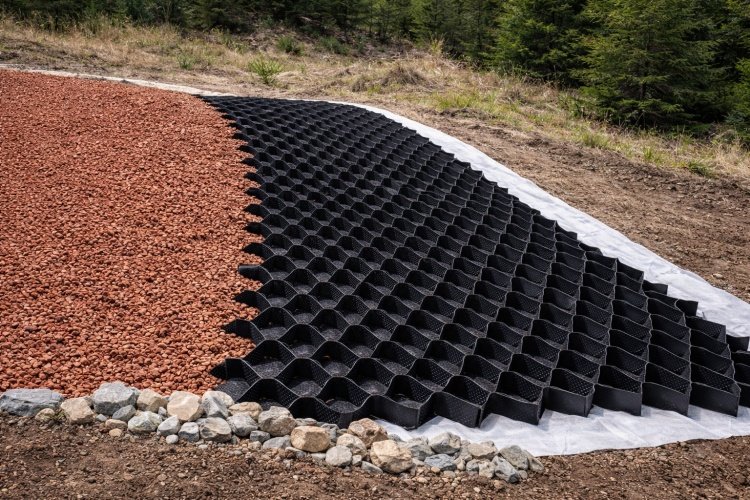
3. Menene Ma'anar Zaɓa don Yashi da Ƙarƙashin Ƙarƙashin Ƙarƙashin Ƙarƙashin Ƙarƙashin Ƙarƙashin Ƙarƙashin Ƙarƙashin Ƙarƙashin Ƙarƙashin Ƙarƙashin Ƙarƙashin Ƙarƙashin Ƙarƙashin Ƙarƙashin Ƙarƙashin Ƙarƙashin Ƙarƙashin Ƙarƙashin Ƙarƙashin Ƙarƙashin Ƙarƙashin Ƙarƙashin Ƙarƙashin Ƙarƙashin Ƙarƙashin Ƙarƙashin Ƙarƙashin Ƙarƙashin Ƙarƙashin Ƙarƙashin Ƙarƙashin Ƙarƙashin Ƙarƙashin Ƙarƙashin Ƙarƙashin Ƙarƙashin Ƙarƙashin Ƙarƙashin Ƙarƙashin Ƙarƙashin Ƙarƙashin Ƙarƙashin Ƙirar Yashi da Ƙwararren Ƙwararren Ƙwaƙwalwa?
Designing for sand (dunes, desert regions, or loose fill) is the exact opposite of clay. Sand has excellent compressive strength idan it is confined, but zero strength if it is unconfined.
Physics na Matsala
Sand particles are hard. They don't deform like clay. However, they lack cohesion.
- Lateral Spreading: Under a wheel load, round sand particles roll over each other and move sideways away from the tire.
- Surface Rutting: This movement creates immediate ruts, increasing rolling resistance and bogging down vehicles.
- Erosion: In wind or water, unconfined sand simply disappears.
The Geocell Strategy: Artificial Confinement
Here, the geocell acts as a ganga. It creates "apparent cohesion." By locking the sand inside a cell, you prevent the particles from rolling away. The sand inside the cell behaves like a solid block rather than a fluid.
Zabi & Dabarun ƙira
- Cell Size vs. Aggregate Size: The selection logic here depends on the "lock-up." If you are filling the cells with on-site sand, you need a cell size that prevents the sand from washing out, but the friction against the cell wall is key.
- Surface Texture is Non-Negotiable: Smooth HDPE strips are terrible for sand. You need highly textured (diamond pattern) surfaces. The friction between the sand particles and the cell wall limits the vertical movement of the sand. If the wall is smooth, the sand creates a passive wedge and pushes the cell up.
- Wall Stiffness: Unlike clay, where the "beam effect" is key, in sand, the damuwa is key. As the sand tries to spread, it pushes against the cell wall. The wall must have high tensile modulus to resist bulging.
- No High-Strength Geotextile Needed: Unlike clay, you usually don't need a heavy woven geotextile underneath. A simple non-woven filter fabric is often sufficient just to prevent mixing with the subgrade, as bearing capacity is rarely the issue—confinement is.
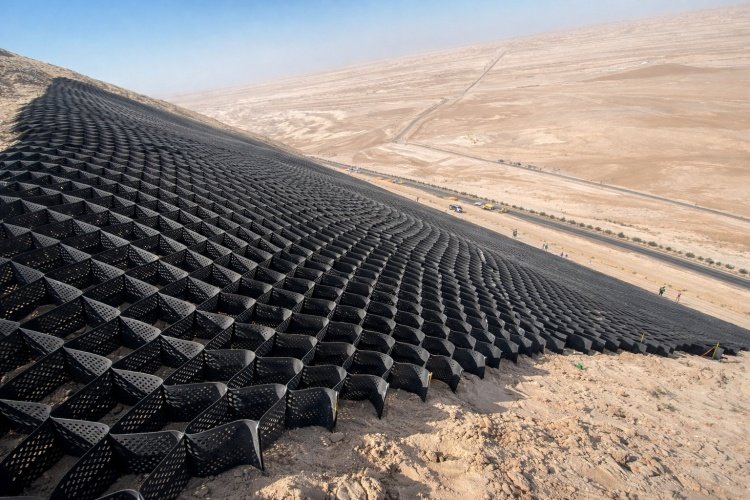
Hankalin mai bayarwa: For desert oil & gas access roads, we often supply mid-sized cells (standard weld distance ~445mm). Large cells are cheaper, but they allow too much movement of the sand particles in the center of the cell (the "dead zone"). Smaller cells provide tighter confinement and better trafficability.
4. How Should We Approach Geocell Selection for Silty Soil Subgrades?
Silty soils are the "wild card" of geotechnical engineering. They fall between sand and clay, often possessing the worst properties of both depending on the weather.
Physics na Matsala
- Moisture Sensitivity: Dry silt can be hard as rock. Wet silt creates a "quick" condition where it loses almost all strength instantly.
- Capillarity: Silt sucks water up from the water table, creating frost heave issues in cold climates or softening in temperate ones.
- Instability: It is difficult to compact and easy to disturb during construction.
The Geocell Strategy: Robustness and Tolerance
The role of the geocell here is Risk Management. We are using the geocell to bridge the periods where the silt is weak (wet) and distribute loads to prevent spot failures.
Zabi & Dabarun ƙira
- Filtration is the Priority: Silt particles are fine enough to migrate but lack the cohesion of clay. The selection of the underlying geotextile is actually more important than the geocell itself. A non-woven needle-punched geotextile with the correct apparent opening size (AOS) is required to prevent the silt from slurrying up into the stones.
- System Stiffness: Since silt strength fluctuates, the geocell system must be rigid enough to bridge over "soft spots" that appear after rain.
- Infill Material: Do not use onsite silt to fill the geocells. This is a common cost-saving mistake. If you fill a geocell with silt, and it rains, you just have a honeycomb of mud. You must import clean, free-draining angular stone to fill the cells.
Hankalin mai bayarwa: In projects involving loess or alluvial silt, I always advise clients to factor in a "drainage layer" logic. The geocell filled with gravel acts as a horizontal drain, allowing water to escape the silt subgrade, keeping the foundation stable.
5. Can Geocells Manage the Risk of Expansive (Swelling) Clays?
Expansive soils (like black cotton soil) shrink when dry and swell when wet. This volume change can crack rigid pavements and destroy foundations.
Physics na Matsala
The issue here is not just bearing capacity; it is upward pressure.
- Heaving: When the soil absorbs water, it pushes up with immense force.
- Shrinkage Cracks: When it dries, it retracts, leaving voids that collapse under traffic.
The Geocell Strategy: Flexible Accommodation
You cannot stop expansive soil from swelling (unless you replace it entirely). The geocell acts as a flexible buffer. It creates a semi-flexible layer that can absorb some of the differential movement without transferring all the stress to the pavement surface.
Zabi & Dabarun ƙira
- Aspect Ratio: High aspect ratio (depth vs. cell width) is preferred to create a thicker buffer zone.
- Flexible Infill: Filling the geocell with a slightly flexible granular material (rather than concrete) allows the system to "breathe" slightly with the soil movement without cracking.
- Separation and Waterproofing: Often, geocells on expansive clay are used in conjunction with a geomembrane (to keep water out of the clay) or a thick sand cushion layer. As a standalone, the geocell doesn't stop moisture, but it reinforces the granular cushion that weighs down the clay.
Hankalin mai bayarwa: The goal here is "Controlled Flexibility." We select geocell grades that have high elongation at break properties, ensuring that if the ground heaves locally, the system deforms rather than snaps.
6. How Do Selection Criteria Compare Across Different Soil Types? (Summary)
To help you make a quick decision, here is a comparative logic table based on typical project inquiries.
| Nau'in Kasa | Injiniyanci na Farko | Critical Geocell Parameter | Critical System Component |
|---|---|---|---|
| Laka mai laushi | Mattress Effect (Beam) | Cell Depth (Stiffness) & Ƙarfin Kafa | High-Strength Geotextile Separator (Woven) |
| Loose Sand | Confinement (Hoop) | Cell Size (tightness) & Friction Texture | Clean Angular Infill (Interlock) |
| Silt | Bridging & Tolerance | System Rigidity | Non-Woven Geotextile (Filtration) |
| Expansive Soil | Flexible Buffer | Aspect Ratio (Height) | Sand Compaction Cushion |
7. Risk, Limitations, and When This Is NOT Recommended
While I am a strong advocate for geocells, it is responsible for me to tell you where they will not work. Geocells are not a magic cure for every geotechnical problem.
1. Deep-Seated Rotational Failures:
If you have a global stability issue (e.g., a landslide deep underground), putting a geocell on the surface is like putting a band-aid on a broken leg. The geocell only reinforces the top 20-30cm. It cannot stop a slip circle that is 5 meters deep.
2. The Liquid Limit:
If the subgrade is so soft that a person cannot walk on it (CBR < 0.5%), a geocell alone is insufficient. You will require a "working platform" of bamboo fascines, timber logs, or a high-strength geogrid kafin you can even install the geocell.
3. Steep Slopes Without Anchoring:
On steep slopes (>45°) with poor soil, the geocell itself is heavy when filled. Without a proper tendon anchoring system (Kevlar/Polyester tendons), the entire geocell system can slide off the slope creates a landslide itself.
Ƙarshe
As a practitioner in this industry, I want to change how you write your purchase requests.
Don't just ask for "10,000 sqm of 100mm Geocell."
Instead, tell us: "We are building a road over soft clay with a CBR of 1.5%."
When you start with the soil conditions:
- We move from selling you a samfur to solving your problem.
- We can recommend the correct cell depth to prevent settlement.
- We can ensure you get the right geotextile to prevent clogging.
The plastic itself is only 20% of the solution. The other 80% is how that plastic interacts with the mud, sand, or silt beneath it. If you get the soil logic right, the geocell will perform for decades. Use the wrong logic, and even the strongest material will fail.
Do you have a project with difficult soil conditions? Send us your soil report or a site description, and let's determine the correct geocell configuration together.