


Systèmes de revêtement de lixiviation en tas pour climat froid pour les projets miniers sous zéro

When we discuss heap leach mining, the focus is usually on chemical kinetics and recovery rates. But for engineers and project managers operating in the world’s "ice box" regions—Canada’s Yukon, Eastern Russia, Mongolia, or the high altitudes of the Andes—the primary challenge is not the chemistry. It is the physics of the cold. Designing a […]
Processus de fabrication des géocellules expliqué : de la matière première aux panneaux finis

In the geosynthetics industry, "Geocell" is often treated as a commodity. Buyers look at a specification sheet, see "HDPE," check the price, and place the order. However, as a China-based manufacturer who has supplied projects ranging from desert roads in the Middle East to slope protection in rainy Southeast Asia, I can tell you that […]
Comment l’exposition aux UV affecte les géomembranes dans l’exploitation minière par lixiviation en tas – Risques, tests & Solutions

In the mining industry, we often focus intensely on chemical compatibility—will this liner survive cyanide or sulfuric acid? While this is critical, there is a "silent killer" of geomembranes that often goes ignored until cracks appear: Ultraviolet (UV) Radiation. Heap leach pads are massive civil engineering structures. Between the time the liner is deployed and […]
Quand utiliser des géocellules au lieu de fondations profondes ou de remplacement de sol ?
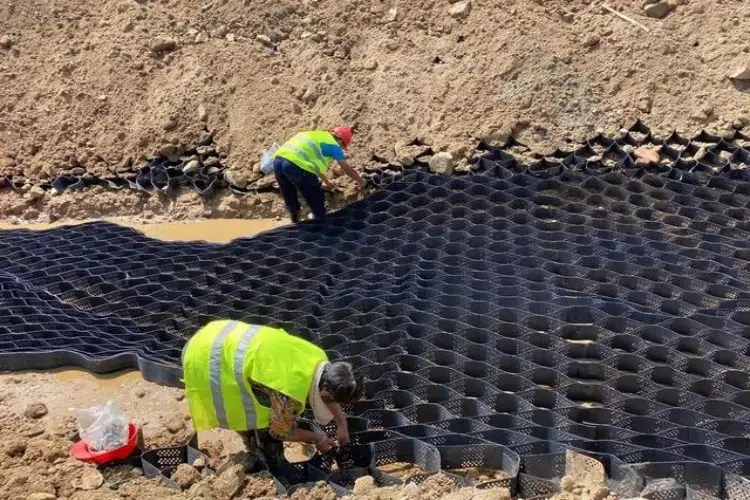
In the geotechnical industry, we generally face three distinct paths when dealing with weak subgrades or soft soils. The first is the Deep Foundation approach (piling), which is structurally reassuring but financially painful. The second is Soil Replacement (excavation and backfill), which is conceptually simple but logistically messy and highly disruptive. The third is the […]
Systèmes d'amélioration du sol basés sur des géocellules : configurations de conception typiques

In the diverse world of geosynthetics, Geocells (Cellular Confinement Systems) are unique. Unlike a geogrid or a geotextile which function as 2D planar reinforcements, a geocell is a 3D structure. However, a common mistake we see in project inquiries is treating the geocell as a magic "standalone" solution. Engineers and contractors often ask us, "Will […]
Revêtement de bassin à résidus et revêtement de tampon de lixiviation en tas : quelles sont les principales différences ?

In mining engineering practice, tailings ponds and heap leach pads are distinct operational systems. However, during the early design phases, specification drafting, or procurement, the "liner system" is often dangerously over-simplified. We frequently see tenders that treat the geomembrane as a generic commodity, assuming that a specification suitable for a tailings dam will automatically work […]
Comment évaluer les fabricants de géocellules : guide de l'acheteur pour les projets d'infrastructure

I have sat on both sides of the negotiation table—defending technical specifications to project engineers and auditing production lines to ensure compliance. In infrastructure projects, choosing a geocell supplier is not like buying office supplies. If a pen breaks, you throw it away. If a geocell fails, a highway embankment collapses, a slope slides, or […]
Exigences techniques clés pour les systèmes de géocellules dans les appels d'offres d'infrastructure

In the high-stakes world of infrastructure tendering, Geocell systems are rarely selected based on brand loyalty. They are selected based on compliance. Whether for a highway embankment in Southeast Asia or a mining slope in South America, the tender document is the law. If a supplier fails to prove compliance with a single technical clause—be […]
Considérations relatives à la conception du revêtement du tampon de lixiviation en tas de cuivre

Copper mine owners and EPC engineers often treat liner design as a simple procurement checkbox, focusing only on price per square meter. This is a critical error, as the unique combination of extreme heap heights, aggressive sulfuric acid, and decades-long operating cycles makes copper heap leaching one of the most demanding applications for geosynthetics. To […]