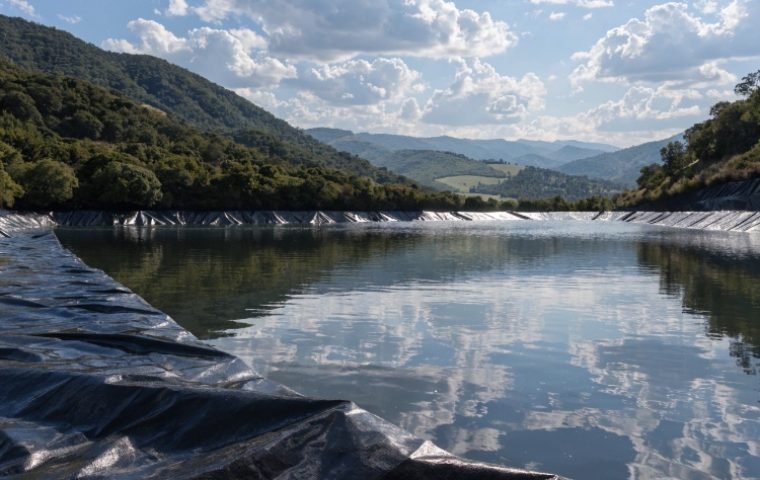


Losing water from a reservoir is not just an operational nuance; it is a direct financial hemorrhage. Whether for agricultural irrigation, industrial water storage, or raw water supply, seepage destabilizes embankments and turns a valuable asset into a liability.
Geomembrane liners prevent long-term water loss by creating an impermeable synthetic barrier that effectively decouples the water body from the porous subgrade. Unlike clay or concrete, high-quality polymeric liners (like HDPE) offer near-zero permeability (typically $1 \times 10^{-14}$ cm/s), protecting against both saturation leakage and geological shifting.
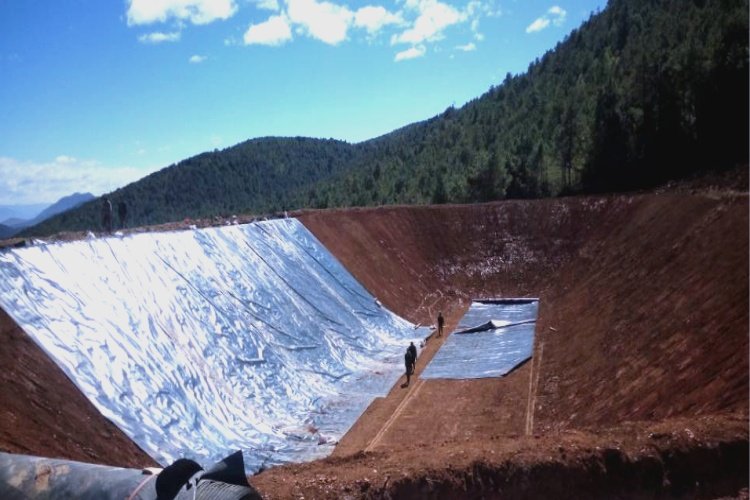
For my clients—ranging from large agricultural cooperatives to municipal water projects—the decision to line a reservoir is driven by the need for certainty. They cannot afford to pump water into a basin only to have it vanish into the groundwater table.
What causes long-term seepage in reservoirs?
Many project owners believe that compacted soil or concrete is "waterproof enough." However, over time, the ground settles, concrete cracks, and clay dries out, leading to silent, continuous volume loss.
Seepage is fundamentally caused by hydraulic head pressure forcing water through the path of least resistance in the soil matrix. Without a synthetic liner, even the tightest clay soils will eventually saturate and allow water to migrate, often carrying fine soil particles with it (piping), which worsens the leak over time.
The Physics of Soil Permeability
In geotechnical engineering, we measure permeability (hydraulic conductivity).
- Sand/Gravel: Water flows through almost instantly.
- Compacted Clay: Often cited as $1 \times 10^{-7}$ cm/s. While this sounds low, across a 5-hectare reservoir, it can amount to thousands of liters of lost water every day.
The Problem with Natural Barriers
Natural barriers are dynamic; they change.
- Desiccation Cracks: If a clay-lined pond fluctuates in water level, the exposed clay dries and cracks. When the water level rises again, water rushes into these cracks before the clay can swell shut.
- Biological Intrusion: Tree roots and burrowing animals can create macro-pores in earthen embankments.
- Geological Faults: A reservior might sit on a limestone or fractured rock base. Without a liner, the hydraulic weight of the water can push through these fissures, draining the pond rapidly.
In my experience exporting to regions with sandy or karst geology, an unlined reservoir is basically a sieve. You are fighting physics, and without a geomembrane, physics always wins.
How do geomembrane liners control water loss?
Relying on traditional lining methods like concrete often results in maintenance nightmares due to thermal expansion cracking. Construction joints and hairline fractures become superhighways for water escape.
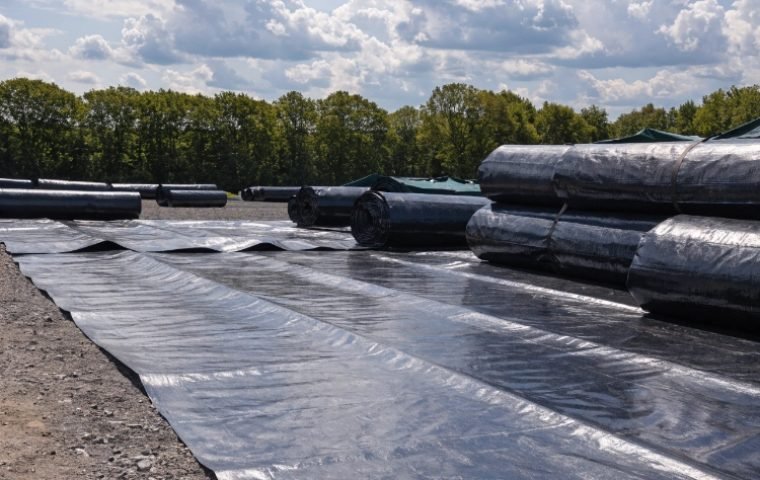
Geomembrane liners control water loss by providing a flexible, continuous, and chemically stable barrier that bridges subgrade imperfections. By thermal fusion welding large sheets together, we create a monolithic "bag" that holds the water entirely separate from the soil interaction.
The Mechanism of Containment
Geomembranes work on two levels: impermeability و elongation.
- Molecular Density: البولي إيثيلين عالي الكثافة (HDPE) has a tightly packed molecular structure. Water molecules simply cannot pass through the polymer chains. This reduces the seepage rate from the "gallons per minute" seen in soil to virtually zero.
- Bridging Capability: Unlike concrete, which snaps when the ground moves, a geomembrane is ductile. If the subgrade settles by 5cm, the liner stretches (elongates) to accommodate the movement without rupturing.
The Importance of the "System"
Controlling water loss isn't just about rolling out plastic. It is about the entire system.
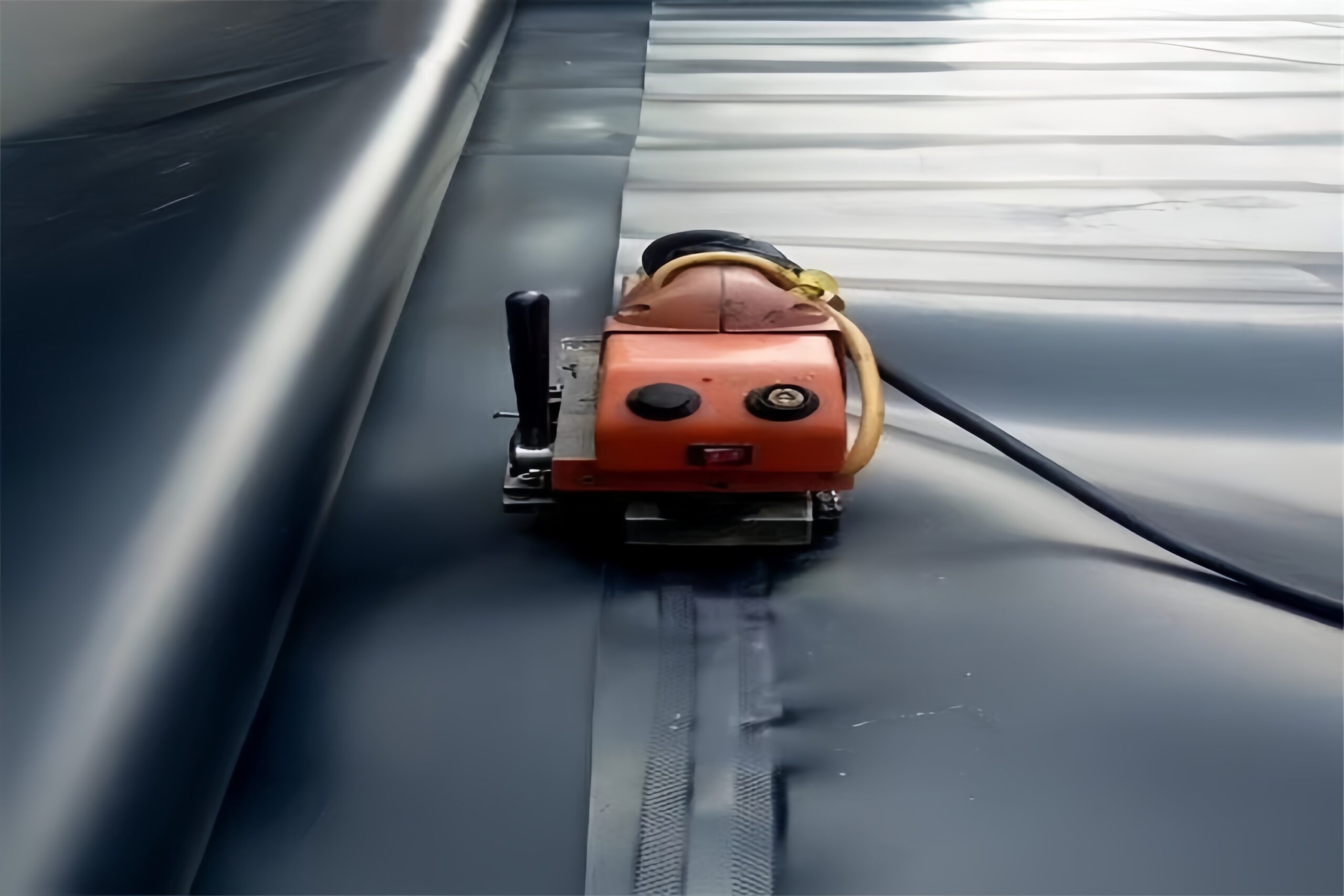
- Seaming: We use double-track wedge welders. This creates two weld beads with an air channel in between. We pressure test this channel to ensure the seam is 100% leak-proof.
- Anchor Trenches: The liner is buried in a trench around the perimeter. This locks the material in place, preventing wind uplift and ensuring that surface runoff doesn't get under the liner.
- Penetrations: Pipes and inlets are the weak points. We use "pipe boots"—pre-fabricated sleeves made of the same liner material—welded to the main sheet and clamped to the pipe. This ensures the seal is continuous even at complex geometries.
Which liner materials are most effective for reservoirs?
Choosing the wrong material is the most expensive mistake a buyer can make. I see clients buying cheap "tarps" or construction-grade plastic that disintegrates in the sun within two years, forcing a complete reconstruction.
HDPE (البولي إيثيلين عالي الكثافة) is the most effective and widely used material for large-scale open reservoirs due to its superior UV resistance and cost-efficiency. LLDPE (البولي إيثيلين الخطي منخفض الكثافة) is an excellent alternative where high flexibility is needed to conform to uneven or settling terrain.
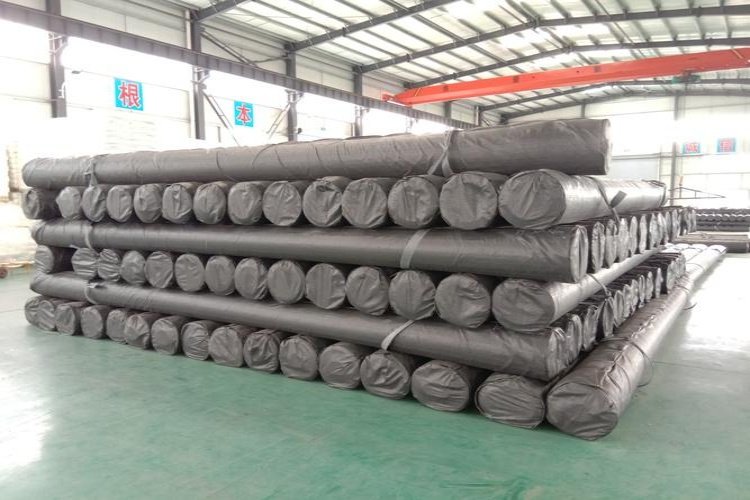
HDPE: The Industry Standard
For 90% of the projects I supply—irrigation ponds, fire water tanks, aquaculture—HDPE is the choice.
- الايجابيات: It is tough. It resists UV radiation better than almost any other polymer because of the carbon black integration. It creates very strong welds.
- السلبيات: It is stiff. It creates wrinkles (thermal expansion) which must be managed during installation.
LLDPE: The Flexible Alternative
We often recommend LLDPE for projects where the subgrade is not perfectly smooth or where differential settlement is expected (like on reclaimed land).
- الايجابيات: It has higher multi-axial elongation. It can stretch further before breaking. It lays flatter than HDPE.
- السلبيات: It has slightly lower chemical resistance and tensile strength than HDPE, though usually sufficient for water.
PVC and EPDM
- PVC: Easy to install (can be glued), but plasticizers migrate over time, making it brittle. I rarely recommend it for long-term exposed applications in hot climates.
- EPDM: Excellent rubber-like flexibility and UV resistance, but the seams (glued/taped) are weaker than thermally welded HDPE seams. It is also significantly more expensive per square meter.
For a professional buyer looking for a 20-year solution, a 1.0mm to 1.5mm HDPE geomembrane is typically the "Goldilocks" zone of performance and price.
What factors affect long-term liner performance?
A geomembrane datasheet might look perfect, but real-world conditions are harsh. If the liner isn't designed for the specific environment or installed with care, "long-term" can turn into "short-term failure" very quickly.
Long-term performance is dictated by UV degradation resistance (OIT), installation quality (welding), and mechanical damage prevention during operation.
1. UV Resistance and Resin Quality
The sun is the enemy. UV radiation breaks down polymer chains, causing the liner to become brittle and crack (Stress Cracking).
- The Solution: We ensure our resin contains 2% to 3% finely dispersed Carbon Black. This absorbs the UV.
- The Metric: Buyers must check the OIT (Oxidative Induction Time). Standard OIT measures antioxidant levels. For a reservoir liner expected to last 20 years, you need a high-pressure OIT (HPOIT) that ensures the stabilizers don't leach out or boil off over time.
2. Thermal Expansion and Contraction
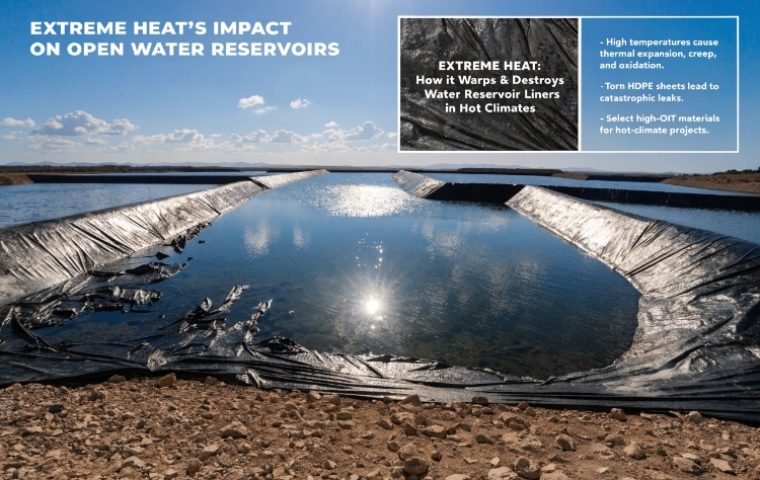
Black liners get hot—up to 60°C or 70°C on a sunny day. They expand. At night, they cool and shrink.
- المخاطر: If installed too tight on a hot day, the liner will shrink at night and bridge across corners (trampolining). The stress will eventually tear the welds.
- The Fix: Experienced installers lay the liner with calculated "slack" (wrinkles) to accommodate these thermal cycles without stressing the material.
3. Physical Damage
- Subgrade: A single sharp stone left under the liner acts like a slow-motion knife. As water pressure increases, the liner is pushed onto the stone.
- Maintenance: Cleaning sludge out of a reservoir often involves machinery. A careless excavator bucket is the leading cause of liner death. We often recommend placing a sacrificial layer of geotextile and extra liner or concrete at the "clean-out ramp" area to protect the primary barrier.
خاتمة
Reservoir liners prevent water loss by replacing the uncertainty of soil with the certainty of engineering.
When designed correctly, an HDPE liner system transforms a reservoir from a leaking sieve into a watertight vault. The key is to select the right thickness (usually 1.0mm - 1.5mm), insist on virgin resin with high UV stabilizers, and ensure that the installation team follows rigorous welding and testing protocols. Do this, and your water stays exactly where you put it.