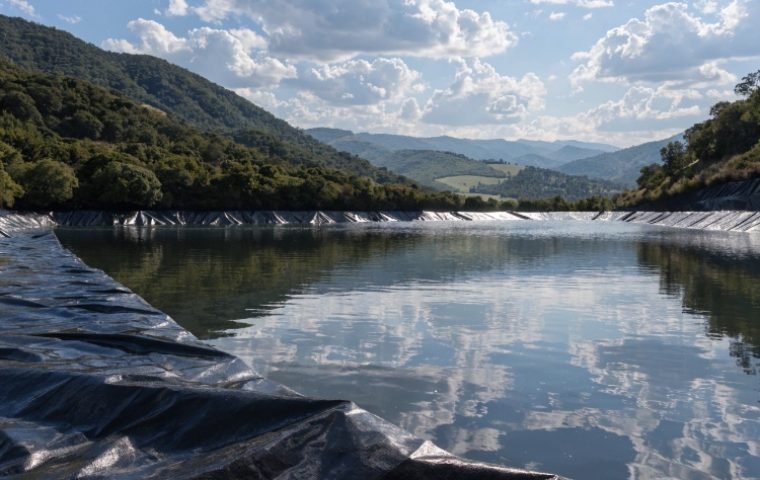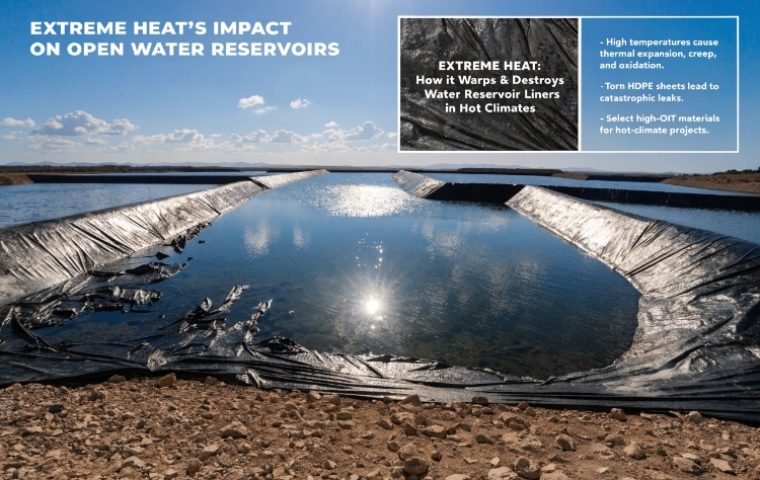


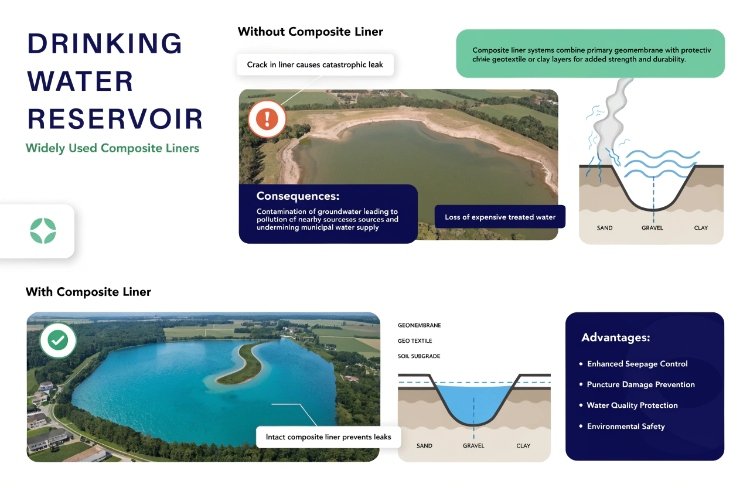
Leaking drinking water reservoirs do not just lose expensive, treated water; they invite dangerous groundwater contamination that can ruin a municipal supply. If your primary barrier fails, the entire surrounding infrastructure is at risk.
Yes, composite liners are widely used in modern drinking water reservoirs. A composite liner system combines a primary غشاء أرضي with protective geotextiles or clay layers to provide enhanced seepage control. This multi-layer approach prevents puncture damage, stops leaks, and ensures strict water quality protection for large-scale storage projects.
Understanding when and how to specify these advanced containment systems is critical for engineers tasked with securing municipal water supplies.
Why Drinking Water Reservoirs Require Effective Lining Systems
A drinking water reservoir is an expensive piece of civil infrastructure. Unlike a standard agricultural pond, the water stored here has often already gone through preliminary treatment, filtration, or costly pumping processes.
Losing this water to seepage is literally draining the municipal budget. But water loss is only half the problem. When we supply materials to municipal engineering firms, their primary concern is strict environmental protection. Regulatory bodies, such as the local equivalents of the U.S. Environmental Protection Agency (EPA) or World Health Organization (WHO) guidelines, mandate that potable water must not interact with the surrounding native ecosystem.
If untreated groundwater seeps داخل the reservoir through a compromised subgrade, it introduces pathogens, heavy metals, and agricultural runoff native to the soil. Conversely, if treated water escapes out of the reservoir, it can alter the local water table or cause internal erosion of the earthen embankment. Over time, internal soil erosion leads to catastrophic structural blowouts. Therefore, drinking water infrastructure requires a flawless, zero-leakage barrier to maintain water quality and facility stability.
What Is a Composite Liner System?
A single sheet of plastic is often not enough to handle the harsh realities of a construction site. A composite liner is a multi-layer lining system typically composed of an impermeable geomembrane combined with a geotextile or clay-based material.
The goal is to create a system where the weakness of one material is covered by the strength of another. In the geosynthetics industry, we do not view containment as just a membrane; we view it as a layered barrier. The most common combinations we export for B2B projects include an HDPE geomembrane paired with a non-woven geotextile cushion, or a geomembrane placed directly over a Geosynthetic Clay Liner (GCL).
Here is how the individual components function within a composite system:
| Layer Material | Engineering Function | Practical Field Notes |
|---|---|---|
| Geomembrane (HDPE/LLDPE) | Primary waterproof barrier | Blocks 100% of liquid and gas transfer. |
| Non-woven Geotextile | Protection and cushioning | Prevents rocks from puncturing the plastic. |
| بطانة الطين الاصطناعية (GCL) | Secondary seepage barrier | Swells to seal itself if the geomembrane is torn. |
Are Composite Liners Commonly Used in Drinking Water Reservoirs?
Yes, composite liners are extremely common in drinking water reservoirs, especially in high-budget municipal and regional water security projects.
When you ask what liner is used for drinking water reservoirs, the answer almost always points to a composite design. The reason is simple: risk mitigation. A single-layer bare geomembrane sitting directly on compacted dirt relies entirely on perfect site preparation. If a bulldozer operator leaves a sharp rock behind, the weight of a 10-meter deep water column will push the geomembrane onto that rock, puncturing the barrier.
Composite liners offer a much higher safety factor. By placing a heavy geotextile under the geomembrane, you create a soft, protective cushion that neutralizes sharp objects. By adding a clay layer, you create environmental redundancy. Over a 30-year design life, this multi-layered protection against mechanical damage, ground settlement, and seismic shifts guarantees a longer service life and a vastly lower maintenance cost for the water authority.
Typical Composite Liner Configurations for Drinking Water Reservoirs
Depending on the project budget and the risk profile of the site, engineers use different configurations of composite liner systems for reservoirs. Here are the three we encounter most often.
1. HDPE Geomembrane + Cushion Geotextile
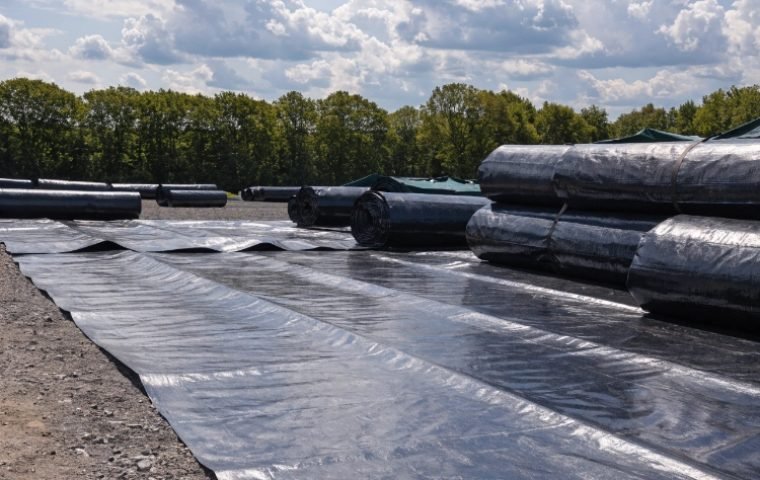
This is the baseline composite system. The contractor first rolls out a heavy non-woven geotextile (usually 300g/m² to 500g/m²) directly onto the subgrade. Then, they deploy the HDPE geomembrane over the top. The geotextile acts as a mattress, protecting the primary geomembrane from puncture. This setup is highly cost-effective and is standard for municipal reservoirs and clean irrigation reservoirs built on rocky soils.
2. Geomembrane + Geosynthetic Clay Liner (GCL)
When regulations require extreme safety, engineers specify a GCL beneath the geomembrane. A GCL consists of powdered sodium bentonite clay trapped between two layers of fabric. It has an extremely low permeability. If a rock punctures the top geomembrane, water reaches the GCL, causing the bentonite clay to swell. This swelling creates a self-sealing capability that plugs the leak automatically. We see this often in environmentally sensitive areas.
3. Double Geomembrane Liner Systems
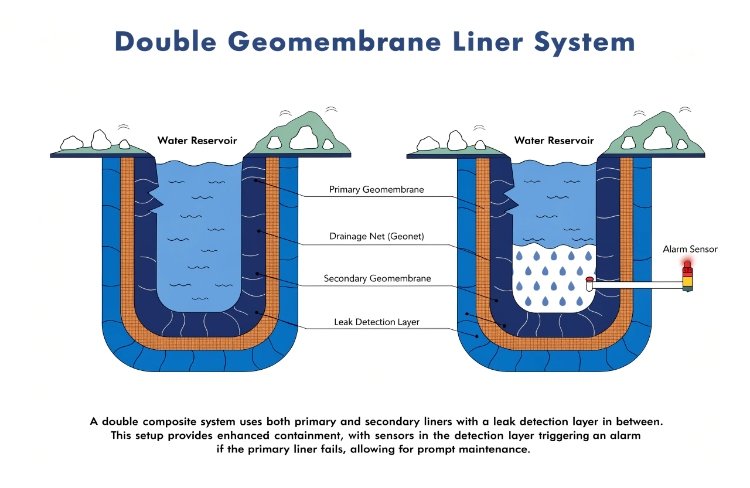
For very large reservoirs or high-risk water storage (such as areas prone to earthquakes), a double composite system is used. This typically involves a primary geomembrane, a drainage net (geonet), and a secondary geomembrane. The space between the two liners serves as a leak detection layer. If the top liner fails, sensors in the middle layer trigger an alarm, while the bottom liner keeps the water safely contained.
Are Geomembranes Safe for Drinking Water Storage?
One of the first questions government buyers ask us is: "Are geomembranes safe for drinking water?" They worry that the black plastic will leach harmful chemicals, heavy metals, or toxic plasticizers into the municipal water supply.
The short answer is yes, they are completely safe, provided you specify the correct manufacturing standards.
When a geomembrane is used for potable water, it must be manufactured from 100% virgin High-Density Polyethylene (HDPE) resin. Virgin HDPE contains no toxic additives, heavy metals, or plasticizers that can migrate into the water. To prove this, reputable manufacturers adhere to strict global testing protocols, the most famous being the NSF/ANSI 61 certification (or local drinking water equivalent).
This certification verifies that the materials do not contaminate drinking water. However, if a buyer tries to cut costs by purchasing a liner made from recycled, low-quality polyethylene, all guarantees are off. Recycled plastics often contain unknown chemical residues. Therefore, strict verification of virgin resin certificates is mandatory for any drinking water reservoir liner.
Advantages of Composite Liners in Drinking Water Reservoirs
Upgrading from a simple compacted clay or single-layer plastic design to a composite liner system offers several clear engineering advantages.
- Enhanced Seepage Control: Even microscopic pinholes in a geomembrane weld can leak water. When you pair a geomembrane with a secondary GCL beneath it, the composite interaction physically blocks the flow of water, practically reducing leakage to zero.
- Improved Protection for Geomembranes: The primary cause of liner failure is mechanical damage during installation or operation. A thick cushioning geotextile absorbs the impact of falling tools, heavy foot traffic, and sharp subgrade aggregates, physically preventing puncture damage.
- Increased System Reliability: Redundancy is the core philosophy of modern civil engineering. A multi-layer system ensures that if one component is compromised by a natural disaster or human error, the secondary barrier prevents a complete structural failure.
- Longer Service Life: Because the geomembrane is protected from under-slab friction and stress-point punctures, its realistic service life extends dramatically. A well-installed composite system can safely hold water for 30 to 50 years with minimal maintenance.
When Is a Composite Liner Recommended for Reservoir Projects?
While composite liners are superior, we do not recommend them blindly for every single pond project. They are engineering solutions tailored to specific risks.
We strongly recommend a composite liner for large municipal reservoirs, where the sheer volume of water generates immense hydrostatic pressure. High pressure forces the liner downward; if it is pressing against bare, sharp gravel, it will eventually yield without a geotextile cushion.
Composite liners are also critical when you have poor soil conditions. If the native soil is highly permeable (like sand or karst limestone), any small leak can cause massive sinkholes beneath your reservoir. A composite system with a GCL is essentially mandatory here. Furthermore, long design-life projects in regions with high groundwater protection requirements legally mandate these multi-layer systems. Engineers will look closely at water depth and soil permeability to decide exactly how thick the geotextile or GCL needs to be.
المخاطر والقيود ومتى لا يوصى بذلك
Despite their excellent performance, composite liner systems have distinct limitations that buyers must respect.
First is the high project cost. Procuring, shipping, and installing two or three distinct layers of geosynthetics significantly increases the overall budget. For a small, privately-owned agricultural pond holding low-value river water, a composite system is usually financial overkill. A single high-quality HDPE liner properly installed on a clean, sandy subgrade is enough.
The second major risk involves using Geosynthetic Clay Liners (GCLs) in wet climates. GCLs must remain completely dry until the geomembrane is fully welded over them. If you are installing a composite system and an unexpected rainstorm hits up-exposed GCL, the bentonite clay will prematurely hydrate and swell. Once it swells before being confined by the heavy water load, it turns into a useless, slippery mush that must be dug out and replaced. Managing a multi-layer installation requires highly skilled contractors and strict weather management.
Design Considerations for Drinking Water Reservoir Liners
When designing a composite liner system for reservoirs, selecting the right material is only the starting point. How the system is engineered in the field dictates its success.
- Subgrade Preparation: Even with a thick cushion geotextile, the underlying soil must be compacted and cleared of large, angular rocks. A geotextile is a shock absorber, not magic armor.
- Liner Thickness: For the primary barrier, a thickness of 1.5 mm (60 mil) or 2.0 mm (80 mil) HDPE is standard for municipal drinking water. Anything thinner risks tearing under heavy municipal usage.
- Anchoring Systems: Multi-layer systems are heavy. They must be secured at the top of the embankment in a deep, properly engineered anchor trench to prevent the liners from sliding down the slope.
- Slope Stability: Placing a very smooth geomembrane directly on a GCL or geotextile creates a low friction surface. If the slope is steep, engineers must specify textured geomembranes to lock the layers together through interface friction, preventing the system from collapsing on itself.
خاتمة
Composite liners are widely used in drinking water reservoirs because they offer the ultimate defense against both water loss and environmental contamination.
By combining the absolute impermeability of an HDPE geomembrane with the structural protection of geotextiles and the self-sealing redundancy of clay liners, engineers can guarantee decades of secure water storage. While the initial investment and installation complexity are higher, proper material selection and design are essential for long-term performance. High-quality geomembrane and geotextile materials play a critical role in ensuring safe and durable reservoir liner systems for communities worldwide.