

When sourcing a geomembrane for a biogas project, what's the first question most buyers ask? "How thick is it?" This focus on thickness is understandable, but it often overshadows a far more critical performance metric: gas-tightness. Overemphasizing thickness can lead to a false sense of security and a system that fails to meet its primary economic goal.
This guide explains why true gas-tightness is the ultimate objective, while thickness is merely one tool—and not always the most important one—to help achieve it. We'll explore what thickness can and cannot do, and show you how to shift your focus to specifying a complete, high-performance gas containment system that protects your investment.
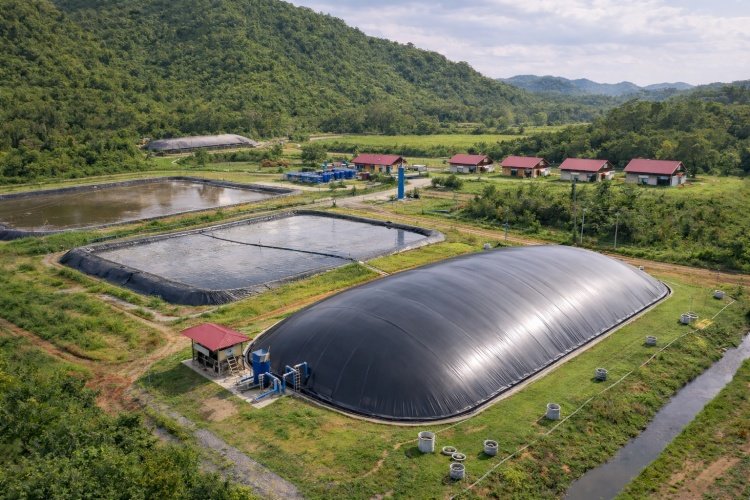
Understanding why this focus on thickness is so common is the first step toward moving beyond it and making more informed engineering decisions.
Why Thickness Is Often the First Parameter Buyers Focus On
In our experience working with project managers and procurement teams across the globe, the conversation almost always starts with thickness. This happens for a couple of very human reasons.
Thickness as an Easy and Familiar Specification
Dikte is a simple, tangible, and easily comparable number. It's straightforward to compare a 1.5 mm liner to a 2.0 mm liner. This simplicity is appealing in the complex world of project specifications. For a procurement professional tasked with getting competitive quotes, thickness provides a clear baseline for an apples-to-apples comparison. It reduces a complex engineering material to a single, understandable metric, which feels efficient. However, this efficiency can be deceptive, as it overlooks the nuances of performance.
How “Thicker Is Better” Became a Common Assumption
The "thicker is better" mindset is a powerful intuitive shortcut that we learn from countless other applications. A thicker steel I-beam is stronger. A thicker concrete wall offers more support. We instinctively transfer this logic to geomembranes, assuming a thicker liner must automatically be more durable, more protective, and therefore, better at containing gas. While there is some truth to the durability aspect, this analogy breaks down completely when it comes to the primary function of a biogas cover: preventing gas leakage.
What Thickness Can — and Cannot — Do in Biogas Applications
To make an informed decision, you must understand the specific roles thickness plays. It is a critical parameter for mechanical performance, but it has significant limitations when it comes to gas containment.
How Increased Thickness Improves Mechanical Robustness
A thicker geomembrane provides clear advantages in terms of physical durability. This is where the "thicker is better" logic holds true. Specifically, greater thickness improves:
- Punksie weerstand: A 2.0 mm liner offers a significantly higher safety margin against being punctured by a dropped tool, sharp rocks in the subgrade, or equipment used for maintenance.
- Abrasion Resistance: It can better withstand wear and tear from contact with floating equipment or from sediment movement within the digester.
- Tensile Strength: It provides greater resistance to tearing during installation, especially when large panels are being deployed under tension.
- Hydrostatic Pressure Resistance: In deep lagoons, a thicker liner is better equipped to handle the immense, constant pressure exerted by the liquid digestate.
These are all important factors for the long-term structural integrity of the liner, especially for the bottom lining of a digester.
The Limitations of Thickness in Controlling Gas Leakage
Here is where the common assumption fails. While a thicker liner will technically have a slightly lower gas diffusion rate, this effect is marginal compared to the primary sources of gas loss. The vast majority of biogas does not escape by diffusing through the body of a high-quality HDPE or LLDPE membrane.
Instead, gas escapes through:
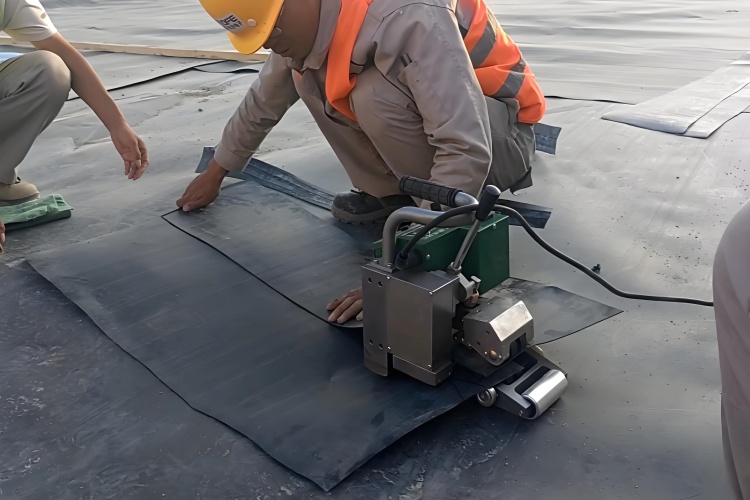
- Imperfectly Welded Seams: A single, tiny flaw in a weld can leak more methane in a day than will diffuse through the entire cover in a year.
- Poorly Sealed Penetrations: The areas where pipes, mixers, and hatches pass through the liner are the most common and significant points of failure.
- Damaged Sections: Mechanical damage that creates a pinhole or tear becomes a highway for gas to escape.
A 2.0 mm liner with a poorly welded seam is far less "gas-tight" than a perfectly installed 1.5 mm liner. Thickness cannot compensate for poor installation quality.
Gas-Tightness Depends on More Than Material Thickness
Achieving a truly gas-tight system requires a holistic approach that goes far beyond a single dimension on a data sheet.
Gas Permeability Is a Material Property, Not a Thickness Shortcut
The inherent ability of a material to resist gas passing through its molecular structure is called permeability. This is a fundamental property of the polymer itself. We choose HDPE and LLDPE for biogas applications precisely because they have an intrinsically very low permeability to methane. The difference in gas diffusion between a 1.5 mm and 2.0 mm sheet of the same high-quality HDPE is minimal in the grand scheme of a project's gas balance. The initial choice of the right polymer is far more impactful than a marginal increase in thickness.
The Role of Seams, Penetrations, and Installation Quality
Think of a biogas cover as a fortress wall. The thickness of the wall is important for resisting cannonballs (mechanical stress), but the entire fortress is useless if the gate (a seam or penetration) is left open. In a biogas system, the "gates" are the tens of thousands of meters of field seams and the dozens of complex penetrations.
A truly gas-tight system is defined by:
- 100% Tested Seams: Every inch of every seam must be non-destructively tested to ensure it is flawless.
- Expertly Sealed Penetrations: Each pipe or mixer must be sealed with a custom-fabricated boot, meticulously welded to create a monolithic seal.
- Certified Installation: The work must be done by experienced technicians who understand the unique challenges of creating a gas-proof barrier.
Why a Thicker Liner Does Not Guarantee Better Gas Containment
In some cases, an excessively thick liner can even introduce new challenges that compromise the overall system's performance.
Stress Concentration and Seam Performance in Thicker Membranes
Thicker geomembranes are significantly stiffer. This rigidity can make them more difficult to handle and weld, especially around curves or complex details. An installer may struggle to get a perfect, uniform weld on a very stiff material, potentially increasing the risk of flaws. Furthermore, this stiffness can cause the material to form sharp folds or wrinkles rather than draping smoothly. Over years of operation, these wrinkles can become points of high stress concentration, leading to fatigue and potential cracking.
Pressure, Movement, and Long-Term Fatigue Effects
A biogas cover is a dynamic component. It rises and falls with gas production and can be subjected to wind uplift and other environmental forces. A highly flexible material (like LLDPE) is better suited to handle this constant movement. A very thick and rigid cover may not respond as well to these dynamic loads, potentially putting more stress on the seams and anchor points. In this context, flexibility can be more important for long-term gas-tight integrity than raw thickness.
When Thickness Still Matters — and How to Use It Correctly
This is not to say that thickness is unimportant. It is a critical parameter when used for the right reasons. The key is to apply it as an engineering tool for structural durability, not as a shortcut for gas containment.
Structural and Durability Considerations
We recommend considering a thicker liner (e.g., 2.0 mm or more) in situations with high mechanical risk, such as:
- Deep Digesters: To withstand high hydrostatic pressure at the bottom of the lagoon.
- Rough Subgrades: When the underlying soil contains sharp stones or debris that could pose a puncture risk.
- High Traffic Areas: In areas where maintenance activities might involve walking on the liner or using equipment.
- Extreme Longevity Requirements: For projects designed with a 30+ year service life, a thicker liner provides an extra buffer against unforeseen wear and tear.
In these cases, the decision to increase thickness is a deliberate choice to enhance mechanical robustness, not a flawed attempt to improve gas-tightness.
Balancing Thickness with Flexibility and System Design
The ideal specification is a balance. For a large floating cover, you need enough thickness to ensure durability and puncture resistance, but not so much that the material becomes too heavy or rigid to function properly. This is why a 1.5 mm LLDPE is often a sweet spot for covers—it balances strength with the essential flexibility needed for a dynamic gas-holding component. The conversation should not be "What's the thickest liner you have?" but rather "What is the optimal thickness to balance durability and flexibility for our specific cover design?"
How to Specify Liners Beyond Thickness
To ensure you get a truly high-performance system, you need to broaden the conversation beyond a single dimension.
Questions Buyers Should Ask Beyond “How Thick Is It?”
When you engage with a supplier like us, these are the questions that will lead to a better project outcome:
- Material Properties: "What is the certified Methane Transmission Rate (MTR) for this material?" and "What are its physical properties like tensile strength, puncture resistance, and stress crack resistance?"
- Installation & QA/QC: "What is your mandatory quality control protocol for field seams?" and "How do your certified installers handle complex penetrations for pipes and mixers?"
- System Performance: "Based on our project's operating pressure and design, can you provide case studies of systems that have achieved long-term gas-tightness?"
- Duursaamheid: "What is the formulation's UV resistance and expected service life under constant exposure?"

Aligning Thickness with Gas-Tight System Requirements
The right approach is to work backward from the goal. Start by defining the performance you need: "Our project must maintain a high level of gas containment to be economically viable and environmentally compliant." Then, work with your engineering partner and supplier to design a complete system to meet that goal. Thickness becomes one component of that design, chosen specifically for the mechanical demands of each part of the system—a robust HDPE for the bottom and a durable, flexible LLDPE for the cover, each at an optimized thickness.
Conclusion: Thickness Is a Tool — Gas-Tightness Is the Goal
Focusing solely on geomembrane thickness is like judging the quality of a car by the thickness of its paint. True performance comes from the engine, the chassis, and how all the parts are assembled. In biogas systems, thickness provides mechanical durability, but true, long-term gas-tightness is a function of the right material, superior seam quality, and expert installation. By shifting your focus from a simple dimension to the overall system performance, you ensure your project captures more gas, improves safety, and delivers a greater return on investment.