

You're designing a road or platform on soft ground, facing a critical choice between geogrids and geocells. Choosing incorrectly can lead to rapid failure, costly repairs, and project delays.
Geocells decisively outperform geogrids under heavy loads because of their three-dimensional structure. This 3D honeycomb system confines soil completely, creating a semi-rigid mattress that distributes weight over a massive area. Geogrids, being 2D, only offer reinforcement in a flat plane, which is far less effective.

From my experience exporting both products, I've seen contractors make costly mistakes by treating them as interchangeable. They are fundamentally different tools. While a geogrid can add strength, a geocell transforms weak soil into a high-performance composite material. Understanding this key difference will help you specify the right product and ensure your project succeeds from the ground up.
What key structural features distinguish geocells from geogrids?
You see both products on data sheets, and they can seem like similar plastic grids. This misunderstanding can lead you to specify a product that simply isn't built for the job.
The defining difference is dimensionality. A geocell is a three-dimensional (3D) honeycomb structure with vertical height. A geogrid is a two-dimensional (2D) flat mesh. This single feature changes everything about how they interact with soil and handle loads.
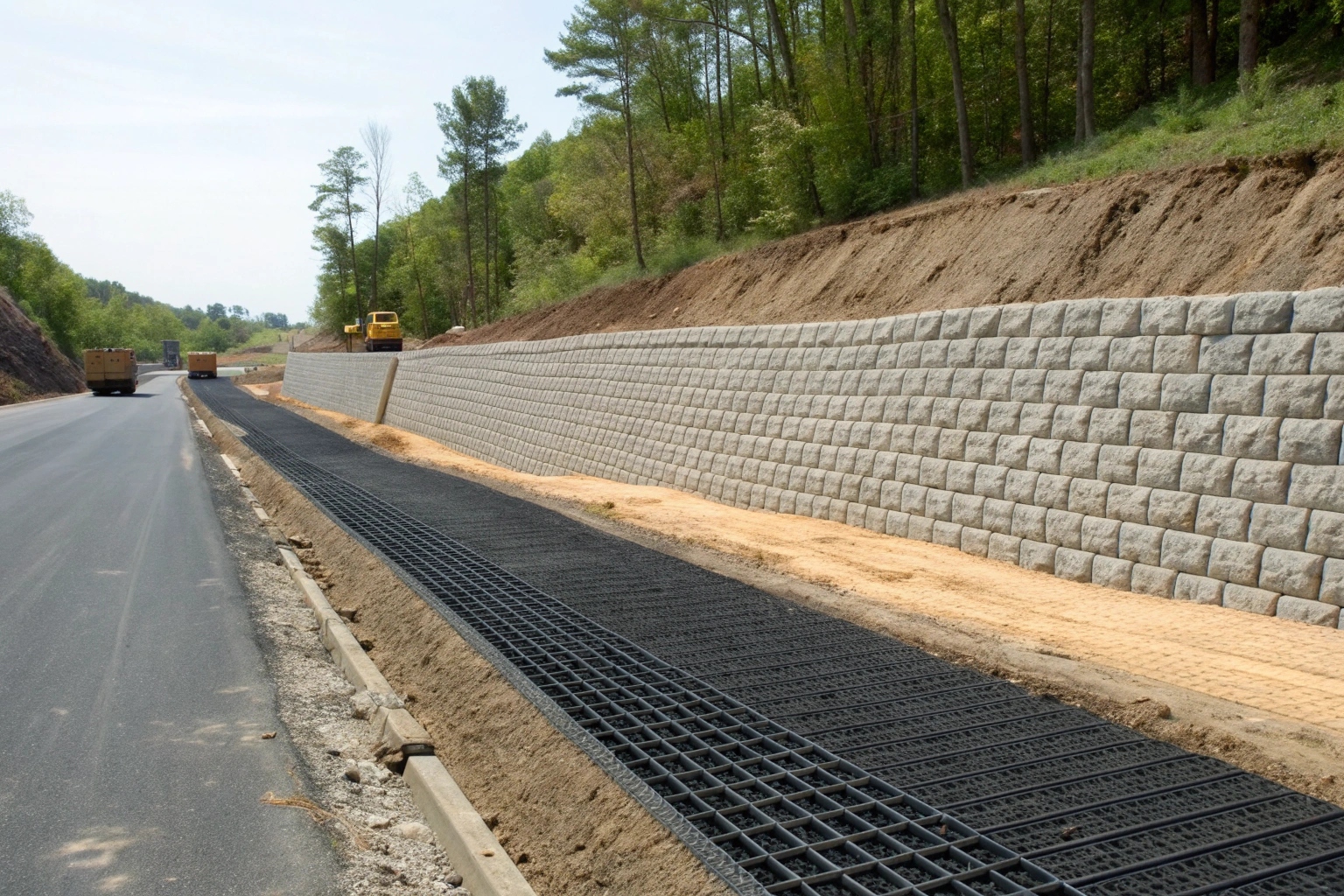
Think of it this way: a geocell, when expanded, forms a series of interconnected boxes. Each box has walls with a specific height (from 50 mm to 250 mm). When you fill these boxes with soil or aggregate, the cell walls completely surround the material. The soil is locked in place vertically and horizontally. This creates a true 3D confinement system.
A geogrid, on the other hand, is like a strong net laid flat on the ground. It provides reinforcement only in its plane by interlocking with aggregate. There are no vertical walls. It can stop soil from sliding sideways, but it can’t stop it from bulging up or deforming vertically. This 2D structure is the primary limitation, especially when heavy loads are applied from above.
| Feature | Geocell | Geogrid |
|---|---|---|
| Structure | Three-Dimensional (3D) Honeycomb | Two-Dimensional (2D) Flat Grid |
| Confinement | Vertical and Horizontal | Horizontal Only |
| Key Component | Cell Walls with Height | Apertures in a Flat Plane |
| Interaction | Encloses and contains the infill | Interlocks with aggregate at the surface |
How does geocell confinement improve load distribution compared with geogrids?
You need to spread a heavy, concentrated load from a truck tire across weak subgrade soil. If the stress isn't distributed properly, the ground will punch through, causing immediate failure.
A geocell system creates a "semi-rigid beam" or mattress effect. Its 3D structure distributes loads over a very wide area, significantly reducing pressure on the soil below. Geogrids rely on a weaker "tension membrane" effect, which only activates after the ground has already started to deform.
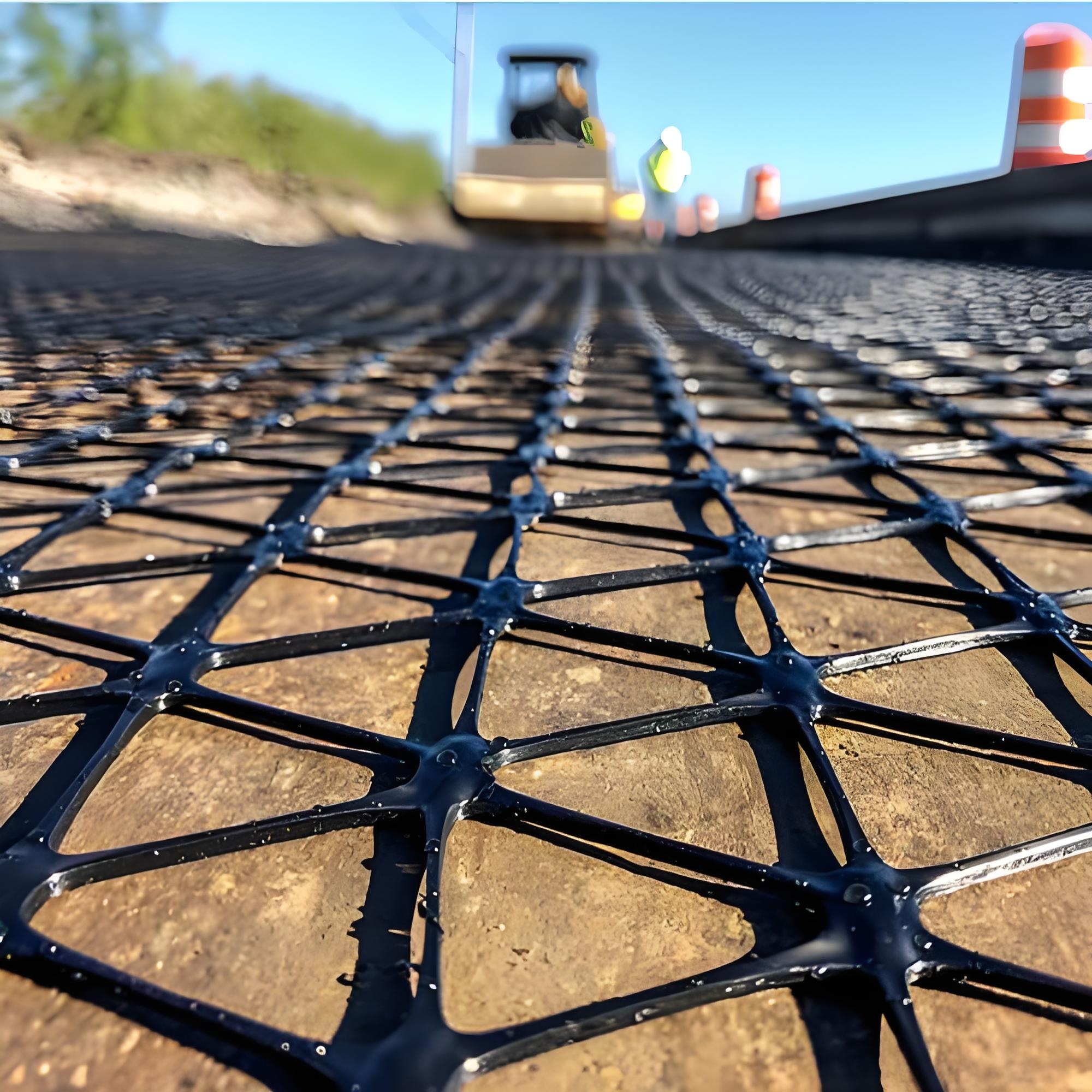
When a load hits a geocell-filled layer, the entire system acts like a thick, stiff slab. The vertical cell walls resist bending and transfer the stress not just down, but also out to adjacent cells. This wider distribution means the pressure on the soft ground underneath can be reduced by over 50%. It's an immediate, rigid response.
A geogrid works differently. For it to distribute a load, it must sag or deform into a curved shape. This creates tension in the grid, like a trampoline. The problem is, for the geogrid to deform, the ground beneath it must already have settled. This mechanism is less efficient and provides much weaker load distribution, often only reducing pressure by 15-25%. On many projects I've consulted for, this difference is the deciding factor between a stable surface and one that quickly develops ruts.
Where do geocells provide better performance than geogrids under heavy loads?
Your project involves extreme conditions: massive loads, constant traffic, and very soft ground. Standard reinforcement methods might only last a few months before needing major repairs, costing you time and money.
Geocells are the superior choice for the most demanding applications, like port container yards, mining haul roads, airport pavements, and military transport routes. Their ability to form a stable platform on extremely weak soils (like those with a CBR under 3%) is unmatched by geogrids.
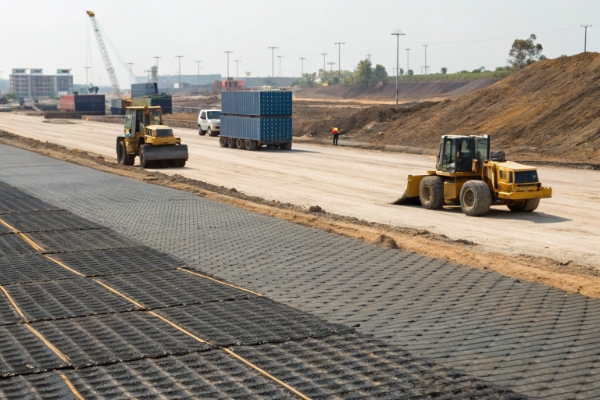
I worked on a port project where the ground was extremely soft clay. The contractor needed to support 200-ton cranes. A traditional geogrid design required digging out the weak soil and building a 1.3-meter-thick reinforced base with multiple layers of geogrids and fabrics.
Instead, we proposed a geocell solution. By using a double layer of high-strength geocells, we were able to build a stable platform directly on the soft clay with a total thickness of just 750 mm. The project not only saved over 20% in costs but also cut construction time by 40%. The geocell's 3D structure was able to immediately support the construction vehicles, which would have sunk into a geogrid-reinforced layer. Under repeated heavy traffic, geocells also significantly outperform geogrids in preventing rutting. Test data shows that after 20,000 vehicle passes, a geocell-reinforced base can have 2.5 times less settlement than a geogrid base.
How can project conditions guide the choice between geocells and geogrids?
You want to make the smartest choice for your project, balancing performance with your budget. Simply picking the most expensive option isn't always the right answer, but cutting corners can lead to disaster.
The choice depends on three things: the subgrade strength, the type of load, and the required fill material. Geocells are the better investment for weak soils and heavy, dynamic loads because they also allow you to use cheaper, locally available fill, which geogrids cannot.
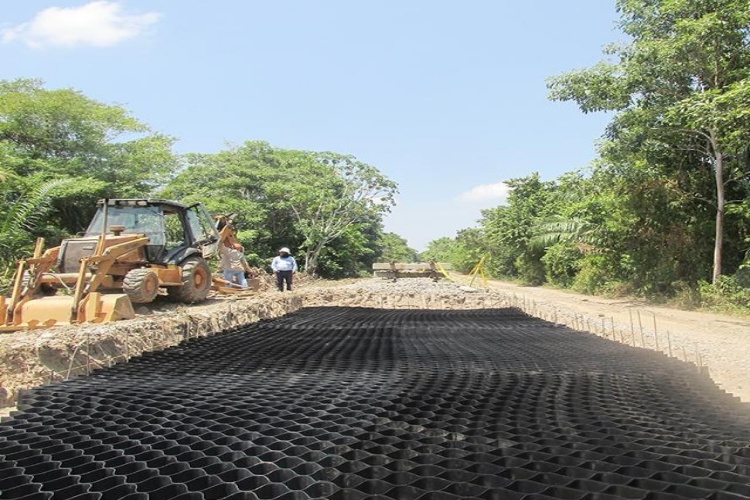
One of the biggest hidden advantages of geocells that I always point out to clients is fill flexibility. Because the 3D cells provide such powerful confinement, you can fill them with almost anything: sand, gravel, recycled concrete, or even low-quality soil excavated on-site. This can save a project enormous amounts of money on material and hauling costs.
Geogrids, however, depend on a strong mechanical interlock to work. This means they require clean, crushed, well-graded aggregate of a specific size. Using fine sand or poor-quality fill with a geogrid will drastically reduce its effectiveness. So, when you evaluate your options, don't just compare the price per square meter of the geosynthetic. Consider the total construction cost. Geocells often allow you to build a thinner base using cheaper fill, making them the more economical solution for demanding jobs.
Here is a summary I use to help clients decide:
| Factor | Choose Geocell When... | Choose Geogrid When... |
|---|---|---|
| Subgrade | Very soft to soft (e.g., CBR < 3%) | Firm to stiff (e.g., CBR > 3%) |
| Load Type | Heavy, dynamic, concentrated (trucks, cranes) | Lighter, static, or uniform loads (parking lots, embankments) |
| Fill Material | You want to use low-cost local fill or recycled materials | You have access to clean, specific-sized aggregate |
| Performance Goal | Minimize ALL settlement and create a semi-rigid platform | Improve bearing capacity and control lateral spreading |
Conclusion
For heavy-load projects on weak ground, the 3D confinement of geocells offers superior performance and long-term value over 2D geogrids, often reducing overall project costs and construction time.