

You've done the work, sourced a geotextile supplier, and the sample you received looks perfect. But when the container arrives and your client begins installation, the material fails. This scenario, often born from a focus on an attractively low price, is a critical risk for importers. The promise of savings disappears, replaced by costly project delays and reputational damage.
As a supplier, we want our import partners to succeed long-term. This guide exposes the eight most common geotextile selection pitfalls we see from an international trade perspective. We'll cover everything from technical specification errors to the dangers of unverified data, helping you source with confidence and avoid the costly trap of inconsistent quality between sample and bulk delivery.
The most frequent and costly mistake begins not with a technical sheet, but with the price list. Let’s start there.
1. Focusing Only on Low Price and Ignoring Long-Term Durability
The most dangerous pitfall for any importer is making the purchasing decision based on the lowest unit price alone. An unusually low price is often a red flag for critical compromises that are invisible on a basic spec sheet or even in a high-quality sample.
We have seen cases where a sample is produced with 100% virgin-grade resin to meet test requirements, but the bulk production uses recycled materials with inconsistent properties. This results in a final product that might have the correct weight (GSM) but fails prematurely due to poor UV resistance, low tensile strength, or inconsistent filtration. A geotextile that degrades in 5 years is far more expensive than a properly certified product that performs for 20+ years, especially when you factor in the cost of failure and replacement. Always be wary of a price that seems too good to be true, as it often signals a potential discrepancy between the approved sample and the final delivered goods.
2. Mixing Up Woven and Nonwoven Geotextiles
This is the number one technical selection error. While both are geotextiles, woven and nonwoven fabrics are engineered for fundamentally different functions and are not interchangeable. Using the wrong type guarantees project failure.
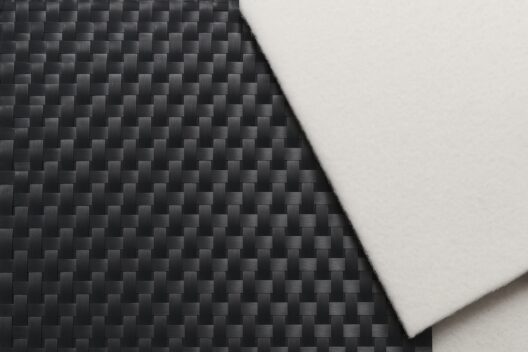
- Woven Geotextiles: These are manufactured by interlacing polypropylene tapes, creating a strong, stiff sheet. Their primary function is reinforcement and separation. Think of them like a high-strength plastic tarp. They have high tensile strength but very low permeability, making them unsuitable for applications requiring water to pass through.
- Nonwoven Geotextiles: These are made by needle-punching or heat-bonding polyester or polypropylene fibers together, creating a felt-like fabric. Their primary functions are filtration, separation, and cushioning. They have excellent permeability and are designed to let water pass through while retaining soil particles.
| Особенность | Тканый геотекстиль | Нетканый геотекстиль |
|---|---|---|
| Primary Function | Reinforcement, Stabilization, Separation | Filtration, Separation, Drainage, Cushioning |
| Структура | Interlaced, grid-like | Random, felt-like fiber mat |
| Предел прочности | Высокий | Ниже |
| Elongation | Low (Stiff) | High (Flexible, conforms to surfaces) |
| Water Permeability | Very Low | Высокий |
| Typical Use Case | Under roads and embankments for stabilization. | French drains, shoreline erosion control, liner protection. |
3. Ignoring Key Parameters Such as Tensile Strength and Permeability
Many buyers make the mistake of specifying a geotextile based only on its weight, measured in grams per square meter (GSM or oz/yd²). While weight is an indicator of mass, it tells you nothing about performance. Two fabrics can have the same weight but vastly different functional properties.
As an importer, you must look deeper into the technical data sheet and verify the parameters that matter for the project's function:
- Tensile Strength (ASTM D4595): The fabric's ability to resist pulling forces. Critical for reinforcement applications.
- Puncture Resistance (ASTM D4833): The fabric's ability to resist being pierced by sharp objects. Essential when used as a protective cushion for geomembranes.
- Permittivity / Permeability (ASTM D4491): How quickly water can pass through the fabric. This is the single most important parameter for any filtration or drainage application.
- Apparent Opening Size (AOS) (ASTM D4751): The approximate largest particle size that can effectively pass through the fabric. This must be matched to the site's soil type to prevent clogging (if AOS is too small) or soil piping (if AOS is too large).
Relying on weight alone creates a false equivalency between products and is a common way that low-quality material is substituted into an order.
4. Overlooking UV Resistance for Exposed Applications
Not all geotextiles are designed to see the sun. Standard geotextiles made from untreated polypropylene or polyester will degrade rapidly when exposed to ultraviolet (UV) radiation. The fibers become brittle, and the fabric loses its strength, eventually disintegrating.
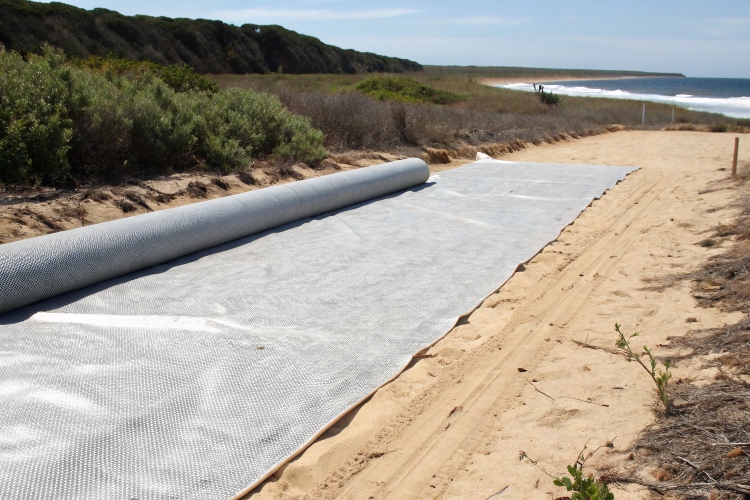
If the geotextile will be exposed to sunlight for any significant period—such as in shoreline protection, slope stabilization, or before a cover material is placed—it must be specifically manufactured with UV inhibitors. This is typically achieved by adding 2.0–2.5% carbon black to the virgin resin during production, which acts as a powerful UV stabilizer. Always verify the UV resistance specifications and ensure the supplier confirms the material is suitable for exposed use if the project requires it. A cheaper, non-stabilized fabric will fail, period.
5. Selecting Incorrect GSM or Thickness for Design Loads
While GSM alone isn't enough, it is still a crucial parameter that must be aligned with the project's physical demands. A common cost-cutting measure is to select a lighter-weight fabric than what is required by the engineering design.
For example, a nonwoven geotextile used as a protective cushion under a geomembrane in a landfill needs sufficient thickness and mass to protect the liner from puncture by the underlying aggregate. Using a 200 GSM fabric where a 400 GSM fabric is specified may save money on the material cost, but it doubles the risk of a liner puncture and catastrophic failure. Similarly, in a soil reinforcement application, a woven geotextile with insufficient tensile strength (often correlated with a lower GSM) will stretch or break under load, leading to structural failure. Always defer to the project's engineering specifications for required strength and thickness.
6. Neglecting Filtration and Separation Performance
The interaction between the geotextile and the site-specific soil is a complex and critical relationship. Choosing a fabric without considering the soil particle size is a recipe for failure.
- Filtration Failure (Clogging): If a nonwoven geotextile's Видимый размер отверстия (AOS) is too small for the surrounding soil, fine soil particles will become trapped in the fabric's structure over time. This blocks the passage of water, effectively turning the drainage layer into a dam and leading to a buildup of hydrostatic pressure.
- Separation Failure (Piping): If the geotextile's AOS is too large, it will allow fine soil particles to be washed through the fabric along with the water. This leads to the erosion and loss of soil from behind the fabric, which can cause voids, settlement, and undermine the stability of the entire structure.
Proper selection requires an analysis of the soil's particle size distribution to choose a geotextile with a compatible AOS.
7. Trusting Supplier Data Without Independent Test Verification
For an importer, this is a critical due diligence step. A supplier's internal data sheet can claim any values. Without independent, third-party verification, you are taking an enormous risk. Always insist on seeing test reports from accredited laboratories that show compliance with international standards like ASTM or ISO.
Furthermore, this is where the "sample vs. bulk order" risk is highest. A sample can be sent for testing, but how do you know the thousands of square meters in the container match that quality? A trustworthy supplier should have a robust internal Quality Assurance / Quality Control (QA/QC) program and be able to provide batch-specific test results from their production runs. A simple check you can perform on-site is a burn test: polypropylene (PP) burns with white smoke and a paraffin-like smell, while polyester (PET) burns with black smoke and a sour smell. Any foul, acrid smell could indicate the presence of unknown recycled materials.
Заключение
Sourcing geotextiles internationally requires you to be more than just a buyer; you must be a diligent verifier. The biggest pitfalls—from choosing the lowest price to accepting unverified data—all stem from a single root cause: a lack of deep product and supplier validation. By understanding the functional differences between materials, demanding performance data beyond simple weight, and partnering with suppliers who provide transparent, verifiable quality control, you can protect your investment, your reputation, and the long-term success of your client's project.