

When we discuss heap leach mining, the focus is usually on chemical kinetics and recovery rates. But for engineers and project managers operating in the world’s "ice box" regions—Canada’s Yukon, Eastern Russia, Mongolia, or the high altitudes of the Andes—the primary challenge is not the chemistry. It is the physics of the cold.
Designing a containment system that survives -40°C is fundamentally different from designing one for the deserts of Chile. In extreme cold, standard plastics reach their glass transition points and shatter. Subgrades freeze and heave, acting like slow-motion earthquakes under your liner.
This guide covers the specific engineering risks of sub-zero mining, the material science behind cold-resistant geomembranes, and the installation protocols required to ensure your heap leach pad doesn't fail during the first winter freeze.
As a specialized manufacturer for high-latitude mining projects, strictly following GRI-GM13 и АСТМ low-temperature standards, I know that purchasing the wrong liner here isn't just a maintenance issue—it's a catastrophic environmental risk that often cannot be repaired until the next summer thaw.
2. Engineering Risks in Cold Climate Heap Leach Pads
If you use a standard, general-purpose HDPE geomembrane in these conditions, you are inviting failure. Here is what happens from an engineering perspective.
2.1 Low-Temperature Material Brittleness
All polymers have a "Glass Transition Temperature" (Tg). Below this point, the amorphous regions of the polymer chains freeze, and the material loses its ductility. It transitions from being "rubbery" to being "glassy."
While HDPE has a naturally low Tg (around -70°C to -100°C depending on the resin), standard-grade liners often contain fillers or lower-grade recycled resins that raise this temperature significantly.
If a rock drops on a brittle liner at -30°C, it doesn't stretch and yield; it shatters or develops micro-cracks. This impact resistance is the first line of defense we lose in the cold.
2.2 Freeze-Thaw Induced Subgrade Movement (Frost Heave)
This is the hidden killer. When moisture in the subgrade freezes, it expands (ice lenses). This pushes the ground up—sometimes by 10 to 30 centimeters. When it thaws, it collapses.
This creates дифференцированный расчет. The geomembrane is dragged and pulled as the ground shifts beneath it. If the liner is already stiff from the cold, this induced strain can exceed the yield point of the material, causing a breach.
2.3 Weld Seam Performance at Sub-Zero Temperatures
Welding is effectively chemical fusion. In extreme cold:
- Heat Sink Effect: The cold air and cold ground suck the heat out of the wedge welder instantly.
- Brittle Seams: If the cooling rate is too fast (thermal shock), the crystalline structure of the weld becomes brittle, leading to seams that peel apart under stress.
2.4 Reduced Construction Window
In Mongolia or Northern Canada, the "safe" installation window might only be May through September. This puts immense pressure on procurement urgency. If materials arrive late or fail on-site testing, you simply cannot install them. The project gets pushed a full year.
3. Material Performance Requirements for Sub-Zero Applications
So, what do you put on the Technical Specification? You cannot simply ask for "HDPE." You must specify a resin package designed for cold ductility.
3.1 Geomembrane Resin Selection
For cold climates, virgin resin is non-negotiable. Recycled resins introduce impurities that act as stress concentration points, which are fatal in brittle conditions.
We recommend resins with a lower density range (closer to 0.940 g/cm³) within the HDPE definition, or specifically formulated Medium Density Polyethylene (MDPE) / LLDPE if the slope stability calculations allow. These offer superior multi-axial strain performance.
3.2 Thickness Recommendation
In temperate climates, 1.5mm (60 mil) is standard. In cold climates, we strongly advise upgrading to 2.0mm (80 mil).
- Почему? The extra thickness provides thermal insulation during the welding process (keeping heat in the seam longer) and offers greater resistance to impact fracture when the material is stiff.
3.3 Impact Resistance Standards
When evaluating a datasheet for a Russian or Canadian project, look beyond basic density and thickness. You must verify:
- ASTM D746 (Brittleness Temperature): This test determines the temperature at which 50% of test specimens fail under impact. You want a value lower than your lowest site temp.
- ASTM D5397 (NCTL / ESCR): Cold lining systems are under high stress. We require >500 hours (and often specify >2000 hours properties) for Stress Crack Resistance.
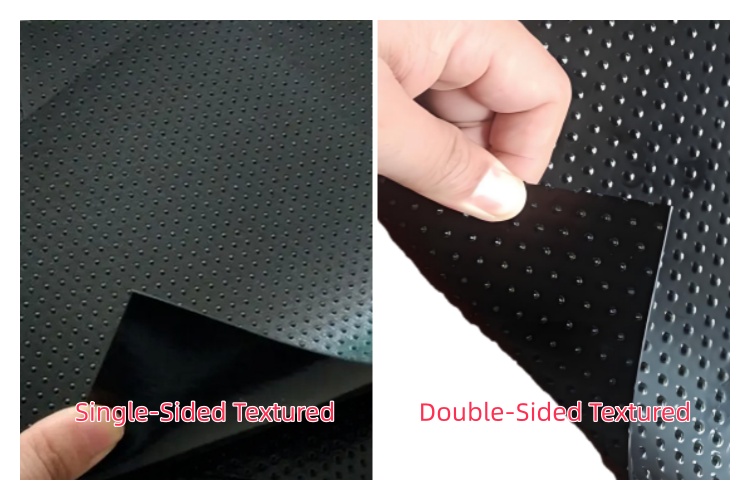
3.4 Textured vs Smooth Surface Selection
In frozen conditions, interface friction changes. Ice or frost on a smooth liner creates a slip plane with near-zero friction.
Textured Geomembranes are essential for slope stability in cold regions to mechanically interlock with the Geotextile or soil, even if frost is present.
4. Recommended Liner System Configuration
In sub-zero mining, redundancy is safety. Relying on a single layer of plastic is risky when investigating a leak involves digging through 50 meters of frozen ore.
4.1 Single Liner System (Cost-Driven Projects)
- Uses: Short-term emergency ponds or non-critical pads.
- Risk: If frost heave cracks the liner, containment is lost.
4.2 Double Liner System with Leak Detection (The Standard)
- Configuration: Primary Geomembrane / Geonet (Drainage) / Secondary Geomembrane.
- Cold Benefit: The air gap in the geonet layer provides a small amount of thermal insulation. More importantly, if the primary liner cracks due to cold brittleness, the secondary liner captures the fluid.
4.3 Geomembrane + GCL Composite System (Best for Cold)
- Configuration: Textured Geomembrane over a Geosynthetic Clay Liner (GCL).
- Why use GCL? Sodium Bentonite (the clay in GCL) has a unique property: it is self-healing. Even if the subgrade heaves and cracks, the hydrated bentonite can swell to seal small fissures. Furthermore, GCLs do not suffer from "brittle cracking" like plastic does. They remain effective backup barriers even in freezing conditions (provided they are hydrated properly).
4.4 Cushion Geotextile Protection Layer
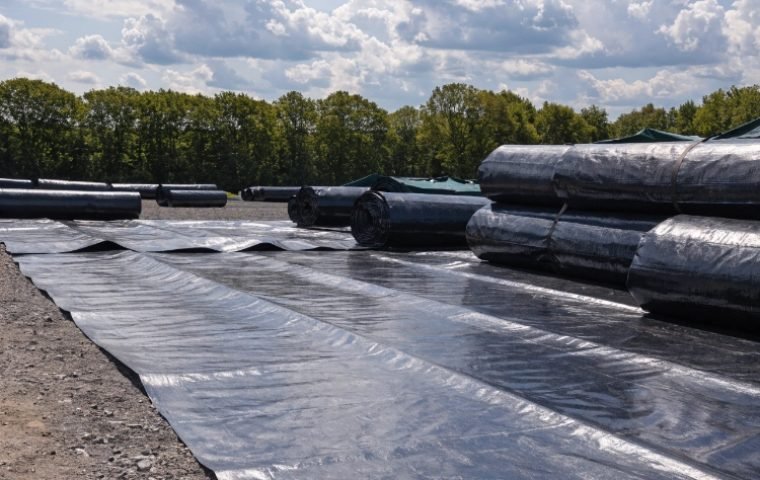
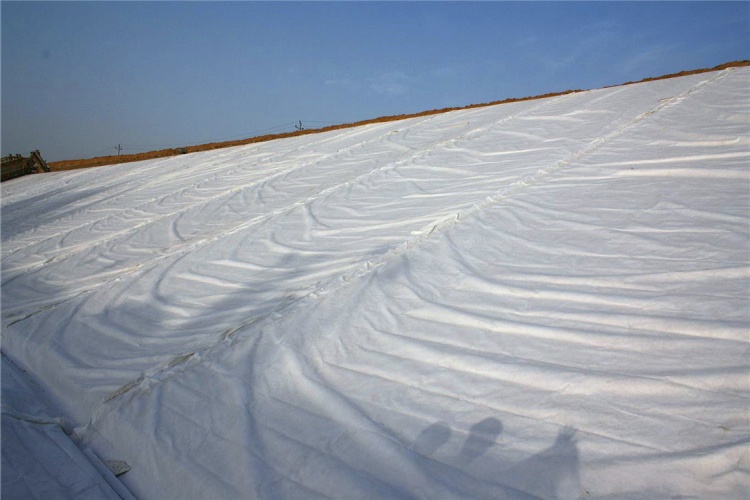
Never place ore directly on a cold liner. We mandate a heavy non-woven geotextile (>500 g/m²) cushion. This acts as a shock absorber. When frozen ore rocks serve as point loads, the cushion prevents puncture.
5. Design Considerations for Permafrost Foundations
This is where the civil engineers must work closely with the material suppliers.
Building a heap leach pad on permafrost is dangerous because Heap Leaching is an Exothermic Process. The chemical reaction in the ore pile generates heat. Additionally, the leaching solution is often heated to keep the chemistry active in winter.
The Problem: You are placing a giant heat source (the leach pad) on top of frozen ground (permafrost).
The Consequence: The heat transfers through the liner, melting the permafrost below. The ground turns to mud and collapses (thaw settlement). The liner bridges the void, stretches, and snaps.
Решение:
- Insulation Layers: We have supplied projects that install a layer of rigid insulation foam (polystyrene) под the secondary liner to prevent pile heat from reaching the permafrost.
- Thick Fill Layers: Using a 1-meter thick non-frost-susceptible soil layer between the native ground and the liner system.
6. Cold Weather Installation Guidelines
Writing the spec is easy; installing it at -10°C is hard. Here are the protocols we enforce for our export clients.
6.1 Minimum Installation Temperature
Standard installation stops at 0°C. For cold climate projects, we can push this to -10°C or even -15°C, but only with strict protocols. Below -15°C, polymer chains are too stiff to unroll without risking structural damage.
6.2 Pre-Heating and Welding Parameter Adjustments
- Pre-heating: The overlap area must be pre-heated with hot air blowers immediately before the wedge welder passes required to drive out frost and moisture. Vapor trapped in the weld = failed seam.
- Slower Speed, Higher Heat: The welder needs more time to transfer energy into the sheet. We typically slow the machine down by 20–30% compared to summer settings.
6.3 Trial Seam Testing Requirements
In summer, you do trial seams in the morning and afternoon. In winter, trial seams are required every time the machine stops for more than 15 minutes. The ambient temperature cools the wedge rapidly, and verification ensures the machine is back up to temp.
6.4 Material Storage & Умение обращаться
Rolls must not be dropped. In cold weather, dropping a roll from a truck can cause internal shattering that isn't visible until you unroll it.
We recommend a "warm tent" approach where rolls for the next day's deployment are stored in a temporary shelter to raise their core temperature slightly before deployment.
7. Quality Control & Testing Protocols
How do you verify a liner system when the test water freezes?
Factory QC Standards
Before shipping to a cold region, we perform low-temperature impact testing in our lab. We verify the resin density is within the tight tolerance needed for ductility.
On-Site limitations
- Hydrostatic Testing: Often impossible in winter.
- Vacuum Box Testing: Difficult because the soapy solution freezes on the liner surface. We use special anti-freeze surfactant mixtures (e.g., windshield washer fluid based) for vacuum box fluid to allow bubble testing in sub-zero temps.
- Spark Testing (Arc Testing): This is the preferred method for cold climates. It uses conductive backing (or water puddle) and electricity to detect holes. It works regardless of temperature and provides 100% surface verification.
8. Risk, Limitations, and When This Is NOT Recommended
Even with high-grade materials, there are physical limits.
Do not deploy geomembranes in high winds at low temperatures. Cold plastic acts like a rigid sail. If the wind catches it, it will create "shatter cracks" at the fold lines rather than bending.
Avoid sharp folding. When detailing corners or pipe penetrations, avoid creating sharp creases. In standard temps, HDPE can be folded. In cold temps, a sharp crease induces high stress that can lead to immediate Environmental Stress Cracking. Large radius curves are mandatory in design.
9. Why Choose Our Geomembrane for Cold Climate Mining Projects
Supplying a mine in Siberia or the Yukon is not the same as supplying a fish farm. The technical requirements are absolute, and compliance is the only way to mitigate risk.
Специалист по водонепроницаемости understands the specific resin architecture required for cold-weather ductility.
- Premium Virgin Resin Only: We strictly adhere to GRI-GM13 formulation standards. We never blend recycled material for cold-climate orders, ensuring consistent molecular structure vital for impact resistance.
- Custom Dimensions for Risk Reduction: We can produce wider rolls to reduce the total linear meters of field welding. Fewer seams means fewer potential failure points in sub-zero conditions.
- ИСО & ASTM Compliance: We don't just claim performance; we verify it. Every batch is tested against ASTM D746 (Brittleness) and ASTM D5397 (ESCR) standards, with third-party reports available upon request to satisfy international EPC requirements.
When the temperature drops and the ground moves, you need a liner system that yields, not one that breaks.