

Water is the single most critical input variable in agriculture. For large-scale operations—whether growing almonds in California, cotton in Australia, or avocados in South America—secure water storage is the difference between a profitable harvest and a failed season.
However, storing water in open reservoirs comes with a "tax." In many arid regions, we see agricultural reservoirs losing up to 30% of their stored volume annually through natural and structural inefficiencies. That is water you paid to pump, treat, and store, disappearing before it ever reaches a crop root.
This guide explains practical engineering strategies to minimize these losses. By addressing the two main culprits, evaporation and seepage, and implementing better design and monitoring practices, you can significantly improve irrigation reservoir efficiency and lower your cost per megaliter.
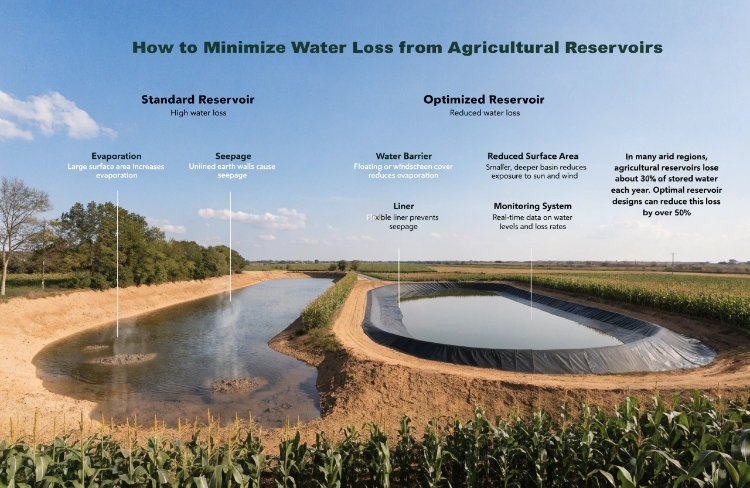
Understanding the Sources of Reservoir Water Loss
Before applying a fix, we have to diagnose the leak. In my experience working with irrigation districts and private farms, water loss isn't usually caused by one massive failure, but by a combination of ongoing factors.
Evaporation
This is the most visible form of loss. It is strictly thermodynamic: water turns to vapor due to solar radiation, ambient heat, and wind speed.
In hot, dry climates, an open water surface can lose 10mm to 15mm of depth per day. Over a 5-hectare reservoir, that equates to hundreds of thousands of liters vanishing into the atmosphere daily. While you cannot stop the sun from shining, you can mitigate how much water is exposed to it.
Seepage
This is the invisible thief. Seepage occurs when water creates a hydraulic path through the soil at the bottom or sides of the reservoir.
Many older irrigation ponds rely on compacted clay soils. While clay is less permeable than sand, it is not impermeable. Over time, wetting and drying cycles cause clay to crack, or geological shifts create fissures. Seepage losses are often constant, occurring 24 hours a day, regardless of the weather.
Operational Losses
These are losses due to human error or poor infrastructure management. Common examples include:
- Overflowing the reservoir due to lack of level sensors.
- Leaking gate valves or outlet pipes.
- Poor embankment maintenance leading to breaches.
Engineering Methods to Reduce Water Loss
Reducing reservoir water loss requires a mix of civil engineering (design), geosynthetics (lining), and environmental management (wind/cover). Here are the proven methods we use in the field.
Install Geomembrane Liners to Prevent Seepage
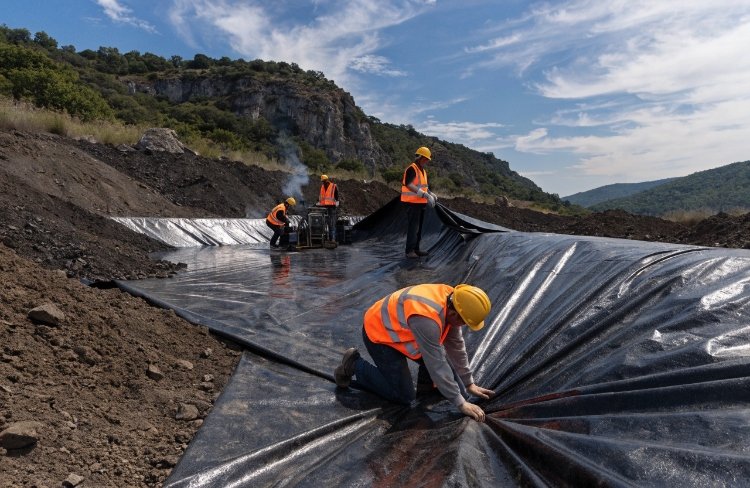
The most immediate and effective way to stop bottom-up loss is to install a geomembrane liner.
In the past, farmers relied on clay capping (bentonite). Today, the industry standard is Polietilen visoke gustoće (HDPE).
A 1.0mm or 1.5mm HDPE liner creates an absolute barrier between the water and the soil. Unlike clay, which has a slow permeability rate ($1 \times 10^{-7}$ cm/sec), HDPE is effectively impermeable.
Why this is the baseline solution:
- 100% Seepage Control: If installed and welded correctly, seepage drops to zero.
- Chemical Resistance: It handles fertilizer-mixed water or treated effluent without degrading.
- Durability: Modern liners are UV stabilized to last 20+ years in exposed sunlight.
If your reservoir is located in sandy, loamy, or karstic soil, a liner is not optional; it is a necessity for water conservation.
Optimize Reservoir Depth and Geometry
If you are in the design phase of a new reservoir, geometry is your best weapon against evaporation.
Evaporation happens on the surface. Therefore, the goal is to minimize the Surface Area-to-Volume ratio.
- The Mistake: Building a shallow, wide pond (like a saucer). This exposes maximum water to the sun.
- Rješenje: Build a deep, narrow reservoir (like a cup).
Example:
Two reservoirs both hold 10,000 cubic meters of water.
- Reservoir A is 2 meters deep. Surface area = 5,000 m².
- Reservoir B is 5 meters deep. Surface area = 2,000 m².
Reservoir B exposes 60% less surface area to the sun. Even without a cover, Reservoir B will lose significantly less water to evaporation simply due to its geometry.
Windbreaks to Reduce Evaporation
Wind is a major driver of evaporation. It strips away the saturated layer of air sitting just above the water surface, replacing it with dry air that absorbs more moisture. This "wicking" effect can double evaporation rates on windy days.
Practical Agricultural Solution:
Installing windbreaks perpendicular to the prevailing wind direction is a cost-effective strategy.
- Vegetation: Planting rows of dense trees (like cypress or poplar) or tall grasses. Note: These must be planted far enough away so roots do not penetrate the reservoir liner (see "Risk" section below).
- Artificial Wind Fences: Installing shade cloth or mesh fencing along the windward side of the embankment.
By reducing wind speed across the water surface, you reduce the thermodynamic drive for evaporation.
Floating Covers for High-Value Water Storage
We are often asked about floating covers. These range from modular plastic balls (shade balls) to continuous tensioned geomembranes.
COVers work by physically blocking sunlight and trapping humidity. They can reduce evaporation by 90% and prevent algae growth.
However, the reality check:
Floating covers are expensive (often costing as much as the liner itself). They are typically reserved for:
- Drinking water reservoirs (to prevent contamination).
- High-value industrial water.
- Very arid regions where water cost is astronomical.
For a standard agricultural irrigation pond, a continuous floating cover is often difficult to justify financially unless the water source is extremely scarce.
Improve Soil Compaction in Earthen Reservoirs
If a geomembrane liner is outside the budget, the next best option is advanced soil compaction. This involves:
- Using sheep-foot rollers to compact the soil to 95% Standard Proctor density.
- Amending the soil with bentonite clay implies mixing imported clay into the native soil to reduce permeability.
Limitation: This only works if the native soil has the right plasticity. If you are building on sandy or rocky ground, no amount of compaction will seal it. You will need a synthetic liner.
Monitoring Water Loss in Irrigation Reservoirs
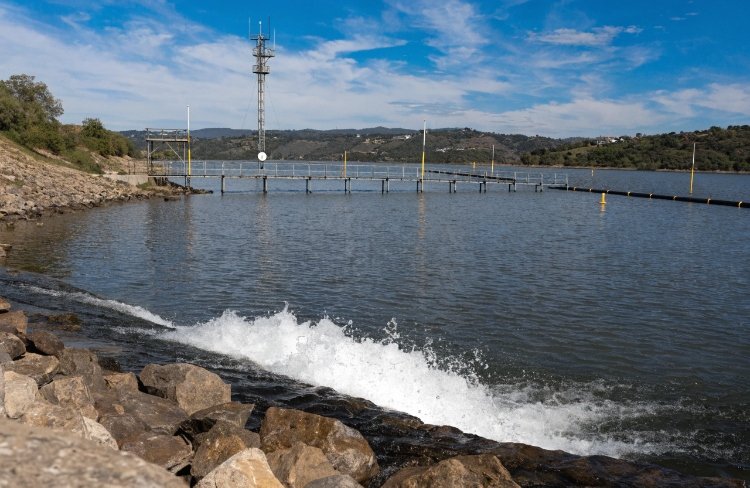
You cannot manage what you do not measure. Many operators do not realize they have a leak until it becomes a crisis. Implementing a monitoring protocol is part of irrigation reservoir efficiency.
Water Level Monitoring Systems
Install a digital pressure transducer or ultrasonic level sensor linked to a telemetry system.
This allows you to see the reservoir level in real-time on your phone.
- Night Test: Check the level drop between 10 PM and 5 AM (when pumps are off and evaporation is low). If the level drops significantly during this window, you have a seepage leak.
Evaporation Modelling
Keep a simple Class A Evaporation Pan nearby or use local weather station data.
Compare your reservoir's level drop against the theoretical evaporation rate.
- Expected Loss: 5mm/day (Evaporation).
- Actual Loss: 15mm/day.
- Difference: 10mm/day (Likely Seepage).
This data confirms whether your water retention strategy is working or failing.
Regular Reservoir Inspections
Walk the banks. Look for:
- Wet spots on the outer embankment (seepage).
- Cracks in the clay or tears in the liner.
- Rodent holes (destructive to both earthen and lined dams).
Choosing the Right Water Retention Strategy
Not every farm needs a floating cover, but almost every farm needs a reliable bottom seal. How do you decide?
| Factor | Scenario A: Budget Focus | Scenario B: Efficiency Focus |
|---|---|---|
| Vrsta tla | High Clay Content | Sandy / Gravel / Karst |
| Water Value | Low (River/Rain fed) | High (Deep Well / Desalinated) |
| Climate | Humid / Low Wind | Arid / High Wind |
| Recommended Strategy | Compacted Clay + Windbreak | HDPE Liner + Deep Design |
Key Trade-off:
Earthworks (compaction) are cheaper upfront but require higher maintenance and allow some seepage.
Geomembrane have a higher initial material cost but provide near-perfect sealing and low maintenance for decades. In the long run, the HDPE liner usually offers the better ROI by saving thousands of megaliters of water.
Rizik, ograničenja i kada se ovo NE preporučuje
While engineering solutions are powerful, they have limitations that must be respected.
1. The Risk of Trees (Windbreaks):
While trees reduce wind, their roots are the enemy of reservoirs. Roots seek water. If you plant trees too close to the embankment (within 10-15 meters), roots can penetrate the dam wall, creating piping channels for leaks, or puncture the geomembrane liner. Always maintain a safe buffer zone.
2. The Limitation of Clay Liners:
In regions with distinct wet and dry seasons, exposed clay liners are risky. During the dry season, if the water level drops, the exposed clay dries out and cracks (desiccation). When the water returns, these cracks often do not seal immediately, leading to massive initial leakage. If your reservoir fluctuates efficiently, a synthetic liner is far safer than clay.
3. Floating Covers and Maintenance:
Do not install a floating cover if your water has high sediment loads or if you cannot perform maintenance. Covers make cleaning sludge out of the bottom of the pond extremely difficult. If a cover tears or sinks, retrieving it is a dangerous and expensive operation.
Zaključak
Reducing water loss in large irrigation reservoirs is not just about environmental stewardship; it is a financial necessity.
While evaporation is a powerful natural force that can be mitigated through smart geometry i windbreaks, seepage is a structural flaw that should be eliminated entirely.
For most agricultural projects, the combination of a deep reservoir design and a high-quality HDPE geomembrane liner provides the most robust defense against water loss. By sealing the bottom and minimizing the top surface area, you ensure that the water you store is the water you get to use.