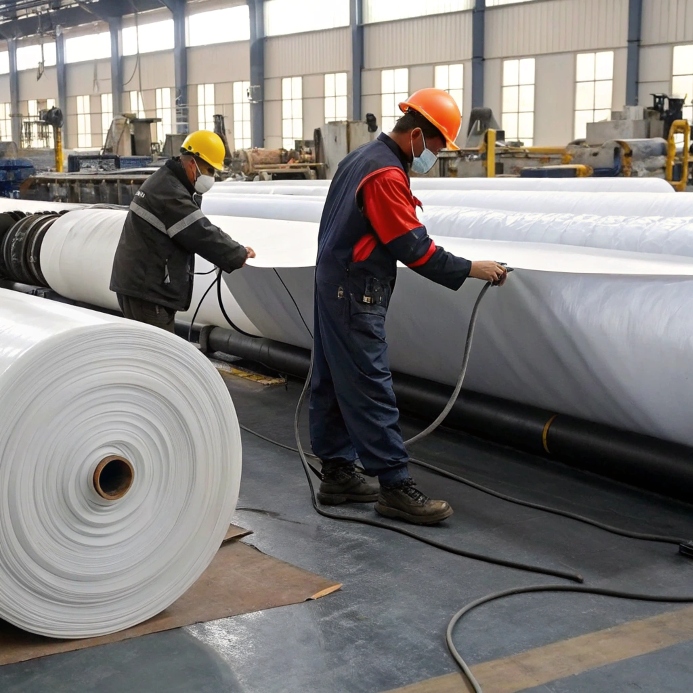


LLDPE Geomembrane — Manufacturer, Specifications & Solution
Linear low-density polyethylene liners for ponds, canals, and reservoirs. Flexible & puncture-resistant, smooth or textured, 0.3–3 mm, factory-direct supply and reliable QA.
ASTM/GRI/ISO-Reference
Factory Kai tsaye
Fitar da Duniya
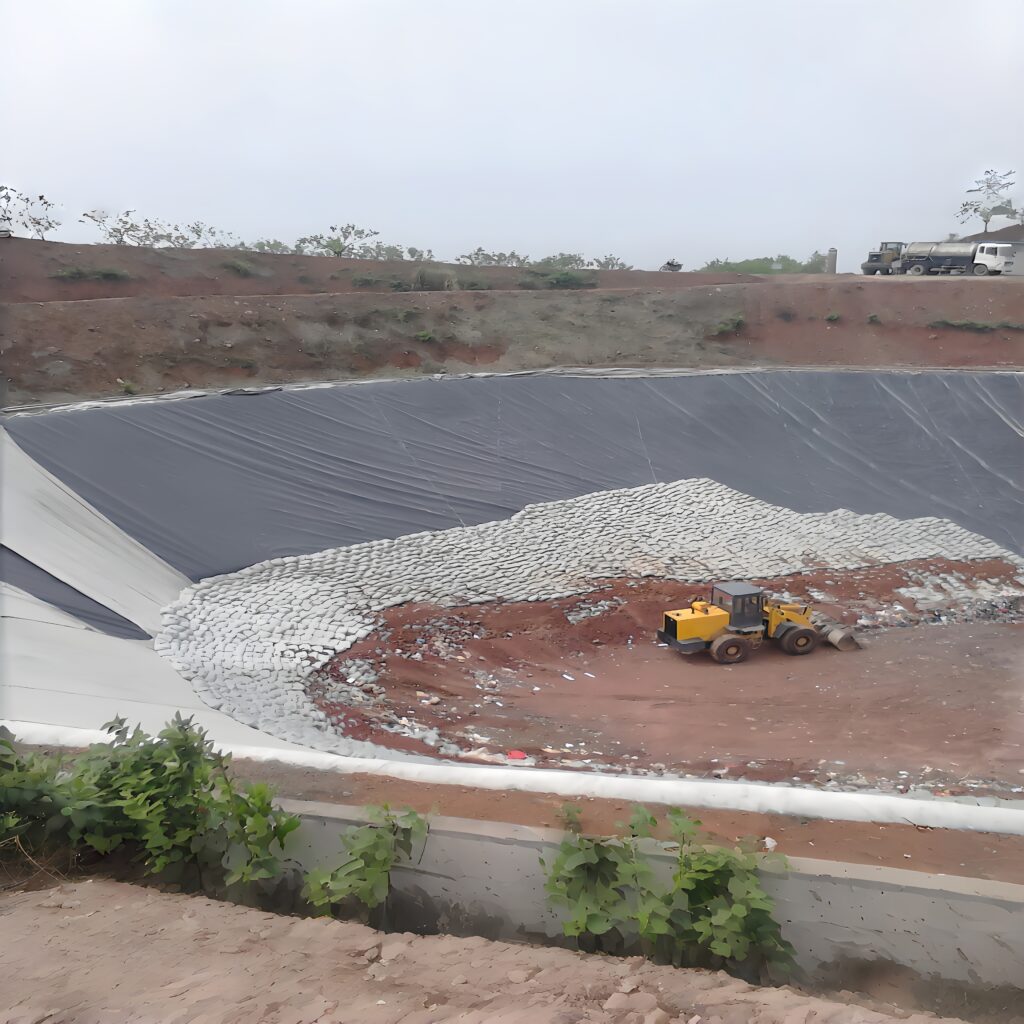
Core Properties na LLDPE Geomembrane
LLDPE geomembrane can stretch over uneven ground and adapt to settlement or deformation without cracking.
While slightly lower than HDPE, LLDPE still offers adequate puncture resistance for ponds, canals, and light-duty containment projects.
Stable against common acids, alkalis, and salts, with good performance in outdoor projects.
Ideal for ponds, canals, and slopes where flexibility is more critical than tensile strength.
LLDPE provides a lower-cost alternative to HDPE for projects that require flexibility over long-term high-strength performance.
Ku sani LLDPE Geomembrane
LLDPE geomembrane (Linear Low-Density Polyethylene liner) is a flexible, impermeable plastic sheet used as a barrier for ponds, canals, reservoirs, and light-duty landfill projects.
LLDPE geomembrane material is made from linear low-density polyethylene with added stabilizers. It combines flexibility, elongation, and chemical resistance, making it suitable for uneven ground conditions.
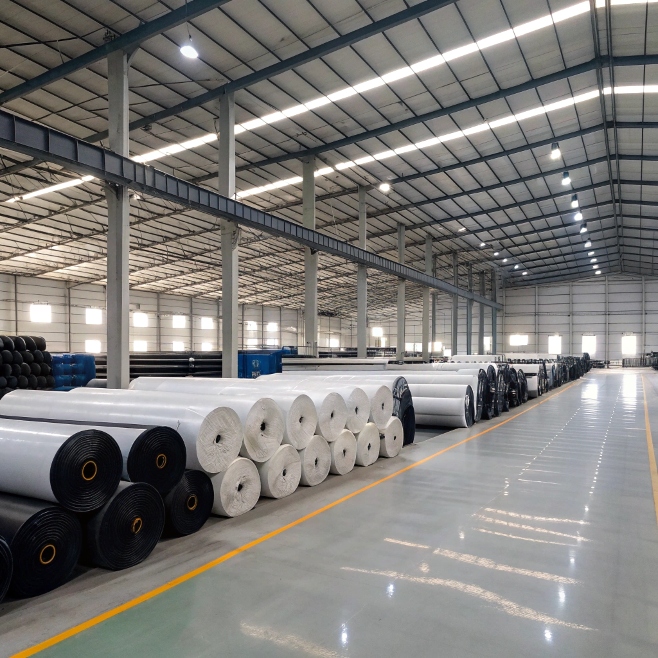
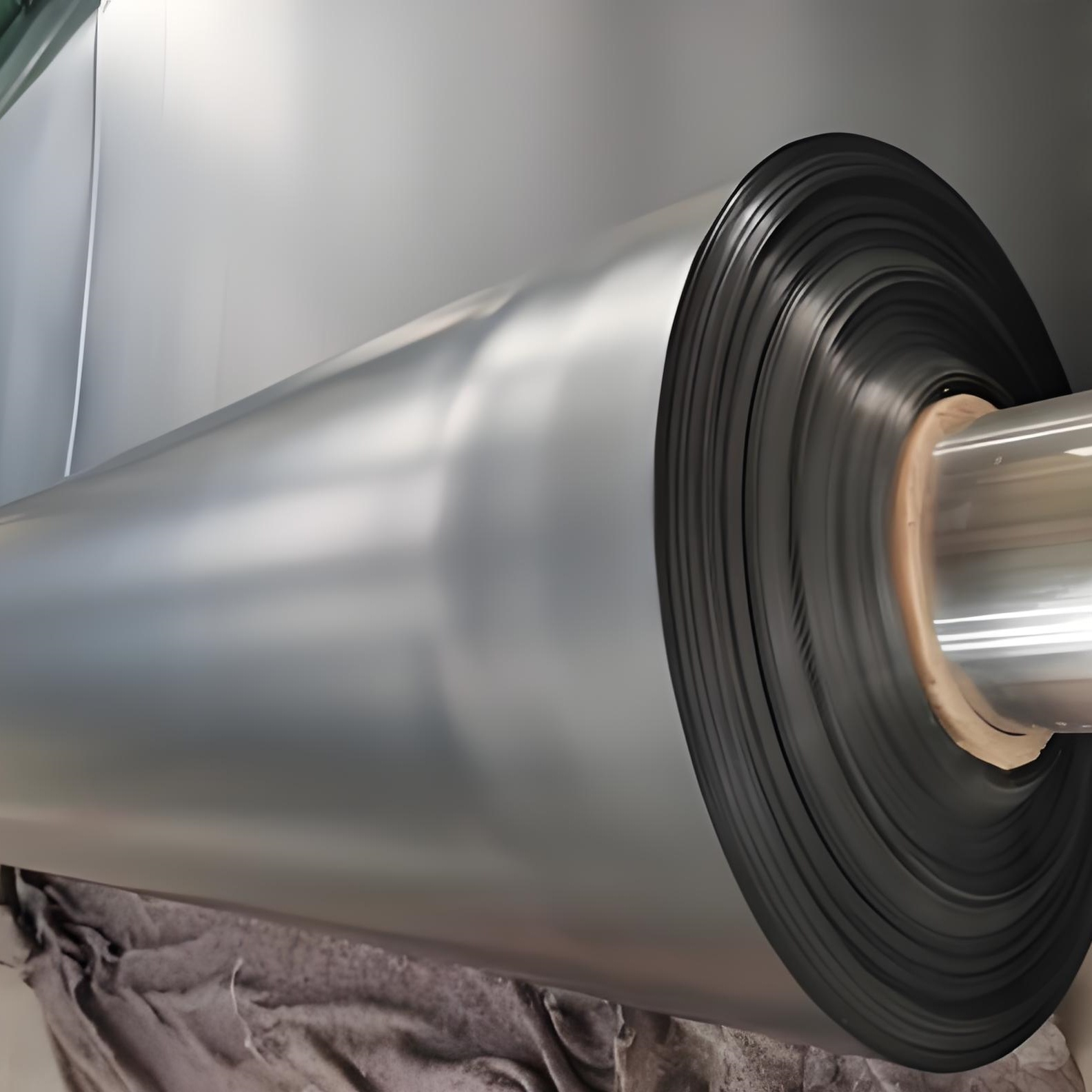
Typical LLDPE geomembrane thickness ranges from 0.3 mm to 3.0 mm (200 micron to 3.0 mm). Common specifications include 0.5 mm, 1.0 mm, 1.5 mm, and 2.0 mm, supplied in rolls or sheets.
LLDPE geomembrane is mainly used for seepage prevention and isolation in a wide range of civil, environmental, and water projects, such as:
Landfills and wastewater/sludge treatment sites (LLDPE geomembrane for landfill)
River dikes, dams, tailings dams, sewage ponds, reservoirs, canals, and liquid storage pits/mines (LLDPE geomembrane for dam lining)
Subway tunnels, underground basements, and lining for underground structures
Roadbeds and other foundations requiring salt-resistance or anti-seepage protection
Horizontal and vertical seepage barriers for dams, cofferdams, and waste disposal sites
Aquaculture ponds for seawater and freshwater fish/shrimp farming (LLDPE geomembrane pond liner)
Highways, expressways, and railway foundations, as waterproofing layers for expansive or collapsible soils
LLDPE geomembrane is valued for its flexibility, adaptability to irregular ground, and effective impermeability, making it a cost-efficient liner for both water and waste containment.
The service life of LLDPE geomembrane is typically 10–20 years, depending on thickness, UV exposure, and installation conditions. For long-term heavy-duty projects, HDPE may offer longer durability.
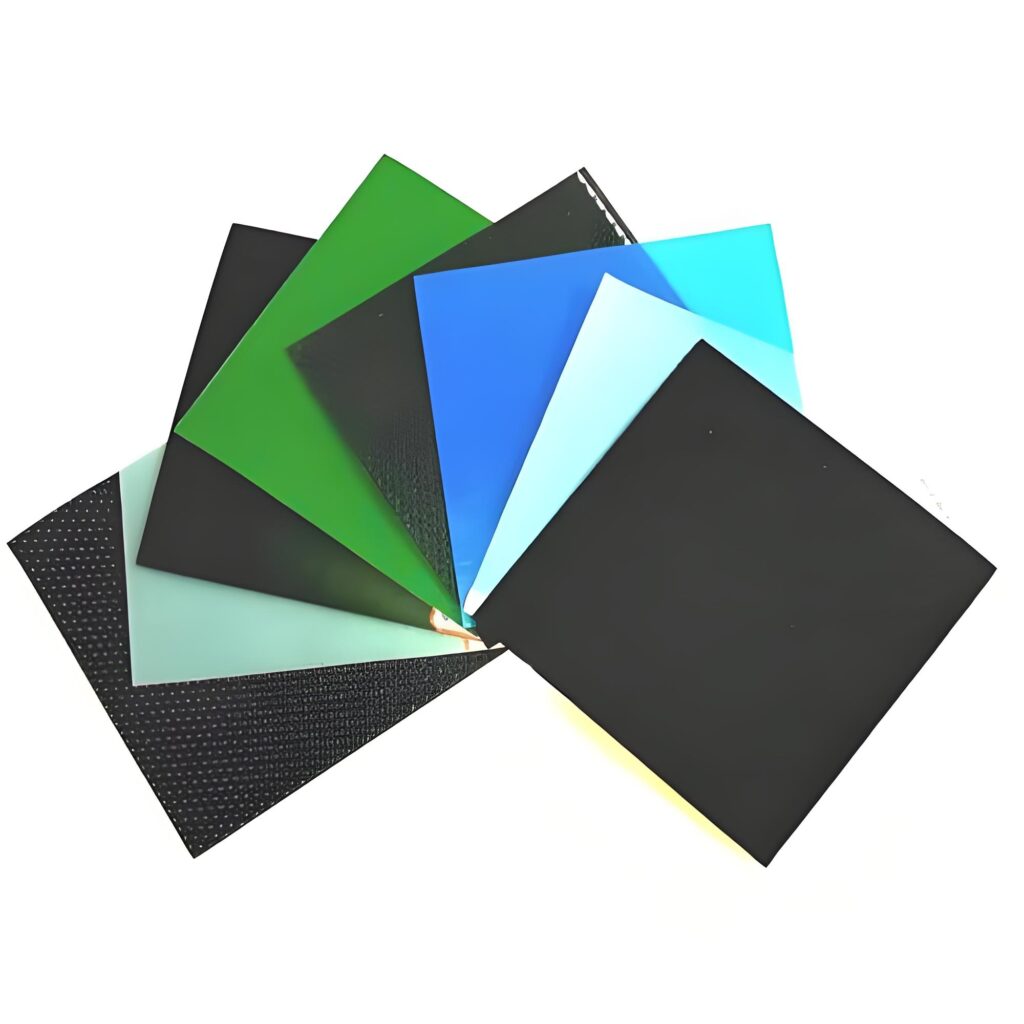
Surface Types & Color Options of LLDPE Geomembrane
Smooth LLDPE Geomembrane
Smooth on both sides, low friction coefficient.Easy to clean and test leakage; ideal for flat and low-slope projects such as reservoirs, canals, and decorative ponds
Single-Sided Textured LLDPE Geomembrane
One smooth side, one embossed side (dots, diamond, or cross pattern).Increases friction with soil or cover layers; suitable for light to medium slope anti-slip applications
Double-Sided Textured LLDPE Geomembrane
Embossed texture on both sides.Maximizes friction and interface shear strength; used for steep slopes, high load areas, and sidewall stabilization
Black LLDPE Geomembrane
The most common choice, containing carbon black to enhance UV resistance and aging performance. Suitable for all general anti-seepage applications including ponds, canals, and reservoirs.
Blue LLDPE Geomembrane
Improves the visual effect of water bodies, widely applied in decorative ponds, artificial lakes, and premium landscape water projects.
Green HDPE Geomembrane
Blends with natural surroundings, suitable for ecological restoration, wetland protection, and agricultural irrigation projects.
White LLDPE Geomembrane
Reflects sunlight and helps reduce liner surface temperature, minimizing wrinkles caused by thermal expansion and contraction. Often used in tropical or high-temperature regions.
LLDPE Geomembrane Thickness Guide & Aikace-aikace
| Kauri (mm) | Mabuɗin Ayyukan Ayyuka | Aikace-aikace na yau da kullun | Shawarwari Takaitattun Bayanai & Bayanan kula |
|---|---|---|---|
| 0.50 mm (200 micron LLDPE geomembrane sheet) |
• Basic impermeability with high flexibility • Excellent elongation; conforms to fine ground conditions |
• Small ecological ponds, garden water features • Farmland irrigation micro-canals • Seasonal or temporary water storage |
• Use 30–50 g/m² nonwoven geotextile protection • Avoid sharp objects/heavy mechanical loads |
| 0.75 mm LLDPE geomembrane roll |
• Improved seepage control • Medium puncture & tensile strength; good UV resistance |
• Medium-size fish & aquaculture ponds (LLDPE geomembrane pond liner) • Agricultural drainage canals • Reclaimed water collection tanks |
• Lay on flat subgrade • Single-textured surface for slopes < 5° |
| 1.00 mm LLDPE Geomembrane |
• Common, cost-effective thickness • Strong impact & puncture resistance |
• Irrigation & drainage systems • Small leachate collection ponds • Municipal stormwater tanks |
• Smooth or single-textured per friction need • Add 10 cm sand cushion or geotextile isolation |
| 1.20 mm LLDPE geomembrane liner |
• Higher puncture resistance • Good chemical & aging resistance |
• Sewage treatment pond lining • Basement wall drainage layer • Light-to-medium tailings dam lining |
• Combine with nonwoven geotextile for extra protection • Use textured side toward contact surface to increase friction |
| 1.50 mm LLDPE geomembrane sheet |
• Excellent tensile & puncture performance • Impact and root-penetration resistant |
• Medium landfill lining & capping (LLDPE geomembrane for landfill) • Medium tailings dam liners • Chemical wastewater ponds |
• Prefer double-textured for 5–15° slopes • Leak testing via air-pressure or spark testing |
| 2.00 mm LLDPE Geomembrane |
• Engineering-grade thickness • High resistance to puncture, chemical corrosion & aging |
• Large sludge thickening tanks • Hazardous waste secondary containment • Long-term exposed projects in hot/UV-intense climates |
• Pair with high-strength geotextile for multi-layer barrier • Automated welding for stable seams |
| 2.50-3.00 mm LLDPE Geomembrane |
• For extreme conditions • Superior puncture, stress-crack & impact resistance |
• Nuclear waste storage • Heavy-metal tailings dams • Deep foundation waterproofing & drainage |
• Multi-layer composite/reinforced structures; professional installation required • Service life can exceed 30+ years |
LLDPE Geomembrane Specifications, Gwaji & Bayanan Bayanai
| Dukiya | Hanyar Gwaji (Ref.) | Matsayi Na Musamman / Min | Lura |
|---|---|---|---|
| Yawan yawa | Saukewa: ASTM D1505 | 0.915–0.935 g/cm³ | LLDPE geomembrane density |
| Tensile Properties (yield & break) | ASTM D6693 | Yield ≥ 11 kN/m Break ≥ 16 kN/m |
High elongation; lower yield strength than HDPE |
| Tsawaitawa a Break | Saukewa: ASTM D638 | ≥ 600% | Excellent flexibility & deformation capacity |
| Resistance Hawaye | Saukewa: ASTM D1004 | ≥ 125 N | Good anti-tear property |
| Resistance Huda | Saukewa: ASTM D4833 | ≥ 160 N | Adequate for ponds & canals |
| Carbon Black Content (black liners) | Saukewa: ASTM D4218 | 2–3% | UV resistance; dispersion per ASTM |
| OIT (Std / HP) | ASTM D3895 / D5885 | ≥ 90 min (Std) ≥ 400 min (HP) |
Oxidative aging resistance |
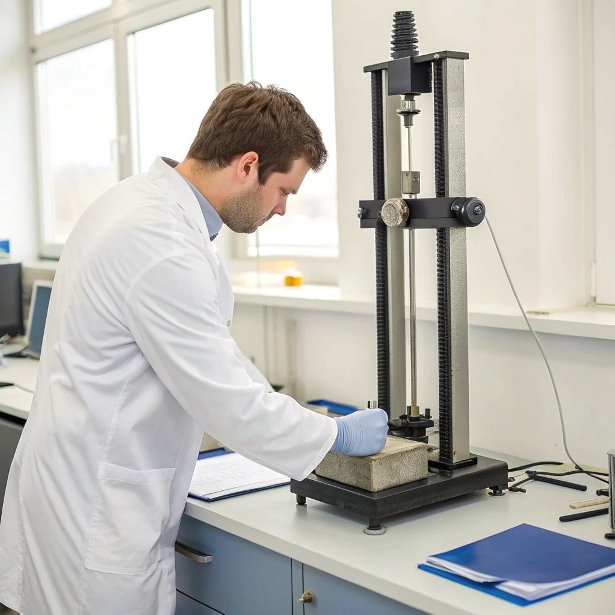
| Stress Crack Resistance (NCTL) | ASTM D5397 | ≥ 150 hr | Environmental stress cracking performance |
| Girman Kwanciyar hankali | Saukewa: ASTM D1204 | ±2% | Thermal stability |
| Lalacewa | ASTM (as specified) | ≤ 1.0 × 10⁻¹³ cm/s | LLDPE impermeable geomembrane |
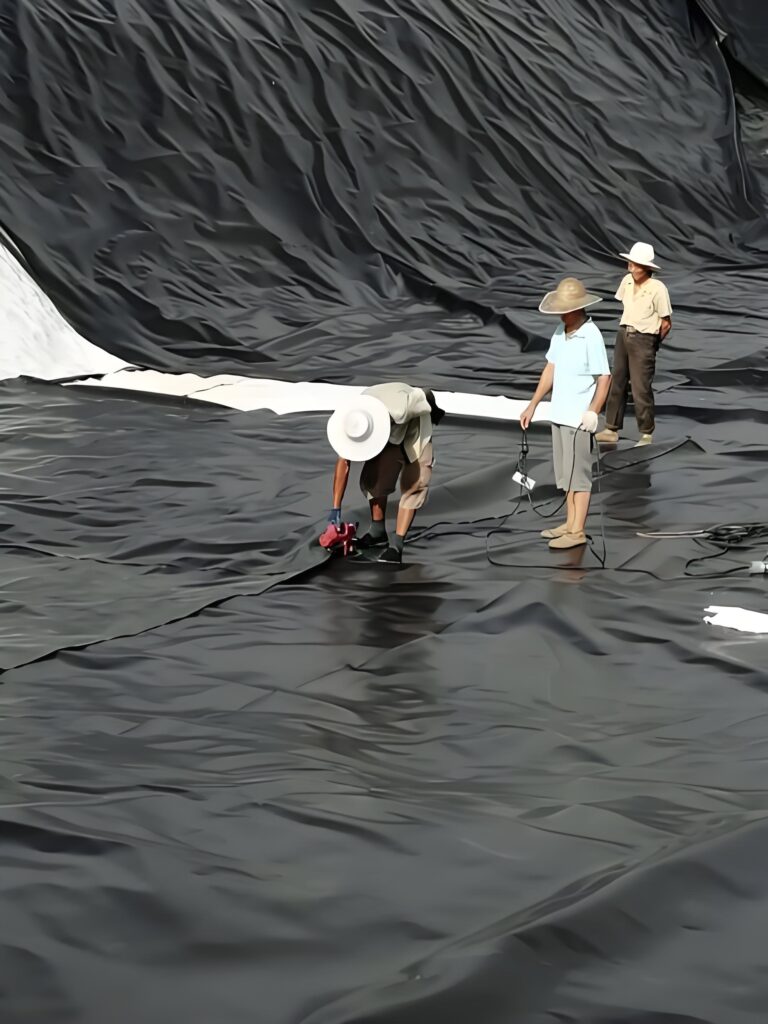
LLDPE Geomembrane Installation, Welding & CQA
Hanyoyin walda
Hot Wedge Welding (Lower Temperature Range): Due to its high flexibility, LLDPE geomembrane requires lower welding temperatures than HDPE, reducing the risk of over-melting. Ideal for long seams in pond liners and canals.
Extrusion Welding for Detail Works: Commonly used for repairs, patching, pipe penetrations, and corner joints. Filler rod welding ensures secure bonding on irregular areas.
Nisa mai haɗe-haɗe: Typically 75–100 mm (less than HDPE) because of the material’s high elongation and ease of fusion.
Quality Control Procedures (CQA)
Trial Welds: Conducted at the beginning of each shift to confirm correct temperature and speed.
Seam Mapping: Visual and mechanical checks to ensure continuous bonding; flexible LLDPE seams are easier to bend and test manually.
Records: Welding logs document machine type, operator, weather, and parameters for traceability.
Testing Methods
Non-Destructive Tests (NDT):
Air Pressure Test: Applied to wedge weld channels to verify seam integrity.
Vacuum Box Test: Used for flat seams, detects leakage points effectively.
Destructive Tests (DT):
Peel & Shear Tests: Samples cut at intervals (every 200–300 m²) and tested per ASTM standards.
For LLDPE, elongation during peel tests is higher than HDPE, reflecting its superior flexibility.
Me yasa Zabi WP Specialist?
Over the years, we have established ourselves among trusted LLDPE geomembrane manufacturers and global lldpe geomembrane distributors. Our focus is on delivering reliable liners that meet critical engineering projects.
- Free Samples of LLDPE Geomembrane Sheet
- Taimakon Aikin Kwararru
- Tabbacin Ingantacciyar Tabbaci
- Sama da Shekaru 10 na Ƙwarewar Masana'antu
- Kayayyakin Masana'anta Kai tsaye
Comparison:LLDPE VS LDPE VS HDPE Geomembrane
| Kwatanta Abun | LDPE Geomembrane | LLDPE Geomembrane | HDPE Geomembrane |
|---|---|---|---|
| Molecular Structure & Crystallinity | Highly branched, lowest crystallinity → very soft and flexible | Short side chains, medium crystallinity → balance of strength and flexibility | Straight chain, highest crystallinity → very rigid and strong |
| Yawan yawa | 0.910–0.925 g/cm³ | 0.915–0.925 g/cm³ | 0.941–0.965 g/cm³ |
| Ƙarfin Ƙarfi | 10–20 MPa (lowest) | 20–30 MPa (medium) | 30–40 MPa (highest) |
| Tsawaitawa | ≥ 800% (highest, extremely flexible) | ≥ 700% (very flexible) | ≤ 500% (lower, more rigid) |
| Tsayayyen Juriya na Hudu | Weak, not suitable for sharp subgrades | Moderate, suitable for uneven foundations with some protection | Excellent, rigid structure resists sharp puncture |
| Impact Resistance | Excellent, best energy absorption | Good, combines toughness with impact resistance | Average, prone to micro-cracking under dynamic stress |
| Resistance Hawaye | Highest, strong crack-arrest property | Good, resists tearing in uneven loads | High tensile but cracks can propagate faster |
| Juriya na sinadarai | Good for mild acids/alkalis | Good for general chemical exposure | Excellent, resists strong acids, alkalis, oils, and hazardous chemicals |
| Resistance UV | Low, needs stabilizers | Good, with carbon black | Excellent, high carbon black → long-term outdoor exposure |
| Temperature Range | -70℃ to +70℃ | -60℃ to +80℃ | -50℃ to +60℃ |
| Common Thickness | 0.5-2.0 mm | 0.5-3.0 mm | 0.5-3.0 mm |
| Cost Level | Lowest (budget option) | Medium (cost-performance balance) | Highest (premium engineering projects) |
| Aikace-aikace na yau da kullun |
• Light water tanks & indoor liners • Decorative ponds & small landscaping • Temporary anti-seepage covers Recommended when budget is tight and flexibility is key |
• Fish ponds, aquaculture, irrigation canals • Mining site rehabilitation & transport underlayers • Medium waste ponds, dynamic load sites Recommended when you need flexibility + durability balance |
• Municipal landfills, tailings dams • Hazardous waste containment, chemical ponds • Large reservoirs, dam linings, long-term exposure Recommended when long service life & chemical resistance are critical |
| Selection Advice | Choose LDPE if project requires maximum softness and is short-term or light-duty. | Choose LLDPE if project requires adaptability to uneven surfaces da medium service life. | Choose HDPE if project requires highest strength, UV/chemical resistance, da 20+ years durability. |
Tushen Wholesale LLDPE Geomembrane
Da fatan za a haɗa nau'in aikin (tafdi, ma'adinan ƙasa, ma'adinai, tafki), kauri da ake buƙata, saman (mai laushi / rubutu), fifikon girman birgima, da sharuɗɗan bayarwa (FOB/CIF + tashar jiragen ruwa).
Yes, free LLDPE geomembrane sheet samples are available for evaluation prior to bulk purchase.
Yawancin lokacin jagora shine kwanaki 15-25 don samarwa, da jadawalin jigilar kaya dangane da tashar jiragen ruwa.
Daidaitaccen faɗin nadi don fitarwa shine 5.8m ku, wanda aka inganta don ɗaukar kaya. Tsawon nisa kamar 7–8 m Hakanan ana samunsu, dangane da ainihin yanayin lodin kwantena. Tsawon mirgine yawanci yakan tashi daga 50-150 m, gyara ta hanyar kauri. Za a iya samar da fanalan da aka riga aka kera na al'ada idan an buƙata.
Weight (g/m²) = Thickness (mm) × Density (g/cm³) × 1000.
For LLDPE geomembrane with density 0.915–0.925 g/cm³ (per ASTM D792), a 1.0 mm liner weighs about 915–925 g/m².
Ana ƙididdige ƙarfin aiki bisa ga 40HQ ≈ 25 ton lodi nauyi. Madaidaicin ƙididdigewa ya dogara da kauri da faɗin yi; muna ƙididdigewa ta hanyar ma'aunin layi a kowace m² da iyakar nauyin kwantena.
Mafi ƙarancin tsari shine 5000m². Tunda geomembrane yana da girma kuma yana da nauyi, muna ba da shawarar aƙalla ɗaya 20GP kwantena don jigilar kayayyaki masu inganci. Hakanan zamu iya taimakawa a ciki ƙarfafawa da sauran kaya idan ana bukata.
Muna a China geomembrane manufacturer, kuma ana iya shirya jigilar kaya daga duk wani babban tashar jiragen ruwa na kasar Sin kamar Qingdao, Shanghai, ko Ningbo.
Shirye don Ƙayyade Geomembrane?
- Shekaru 15+ na masana'antar kai tsaye
- Abincin da aka kirkira don kayan aikinta don bukatunku
- Jigilan duniya & Tallafin Lissafi
- A bayyane, babu-hari
- 100% ya tabbatar da tabbacin
Bayanin imel ɗinku za a kiyaye tsananin tabbatacce kuma ma'aikatan kasuwancinmu zasu tabbatar da bayanan sirri na sirri cikakke ne!
Hulɗa
- info@watproofspecilist.com
Amsa a cikin awanni 12!
Da fatan za a kula da imel tare da Sayad "@ @ R ratsar ruwa.