

A leak in a heap leach pad liner is one of the most severe risks in a modern mining operation. It threatens not just metal recovery and revenue, but also poses a significant environmental liability that can lead to regulatory fines, massive remediation bills, and operational shutdowns. Understanding why these liner systems fail is the first step toward preventing it.
While it's easy to blame the material itself, most heap leach liner failures are caused by system-level issues, not isolated defects in the geomembrane. This guide breaks down the eight primary reasons for liner leakage, moving from the ground up to provide a holistic view of risk and prevention.
By understanding these root causes, facility owners and engineers can shift from a reactive to a proactive approach, building resilience into every stage of the liner system’s life cycle.
Reason 1: Poor Subgrade Preparation Leading to Heap Leach Liner Leakage
The most robust liner system can be compromised before the first panel is even deployed if the foundation it rests on is flawed. The subgrade is the platform for the entire multi-million dollar containment system, and its preparation is a critical first step.
Common Causes:
- Inadequate removal of sharp rocks, roots, construction debris, or other angular materials from the subgrade surface.
- Insufficient soil compaction, leading to a loose or inconsistent foundation.
- Failure to address areas of soft, organic, or highly variable soil layers that will settle differently under load.
How It Causes Leakage:
When the immense weight of the ore heap is applied, any sharp object left in the subgrade creates a point load that can puncture the geomembrane from below. Even if it doesn't cause an immediate hole, it creates a high-stress point that can develop into a leak over time. More dangerously, a poorly compacted or variable subgrade will experience differential settlement. This means some areas sink more than others, inducing tremendous tensile stress on the geomembrane, which can stretch the material beyond its limits and cause it to tear, often at the seams.
Prevention Using Geosynthetics:
Prevention starts with strict adherence to subgrade conditioning standards—grading to a smooth, uniform surface free of sharp objects. As a vital secondary defense, we always recommend a robust matattarar geotextile mara saka ko a Geosynthetic Clay Liner (GCL) be placed directly on the prepared subgrade. This layer acts as a buffer, protecting the geomembrane from any imperfections in the foundation below.
Reason 2: Mechanical Damage During Installation Causing Geomembrane Liner Leakage
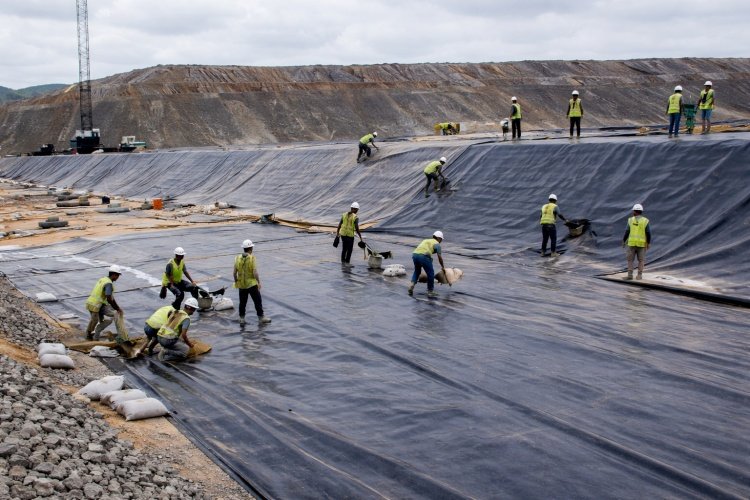
The installation phase is when the geomembrane is most vulnerable. A surprising number of leaks—some studies suggest up to 40-50%—originate from mechanical damage that occurs before the liner is ever covered.
Common Causes:
- Uncontrolled vehicle traffic (trucks, ATVs) driving directly on the exposed liner.
- Workers dropping tools, walking with sharp objects in their pockets, or dragging equipment across the surface.
- Improper handling and deployment, such as dragging panels across abrasive ground instead of lifting and placing them.
- Wind uplift causing the liner to flap against rough surfaces, leading to abrasion.
How It Causes Leakage:
This activity often creates small scratches, gouges, and micro-punctures that are nearly impossible to detect with a visual inspection. These tiny holes may seem insignificant at first, but once the system is operational and under hydraulic head, they become direct conduits for leakage. What starts as a pinhole can expand over time as the liner is subjected to operational stress.
Prevention Measures:
A rigorous installation protocol is non-negotiable. This includes designated travel paths for vehicles, mandatory use of temporary protection layers (e.g., sacrificial geotextiles) in high-traffic areas, and strict site rules about handling tools and equipment. The most important prevention is hiring a certified and experienced installation contractor who enforces a culture of quality control and liner protection from day one.
Reason 3: Defective Welding and Seaming Resulting in Heap Leach Liner Failure
A geomembrane liner system is only as strong as its weakest link, and that is almost always the field seams. While the geomembrane material is manufactured in a controlled factory environment, the seams are created on-site, exposed to variable weather, dust, and the potential for human error.
Common Causes:
- Inconsistent welding parameters (temperature, speed, pressure) due to poorly calibrated equipment or operator inexperience.
- Contamination of the seam area with dust, moisture, or dirt, which prevents a proper molecular bond.
- Lack of thorough and documented quality assurance/quality control (QA/QC) testing on 100% of the seams.
How It Causes Leakage:
An improperly welded seam may look fine initially but can contain unbonded sections or "cold welds" that slowly peel apart under the long-term thermal and mechanical stresses of the heap. This is particularly dangerous because a seam failure can unzip along a considerable length, creating a major leak path.
Prevention Measures:
This risk is managed through a multi-layered quality control process. It starts with using only qualified and certified welding technicians. Employing dual-track thermal fusion welders, which create a testable air channel between two parallel welds, is the industry standard. This allows for 100% non-destructive air pressure testing of every single meter of seam. This must be supplemented with destructive testing, where samples are cut from the seam at regular intervals and tested in a field laboratory to verify their peel and shear strength meet project specifications.
Reason 4: Inadequate Chemical Resistance Leading to Heap Leach Liner Leakage
The chemical environment in a heap leach pad is incredibly aggressive. The liner will be in continuous contact with either a low-pH acidic solution (for copper leaching) or a high-pH cyanide solution (for gold leaching) for decades. Selecting a material that cannot withstand this chemical attack is a guarantee of eventual failure.
Common Causes:
- Failure to perform a thorough chemical compatibility evaluation for the specific leach solution being used.
- Specifying the wrong type of polymer (e.g., using a polymer susceptible to hydrolysis in a high-pH environment).
How It Causes Leakage:
Long-term exposure to these aggressive chemicals can cause the geomembrane’s polymer structure to break down. This process, known as degradation, leads to a loss of antioxidants, embrittlement, and a significant reduction in mechanical properties like tensile strength and puncture resistance. The liner becomes brittle and weak, making it highly susceptible to cracking and failure.
Prevention Through Proper Material Selection:
This is one of the most straightforward risks to mitigate. Polyethylene Mai Girma (HDPE) is the go-to material for heap leach liners precisely because of its exceptional, broad-range chemical resistance. For projects with unusual chemistry or extremely high temperatures, specific chemical compatibility testing should be conducted by immersing samples of the proposed liner in the actual site solution for an extended period to confirm its long-term performance.
Reason 5: Thermal Stress and Temperature Cycling Causing Heap Leach Liner Failure
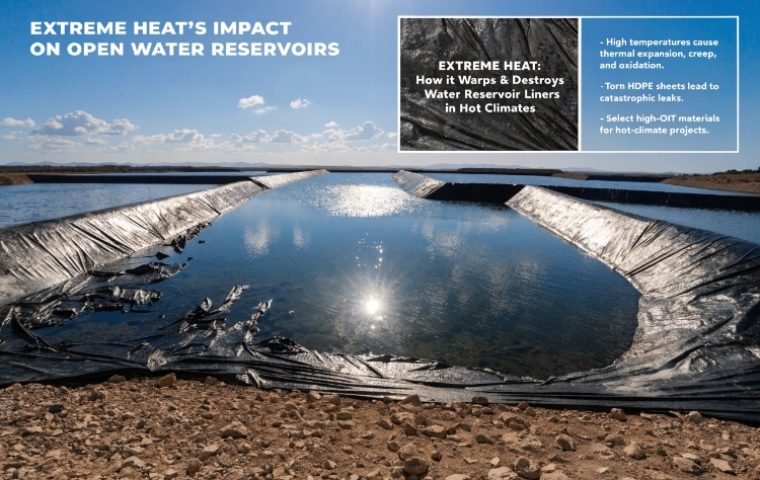
Geomembranes, like all materials, expand when heated and contract when cooled. In a large, exposed liner system, daily and seasonal temperature swings can be significant, inducing powerful stresses within the material.
Common Causes:
- Large daily temperature variations between the heat of the day and the cool of the night.
- Frictional heat generated by the movement of the liner over subgrade soils.
- Exothermic chemical reactions within the ore heap that can raise the liner temperature significantly.
How It Causes Leakage:
This constant cycle of expansion and contraction creates fatigue, particularly at the seams and in areas where the liner is fixed, such as at anchor trenches. Over thousands of cycles, this stress can cause cracks to develop and propagate, leading to leakage. It also causes wrinkles to form, which can become points of concentrated stress and potential damage once covered.
Prevention Measures:
Good design accounts for thermal movement. This includes orienting panels to minimize stress, designing anchor trenches that allow for some movement, and placing a soil cover over the liner as quickly as possible to insulate it from extreme temperature swings. In very cold climates or situations requiring more flexibility, Polyethylene Low-Density Linear (LLDPE), which has a higher elongation capacity than HDPE, may be considered.
Reason 6: Lack of Protective and Drainage Layers Resulting in Heap Leach Liner Leakage
The geomembrane is the barrier, but it should never work alone. A well-designed liner system is a layered composite where each component has a specific job. Omitting these supporting layers in an attempt to cut costs is a classic example of false economy.
Common Causes:
- Eliminating the geotextile cushion layer to save on upfront material costs.
- Designing an inadequate drainage system (e.g., geonet or drainage aggregate) that becomes clogged or has insufficient flow capacity.
How It Causes Leakage:
Without a thick, nonwoven geotextile protection layer, the geomembrane is placed in direct contact with the sharp, angular stone of the leachate collection system or the ore itself. This dramatically increases the risk of puncture. Furthermore, if the drainage layer cannot efficiently remove the leachate, the liquid level (hydraulic head) builds up on top of the liner. This increased pressure forces liquid through any tiny, undetected pinhole at a much higher rate, turning a minor leak into a major one.
Prevention Using Layered Design:
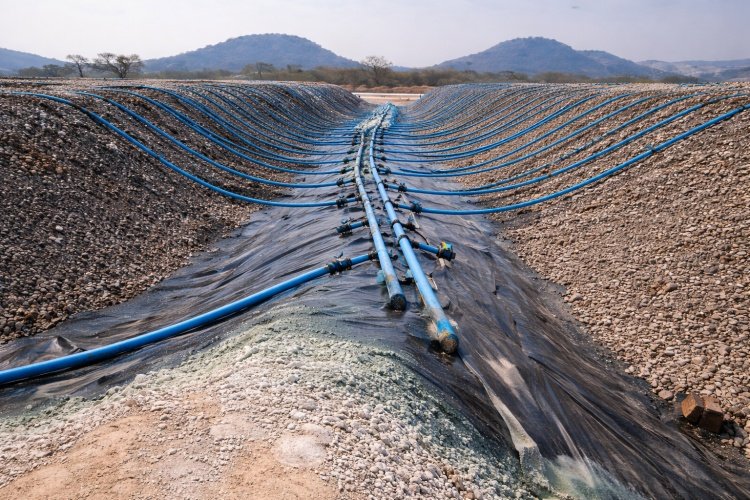
The solution is to always include a robust matattarar geotextile mara saka (e.g., ≥800 g/m²) directly on top of the geomembrane. This protects it from puncture from the overlying drainage stone. Above this, a high-capacity drainage layer (either a thick geonet or a properly sized aggregate layer) is essential to keep the hydraulic head on the liner as close to zero as possible.
Reason 7: Differential Settlement Causing Heap Leach Liner Leakage
This is one of the most insidious causes of liner failure because it happens slowly and is driven by a cascade effect that is difficult to stop once it starts.
Common Causes:
- Variable foundation soil conditions across the large footprint of the pad.
- The progressive and immense loading from stacking ore to heights of 100 meters or more.
- A small, undetected leak causing localized erosion of the subgrade soil beneath the liner.
How It Causes Leakage:
When a small leak occurs, the liquid can wash away fine particles in the subgrade, creating a small void directly beneath the liner. As more liquid flows, the void grows larger. Eventually, the geomembrane, no longer supported, sags into this void. The weight of the ore above then stretches the liner across the edges of the void, inducing massive tensile strain that dramatically exceeds the material's yield strength, causing the small hole to expand into a large tear. This creates a self-reinforcing cycle of failure: a larger tear leads to more leakage, which causes more erosion, a larger void, and an even bigger tear.
Prevention Through System Engineering:
This risk highlights why a "zero leaks" construction quality standard is paramount. It begins with a thorough geotechnical investigation to understand and mitigate potential settlement issues. Using geomembranes with high multiaxial strain tolerance (like LLDPE) can provide an extra margin of safety. Most importantly, it underscores the need for 100% leak detection surveys (like electrical leak location surveys) after installation to find and repair even the smallest pinholes before the system becomes operational and this destructive cycle can begin.
Reason 8: Aging and Long-Term Creep Leading to Heap Leach Liner Failure
A heap leach liner is expected to perform for the entire life of the mining operation, which can span several decades. Over this long period, the material is subjected to sustained loads and environmental exposure that can slowly degrade its properties.
Common Causes:
- Prolonged exposure to UV radiation (sunlight) and oxygen during and after installation.
- Sustained high temperatures and aggressive chemical attack depleting the liner's antioxidant package.
- Sustained tensile loads from the weight of the heap causing the material to slowly stretch over time (a phenomenon known as creep).
How It Causes Leakage:
As the liner's built-in antioxidants are consumed over time, the polymer becomes vulnerable to oxidation, which leads to embrittlement and a loss of strength and flexibility. Creep can cause localized thinning of the material, especially in high-stress areas, making it more susceptible to puncture. Eventually, after decades of service, the material's resistance can drop below the level required to withstand the operational stresses, and a failure can occur.
Prevention for Long-Term Performance:
This is managed by selecting high-quality geomembranes made from prime resins with a robust and durable antioxidant package designed for long-term performance. The liner should be specified with a thickness that accounts for potential creep and long-term stress. Finally, covering the liner with drainage aggregate and ore as quickly as possible is the best way to protect it from UV radiation and thermal degradation, preserving its design life.
Ƙarshe
Preventing heap leach liner leakage is not about finding a magic bullet; it's about adopting a holistic, systems-based approach. The vast majority of liner failures are not a surprise but are the predictable outcome of issues in design integration, material selection, or—most commonly—construction quality control. A well-designed and properly constructed geosynthetic liner system, featuring the right combination of barrier, protection, and drainage layers, is the most effective and reliable way to manage this critical risk and ensure the long-term environmental and financial security of your mining operation.