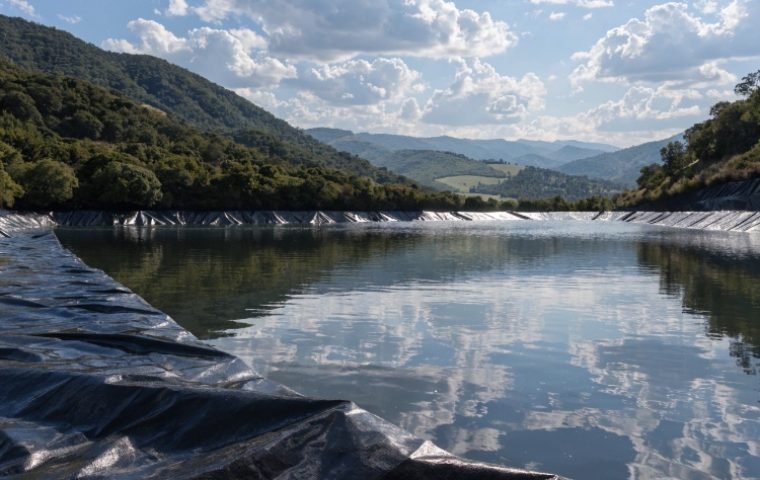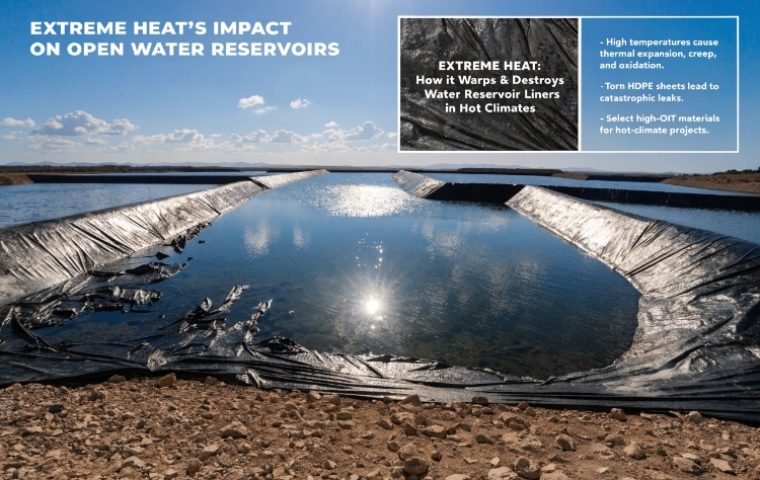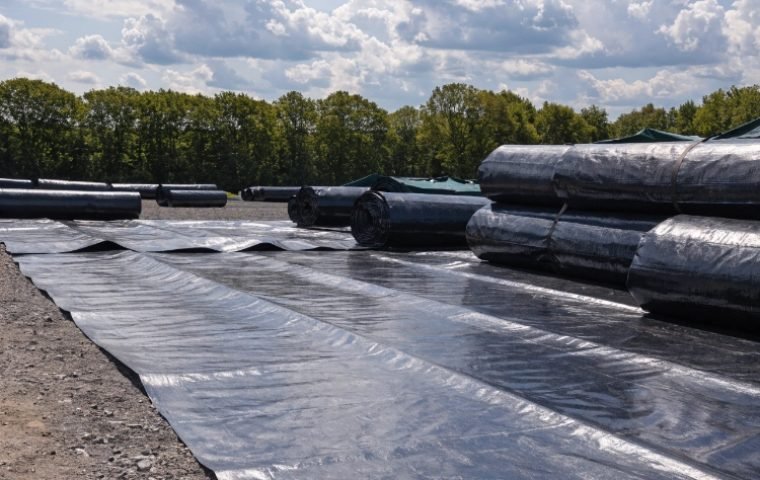


In heap leach mining, the drainage layer is arguably the most undervalued component of the pad design. While the geomembrane liner gets all the attention for "containment," it is the drainage layer that determines the "performance."
If the drainage system fails, the hydraulic head on the liner rises. This triggers a cascade of failures: slope stability decreases due to pore pressure buildup, leakage rates skyrocket due to increased driving head, and metal recovery drops as the "bathtub effect" stalls leaching kinetics.
For decades, mined gravel was the default choice. Today, however, we have high-transmissivity geonets (drainage geocomposites). The question I hear most often from EPC contractors and mine operators is: "Should we stick with the traditional gravel layer, or switch to geosynthetics?"
The answer is rarely a simple "one is better than the other." It depends on the stack height, the compressive stress, and the chemical environment. This article compares these two approaches and explores why the industry is moving toward hybrid designs.
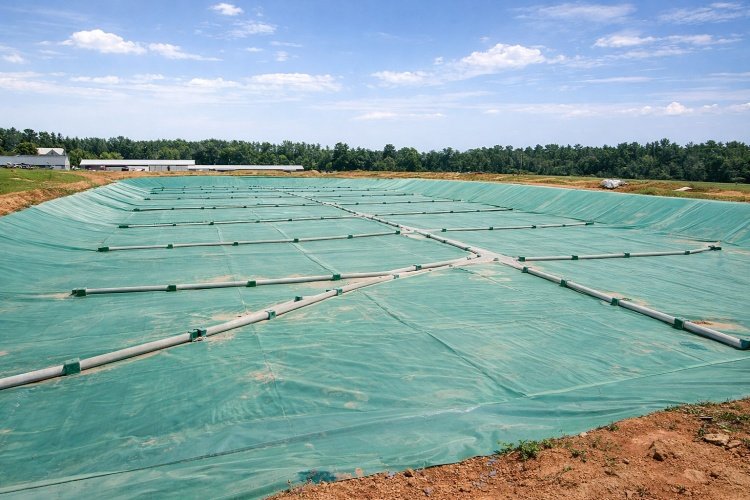
1. Introduction: Drainage Requirements in Heap Leach Pads
Before comparing materials, we must define what the drainage layer actually needs to do. In a modern heap leach operation—whether it’s a copper mine in Chile or a gold project in Central Asia—the drainage system faces brutal conditions.
It must maintain high-flow capacity under massive compressive loads. We are talking about hydraulic loads from continuous irrigation (plus storm events) and physical loads from ore stacks that can reach 150 to 200 meters in height.
Key Functional Requirements:
- Hydraulic Head Control: The system must evacuate pregnant leach solution (PLS) fast enough to keep the hydraulic head on the liner below 0.3m to 0.6m. Exceeding this limit endangers slope stability.
- Liner Protection: It must act as a buffer between the sharp ore and the geomembrane liner.
- Long-Term Durability: It must survive 10 to 20 years of exposure to sulfuric acid or cyanide without chemical degradation or mechanical creep.
If the drainage layer clogs or crushes, you cannot dig it up to fix it. It is buried under millions of tons of ore. Failure is permanent.
2. Traditional Gravel Drainage Layers
The "Overliner" or granular drainage layer has been the industry standard for 40 years. Typically, this consists of a 500mm to 700mm layer of crushed, screened gravel (particle size 25–38mm) placed directly over the geomembrane, housing a network of perforated piping.
The Engineering Logic
Gravel is conceptually simple. It relies on larger voids between stones to allow fluid flow. Because it is bulky, it provides a robust separation distance between the heavy equipment operating on top and the delicate liner below.
The Limitations in Modern Deep Heaps
While effective for shallow heaps (<60m), gravel reveals significant weaknesses in deep, high-stress environments (>100m):
- Crushing and Creep: Under high confining stress (>1000 kPa), individual gravel stones grind against each other. They fracture and create "fines." Over 10 years, what started as clean gravel can degrade into a low-permeability silt-gravel mix. Field data shows that gravel hydraulic conductivity can drop by 50-60% over a decade due to this degradation.
- Stress Concentrations: Placing a rigid perforated pipe inside a gravel layer creates pressure points. Studies show that stress on the liner directly beneath a drainage pipe can be 125% of the average overburden pressure. This concentration is a primary cause of stress cracking in HDPE liners.
- Logistical Cost: To cover a 10-hectare pad with 500mm of gravel requires moving 50,000 cubic meters of aggregate. That is thousands of truck trips, massive crushing costs, and a slow installation process that delays ore stacking.
3. Geonet Drainage Layers (Geocomposites)
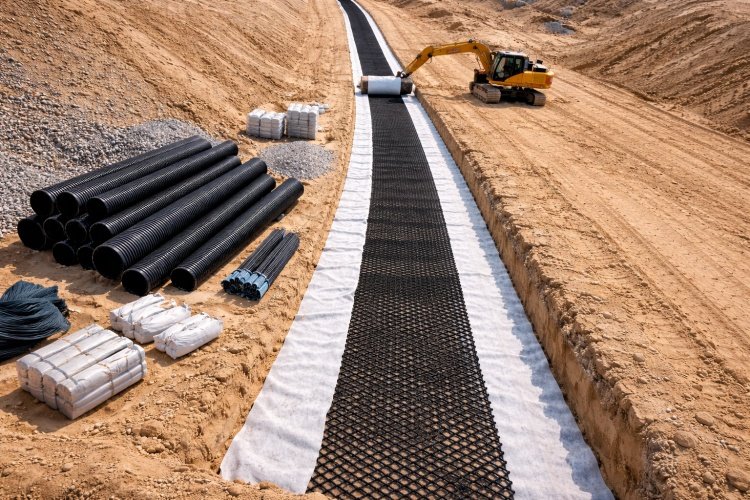
The modern alternative is the Drainage Geocomposite (often referred to as a Geonet). This is a factory-manufactured system, typically consisting of a tri-planar HDPE/PP core (the net) heat-bonded to non-woven geotextiles on one or both sides.
How It Works: In-Plane Flow
Unlike gravel, where water meanders around stones, a geonet provides engineered channels. The rigid ribs of the net hold the geotextile open, creating a void space that allows fluid to flow horizontally (in-plane flow) under high pressure.
Engineering Advantages
- Ultra-Thin Profile: A 7mm geocomposite can often match the flow capacity of 300mm of gravel. This reclaims "airspace" for more ore.
- Consistent Quality: Unlike gravel, which varies by quarry and crushing batch, a geocomposite is manufactured to strict ISO standards. You know exactly what transmissivity you are getting.
- Cushioning Effect: The geocomposite acts as a continuous protection layer. Instead of sharp stones contacting the liner, a soft geotextile safeguards it. This reduces the risk of installation damage (punctures) by over 90% compared to bare liners.
4. Gravel vs. Geonet: Engineering Comparison
This is the most critical section for decision-makers. When we compare these two systems, we look at performance not just on Day 1, but at Year 10.
4.1 Transmissivity Under Load
- Gravel: Has extremely high flow rates initially. However, as the heap grows and stress increases, the gravel compacts. If "breakdown" occurs, fines migrate to the bottom, effectively sealing the drainage path.
- Geonet: Starts with a defined flow rate. While it also experiences some compression (creep), high-performance tri-planar cores are designed to resist crushing up to 2000+ kPa. The flow rate remains predictable and stable over the project life.
4.2 Liner Damages and Leakage Risk
This is where the Geonet wins decisively.
- Gravel Scenario: Without a protection layer, the geomembrane is subjected to point loads from stones. A typical "gravel-on-liner" site might experience 5–10 micro-punctures per hectare during placement.
- Geonet Scenario: The composite acts as a shield. Punch tests confirm that a geonet overlay reduces strain on the liner significantly. In projects requiring zero-leakage assurance (strict environmental compliance), a geocomposite is virtually mandatory as a protection layer.
4.3 Cost Analysis (CAPEX vs. OPEX)
- Initial Cost: A geocomposite system often costs 20–30% more to purchase than raw gravel (depending on local aggregate availability).
- Installation Cost: Geocomposites install like carpet—fast and with minimal heavy equipment. Gravel requires fleets of dump trucks and dozers.
- Total Project Cost: When you factor in the reduced leakage risk, the eliminated pipe bedding labor, and the recovery of dissolved metals (due to better drainage), the 20-year Total Cost of Ownership (TCO) for geosynthetic systems is typically 40-60% lower than traditional gravel.
| Siffar | Traditional Gravel Layer | Geonet/Geocomposite Layer |
|---|---|---|
| Typical Thickness | 300 mm – 600 mm | 5 mm – 15 mm |
| Construction Time | Slow (requires heavy earthworks) | Fast (unroll and cover) |
| Kariyar Liner | Poor (stones contact liner directly) | Excellent (fabric cushion) |
| Long-Term Creep | High (particle crushing & rearrangement) | Low (engineered polymer structure) |
| Hydraulic Head | Unstable (rises as fines accumulate) | Stable (predictable flow) |
| Logistics | Thousands of truck loads | Few containers |
5. Combined Drainage Systems: When Gravel and Geonet Work Together
In my experience with "Valley Fill" heap leaches and mega-projects, the best solution is often a Hybrid System. This approach acknowledges the strengths of both materials.
The "Hybrid" Saɓa
In this design, we do not choose between gravel or geonet. We use both.
- Bottom Layer (Liner Interface): A tri-planar Geocomposite is placed directly on the geomembrane.
- Top Layer (Mass): A thinner layer of gravel (e.g., 300mm instead of 600mm) is placed over the geocomposite.
- Piping: Collection pipes are placed within the gravel layer or integrated into the geonet layout.
Why go Hybrid?
- Redundancy: If the gravel permeability drops due to crushing, the geocomposite below continues to evacuate fluid. If the geonet is overwhelmed by a storm surge, the gravel provides surge storage capacity.
- Liner Security: The geocomposite performs its primary function as a protection layer, ensuring high friction angles and preventing punctures, while the gravel allows equipment to drive over the pad without damaging the geosynthetics.
- Stability Management: In valley fills, maintaining the phreatic surface (water level) as low as possible is critical for stability. The hybrid system offers the lowest possible hydraulic head, keeping the factor of safety (FS) high.
For stacks exceeding 150m, I almost always recommend a Hybrid approach. The risk of relying on a single drainage mechanism is simply too high when the slope stability of millions of tons of ore is at stake.
6. Design Considerations for Hybrid Drainage Layers
Implementing a hybrid or geosynthetic-heavy drainage system requires specific engineering attention. It is not as simple as swapping materials.
6.1 Compressive Creep and Reduction Factors
You cannot rely on the "data sheet" flow rate. Manufacturers test flow for short periods (1-100 hours). Real mines run for 20 years.
Designers must apply Reduction Factors ($RF$) to the ultimate transmissivity:
$$T{allow} = T{ult} / (RF{CR} \times RF{CC} \times RF_{BC})$$
- $RF_{CR}$ (Creep): Accounts for the net thinning under load over time.
- $RF_{CC}$ (Chemical Clogging): Accounts for scaling/precipitation.
- $RF_{BC}$ (Biological Clogging): Accounts for algae/bacteria growth.
For deep heaps, we look for geonets with high compressive strength ribs that do not "roll over" under high shear stress.
6.2 Filtration Compatibility
The geotextile bonded to the geonet must be compatible with the ore or the gravel above it. If the geotextile openings are too large, fines will wash into the net core and clog it. If they are too small, the fabric will "blind" and block flow.
We perform Gradient Ratio Tests (ASTM D5101) to ensure the soil-geotextile system reaches equilibrium without clogging.
6.3 Interface Friction for Stability
Introducing a geocomposite creates a new slip plane.
- Interface: Geomembrane / Geocomposite / Ore.
- Hadari: If the friction angle between the geocomposite and the geomembrane is lower than the slope angle, the entire heap could slide.
- Magani: We use double-sided textured geomembranes and specify geocomposites with high-friction non-woven surfaces to "lock" the system together. Shear box testing is mandatory here.
Conclusion: Selecting the Right Drainage Strategy
There is no "one size fits all" in heap leach drainage. However, the trend is clear: the industry is moving away from depending solely on gravel, towards engineered geosynthetic solutions that offer predictability and protection.
Summary of Recommendations:
- For Shallow, Short-Term Heaps (<60m): Traditional gravel acts as a sufficient, low-tech solution, provided high-quality aggregate is locally available.
- For Deep, Long-Term Heaps (>100m): Gravel alone is a risk. Its transmissivity will degrade. A Hybrid System (Geocomposite under gravel) is the robust engineering choice to guarantee long-term collection rates and liner safety.
- For Strict Environmental Compliance: Use a Geocomposite. The puncture protection it offers to the liner is invaluable for preventing leaks and regulatory fines.
A da Kwararre mai hana ruwa ruwa, we emphasize that the drainage layer is a system, not a commodity. Whether you choose geonets, gravel, or a hybrid, the goal is the same: maintain low hydraulic head to ensure the safety and profitability of the mine.
Need help specifying the drainage layer for your next pad?
We can assist with transmissivity calculations, creep reduction analysis, and selecting the optimal geocomposite-liner interface for your specific stack height and ore characteristics.