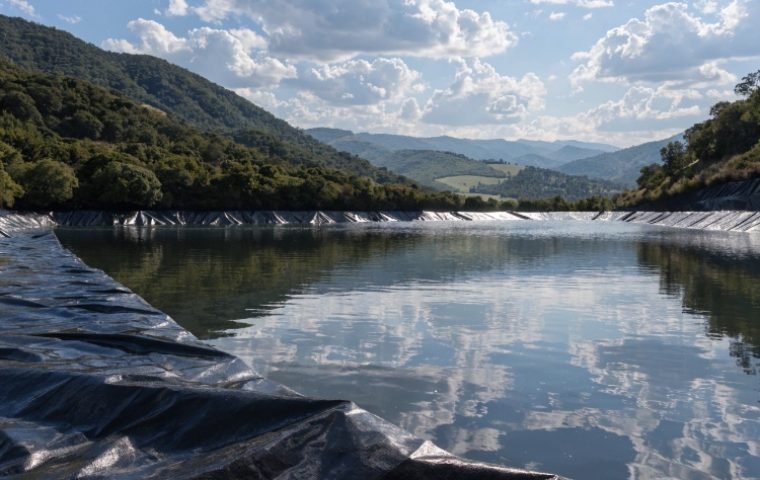
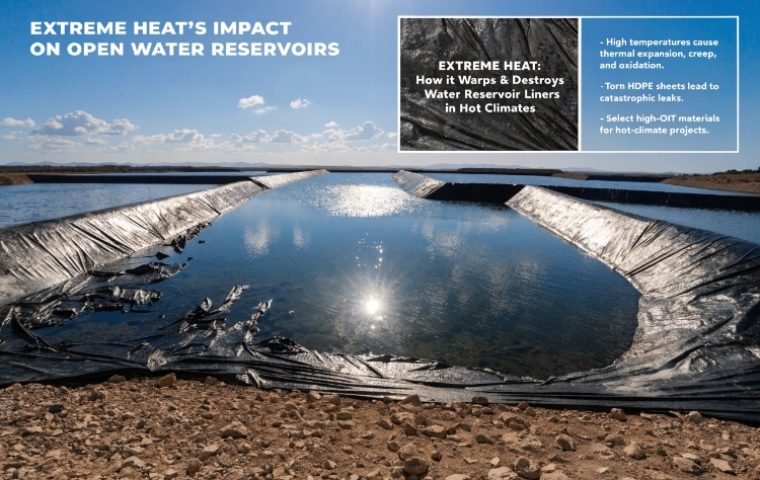
Open reservoirs face a relentless and invisible threat from the sun. When high-intensity ultraviolet (UV) rays bake an exposed geomembrane liner for years, rapid material degradation can cause catastrophic leaks, ultimately shutting down your entire water storage system.
This guide explains how UV exposure degrades High-Density Polyethylene (HDPE) liners in open reservoirs and how professional engineers mitigate this risk. You will learn how carbon black protects the polymer matrix, how to spot early signs of solar damage, and how specifying the right material thickness and grade determines the lifespan of your project.

In my experience supplying geosynthetics for water infrastructure across equatorial and high-altitude regions, sun damage is the silent killer of exposed containment projects. Let me explain exactly how UV light attacks your project and what practical steps you must take to stop it.
Why UV Exposure Matters in Water Projects
When we supply materials for open agricultural ponds, municipal water reserves, or mining evaporation ponds, the most highly stressed area of the installation is rarely the deep bottom. It is the slopes. Specifically, the "drawdown zone"—the area of the embankment where the water level continuously rises and falls based on seasonal usage or pumping.
In this exposed zone, the geomembrane is subjected to intense, direct sunlight day after day. One of the most common and dangerous misconceptions I hear from contractors and government procurement officers is the belief that "HDPE is completely immune to the sun." Because the plastic is black and heavy, many buyers assume they can leave a thin, standard 0.75 mm sheet baking in the desert sun for thirty years without consequence.
This is structurally false. While virgin HDPE is highly durable, UV radiation represents the primary environmental aging factor for exposed geosynthetic liners. The fluctuating water line creates extreme thermal cycling. The black liner absorbs solar heat, expanding during the peak of the day, and then rapidly contracts at night or when cool water is pumped back into the basin.
When you combine constant thermal expansion with relentless UV bombardment, the physical toll on the plastic is massive. If an engineer specifying a water project ignores UV exposure calculations, the liner will prematurely age, crack, and fail long before its intended design life. Replacing a degraded liner on an operational reservoir is often ten times more expensive than installing the correct, UV-stabilized material in the first place. Therefore, understanding and designing for UV exposure is a mandatory requirement for any reliable B2B water storage solution.
How UV Radiation Degrades HDPE
To understand how to protect your reservoir, you must first understand the mechanism of failure. Geomembrane degradation from sunlight is not just cosmetic; it is a deep chemical breakdown of the plastic itself. As a supplier, I often have to explain to project managers that UV aging happens at the molecular level through a process called photo-oxidation.
HDPE is a polymer made up of long, tightly bound chains of carbon and hydrogen atoms. When short-wave ultraviolet photons from the sun hit the surface of the geomembrane, they carry enough energy to physically break the carbon-carbon bonds in these polymer chains. This process is known as chain scission.
When the chains break, they create highly reactive free radicals. Because the open reservoir is constantly exposed to the air, these free radicals immediately react with oxygen. This photo-oxidation triggers a cascading chain reaction that further destroys the molecular weight and physical structure of the plastic.
However, high-quality HDPE does not break down immediately. The degradation happens in three distinct stages:
- Antioxidant Depletion: Premium geomembranes are manufactured with specialized antioxidant additive packages. During the first phase of UV exposure, these antioxidants "sacrifice" themselves to neutralize the free radicals caused by the sun. As long as antioxidants remain in the plastic, the liner's mechanical strength stays intact.
- Induction Period: Once the sun and heat entirely consume the antioxidant package, the polymer is left defenseless. The oxidation process begins to accelerate internally, though the naked eye cannot see it yet.
- Rapid Degradation (Chain Scission): In this final stage, the polymer chains break rapidly. The material loses its elongation capacity, becomes incredibly brittle, and cracks under even minor stress.
This chemical reality is exactly why buying cheap, recycled liners is a fatal engineering error. Recycled resins do not have the proper virgin antioxidant packages, meaning they skip the first stage entirely and begin degrading within a few short months in an open reservoir.
The Critical Role of Carbon Black in UV Resistance
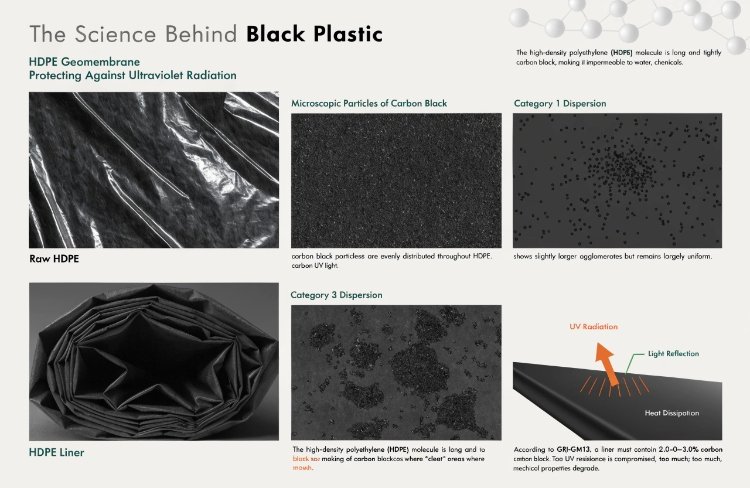
If you look at most geomembranes used in water infrastructure, they are deeply black. This is not for aesthetic reasons; it is highly functional chemistry. The single most important defense an HDPE liner has against UV radiation is an additive called carbon black.
Carbon black physically acts as a microscopic UV absorber. When ultraviolet light hits the geomembrane, the carbon black particles absorb the radiation and convert it into harmless heat. This prevents the UV energy from penetrating deep into the polymer matrix and breaking the carbon-carbon bonds.
According to the GRI-GM13 standard—the global benchmark for high-quality HDPE geomembranes—a liner must contain between 2.0% and 3.0% carbon black.
Many buyers ask me: "If carbon black protects it from the sun, why don't we use 5% or 10% to make it last forever?"
The answer lies in mechanical trade-offs. If a manufacturer adds too much carbon black, the HDPE becomes too rigid and brittle. It will lose its flexibility, fail its elongation testing, and crack when the subgrade settles. Two to three percent is the scientifically proven "sweet spot" that maximizes UV protection while maintaining the plastic's flexible, waterproof properties.
Equally important is carbon black dispersion. It does not matter if a factory puts 2.5% carbon black into the mix if they do not blend it properly. If the carbon black clumps together during extrusion (Category 3 dispersion), it leaves microscopic "clear" windows in the plastic. UV rays will shoot straight through those gaps and destroy the polymer from the inside out. When we supply materials, we guarantee Category 1 or 2 dispersion, ensuring that the UV shield is perfectly uniform across every single millimeter of the roll.
Signs of UV Damage in Geomembranes
For maintenance teams managing drinking water reservoirs or agricultural ponds, recognizing the early physical signs of UV degradation can prevent a catastrophic blowout. By the time a liner starts leaking heavily, the damage is irreversible.
When we conduct site audits or field consultations for aging projects, we look for three distinct physical symptoms that indicate the UV protection has failed.
1. Surface Chalking and Crazing
The earliest visual indicator of severe photo-oxidation is "chalking." The surface of the once-glossy black liner will turn dull and grayish. If you rub your hand firmly across the slope of the liner, you will come away with a fine, dark powder. Following the chalking phase, you will see "crazing"—microscopic, shallow cracks that look like dry alligator skin on the very top layer of the plastic. This means the surface polymer chains are shattered.
2. Loss of Elongation (Brittleness)
Healthy HDPE is incredibly tough and flexible; a good 1.5 mm sample can stretch up to 700% of its original length before snapping. When UV damage penetrates the core of the material, it loses this elasticity. Instead of stretching, the material simply snaps like a dry twig. If workers step on an old liner and hear sharp cracking sounds, or if a rock underneath simply punches through rather than denting the plastic, the molecular structure has failed.
3. Environmental Stress Cracking
Because the material is shrinking and becoming brittle, it no longer has the capacity to handle physical tension. You will begin to see large, jagged splits appear out of nowhere. These stress cracks usually form in the anchor trenches at the top of the reservoir, where the liner is pulled tightest, or directly adjacent to the extrusion welds where the heat of installation already weakened the surrounding polymer.
How to Improve UV Resistance in Open Reservoirs
When a client tells me they are building an exposed water storage facility in a high-UV region like the Middle East, North Africa, or high-altitude South America, we do not just quote a standard price list. We engineer the specification to survive the environment.
Here are the practical methods professionals use to maximize the lifespan of open reservoir liners.
Specify High-Quality, Virgin HDPE (GRI-GM13)
The absolute baseline for an exposed project is strictly adhering to the GRI-GM13 specification. You must demand the manufacturer uses 100% virgin polyethylene resin. Only virgin resin features the proper, fully intact antioxidant formulation (measured via High-Pressure Oxidation Induction Time, or HP-OIT testing). If you use off-spec or recycled resins, the UV rays will obliterate the material in a fraction of the time, no matter how thick it is.
Increase Material Thickness
Thickness directly correlates with longevity in exposed conditions. When UV light hits a geomembrane, it only degrades the top microscopic layers; it takes time to eat through the material. A thicker liner simply has more mass and more integrated antioxidants to sacrifice over time.
For an exposed reservoir, I strongly recommend upgrading from 1.0 mm (40 mil) to 1.5 mm (60 mil) or even 2.0 mm (80 mil). A 1.5 mm liner will outlive a 1.0 mm liner by over a decade in brutal, direct sunlight because it maintains a thicker un-degraded structural core beneath the sun-baked surface.
Implement Protective Covers
If your budget does not allow for ultra-thick HDPE, the best strategy is to take the sun out of the equation entirely.
- Water Cover: Keep the reservoir as full as possible. Water acts as an excellent UV filter. The liner deep underwater is practically immune to photo-oxidation.
- Soil Cover: You can bury the liner under 30 centimeters of soil or sand. However, if you do this on the slopes, you must use textured geomembrane to provide the friction necessary to keep the soil from sliding into the basin.
- Floating Covers: For municipal or highly sensitive projects, installing a floating cover over the reservoir not only shields the entire bottom liner from UV rays but also stops evaporation and prevents algae growth.
Risk, Limitations, and When Exposed HDPE Is NOT Recommended
As a supplier, it is my job to tell buyers the truth about material limits. While HDPE is the global standard for waterproofing, there are specific situations where relying on a permanently exposed geomembrane is an engineering mistake.
Do not use exposed liner if your site features extreme UV combined with high physical impact.
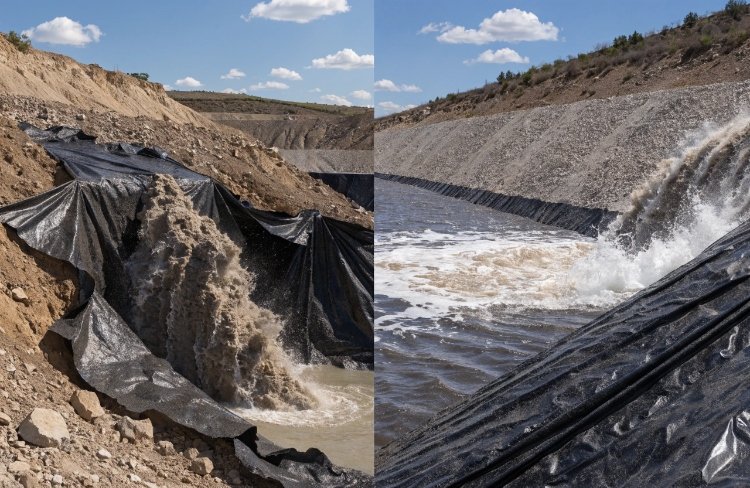
For example, if you are designing a tailings reservoir in a high-altitude desert where the UV index is perpetually extreme, and you plan to have heavy machinery or turbulent rocky slurry constantly hitting the exposed slopes, an uncovered HDPE liner will fail. The UV radiation will slowly make the liner brittle, and the sharp slurry or mechanical traffic will immediately shatter the weakened plastic.
The Stiffening Trade-off of Thicker Liners
While I advise using thicker liners (2.0 mm or 2.5 mm) for severe UV longevity, you must accept the installation limitations. A 2.5 mm liner is incredibly stiff. It acts more like a rigid board than a flexible sheet. It will not drape smoothly over uneven dirt, meaning it will "bridge" across gaps, creating tight stress points that weaken the system. Furthermore, wedge welding a 2.5 mm liner requires specialized high-heat equipment and experienced technicians.
If your design requires flexibility for an uneven subgrade, you cannot simply brute-force the problem with a thicker sheet. In these severe scenarios, the only responsible engineering choice is to use a 1.5 mm liner and mandate a physical protective cover layer, such as shotcrete, concrete canvas, or a heavily engineered soil backfill.
Summary of Geomembrane Choices for UV Exposure
To help B2B buyers make quick, practical decisions during the procurement phase, we use this general decision matrix based on real-world project tracking.
| Material Thickness | Best Fit Project Scenario | Expected Longevity (Exposed) | Practical Field Notes |
|---|---|---|---|
| 0.75 mm – 1.0 mm | Covered irrigation ponds, temporary pits | Short-Medium | Cost-effective but highly vulnerable if drawdown zone is left exposed for years. |
| 1.5 mm (60 mil) | Standard Open Reservoirs | Long Term | The global industry standard for balancing UV mass, cost, and installation flexibility. |
| 2.0 mm (80 mil) | High altitude, heavy UV, severe conditions | Maximum | Harder to install but offers the highest reservoir of sacrificial antioxidants. |
Conclusión
UV radiation is an unavoidable threat to open reservoirs, but it is a highly predictable one. Photo-oxidation, chain scission, and cracking only destroy a project when the procurement and engineering teams fail to account for the environment. By specifying 100% virgin resin, ensuring a 2-3% well-dispersed carbon black content, and utilizing adequate thickness or protective covers, you can guarantee your water infrastructure yields decades of reliable service.
Do not let poor specifications cut your project lifespan short. Contact Waterproof Specialist for UV-resistant HDPE liner specifications today. Our team will help you review your site conditions, provide exact material datasheets, and deliver specific project recommendations to ensure your reservoir stays leak-free under the harshest sun.