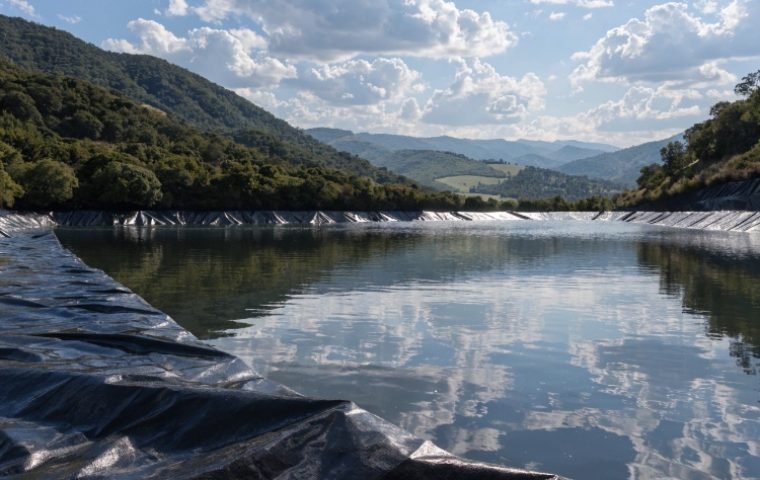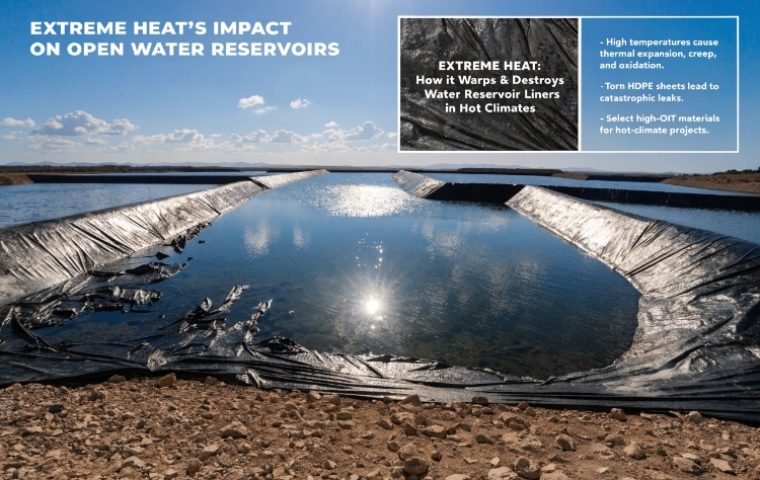


Industrial fires require thousands of gallons of water instantly. If your emergency reservoir leaks slowly into the soil due to a failing liner, your fire pumps will pull air during a crisis, risking lives and guaranteeing massive facility damage.
This guide helps facility managers and industrial contractors select and design geomembrane liners for fire water reservoirs. You will learn how to meet strict industrial safety regulations, choose high-durability HDPE materials, and ensure leak-proof installation for reliable, long-term emergency water storage.
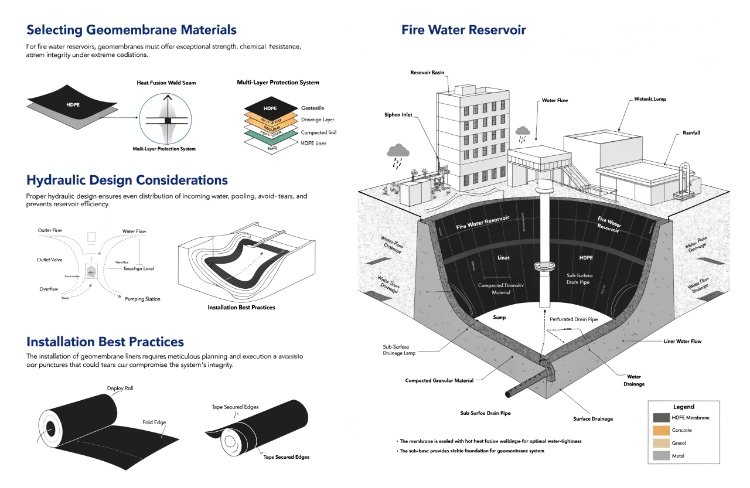
As a geosynthetics supplier handling industrial exports globally, I constantly review containment specs for petrochemical plants, logistics parks, and massive manufacturing hubs. A fire water reservoir is not an agricultural pond; it is a highly scrutinized, mandatory safety asset. Here is how professional contractors engineer these systems to guarantee zero failure.
The Role of Fire Water Reservoirs in Industrial Safety
Municipal water pressure is rarely adequate to fight a full-scale industrial fire. High-hazard facilities—like chemical processing plants, massive timber yards, or battery manufacturing sites—are required by law to maintain their own dedicated emergency water supply.
This water must be available on demand, 24 hours a day, 365 days a year. If a fire breaks out, high-capacity diesel or electric fire pumps will activate automatically, drawing massive volumes of water from the reservoir to feed the facility’s sprinkler systems and fire monitors.
Because this water sits stagnant for years at a time, the containment structure must be flawless. If a concrete basin cracks or a natural soil pond seeps, the water level will slowly drop below the mandatory volume limits. When safety auditors or insurance inspectors measure the fire pond and find it lacking, they will flag the facility, significantly raising insurance premiums or even shutting down site operations until the leak is fixed. Absolute containment is the foundation of industrial fire safety.
Key Design Standards and Regulations
When I ship materials to international industrial projects, the engineering firms always reference strict fire protection standards. Understanding these rules dictates how we supply the liner.
NFPA and Local Fire Codes
In many regions, fire water storage is guided by standards like NFPA 22 (Standard for Water Tanks for Private Fire Protection) or NFPA 1142 (Water Supplies for Suburban and Rural Fire Fighting). While NFPA 22 traditionally focuses on steel and concrete tanks, the industry heavily utilizes lined earthen reservoirs for massive volume requirements (e.g., over 10,000 cubic meters) because building a steel tank that large is financially prohibitive.
These standards do not always dictate the exact type of plastic to use, but they strictly dictate water availability and zero-leakage requirements.
Insurance and Safety Audits
Major industrial insurers, such as FM Global, have their own rigorous loss-prevention data sheets. They demand proof that the water loss in a reservoir is exclusively from surface evaporation, not seepage. If a client buys a cheap, uncertified plastic liner and the basin loses anomalous amounts of water, the facility will fail its insurance audit. We only supply geomembranes with strict QA/QC laboratory certificates to ensure buyers can prove exactly what material is securing their fire water.
Why Geomembrane Liners Are Used in Fire Water Reservoirs
Historically, facilities relied on heavy reinforced concrete basins or simply dug deep clay ponds. Today, geomembrane liners are the standard for large-footprint fire reservoirs for three very practical reasons.
First, geomembranes offer total impermeability. Unlike clay, which can absorb moisture and allow slow seepage, or concrete, which inevitably cracks due to thermal expansion and minor soil settlement, a welded HDPE liner acts as an absolute physical barrier. Water simply cannot pass through a properly installed 1.5mm HDPE sheet.
Second, liners provide superior long-term water storage with low maintenance. A high-quality geomembrane does not react with the stagnant water. It does not rot, and it resists the harsh chlorine or algaecides facility managers often dump into fire ponds to keep the water clear and prevent pump filters from clogging.
Third, the cost efficiency is unbeatable for large volumes. Excavating a massive earthen basin and lining it with HDPE is a fraction of the cost—and takes a fraction of the time—compared to pouring a monolithic concrete tank of the exact same capacity.
Risk, Limitations, and When Open Lined Reservoirs Are NOT Recommended
I must directly address situations where an HDPE geomembrane reservoir is the wrong engineering choice. Lined earthen ponds have specific geographical and spatial limitations that buyers often overlook.
Freezing Climates
If your industrial facility is located in a severe cold-weather environment, an open lined reservoir is highly dangerous. A geomembrane does not insulate. In sub-zero temperatures, the open water will freeze solid. If a fire breaks out, your pumps will hit a wall of ice. In these climates, you must use heavily insulated, heated vertical steel tanks or bury the reservoir entirely below the frost line in concrete.
High-Density Urban Facilities (Space Constraints)
Earthen reservoirs require sloped embankments—usually a 1:3 or 1:2 ratio to prevent slope failure. This footprint consumes a massive amount of real estate. If you are designing fire protection for a tight urban data center or a crowded factory where land is extremely expensive, an open pond is a terrible use of space. Vertical cylindrical tanks are much more appropriate when the footprint is limited.
Material Selection for Fire Water Systems
If the site conditions allow for an open reservoir, selecting the right polymer is the next critical step. Do not use thin, temporary agricultural plastics for a permanent safety asset.
Polietileno de alta densidad (HDPE)
For $95\%$ of the industrial fire water projects we supply, smooth HDPE is the required material. We recommend a minimum thickness of 1.5mm (60 mil) to 2.0mm (80 mil) for absolute puncture resistance. HDPE is stiff, dimensionally stable, and incredibly tough against physical damage from debris or maintenance workers walking on the slopes.
Anti-Aging and UV Resistance
Because fire ponds sit full most of the time, the bottom of the liner is protected by the water. However, the upper slopes above the water line (freeboard) are exposed to brutal UV radiation every single day. The liner must be manufactured with 100% virgin resin, a minimum of 2% premium carbon black, and advanced antioxidant packages. If the manufacturer uses cheap regrind plastic, the exposed slopes will become brittle and shatter within five years, taking the entire fire system offline for repairs.
Design Considerations for Extreme Reliability
Designing a fire water pond is different from designing a wastewater pond. The most critical moments for this reservoir occur when massive high-capacity pumps suddenly turn on.
Managing Water Drawdown and Pump Suction
When a 2,500 GPM (gallons per minute) fire pump activates, it creates a massive localized suction force at the concrete intake structure. The interface between the flexible geomembrane and the hard concrete intake is the highest risk area for failure.
We advise engineers to use heavy-duty stainless steel batten strips, embedded anchor bolts, and specialized industrial-grade polyurethane sealants to clamp the liner permanently to the concrete. If this mechanical seal is weak, the sudden suction vortex will tear the liner right off the wall, potentially clogging the intake pipe with loose plastic and shutting down the fire suppression system entirely.
Long-Term Static Stress
Fire water often sits untouched for decades. The subgrade beneath the liner must be impeccably compacted and cleared of any sharp rocks. Even a small rock under a 1.5mm liner at the bottom of a 5-meter deep pond creates an immense localized pressure point. Over ten years, that point can slowly yield and puncture. We frequently supply heavy non-woven geotextile (300g/m² or higher) to lay directly under the HDPE as a permanent protective cushion.
Installation and Quality Control
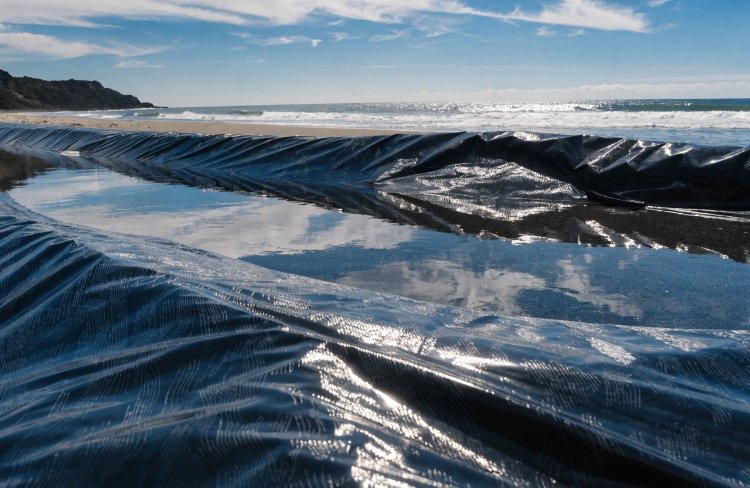
When B2B clients purchase liners for industrial safety projects, they do not just buy plastic; they buy the QA/QC documentation that proves the installation is flawless. A fire marshal will not approve the facility without looking at the welding records.
The installation must follow strict GRI-GM19 standards for seam strength. Installers use automated hot-wedge welders to join the large HDPE panels. This machine creates a double seam with a hollow air channel down the middle.
El Air Pressure Test
To prove zero leakage, technicians seal both ends of that hollow channel, insert a needle, and pump it full of compressed air (typically around 30 psi). If the pressure holds steady for 5 minutes, it scientifically proves the entire length of the weld is perfectly sealed.
Prueba de caja de vacío
Any complex corners, pipe boots, or batten strip attachments cannot be wedge-welded. They must be manually welded using an extrusion gun. Because these cannot be pressure tested, technicians place a soapy vacuum box over the fresh weld. If bubbles form, there is a micro-leak, and it must be ground down and re-welded immediately. This rigorous testing guarantees the fire water reservoir will not lose a single drop to seepage.
Material Comparison for Fire Containment Structures
To help facility owners make the right decision, here is how an HDPE geomembrane compares to traditional structures for massive industrial water storage.
| Característica | Concrete Basin | Welded Steel Tank | HDPE Geomembrane Liner |
|---|---|---|---|
| Initial Cost | muy alto | Alto | Low to Moderate |
| Velocidad de instalación | Slow (Curing time) | Moderado | Fast (Weeks) |
| Leakage Risk | High (Thermal cracking) | Low (Rust/Corrosion) | Zero (If QA/QC tested) |
| Land Footprint | Moderado | Small | Large (Requires embankments) |
Conclusión
An industrial fire water reservoir is the ultimate fail-safe for preventing catastrophic plant loss. By utilizing high-quality, thick HDPE geomembranes, rigorous subgrade engineering, and strict mechanical fastening to pump intakes, you create a water storage asset that guarantees 100% reliability during an emergency.
Never cut corners on materials protecting billion-dollar industrial assets. Contact Waterproof Specialist today for pricing, technical datasheets, and complete export support. We will provide the exact high-durability geomembrane specifications required to meet industrial safety audits and keep your facility protected for decades.