Selecting the wrong geomembrane for chemical storage containment can lead to rapid material degradation, leakage, and costly environmental damage. However, many procurement teams and engineers still choose liners based only on a generic material type or the lowest price—which is a major operational risk.
This guide breaks down a step-by-step selection process to help you choose the exact chemical containment liner required for your project. By evaluating chemical concentration, operating temperatures, and subgrade mechanics, buyers can specify a geomembrane liner that prevents catastrophic environmental failures and costly facility shutdowns.

In my experience supplying containment solutions for global industrial projects, hoping a standard plastic sheet will hold aggressive chemicals is a recipe for disaster. You need a systematic approach to material selection.
Why Selecting a Chemical Containment Liner is Complex
Unlike general water ponds or basic fuel depots, chemical storage environments involve highly reactive variables. You are not just holding back a neutral liquid; you are defending the surrounding soil from chemical reactivity, elevated temperatures, and severe mechanical stress simultaneously.
A geomembrane liner that performs perfectly well under a municipal water tank will melt, swell, or fracture within weeks if exposed to concentrated acids or hot alkaline solutions. To make matters more complicated, these environmental factors compound one another. A chemical that is relatively harmless to a liner at 20°C can become highly corrosive and rapidly degrade the plastic if the storage tank operates at 50°C. Therefore, material choice must be an intersection of chemistry, physics, and site realities.
The 6-Step Selection Framework
When international buyers send me an inquiry for a chemical tank farm, I refuse to quote a price until we walk through this exact 6-step framework. This is how professional engineers evaluate geomembranes to ensure long-term safety.
Step 1: Identify the Chemical Type and Concentration
The very first decision filter is exactly what chemical will pool on the liner if a spill occurs. Are you storing an acid (e.g., sulfuric acid), an alkali (e.g., sodium hydroxide), or complex hydrocarbons?
More importantly, what is the concentration? Even the same chemical at different concentrations can have vastly different impacts on geomembrane performance. A geomembrane that comfortably contains 10% sulfuric acid might suffer severe oxidative degradation if exposed to 98% concentrated sulfuric acid. Never assume a liner is simply "acid-proof"—you must match the polymer to the exact chemical composition and percentage.
Step 2: Verify Chemical Compatibility
Once you know the chemical data, do not guess the material. Engineers should always consult established chemical resistance charts or testing data provided under rigorous industry standards.
Organizations like ASTM International and the Geosynthetic Institute (GSI) provide extensive testing frameworks (such as EPA Method 9090) that measure how a specific polymer reacts to a chemical over time. We look at whether the plastic swells, loses tensile strength, or suffers environmental stress cracking when submerged. If the data shows a loss of physical properties greater than 10%, that material is disqualified for your project.
Step 3: Evaluate Temperature Conditions
Temperature is the silent killer of plastic containment systems. You must evaluate the difference between ambient temperature projects and high-temperature storage tanks.
Elevated temperatures drastically accelerate oxidation and chemical diffusion rates, significantly reducing the lifespan of certain geomembranes. If your chemical tank is heated, that thermal load transfers directly through the tank floor into the liner beneath it. A standard polymer might survive the chemical at room temperature, but it will fail prematurely under heat. In these scenarios, specially formulated high-temperature resistant HDPE or specific alloy liners are strictly required.
Step 4: Assess Mechanical and Structural Requirements
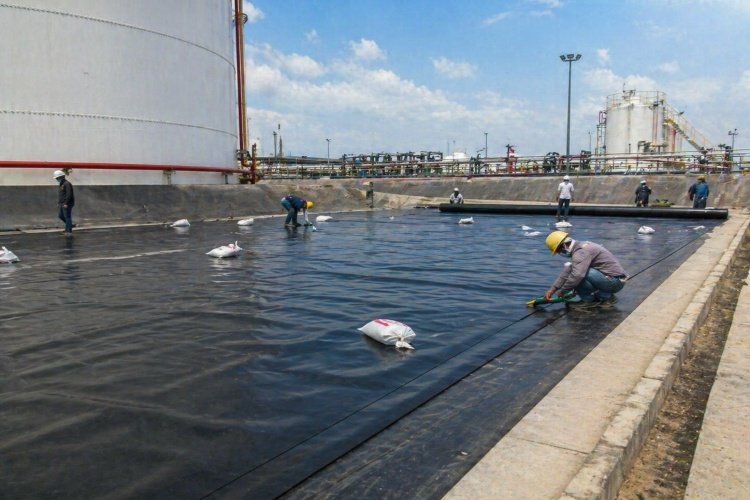
A liner must survive the physical weight of the facility. You have to account for the immense static load generated by a full chemical tank pressing down on the base.
Furthermore, you must evaluate the subgrade condition and equipment traffic. Will maintenance trucks drive inside the secondary containment bund? Is the ground beneath the liner laser-leveled concrete, or is it compacted earth with hidden sharp stones? A liner with perfect chemical resistance is completely useless if it gets mechanically punctured by a rock or a dropped wrench before a chemical spill even happens.
Step 5: Determine Required Thickness
I am often asked if a 1.0 mm liner is "good enough" for chemical storage. The answer relies on judging risk, not just reading a spec sheet.
For chemical containment, you determine thickness by evaluating the hydraulic head pressure of a potential spill and the roughness of the subgrade. Higher-risk applications—such as large hazardous chemical tank farms or highly abrasive subgrades—typically require thicker HDPE liners (1.5–2.0 mm) to provide enhanced puncture resistance and a larger sacrificial mass against chemical attack. Thinner liners are only acceptable for very small, highly controlled, low-risk indoor chemical bunds.
Step 6: Consider Installation and Site Constraints
This is where theoretical engineering meets the dirt. The best chemical liner in the world fails if the installation crew cannot physically weld it in the space provided.
Consider the site accessibility and geometries. A massive, flat tank farm favors thick, rigid HDPE because automated hot-wedge welders can travel long distances quickly. However, if your chemical containment area is a maze of tight concrete trenches, dozens of pump plinths, and intersecting pipes, a stiff 2.0mm HDPE liner will be a nightmare to install. In complex geometries, extrusion welding thick plastic is highly prone to human error. You may need to specify a more flexible, chemically compatible LLDPE or specialized alloy simply to ensure the site crew can achieve perfectly sealed seams. Quality control on the weld is just as important as the plastic itself.
Decision Matrix for Chemical Geomembranes
To help visualize how these variables dictate the material choice, I use a simplified matrix. While every project requires specific chemical compatibility verification, this table highlights the general logic behind industrial liner selection.
| Project Condition | Recommended Liner Choice | Practical Reasoning |
|---|---|---|
| Strong Acid + High Temperature | Thick HDPE (2.0 mm) | Maximum chemical inertness and mass to resist accelerated oxidation. |
| Light Hydrocarbons / General Chemicals | LLDPE | Good chemical resistance paired with excellent flexibility for complex bunds. |
| Highly Uneven or Settling Subgrade | LLDPE | High elongation prevents tension cracking if the heavy tank bends the earth. |
| Complex Shapes / Many Pipe Boots | Flexible liners (LLDPE) | Allows installers to fold and safely extrusion-weld around tight corners. |
Common Selection Mistakes That Lead to Failure
Over years of exporting and consulting on these materials, I see the same procurement mistakes repeat themselves. Avoid these errors to protect your facility from catastrophic leaks.
- Choosing a liner based only on cost: Buying the cheapest generic plastic guarantees failure. Consequence: The material chemically degrades within months, leading to a massive environmental fine when the first spill occurs.
- Ignoring chemical concentration: Specifying a liner based on testing done at 5% concentration, but using it for 50% concentration. Consequence: The aggressive liquid rapidly eats through the polymer matrix, rendering the barrier useless.
- Underestimating temperature impact: Failing to account for hot tropical climates or heated storage vessels. Consequence: The geomembrane ages prematurely, becomes incredibly brittle, and shatters under the weight of the tank.
- Using thin liners in high-load areas: Placing a 1.0mm liner under a massive steel tank resting on gravel. Consequence: The static weight instantly pushes the gravel through the thin plastic, creating thousands of invisible puncture leaks.
Risks, Limitations, and When NOT to Use Certain Liners
To ensure true site safety, you must understand where these materials fail. No single geomembrane is invincible.
When to avoid LLDPE:
Do not specify LLDPE if your facility is storing pure, concentrated oxidizing acids (like highly concentrated nitric or sulfuric acid) or aggressive halogenated solvents. LLDPE has a lower density than HDPE, making it inherently more permeable to extreme chemicals. In these intense chemical environments, LLDPE will absorb the chemical, swell, and lose its tensile strength rapidly.
When to avoid thick HDPE:
Never specify a rigid 2.0mm HDPE liner if your containment area features highly unstable, shifting ground that is prone to severe differential settlement. While HDPE boasts extreme chemical resistance, its rigidity is a severe limitation. If the earth sinks beneath the liner, the stiff HDPE cannot stretch far enough to accommodate the void; it will suffer from environmental stress cracking and snap open.
Typical Chemical Containment System Structure
A successful chemical barrier is rarely just a single sheet of plastic. It is an engineered system designed to protect the primary containment layer.
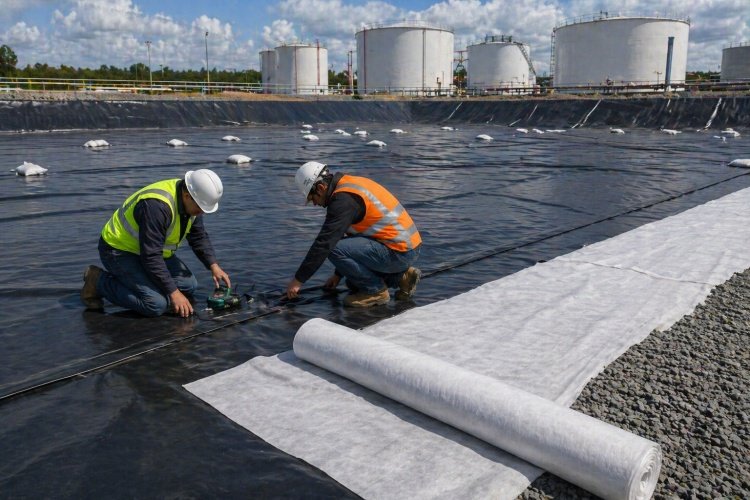
A typical, reliable system includes an HDPE geomembrane liner combined intimately with a heavy nonwoven protective geotextile layer. The geotextile acts as a critical shock absorber and puncture shield, placed directly between the raw subgrade and the geomembrane. This ensures that the heavy mechanical loads of the chemical tanks do not force sharp subgrade debris through the impermeable plastic, severely enhancing the durability and performance of the entire containment system.
Get Expert Engineering Support
Procuring materials for chemical secondary containment is not an area where you can afford trial and error. Analyzing chemical compatibility, managing thermal expectations, and evaluating subgrade risks are essential steps to preventing expensive facility failures.
Not sure which geomembrane liner is suitable for your highly specific chemical storage project?
Do not base your decision on generic datasheets. Share your exact chemical type, operating temperature, and site foundation conditions with us. Our engineering support team at Waterproof Specialist can analyze your facility's parameters and recommend a tailored, perfectly compatible liner solution within 24 hours. Contact our team today to secure the precise material your project demands.