Procurement teams often receive conflicting advice on containment liners. Purchasing the wrong material wastes project budgets, severely complicates contractor installation, and risks catastrophic field failures when exposed to chemical leaks.
Choosing between HDPE and LLDPE liners depends entirely on your specific project conditions, not just a laboratory spec sheet. HDPE offers exceptional chemical resistance for flat, large-scale tank farms, while LLDPE provides essential flexibility to withstand uneven ground, settling subgrades, and complex bund geometries without cracking.
One of the most common questions I get from global importers and project managers is simply, "Which material is better?" But in commercial export, there is no inherently "better" material. The real question must always be: "Which liner fits the physical realities of my specific site?"
Why Material Choice Depends on Application, Not Just Properties
It is a common pitfall in B2B procurement to rely purely on manufacturer datasheets. Buyers will often look at the tensile strength numbers and instantly assume that the strongest material is the safest choice for secondary containment. This logic causes major project failures.
The same roll of geomembrane will perform flawlessly in one environment and fail miserably in another. For instance, high-density materials look incredibly tough on paper. However, if that rigid plastic is deployed over a shifting, muddy base or forced around complex pipe penetrations, its stiffness becomes a major liability. It cannot stretch, so it eventually cracks under the strain.
Conversely, relying on flexible liners simply because they are easier to unroll can backfire if the stored liquid requires extreme chemical resistance. There is no universally superior plastic; there is only the most suitable polymer formulation for your unique subgrade, climate, and chemical exposure profile.
Project-Based Selection Logic
In my years of supplying geosynthetics to international oil and gas facilities, I guide buyers to evaluate their sites first, then pick the material. Here is how professional operators approach the decision across different real-world scenarios.
Scenario 1: Heavy Oil Storage and Large Tank Farms
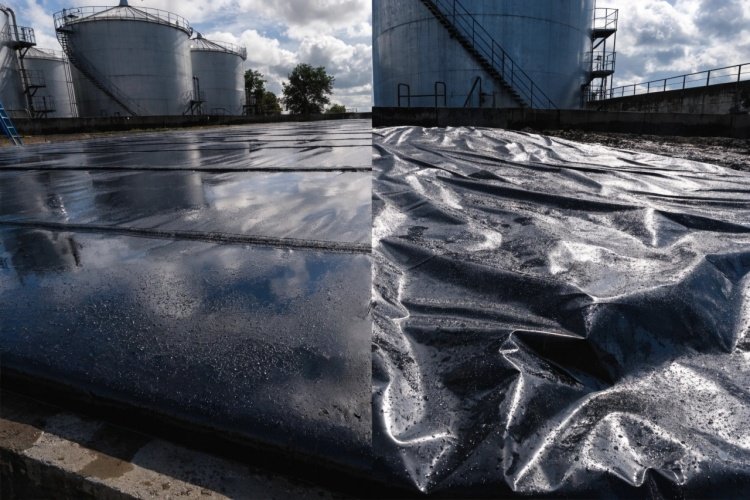
When dealing with massive crude oil storage tanks, the containment footprint is usually vast, mostly flat, and engineered to remain in place for decades. The primary requirements here are high tensile strength, extreme impermeability, and robust chemical resistance to long-term hydrocarbon pooling.
For these perfectly graded expanses, High-Density Polyethylene (HDPE) is typically the standard deployment. It lays perfectly flat on prepared sand or geotextile subgrades. Because of its dense molecular structure, it naturally resists highly aggressive crude oils and fuel mixtures over a prolonged lifespan. The rigidity of HDPE is an asset here, as the flat terrain does not require the material to stretch or conform to deep irregularities.
Scenario 2: Light Oil and Chemical Process Containment
Moving away from large tank farms, localized process areas and chemical storage bunds present totally different geometries. These zones are filled with concrete plinths, tight corners, pump stations, and dozens of intersecting pipelines.
In these environments, flexibility is significantly more valuable than rigid strength. Installers must fold, wrap, and weld the liner around awkward, three-dimensional shapes. Linear Low-Density Polyethylene (LLDPE) fits this scenario perfectly. Its molecular structure allows it to flex and mold around corners without suffering from stress fatigue. Forcing a stiff liner into a 90-degree trench often leads to tearing, whereas LLDPE handles complex containment architectures seamlessly.
Scenario 3: Uneven or Soft Subgrade Conditions
Not every project happens on a perfectly leveled, compacted foundation. Many export projects we supply are built on reclaimed land, soft marshy soils, or highly uneven earthen dikes. Over the years, the massive weight of storage tanks and heavy rains will cause the ground below to settle and shift.
This is known as differential settlement. If the earth sinks beneath a rigid liner, the plastic is left suspended. Under the weight of captured rainwater or a chemical spill, it will stretch to its breaking point and snap. LLDPE shines in this exact scenario. It possesses highly superior elongation properties, meaning it can stretch tremendously before breaking. If the subgrade sinks, an LLDPE liner simply stretches and conforms to the new contour, keeping the containment system completely intact.
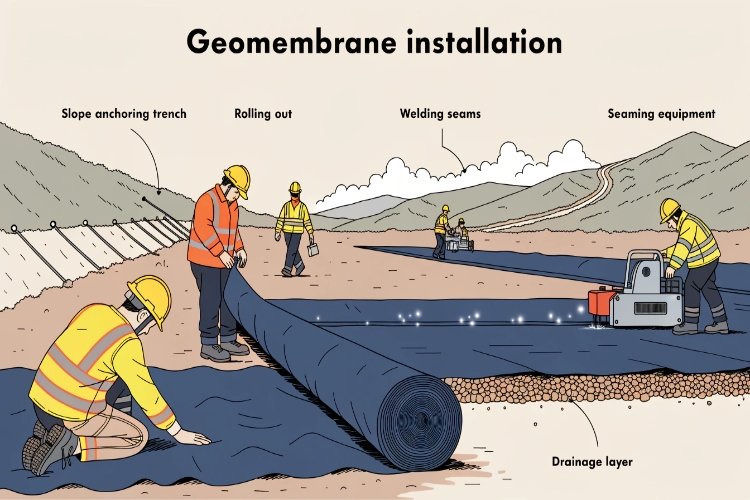
Scenario 4: High Temperature and Harsh Sun Exposure
Climate dictates containment survival. Projects located in prolonged direct sunlight—such as installations in the Middle East, Africa, or the Australian outback—demand extreme ultraviolet (UV) stability.
HDPE is incredibly stable under harsh environmental exposure. When properly formulated with high-quality carbon black and UV stabilizers, it provides outstanding resistance to oxidative degradation. It does not break down or become brittle easily under years of punishing solar radiation. For long-term, exposed outdoor applications, HDPE brings an unmatched level of enduring stability.
Scenario 5: Fast Installation and Temporary Projects
Temporary drill pads, fracking water pits, and short-term chemical holding ponds prioritize rapid deployment over decades-long durability. The objective is to roll out the liner quickly, utilize it for six to twelve months, and potentially pack it up.
In these fast-paced timelines, LLDPE is often easier for field crews to handle. Because it is softer, the rolls unspool more easily, and the material lays closer to the ground without requiring time to "relax" in the heat. For projects requiring even higher mechanical abuse resistance during rapid deployment, heavily reinforced geomembranes (with internal scrims) are utilized, but when choosing between unreinforced PE options, LLDPE typically wins on installation speed.
Installation Considerations and Hidden Costs
Procurement managers often isolate the price of the material from the cost of the installation. This is a critical oversight. Your material choice directly dictates how difficult, slow, and expensive your contractor labor will be.
Because HDPE is rigid, it is fantastic for automated wedge welding on straight, long seams. Two overlapping sheets on a flat floor can be welded at high speeds with minimal human error. However, a site full of trenches, vertical walls, and tight pipe boots requires manual extrusion welding. Extrusion welding stiff HDPE in tight spaces is incredibly difficult and requires highly skilled, expensive technicians.
LLDPE, being much softer and more forgiving, is vastly easier for crews to manipulate. If your local labor force lacks advanced welding expertise, or if the weather is cold (which makes plastics even stiffer), selecting LLDPE can drastically reduce installation errors, minimize failed seam tests, and keep the contractor timeline on schedule. The material choice ultimately defines the installation risk.
Cost vs Performance in Real Projects
When evaluating B2B orders, buyers sometimes hyper-focus on the slight difference in polymer cost per square meter. However, the true metric for industrial containment is long-term cost-efficiency versus failure risk.
Selecting a marginally cheaper liner that ultimately stress-cracks because it was too rigid for a settling subgrade will cost millions in environmental remediation and regulatory fines. The clean-up costs dwarf the initial material savings.
Conversely, buying a highly flexible liner for a completely flat, highly aggressive chemical pond might result in premature chemical degradation, requiring an expensive facility shutdown to replace the barrier. You must evaluate the total lifetime value. A liner that perfectly matches the subgrade and chemical reality will require zero maintenance, easily outlasting its projected service life and providing maximum return on investment.
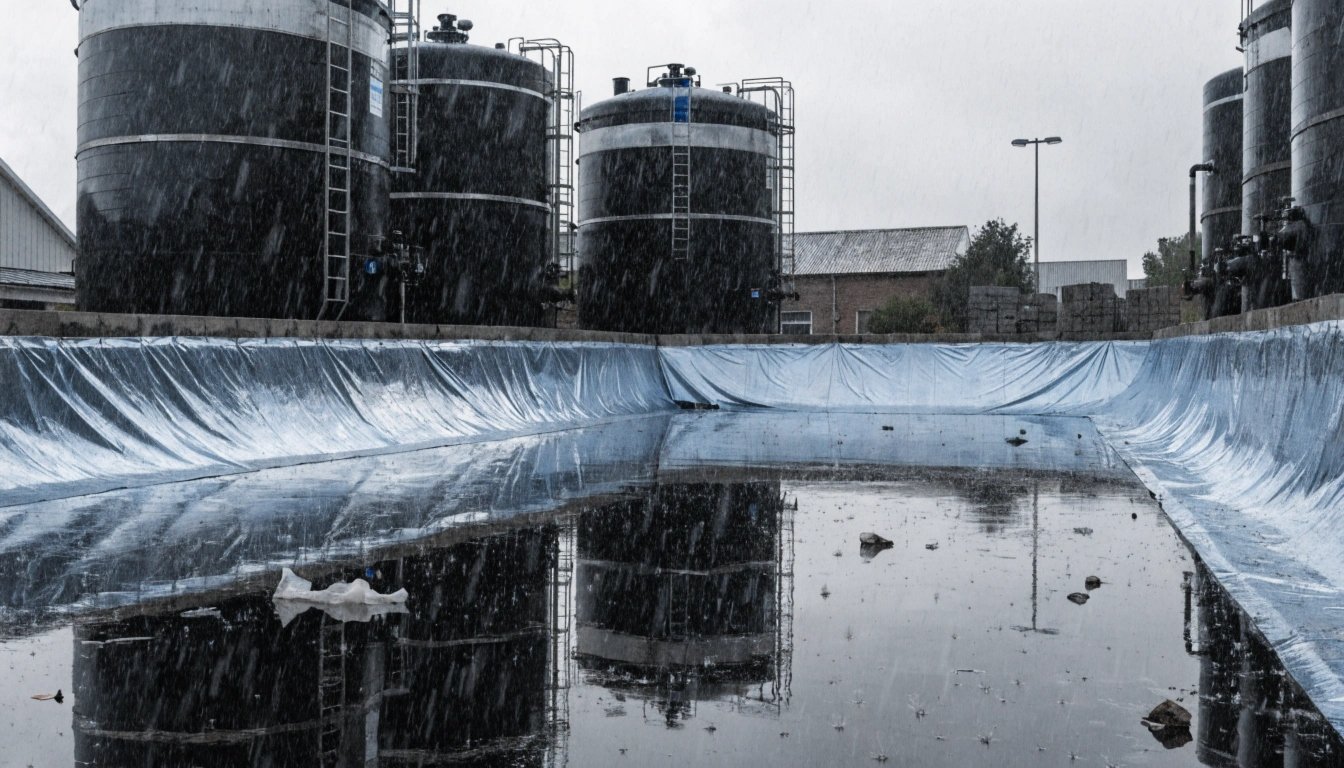
Risks, Limitations, and When These Materials Are NOT Recommended
As an active supplier, I must be completely transparent about the physical limitations of these materials to protect buyers from catastrophic purchasing mistakes.
When NOT to use LLDPE:
I actively discourage buyers from using standard LLDPE in environments storing highly aggressive, concentrated organic solvents or pure, highly corrosive acids. Due to its lower density molecular structure, LLDPE is inherently more permeable to specific harsh chemicals compared to its high-density counterpart. If extreme chemical inertness is the absolute priority, LLDPE will not provide the necessary safety margin.
When NOT to use HDPE:
Never deploy HDPE in projects characterized by highly uneven, rocky, or heavily settling subgrades. Because HDPE lacks high multiaxial elongation, forcing it over jagged terrain or into sharp 90-degree earthen corners creates severe internal tension. Over time, this constant tension leads to Environmental Stress Cracking (ESCR). The liner will literally tear itself apart at the stress points without any external damage. Furthermore, installing thick HDPE in freezing climates is incredibly challenging, as the cold makes it stiff and nearly impossible for workers to manipulate.
Simple Decision Framework for Procurement
To simplify the procurement process, we guide project engineers through a basic operational checklist. While site-specific lab testing is always advised, these general rules steer the vast majority of safe material decisions.
| Project Condition | Primary Recommendation | Practical Reasoning |
|---|---|---|
| Flat, Stable Ground (Large Area) | HDPE | Excellent chemical resistance, fast automated welding |
| Uneven Earth or Soft Subgrade | LLDPE | High elongation handles differential settlement safely |
| Complex Geometry / Many Pipes | LLDPE | Flexibility allows easy wrapping and extrusion welding |
| High UV / Exposed for Decades | HDPE | Maximum oxidative stability against intense sun |
| Cold Weather Installation | LLDPE | Remains pliable and workable in low temperatures |
Conclusion
Choosing between HDPE and LLDPE for oil and chemical containment is not about finding the "best" material overall; it is about finding the exact polymer fit for your site’s physical and environmental reality. Flat tank farms with harsh chemicals heavily favor the rigidity and resistance of HDPE, while complex, settling, or temporary site bunds demand the pliable safety of LLDPE.
Relying purely on datasheet numbers without factoring in installation complexity, subgrade shifting, and climate leads to expensive failures. If you are preparing a procurement strategy and need to ensure your material perfectly aligns with your project constraints, contact Waterproof Specialist. We provide practical, field-tested containment solutions and can help you select, source, and securely export the precise geomembrane required for your facility.