

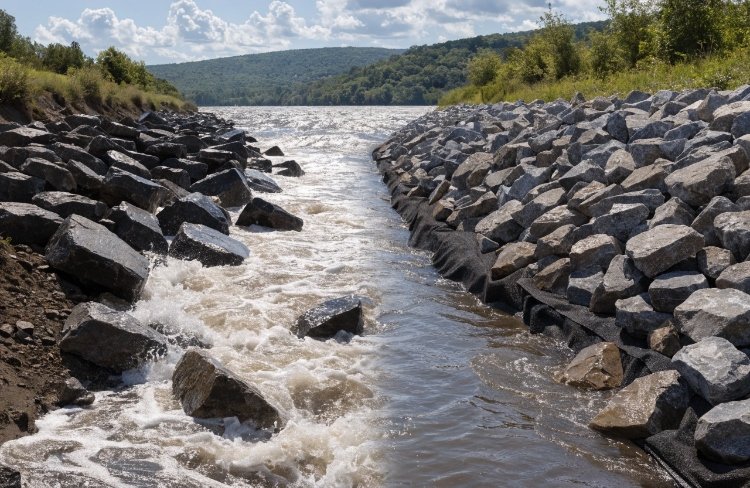
Dumping rocks directly on riverbanks often leads to disaster. Without a filter, waves wash out the underlying soil, causing the heavy stones to sink and the slope to fail. The solution is simple but critical for long-term stability.
Selecting the right geotextile for riprap prevents soil erosion and secures heavy stone placements in coastal and riverbank projects. This guide covers how to choose between woven and nonwoven fabrics, determine the correct weight, and install geotextile under riprap to ensure structural stability and prevent costly failures.
Over my years exporting geosynthetics, I’ve seen buyers skip the filter fabric to save a few dollars, only to watch their entire coastal defense wash away a year later. Let's look at how to get this right in real-world projects.
1. What Is Riprap and Why Use Geotextile?
Buyers often come to me focused entirely on sourcing the heaviest armor stones they can afford. They understand that riprap—the large chunks of rock, concrete, or rubble placed along shorelines—is necessary to absorb the impact of water. We see riprap commonly applied on riverbanks, coastal shorelines, bridge abutments, steep slopes, and storm drainage channels.
But placing heavy stones directly onto bare earth is a serious mistake. When you do this, water easily flows through the large gaps between the stones. Over time, wave action, tidal currents, or heavy rain pulls the fine soil particles right out from underneath the riprap. This process is called soil erosion or piping.
When the soil disappears, empty voids are left behind. The heavy rocks eventually collapse into these voids. This leads to massive settlement, slope failure, and a complete loss of the protective structure. I have seen entire riverbank stabilization projects fail within a single rainy season simply because the contractor did not use a geotextile separator. The rocks sank into the mud, and the riverbank washed away as if the rocks were never there.
This is why geotextile is used as a critical layer beneath riprap. It acts as a safety barrier that keeps the soil in place while dealing with the tremendous weight of the stones above.
2. Functions of Geotextile Under Riprap
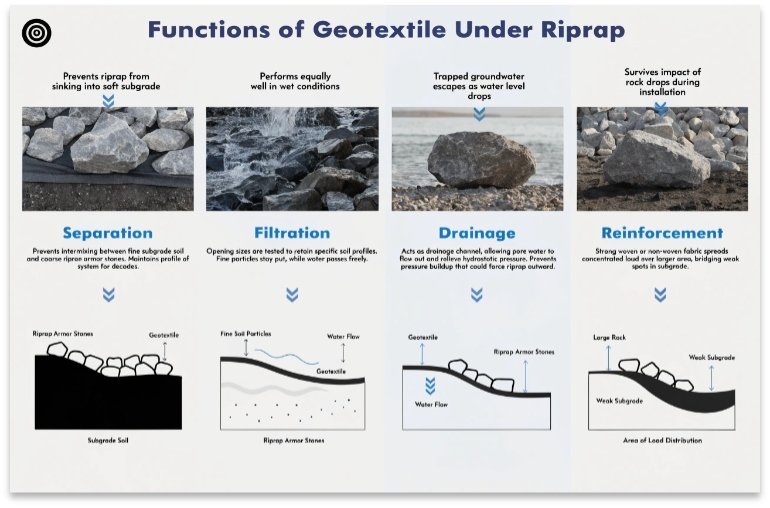
When we supply geotextile for riprap projects, we are not just selling rolls of fabric. We are supplying an engineered layer that performs four very specific tasks simultaneously. If any of these functions fail, the riprap structure will eventually fail too.
Separation
The primary job of the geotextile under riprap is separation. It places a distinct boundary between the soft, fine subgrade soil and the heavy, coarse armor stones. Without separation, the heavy rocks will sink deep into soft clay or mud, especially when the ground gets wet. By separating the layers, the original design profile of the slope is maintained for decades.
Filtration
This is arguably the most critical function of a geotextile filter fabric. The fabric must hold the fine soil particles in place while still allowing water to pass through. If the water cannot pass, the system fails. We test the opening size of our fabrics specifically to ensure they match the soil profile of the project site.
Drainage
Water needs to move freely in both directions. When the water level in a river drops suddenly, groundwater trapped behind the slope needs to escape. The geotextile acts as a drainage channel, relieving hydrostatic pressure that would otherwise build up and push the entire slope outward.
Reinforcement
While riprap rocks are heavy, the geotextile helps bridge the gaps over soft spots in the subgrade. It distributes the localized loads of the massive stones over a wider area. Even so, the fabric must be tough enough to survive the initial impact when those rocks are dropped during construction.
3. Types of Geotextile for Riprap
One of the most common questions I get from importers and project managers is whether they should use a woven or nonwoven fabric. Both materials are made from synthetic polymers (usually polypropylene or polyester), but they are manufactured differently and behave very differently in the field.
Woven Geotextile
Woven geotextiles are made by weaving flat synthetic slits or yarns together, much like a tarp or a burlap sack. They have incredibly high tensile strength and very low elongation. This makes them fantastic for load-bearing applications like road construction over soft soils. However, I rarely recommend them for riprap. Why? Because their flat, uniform structure limits permeability. The small openings in woven fabrics can easily become clogged with fine silt or clay. Once the fabric clogs, water pressure builds up behind it, leading to slope failure.
Nonwoven Geotextile
Nonwoven geotextiles are manufactured by bonding synthetic fibers together using heat or needle-punching methods. They look and feel like a thick industrial felt. Because they have a chaotic, 3D internal structure, they possess extremely high permeability. They let water flow through freely while trapping soil particles. They also stretch (high elongation), which means they can absorb the impact of heavy, jagged rocks dropped from an excavator without immediately tearing. Their resistance to clogging and their ability to conform to rough ground make them ideal for hydraulic applications.
Because filtration and puncture resistance are the top priorities in shoreline and drainage projects, nonwoven geotextile is typically recommended for riprap applications.
4. How to Choose the Right Geotextile for Riprap
Choosing the correct material is the most important decision you will make. I regularly help contractors avoid disaster by adjusting their material specs. If the fabric is too weak, the rocks will punch through. If the pores are too small, water won't drain.
Here are the key parameters you must evaluate:
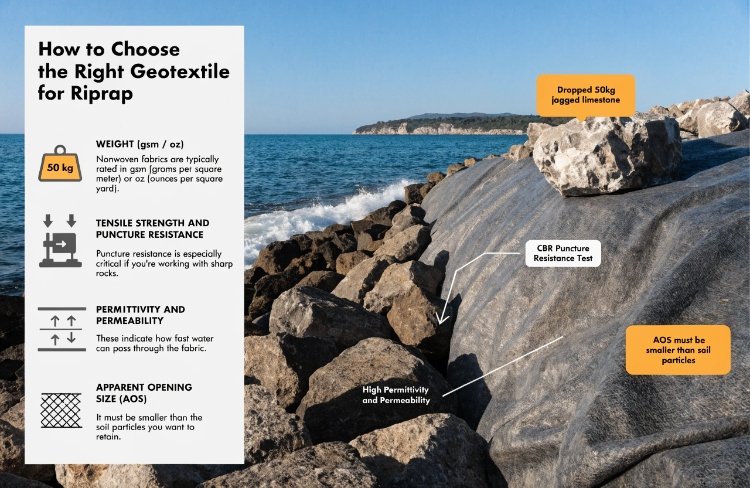
Weight (gsm / oz)
Weight, measured in grams per square meter (gsm) or ounces per square yard (oz), is a direct indicator of heavy-duty performance. A heavier fabric is thicker and absorbs more punishment.
Tensile Strength and Puncture Resistance
When a 50kg jagged limestone block is dropped onto the fabric, the fabric must not tear. Puncture resistance (often tested via CBR method) is non-negotiable. If the fabric tears during installation, its filtration ability is compromised instantly.
Permittivity and Permeability
This measures how fast water passes through the fabric. For tidal areas or rapid drawdown conditions, you need high permittivity so hydrostatic pressure does not blow the fabric off the slope.
AOS (Apparent Opening Size)
The holes in the fabric must be smaller than the soil particles you are trying to retain, but large enough to prevent clogging. Fine sandy soils require a tighter AOS, while coarse gravelly soils can handle a larger AOS.
Here is my practical guide for selecting nonwoven geotextile for structural riprap:
| Application / Rock Size | Recommended Weight | Practical Notes |
|---|---|---|
| Light drainage / Small rocks | 150–300 gsm | Used for small residential swales and landscaping riprap. |
| Normal slope / Medium stones | 300–500 gsm | Standard for riverbanks and moderate coastal erosion control. |
| Heavy armor / Coastal breakwaters | 500+ gsm | Mandatory for massive boulders and heavy wave action. |
Ultimately, the selection should be based on soil conditions, hydraulic forces, and stone size. If you are unsure, always err on the side of a heavier, more puncture-resistant fabric.
5. Installation of Geotextile Under Riprap
Even the highest quality nonwoven geotextile for erosion control will fail if installed poorly. In my experience, most site failures trace back to sloppy installation practices rather than defective materials.
Subgrade Preparation: First, you must clear the slope. Remove all sharp tree roots, large rocks, and debris. The surface should be compacted and relatively smooth. Leaving jagged branches under the fabric is a guaranteed way to cause hidden punctures.
Laying the Geotextile: The rolls must be laid starting from the bottom of the slope to the top, or rolled down vertically. Never lay rolls horizontally across the slope if the water current is strong, as the flow can catch the overlapping edges. The fabric should lay loose enough to conform to the ground without tension.
Overlapping: Never butt the edges together. You must overlap adjacent panels by at least 30 to 50 cm. If the site is underwater or subject to high wave action, I advise my clients to overlap by up to 1 meter or sew the seams together using portable sewing machines.
Anchoring: At the top of the slope, you must dig an anchor trench. Drop the edge of the geotextile into the trench and backfill it with soil. This prevents the fabric from sliding down the slope when you place the heavy rocks on it.
Placing the Riprap: Start placing rocks from the bottom up. Do not drop massive stones from higher than 1 meter. Heavy, sharp drops from an excavator bucket will destroy even heavy-duty fabrics. Always avoid tearing the material, and avoid leaving the fabric exposed to sunlight for more than a few days, as UV rays degrade the polymers.
6. Risks, Limitations, and Common Mistakes to Avoid
As a professional supplier, I must be honest about what geotextile can and cannot do. A geotextile fabric will not fix an inherently unstable slope. If the soil mechanics are wrong, or the slope angle is too steep, the entire riprap system will slide away regardless of the fabric you use.
There are also strict limitations during construction. Here are the most common project-killing mistakes I see buyers make:
Using the Wrong Type: Substituting nonwoven for woven fabric to save money in muddy, fine-silt environments is a fatal mistake. The woven fabric will clog, water pressure will build, and the slope will blowout from the inside.
Insufficient Weight: Dropping sharp, 200kg riprap onto a thin 150gsm fabric will shred the material. The fabric must match the energy of the stone placement.
No Overlap: Contractors sometimes try to stretch the material by skipping the overlap. Soil will immediately wash through these unsealed joints.
No Anchor Trench: Without anchoring the top edge, the entire sheet of fabric to slides down into the river as soon as the first load of rock is placed on it.
Prolonged UV Exposure: Geotextiles are meant to be buried. If you leave the uncovered fabric exposed to the sun for months before the riprap arrives, UV degradation will destroy its tensile strength. It will turn brittle and fail beneath the rocks.
7. Factory Direct: Why Choose Our Geotextile
At Waterproof Specialist, we understand the stakes involved in your erosion control projects. We don't just act as middlemen; we are a factory-direct manufacturer supplying geosynthetics globally.
When you order riprap geotextile fabric from us, you get exactly what your engineering specs demand. We produce ISO-certified woven and nonwoven geotextiles engineered for heavy-duty marine, riverbank, and slope applications.
We also offer customized roll widths up to 6 meters. This is a massive advantage for large projects because wider rolls mean fewer overlaps, less wasted material, and faster installation times. I personally oversee export packing to maximize loading capacity in 40HQ containers, keeping your shipping costs to an absolute minimum. We have a proven track record supplying massive infrastructure projects across Southeast Asia, the Middle East, and South America with fast, reliable delivery.
Contact us for technical support and quotation. Let us review your site parameters to recommend the safest, most cost-effective fabric configuration.

8. Conclusion
Securing a shoreline or slope is a heavy investment, and the geotextile filter fabric sits literally at the foundation of that work. A geotextile under riprap is an essential layer that prevents soil washouts, stabilizes heavy rocks, and provides critical drainage. For nearly all of these projects, a heavy-duty nonwoven geotextile remains the superior choice due to its puncture resistance and unmatched filtration. By correctly matching the fabric weight to your rock size and ensuring strict installation practices, you guarantee the long-term stability of the structure. Evaluate your site conditions carefully, and do not compromise on the protective filter layer.