

Farming runs on water, but storing it in an unlined earth pond is like pouring money into a leaky bucket. Seepage and evaporation can drain a massive percentage of your stored water before it ever reaches your crops, forcing you to run expensive pumps longer. Installing a highly engineered geosynthetic liner solves this immediately.
This guide explains how to select the right geomembrane liner for agricultural irrigation reservoirs. You will learn how to completely stop soil seepage, compare the return on investment (ROI) against unlined ponds, and make practical decisions regarding material thickness and subgrade preparation based on your farm’s specific site conditions.
As a supplier exporting geosynthetics to commercial farms and agricultural projects globally, I constantly talk to farm managers who are frustrated by water stress. Designing a reliable water storage system is not just about digging a hole; it is about creating a waterproof asset. Here is how professional agriculture handles water containment.
Why Water Loss Is a Major Challenge in Irrigation Systems
When agricultural clients first contact me for a quote, they are usually dealing with an existing soil pond that is failing. Often, these ponds were dug into natural clay with the assumption that the heavy soil would hold the water.
In reality, unlined earth ponds are highly permeable. Even well-compacted clay will eventually dry out, crack during the off-season, and allow catastrophic seepage when refilled. Depending on the soil profile, an unlined reservoir can lose between 10% and 40% of its total water volume straight into the ground.
This seepage creates a dual financial penalty. First, you lose the physical water required to keep your crops alive during a drought. Second, you waste the electricity or diesel fuel you burned to pump that water out of a well or river in the first place. When you combine steady soil seepage with aggressive daily surface evaporation in hot climates, it becomes financially impossible to maintain reliable irrigation pressure without a physical barrier.
What Is an Irrigation Reservoir Liner System
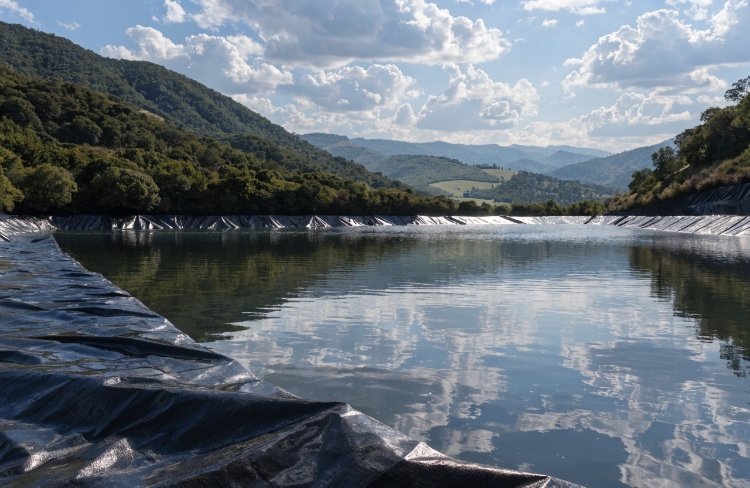
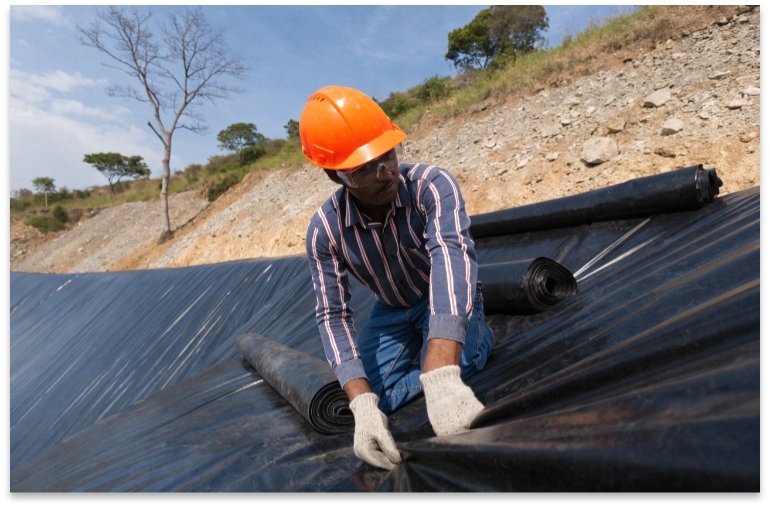
A modern agricultural reservoir is a fully engineered containment structure. Simply throwing a plastic tarp over a hole will result in tears and immediate failure. An actual liner system consists of specific, interacting layers.
At the core of the system is the geomembrane itself. For agriculture, we almost exclusively supply two materials:
- HDPE (High-Density Polyethylene): The global standard. It offers the highest chemical and UV resistance, making it perfect for exposed ponds. It is rigid and incredibly durable.
- LLDPE (Linear Low-Density Polyethylene): A softer, highly flexible alternative. We recommend LLDPE when the farm’s pond design has very steep slopes, uneven terrain, or requires significant stretching during installation.
Beyond the geomembrane, the system relies on physical preparation. The soil subgrade must be compacted and cleared of sharp rocks. In rocky areas, we supply a non-woven geotextile to sit beneath the plastic as a cushion. Finally, the perimeter of the liner must be securely buried in an anchor trench around the top of the embankment to prevent the wind from lifting it and the plastic from sliding down the slope.
Key Benefits of Geomembrane Liners for Agriculture
Investing in a proper geomembrane system shifts your water management from a constant battle against nature to a predictable, controlled process. Here is what happens when you line an agricultural pond.
- Absolute Seepage Control: High-quality HDPE has a permeability rate of essentially zero. Once installed and properly welded, water stops sinking into the dirt entirely.
- Reduced Pumping Costs: Because you retain 100% of the water you pump (minus surface evaporation), your pumps run for fewer hours. This directly lowers your monthly diesel or electrical overhead.
- Erosion Prevention: Without a liner, wave action and the constant rising and falling of water levels erode the earthen banks of the pond. A geomembrane locks the soil structure in place, eliminating embankment collapse.
- Improved Water Quality: Lined ponds prevent groundwater contamination. If you mix fertilizers or liquid nutrients directly in your irrigation reservoir (fertigation), the liner ensures those expensive chemicals go to your crops, not into the local water table.
Cost Comparison: Lined vs Unlined Reservoirs
The most common hesitation buyers have is the upfront cost. Earthmoving is relatively cheap; buying rolls of black plastic and hiring a welding crew adds a new budget line. However, professional farm managers look at ROI, not just initial capital expenditure.
The Initial Cost:
An unlined pond only requires an excavator. A lined pond requires the excavation, the cost of the geomembrane (usually priced per square meter), freight to the site, and the labor to wedge-weld the seams.
The Long-Term ROI Analysis:
Let’s look at the operational reality. Suppose an unlined pond loses 200 cubic meters of water a week to seepage. If you are pumping replacement water from a deep bore well, calculate the hourly fuel cost of that pump.
In my experience working with commercial plantations, the electrical savings from reduced pumping alone usually pay for the entire geomembrane installation within 12 to 24 months. Furthermore, during a severe dry season, the extra water retained by the liner can save an entire harvest. The ROI in crop yield protection makes the liner an absolute necessity, not an optional luxury.
Risk, Limitations, and When an Exposed Liner is NOT Recommended
As a supplier, I have to reject certain designs to protect the buyer from failure. Installing an exposed HDPE liner is not a magic solution for every single farm environment. There are specific conditions where this approach will fail.
Do not use an exposed liner if you plan to use heavy machinery to dredge the pond.
Many traditional farmers are used to driving skid steers or excavators directly into their dry dirt ponds to scrape out accumulated silt. If you do this on an exposed 1.0mm HDPE liner, the tracks and buckets will immediately puncture and shred the material. If your operations require mechanical dredging, you must install the liner and then cover it entirely with a thick layer of protective soil, or use a much more expensive concrete protection layer.
High Groundwater Tables (The "Whale" Effect)
If your farm is located in a low-lying valley or a coastal area with a very high groundwater table, laying an empty liner into the pit is highly risky. If the groundwater level rises higher than the water level inside the pond, the external hydrostatic pressure will push the liner upward, creating massive plastic "whales" or bubbles that float to the surface. In these high-groundwater scenarios, you must install a specialized underdrain system beneath the liner to pump the groundwater away, or reconsider using a geosynthetic liner altogether.
Design Considerations for Irrigation Reservoirs
When a client wants to move forward, we have to finalize the exact material specification. Choosing the wrong parameters here will lead to a shorter lifespan and wasted money.
Selecting the Right Thickness
Do not buy the thinnest material to save a few dollars. While 0.5mm or 0.75mm liners are cheap, they puncture easily if someone walks on them or drops a tool. For standard exposed agricultural reservoirs, I highly recommend 1.0mm (40 mil) HDPE. It offers the perfect balance of puncture resistance, UV durability, and reasonable cost. If your pond is very deep (over 5 meters), step up to 1.5mm (60 mil) to handle the increased water pressure.
Managing UV Exposure
Because agricultural ponds constantly rise and fall (the drawdown zone), the slopes spend a lot of time baking in the sun. You must verify that your supplier uses virgin resin with a minimum of 2% carbon black. This acts as a UV shield, ensuring the plastic does not turn brittle and shatter after two summers.
Subgrade Preparation
The liner is incredibly strong, but it is only as good as the ground beneath it. The soil must be compacted smoothly. If the excavation brings up sharp stones, roots, or hard clay clods, the weight of the water will push the plastic down onto those sharp points, causing microscopic leaks. If you cannot get the soil smooth, we will add a 200g/m² non-woven geotextile to act as a puncture-resistant blanket.
Case Study: 50,000 Cubic Meter Banana Plantation Reservoir
To illustrate this, consider a project we supplied recently in Southeast Asia. A commercial banana plantation had constructed a 50,000 cubic meter irrigation pond directly into the loamy soil. During the dry season, they were losing so much water to seepage that their local river pump had to run 18 hours a day just to maintain the required reservoir level.
They contacted us for a solution. Because the pond had simple, uniform slopes and the region experienced high UV intensity, we supplied several containers of 1.0mm virgin HDPE geomembrane.
After a two-week installation process, the results were immediate. The seepage was reduced to zero. The farm was able to cut their pumping time from 18 hours down to just 6 hours a day, saving thousands of dollars in diesel fuel monthly. The stabilized water supply allowed them to expand their planted acreage by 15%. The capital cost of the liner and installation paid for itself in less than 14 months based purely on fuel savings.
Material Selection Guide for Farms
We use this quick reference table to help farm managers choose the right geomembrane for their specific land conditions.
| Material Type | Best Use Case | Farm Site Conditions | Flexibility |
|---|---|---|---|
| HDPE (1.0mm) | Standard exposed reservoirs | Smooth clay/soil, standard slopes | Rigid, requires smooth subgrade |
| LLDPE (1.0mm) | Uneven terrain reservoirs | Rocky ground, steep/irregular slopes | Highly flexible, stretches without breaking |
| HDPE (1.5mm) | Deep commercial water storage | Ponds deeper than 5 meters | Very rigid, handles high pressure |
Conclusion
Losing valuable water to soil seepage is a massive hidden cost that drains agricultural profitability. By installing a high-quality, properly engineered geomembrane liner, you stop water loss entirely, slash your pumping costs, and guarantee that your crops have the water they need during extreme dry seasons.
Do not settle for a leaking dirt pond. Contact Waterproof Specialist today for pricing, technical datasheets, and complete design support. We will help you select the exact liner thickness and material type your farm needs to maximize water efficiency and secure your harvest.